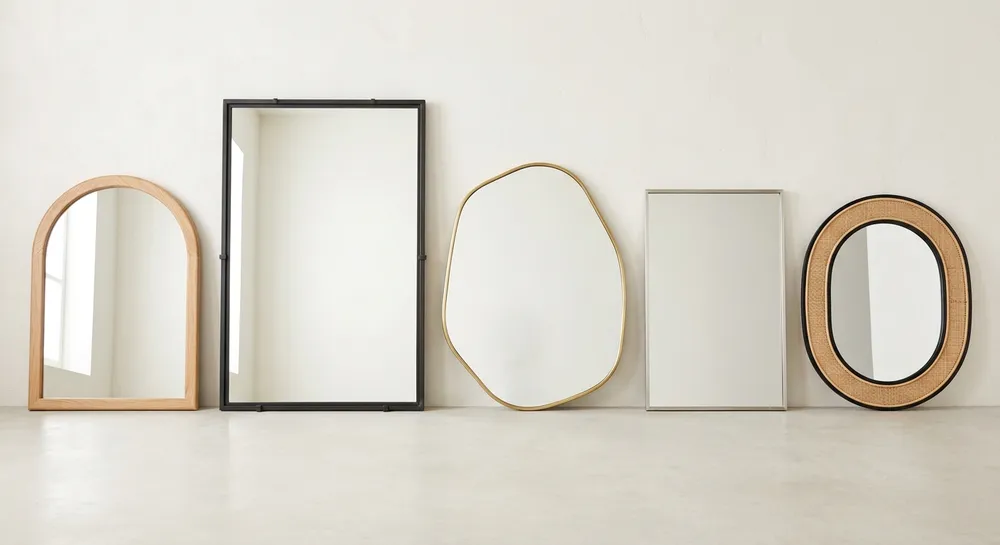
Most trend articles on living room mirrors are written for the person hanging the mirror, not the person buying 500 of them. They tell you what looks good. They don't tell you what the frame is made of, how thick the glass runs, whether the shape requires a custom mold, or what happens to your lead time when you order 300 units of an arched design for a Q4 retail push.
That gap is what this article fills. We've been manufacturing decorative mirrors since 2008, and we ship Living Room Decor Mirrors to US distributors, retailers, and hospitality buyers every quarter. What follows is a production-floor read of the trends actually moving in the US market right now — with the specs, tooling context, and channel fit that help you make a sourcing decision, not just a mood board.

The Five Trend Categories Shaping US Living Room Mirror Demand
These aren't predictions. They're what's showing up in the RFQs we receive, the reorder patterns from our US accounts, and the SKU mix our buyers are building for 2026 retail programs.
1. Arched frames — still the dominant silhouette, now moving into double-arch and asymmetric arch variants. The single arch peaked in 2023–2024; buyers who got in early are now looking for the next iteration to refresh their assortment without abandoning the category.
2. Oversized statement mirrors — 48"×36" and larger, typically rectangular or softly rounded rectangular. These are the anchor SKUs in living room programs: high ASP, strong visual impact on a planogram, and a clear margin story for your retail buyers.
3. Organic and irregular shapes — sunburst, petal, and freeform silhouettes. High visual differentiation, but the production story is more complicated than it looks. More on that below.
4. Minimalist thin-profile metal frames — 10–15mm frame width, powder-coated in matte black, brushed gold, or brushed nickel. These run well in e-commerce because they photograph cleanly and ship efficiently. Low tooling cost, fast reorder.
5. Mixed-material designs — metal combined with rattan, wood, or woven natural fiber. Strong in the mid-to-premium segment. The assembly complexity is real, but the margin premium is real too.
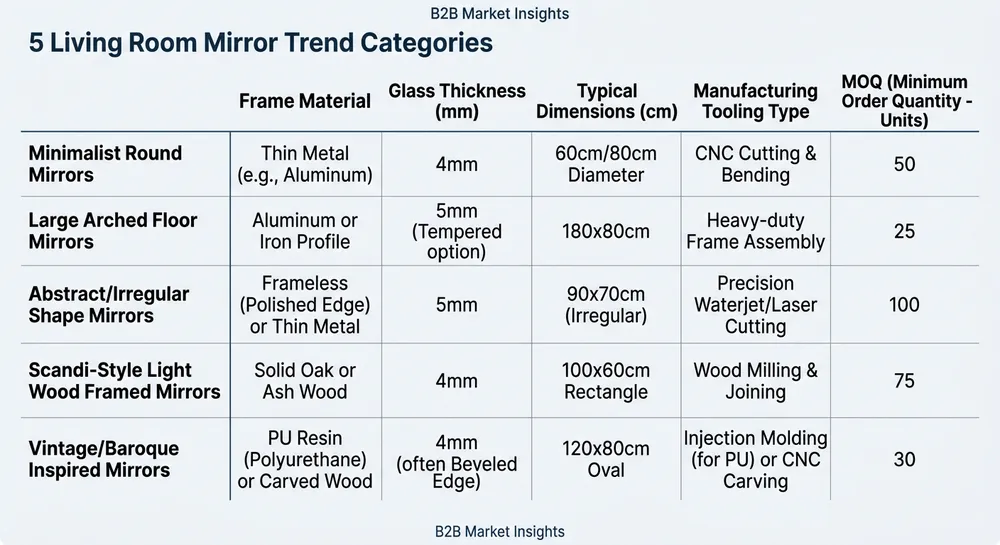
Each of these has a different production profile, a different retail channel fit, and a different risk profile for your inventory. The table below gives you the sourcing-relevant summary before we go deeper.
| Trend | Frame Material | Glass Thickness | Typical Dimensions | Tooling Requirement | Standard MOQ |
|---|---|---|---|---|---|
| Arched frames | MDF, solid wood, metal | 4–5 mm | 24"×36" to 30"×60" | Existing molds (standard arch); new tooling for double/asymmetric | 100–200 pcs |
| Oversized rectangular | Metal, MDF | 5–6 mm | 48"×36" to 60"×48" | Existing tooling for standard profiles | 100 pcs |
| Organic / irregular | Resin, metal | 4–5 mm | 24"–40" diameter equivalent | Custom mold required for most shapes | 200–300 pcs |
| Minimalist metal | Metal (iron/aluminum) | 4 mm | 20"×28" to 36"×48" | Existing tooling | 100 pcs |
| Mixed-material | Metal + rattan/wood | 4–5 mm | 24"×36" to 36"×48" | Partial new tooling for frame junction hardware | 150–200 pcs |
Arched Frames: Existing Tooling, Evolving Silhouettes
The standard single-arch mirror is the most production-efficient trend on this list. We have existing molds for the most common arch profiles — 24"×36", 24"×48", and 30"×60" — so a reorder on a proven arch design runs on existing tooling with no development cost and a 30–35 day production window on a 500-piece order.
Where it gets more interesting — and more expensive — is the move toward double-arch and asymmetric arch profiles. These require new mold development, which adds 15–20 days and a one-time tooling cost that typically runs $800–$1,500 depending on frame complexity. For buyers building a differentiated assortment, that's a reasonable investment. For buyers who want to test the category first, start with a standard arch profile and move to custom silhouettes once you have sell-through data.
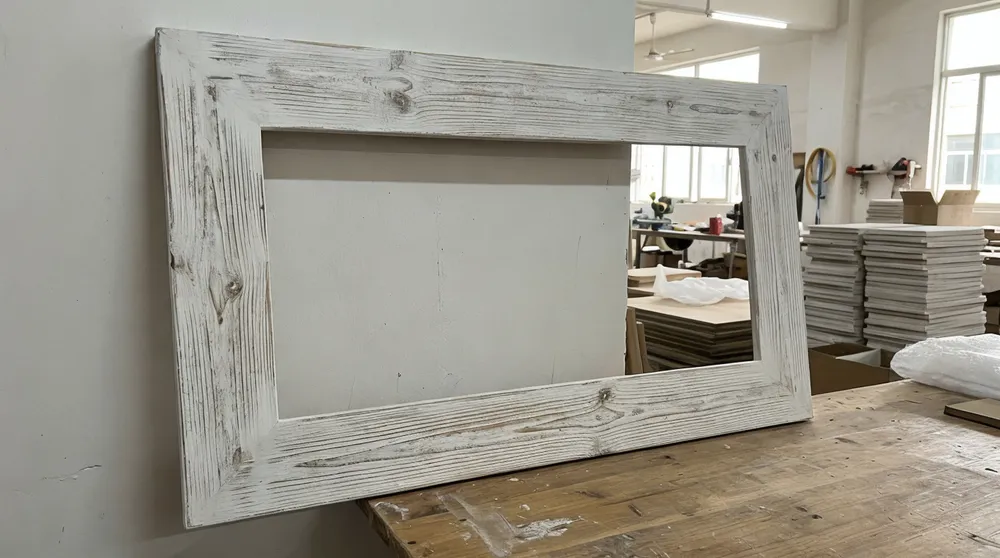
Frame material choice matters here more than buyers often realize. MDF arch frames are the most cost-efficient and hold paint finishes well — antique white, warm walnut, and matte black are the finishes moving fastest in the US market right now. Solid wood arch frames carry a higher price point and a cleaner grain story for premium retail positioning, but they add weight and affect your freight cost on large orders. Metal arch frames are less common in this silhouette but work well for the minimalist-leaning buyer who wants the arch shape without the traditional wood aesthetic.
Glass runs at 4–5mm for most arch mirrors in the 24"–36" width range. We don't recommend dropping to 3mm on arched designs above 24" wide — the flex stress at the curve junction increases breakage risk in transit, and the warranty claim cost on a 500-piece order isn't worth the per-unit glass savings. (We've seen buyers push for 3mm to hit a price target and regret it after the first container.)
Oversized Statement Mirrors: The Margin Anchor in Your Living Room Program
Oversized living room mirrors — 48"×36" and up — are the highest-ASP SKU in most retail living room mirror programs, and they're the category where your margin story is clearest. A well-specified 48"×36" metal-frame mirror with copper-free silvering and a brushed gold finish retails comfortably at $180–$280 in the US mid-market. Your landed cost at volume leaves meaningful room.
The production considerations are different from smaller formats. Glass at this size runs 5–6mm — 4mm is technically possible but introduces distortion risk on large flat panels, and a distorted reflection is the fastest way to generate returns from your retail buyers' customers. We run 5mm as our standard for anything above 40" in the longest dimension, and 6mm for premium lines where the buyer is positioning on quality.
Frame profiles for oversized mirrors need to be engineered for the weight. A thin 10mm metal frame that looks elegant on a 24"×36" mirror becomes a structural problem on a 48"×36" panel — the corner joints carry significantly more load. We reinforce corner hardware on oversized metal frames with welded internal brackets rather than relying on the miter joint alone. It adds a small amount to the unit cost but eliminates the frame separation failures that generate the most expensive warranty claims.
Packaging is the other variable that catches buyers off guard on oversized formats. A 48"×36" mirror in retail-ready packaging is a large, heavy carton. Container loading efficiency drops compared to smaller SKUs, which affects your landed cost calculation. We engineer the inner packaging — foam corner protection, cardboard interleaving, carton wall thickness — to maximize stack height and minimize wasted cubic space. On a recent US retail program, re-engineering the carton for a 48"×36" SKU added 8 units per pallet layer, which translated directly to freight savings across the program.
For brick-and-mortar retail, oversized mirrors are strong planogram anchors — they command wall space and drive category visibility. For e-commerce, the main challenge is the photography: a 48"×36" mirror needs to be shot in a staged room context to communicate scale, and buyers who invest in that photography see meaningfully better conversion rates. If you're building an e-commerce program around oversized mirrors, factor that into your launch budget.
Organic and Irregular Shapes: High Differentiation, Real Production Complexity
Sunburst, petal, scallop, and freeform organic mirrors are the highest-differentiation SKUs in the living room category. They're also the ones where the gap between a showroom sample and a 300-piece production run is widest — and where buyers who haven't worked with a factory on custom shapes most often run into problems.
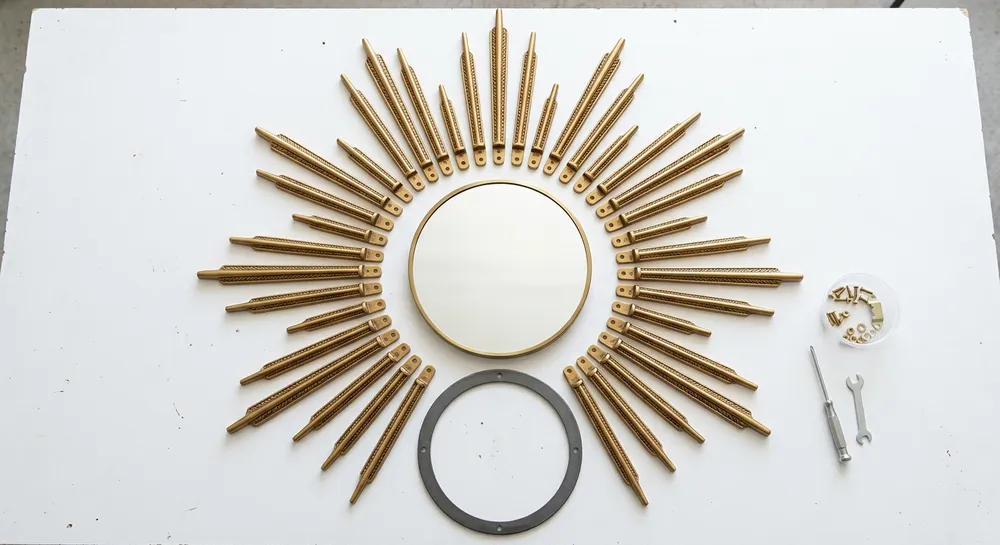
The core issue is that most organic shapes require custom mold development. A sunburst mirror with 12 radiating arms isn't something you pull from a standard catalog — each arm profile needs a mold, and the assembly involves joining those components to a central mirror panel with consistent alignment across every unit. We've developed dozens of organic frame profiles over the years, and the ones that scale well share a few characteristics: the arm or petal geometry is simple enough to cast cleanly in resin or stamp in metal, the assembly sequence is repeatable without excessive hand-finishing, and the mirror panel itself is a standard circle or oval that we cut on existing equipment.
Resin is the dominant material for organic shapes because it allows complex geometry at reasonable tooling cost. Metal (typically iron) works well for sunburst and starburst designs where the arms are flat and uniform. The finish options are wide — antique gold, matte black, brushed bronze, and champagne are all strong in the US market for this category.
MOQ on organic shapes typically starts at 200–300 pieces because the tooling investment needs to amortize across enough units to keep your per-unit cost competitive. If you're testing a new organic shape, we recommend starting with a design that uses existing mold components where possible — a petal mirror that uses a standard oval center panel and resin petals we've cast before can often be sampled and produced faster than a fully custom design.
(One thing worth knowing: the most visually dramatic organic shapes — the ones with very thin, elongated arms or extremely irregular silhouettes — are also the most fragile in transit. We've had to redesign arm profiles on a few sunburst mirrors after the first production run showed breakage at the arm-to-center junction. If you're developing a custom organic shape, let our engineering team review the geometry before tooling is cut.)
Minimalist Thin-Profile Metal Frames: The E-Commerce Workhorse
If you're building or expanding an e-commerce living room mirror program, thin-profile metal frames are the most operationally efficient SKU category on this list. The reasons stack up quickly.
Tooling is standard — we have existing profiles for 10mm, 12mm, and 15mm frame widths in rectangular and softly rounded rectangular formats. No mold development cost, no sampling delay. A 500-piece order on an existing profile ships in 30–35 days. Reorders are straightforward.
The frames are iron or aluminum, powder-coated in the finishes that photograph best for e-commerce: matte black, brushed gold, brushed nickel, and antique brass. Powder coat at 60–80μm gives you a consistent, durable finish that holds up through shipping and handling — no chipping at corners, no color variation across a batch. We run adhesion testing on every powder coat batch, so you're not discovering finish failures after the container arrives.
Glass at 4mm is standard for this format. The thin frame profile means the mirror panel is the visual focus, so glass quality matters — we use copper-free silvering as standard, which gives you a cleaner, more neutral reflection than conventional silvering and holds up better in the humidity variations that come with cross-continental shipping and warehouse storage.
For e-commerce specifically, the weight and dimensional efficiency of thin metal frames means better container loading and lower per-unit freight cost compared to heavier wood or resin alternatives. A 24"×36" thin metal frame mirror typically runs 8–12 lbs finished and packaged — manageable for standard parcel shipping if your e-commerce channel uses that model, and efficient for palletized LTL or container freight.
The one limitation: thin metal frames don't carry the same premium positioning as wood or mixed-material designs. They're a volume play, not a margin-maximization play. If your program needs both, the typical approach is to anchor the assortment with 2–3 thin metal SKUs for velocity and add 1–2 higher-margin wood or mixed-material designs for ASP lift.
Mixed-Material Designs: Where the Margin Premium Lives
Mixed-material living room mirrors — metal frames combined with rattan, woven seagrass, reclaimed wood accents, or natural fiber wrapping — are the strongest margin opportunity in the current trend cycle. They're also the most assembly-intensive, which is why not every factory can produce them consistently at scale.
The production complexity comes from the junction between materials. A metal frame with rattan wrapping, for example, requires the metal frame to be fabricated and finished first, then the rattan or fiber component to be applied by hand in a way that's consistent across every unit. Inconsistency in the wrapping — uneven tension, visible gaps, color variation in natural fiber — is the most common quality failure in this category, and it's the kind of defect that generates returns from retail buyers whose customers notice it immediately.
We handle mixed-material assembly in a dedicated area of the production floor where the hand-finishing work can be done at a controlled pace with proper QC checkpoints. Each unit gets inspected for wrapping consistency, material junction quality, and finish alignment before it moves to packaging. It's slower than running a standard metal frame through the powder coat line, which is why the MOQ on mixed-material designs starts at 150–200 pieces — below that, the setup and quality control overhead doesn't make the economics work for either side.
Frame dimensions for mixed-material designs typically run 24"×36" to 36"×48". Larger formats are possible but add significant weight and assembly time. The most commercially successful mixed-material SKUs we've produced for US buyers have been in the 24"×36" to 30"×40" range — large enough to be a statement piece, manageable enough to ship and handle efficiently.
Finish combinations that are moving in the US market: matte black metal with natural rattan, brushed gold metal with bleached or whitewashed wood accents, and antique bronze metal with dark woven fiber. These combinations photograph well, carry a clear design story, and position comfortably in the $120–$220 retail range where the mid-premium living room mirror buyer shops.
For buyers building a Decor Mirrors by Room program across multiple categories, mixed-material living room mirrors are worth including even at lower initial volumes — the margin contribution per SKU is high enough that a 150-piece order can meaningfully improve your program's overall margin profile.
Which Trends Need New Tooling — and What That Means for Your Timeline
This is the question that separates buyers who plan well from buyers who miss their seasonal window. Tooling lead time is a fixed constraint — you can't rush a mold, and a mold cut wrong costs you another 2–3 weeks to correct.
Here's the practical breakdown:
No new tooling required (fastest path to production):
- Standard single-arch frames in existing profile sizes
- Thin-profile metal frames in standard rectangular formats
- Oversized rectangular mirrors in existing frame profiles
- Standard oval and round mirrors
Partial tooling or hardware development (adds 7–10 days):
- Mixed-material designs requiring new frame junction hardware
- Oversized formats requiring reinforced corner bracket modifications
- New finish combinations on existing frame profiles (color sampling adds time, not tooling)
Full custom mold development (adds 15–20 days + tooling cost):
- Double-arch and asymmetric arch profiles
- Organic and irregular shapes (sunburst, petal, freeform)
- Any frame profile not in our existing library
If you're sourcing for a specific retail window — Q4 holiday, spring refresh, back-to-school home decor — work backward from your in-store or in-warehouse date and add the appropriate buffer. A custom organic shape ordered in August for a November floor set is tight. The same design ordered in June is comfortable.
We can tell you within 24 hours whether a design you're considering uses existing tooling or requires development. Send us a reference image or sketch and we'll give you a straight answer on tooling status, lead time, and cost before you commit to anything. See our guide on how to source living room mirrors at volume for a fuller breakdown of the RFQ-to-production timeline.
Retail Channel Fit: E-Commerce vs. Brick-and-Mortar Planograms
Not every trend performs equally across channels. Sourcing the wrong style for your channel is one of the more avoidable margin problems in this category.
E-commerce-optimized styles:
- Thin-profile metal frames — clean photography, efficient shipping weight, easy returns processing
- Standard arch mirrors in proven dimensions — high search volume, established consumer recognition
- Minimalist rectangular formats — versatile staging, broad demographic appeal
Brick-and-mortar planogram anchors:
- Oversized statement mirrors — command wall space, drive category visibility, justify floor placement
- Mixed-material designs — tactile differentiation that doesn't translate as well in photography
- Organic shapes — visual impact at shelf that photos underrepresent
Dual-channel SKUs (work in both with the right photography):
- Mid-size arch mirrors (24"×36" to 30"×48") with distinctive finish treatments
- Mixed-material designs with strong visual contrast between materials
The channel fit question also affects your packaging spec. E-commerce packaging needs to survive parcel handling — individual cartons with foam corner protection and sufficient wall thickness to handle drops. Brick-and-mortar retail packaging needs to be shelf-ready or floor-display-ready, with retail-compliant labeling, barcodes, and often a hang tag or insert that communicates the design story to the end consumer.
We configure packaging to your channel requirements. If you're running the same SKU across both channels, we can produce two packaging configurations from the same production run — retail-ready cartons for your store program and e-commerce-optimized cartons for your online fulfillment center. (This is more common than buyers expect, and it's worth discussing at the RFQ stage rather than after production is complete.)
Copper-Free Silvering and Multi-Coat Finishing as Quality Differentiators
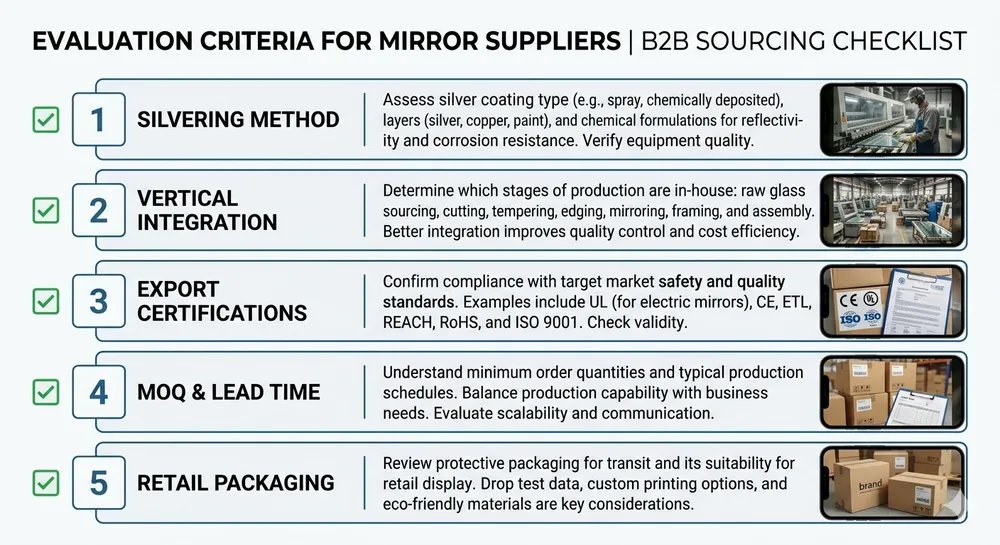
Living room mirrors are a category where the glass quality is visible every time someone looks at the product. A slightly yellow tint, a faint distortion, or a silver layer that starts to oxidize at the edges within 18 months — these are the quality failures that generate returns, damage your brand relationship with retail buyers, and cost more to recover from than they cost to prevent.
Copper-free silvering is our standard process across all living room mirror production. The silver layer goes down first, followed by a copper-free barrier coat and two protective paint layers. The result is a mirror that holds its reflection quality in the humidity and temperature variations that come with US warehouse storage, retail floor environments, and residential installation. Conventional copper-bearing silvering is cheaper to run, but the oxidation risk in humid conditions is real — we switched to copper-free as our default years ago because the warranty claim reduction justified the process cost difference immediately.
Multi-coat finishing on frames matters for the same reason. A single-coat finish on an MDF frame looks fine in a sample but shows wear at corners and edges after handling. We run a minimum of two finish coats on MDF and wood frames — primer plus topcoat — with sanding between coats. For premium lines, three coats with a final protective lacquer. The difference is visible in the finish depth and durability, and it's the kind of quality signal that your retail buyers' customers notice even if they can't articulate why one mirror looks better than another.
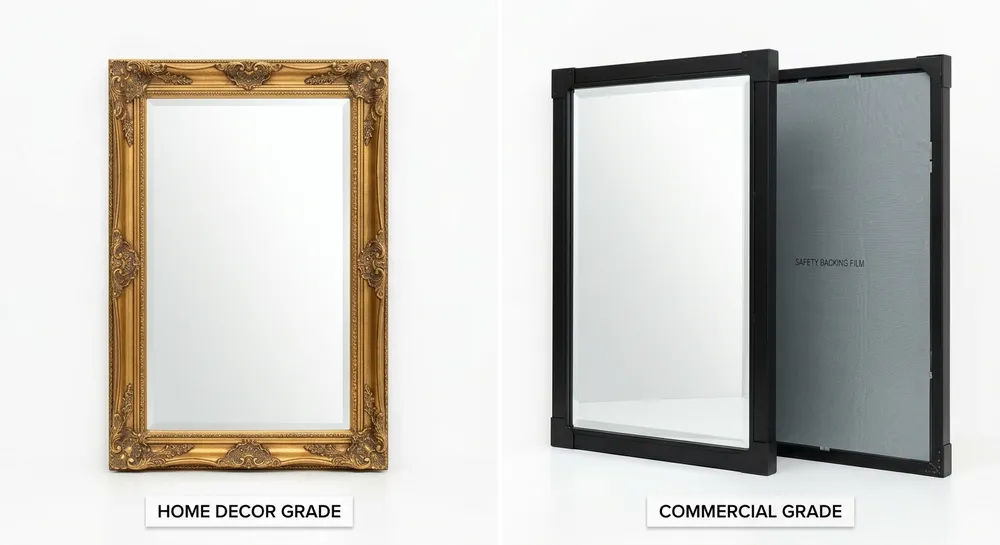
For buyers sourcing into the premium living room segment — boutique retail, interior design trade programs, hospitality FF&E — these process details are worth specifying explicitly in your RFQ. Not every factory runs copper-free silvering as standard, and not every factory does multi-coat frame finishing. Asking the question separates suppliers who can deliver premium quality from those who will promise it and deliver something else.
You can review the full range of specifications available across our Living Room Decor Mirrors line, or explore room-based mirror demand trends if you're building a multi-room assortment program.

Packaging and Freight Considerations for Oversized and Irregular Formats
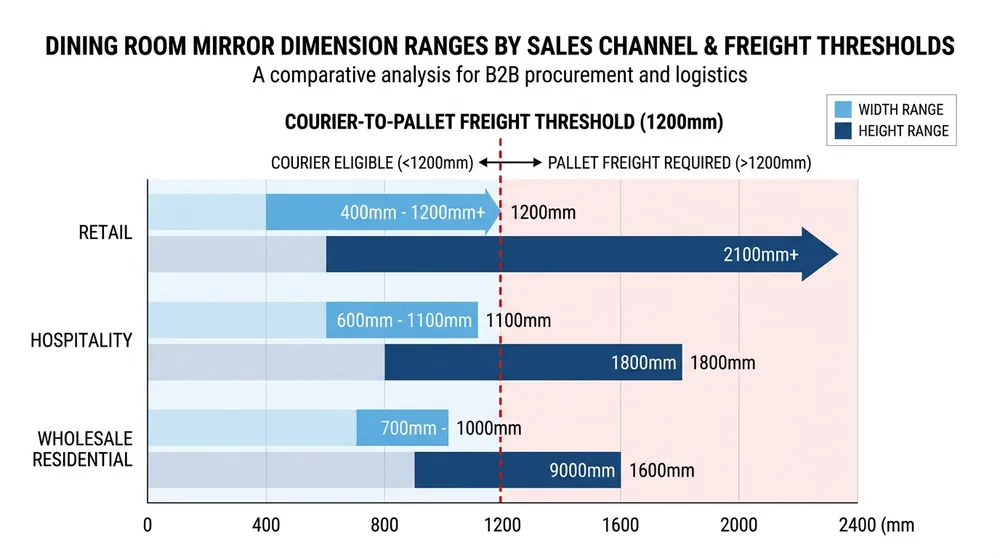
This section exists because it's where sourcing plans fall apart most often. A buyer locks in a great price on a 48"×36" mirror program, then discovers the freight cost per unit is 30% higher than modeled because the packaging wasn't engineered for container efficiency.
The variables that drive freight cost on living room mirrors:
Glass weight — 5mm glass on a 48"×36" panel weighs roughly 14 lbs before frame and packaging. At scale, glass weight is the dominant freight driver for oversized formats.
Carton dimensions — Oversized mirrors often can't be nested or stacked without custom inner packaging. A poorly designed carton wastes cubic space and reduces units per container.
Frame geometry — Organic and irregular shapes are the hardest to pack efficiently. A sunburst mirror with 12 radiating arms needs individual arm protection and can't be stacked flat. We design custom foam inserts for these formats, which adds to packaging cost but reduces breakage claims.
Fragility rating — Mirrors are fragile cargo. Parcel carriers apply fragile surcharges. LTL and container freight require adequate corner and edge protection to survive port handling.
Our engineering team reviews packaging design as part of the RFQ process for any oversized or irregular format. We'll tell you the expected carton dimensions, weight, units per pallet, and estimated container loading efficiency before you finalize your order. That information belongs in your landed cost model, not as a surprise after the container ships.
For buyers new to sourcing oversized living room mirrors, the living room mirror size selection guide covers the dimensional and weight considerations in more detail.
Building a Sourcing-Ready Living Room Mirror Assortment for 2026
The buyers who build the strongest living room mirror programs aren't the ones who chase every trend — they're the ones who select 4–6 SKUs that cover the trend landscape efficiently, match their channel requirements, and can be reordered without tooling delays.
A practical starting framework for a US retail living room mirror program:
- 1–2 arch SKUs — one standard single-arch in a proven finish (antique white or matte black MDF), one differentiated variant (double-arch or asymmetric if you want to invest in tooling, or a distinctive finish treatment on an existing profile if you don't)
- 1 oversized rectangular SKU — 48"×36" or 60"×48" in a metal frame, brushed gold or matte black, 5mm glass, copper-free silvering
- 1 thin-profile metal SKU — your e-commerce velocity driver, 24"×36" or 30"×40", existing tooling, fast reorder
- 1 mixed-material or organic SKU — your margin and differentiation anchor, selected based on your channel and customer profile
That's a 5–6 SKU program that covers the major trend categories, balances tooling investment against reorder simplicity, and gives you a clear story for your retail buyers about why the assortment is built the way it is.
If you're starting from scratch or refreshing an existing program, the most useful next step is to send us your target retail price points, channel mix, and any reference styles you're considering. We'll come back with a technical proposal — frame specs, glass spec, finish options, MOQ, lead time, and pricing — for each SKU in your proposed assortment. That proposal gives you everything you need to build your landed cost model and make a sourcing decision. Request a quote and our team will respond within 48 hours.