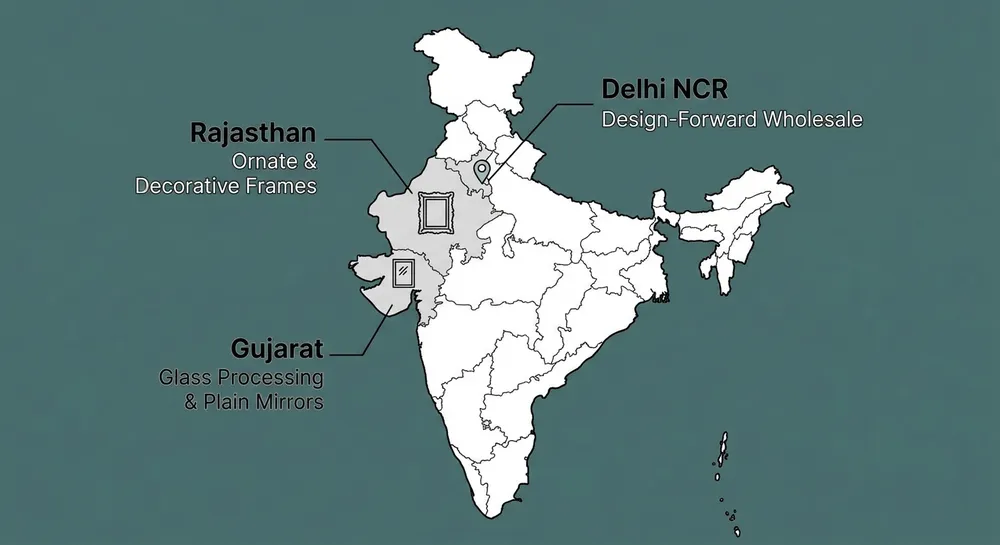
India's decorative mirror manufacturing base is real, active, and worth understanding before you commit to a sourcing route. Rajasthan, Gujarat, and parts of Maharashtra host clusters of mirror factories ranging from small frame workshops to mid-scale glass processors. If you're screening suppliers right now, this review covers 10 named manufacturers, what each one is actually set up to do, and where the gaps tend to appear when export orders scale up.
One note on methodology: this list is built from verified company presences — official websites, trade directory profiles cross-checked against company domains, and export market signals. Where production capacity or MOQ data isn't publicly confirmed, I've said so rather than inventing numbers. The goal is a sourcing decision tool, not a theatrical ranking.
What Serious B2B Buyers Are Actually Evaluating
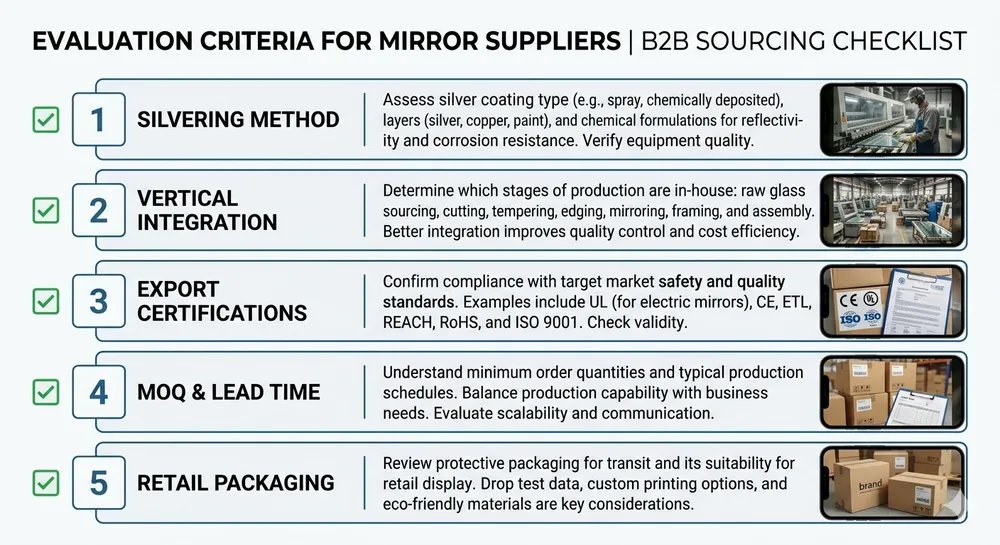
Before the list, it's worth naming the criteria that separate a workable supplier from one that looks good in a directory and disappoints at shipment. These are the questions I'd ask on a factory visit — and the ones your supplier should be able to answer without hesitation.
Silvering method is the first filter. Copper-backed silver coating is the Indian market standard. It's cheaper to produce, but copper migration causes edge darkening within 18–36 months in humid environments — a warranty problem for bathroom mirror programs and hospitality projects. Copper-free (lead-free, copper-free) silvering costs more to run but holds up in moisture-exposed rooms. Ask specifically which process a factory uses before you assume.
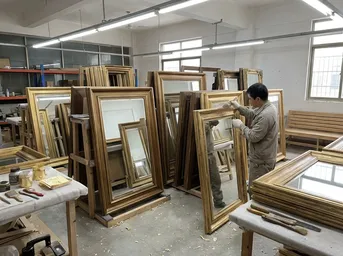
Vertical integration depth matters for quality consistency. Many Indian mirror suppliers are assemblers: they buy float glass from a primary processor, send it to a silvering subcontractor, source frames from a separate workshop, and assemble in-house. Each handoff is a quality variable. A factory that cuts, silvers, frames, and packs under one roof gives you one accountable point of contact and tighter defect control.
Export certification tells you whether a factory has been audited for the markets you're selling into. ISO 9001 is the baseline. CE marking matters for European retail. BSCI or SEDEX matters for buyers with ethical sourcing requirements. A factory without these isn't automatically disqualified for every order — but it adds compliance work on your side.
MOQ and lead time are where Indian factories most often lose export business. Standard MOQs of 500–1,000 pieces per SKU are common. For buyers building a multi-SKU room mirror program, that math gets expensive fast on initial inventory. Lead times of 45–75 days ex-factory are typical; add 25–35 days ocean freight to North America or Europe and you're planning 10–12 weeks out minimum.
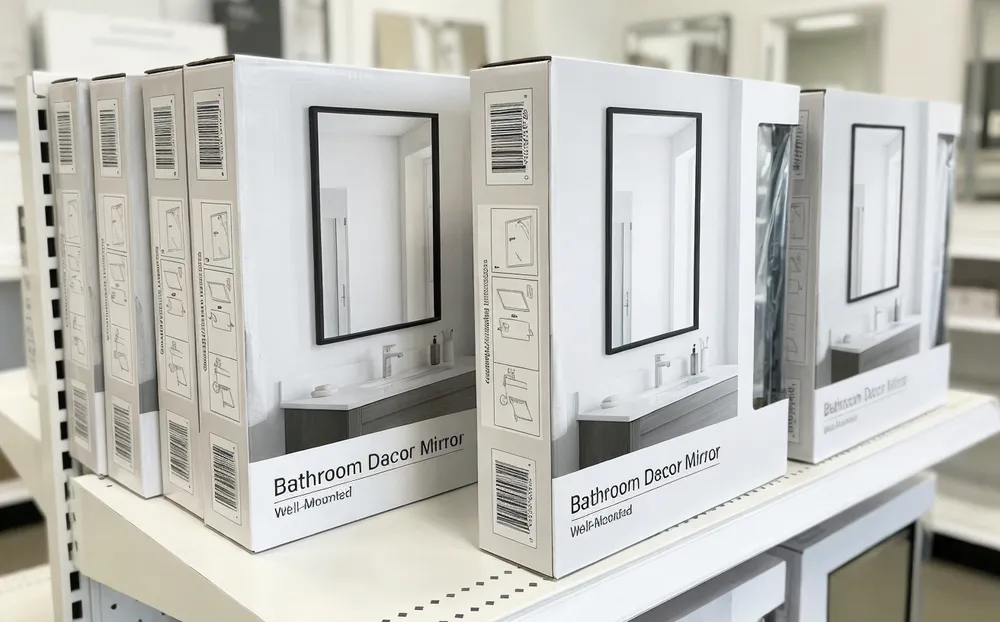
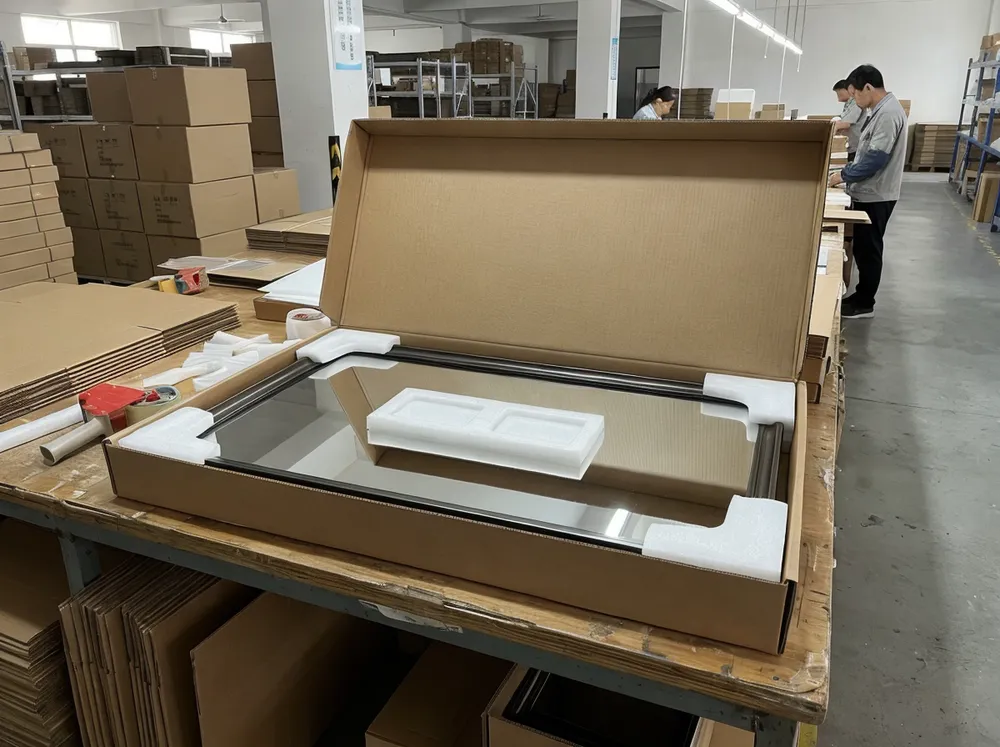
Retail-ready packaging is the gap most Indian factories haven't closed. Walmart, Wayfair, and Amazon have specific carton labeling, barcode placement, and drop-test requirements. A factory that ships mirrors in generic export cartons will require you to repack domestically — adding cost and handling risk.

The 10 Manufacturers: What Each One Is Set Up to Do
1. Elegant Mirrors — Rajasthan
Website: elegantmirrors.in
Elegant Mirrors operates out of Rajasthan and focuses on decorative wall mirrors with ornate frame profiles — carved wood, resin, and metal frame options targeting the export gift and home décor segment. Their catalog skews toward living room and entryway mirrors with high visual complexity. MOQ is reported in the 200–500 piece range depending on frame type. Export markets include the Middle East and parts of Europe. Silvering method is conventional copper-backed; copper-free options are not prominently featured. Useful for buyers sourcing decorative statement mirrors where frame complexity is the primary value driver.
2. Hindustan Mirror Works — Gujarat
Website: hindustanmirror.com
One of the older names in Indian mirror manufacturing, Hindustan Mirror Works has been producing plain and beveled mirrors for domestic and export markets for decades. Their core strength is glass processing — cutting, beveling, and edge finishing — rather than decorative framing. They supply to glaziers, furniture manufacturers, and some export buyers. MOQ tends to be lower for plain glass mirrors than for framed decorative products. Less relevant for buyers needing fully assembled room décor mirrors with retail packaging, but worth knowing if you're sourcing glass components or plain beveled mirrors at volume.
3. Ayna Mirrors — Delhi NCR
Website: aynamirrors.com
Ayna positions itself as a design-forward decorative mirror brand with a manufacturing base serving both domestic retail and export wholesale. Their product range covers bathroom, living room, and hallway mirrors with contemporary frame profiles. They've invested in e-commerce presence alongside B2B supply, which means their catalog is more accessible than most Indian factories. MOQ for export orders is in the 100–300 piece range for standard SKUs. Export certifications are not prominently published; buyers should request documentation directly. A reasonable option for buyers wanting design variety with moderate MOQ.
4. Mirrorwalla — Delhi NCR
Website: mirrorwalla.com
Mirrorwalla operates primarily as a domestic retail and wholesale supplier of decorative mirrors, with a catalog spanning bathroom, bedroom, and living room categories. Their strength is SKU breadth — they carry a wide range of frame styles and sizes. Export capability exists but appears secondary to their domestic business model. For international buyers, this means lead times and packaging standards may not be optimized for container-load export. Worth contacting if you need a wide SKU mix for market testing, but verify export process capability before committing to volume.
5. Jaquar Group — Haryana (Mirror Division)
Website: jaquar.com
Jaquar is primarily known as a bathroom fittings manufacturer, but their mirror division produces bathroom and vanity mirrors that ship alongside their sanitaryware and fittings programs. This makes them relevant for hospitality and project buyers who are already sourcing Jaquar fittings and want to consolidate suppliers. Their mirror range is functional and bathroom-focused rather than decorative-statement oriented. MOQ and pricing are structured around project volumes. For buyers specifically sourcing room décor mirrors across multiple room categories, Jaquar's mirror range is narrow — but for bathroom-only programs bundled with fittings, the consolidation value is real.
6. Glasxperts (Saint-Gobain India Network) — Pan-India
Website: glasxperts.com
Glasxperts is Saint-Gobain India's retail and project glass network, offering processed glass products including mirrors through a franchise and dealer model. They're not a mirror manufacturer in the traditional sense — they're a glass processing and distribution network. For buyers needing custom-cut mirrors for fit-out projects within India, they're highly accessible. For export wholesale, they're not the right model. I'm including them because they appear frequently in Indian mirror sourcing searches and it's worth understanding what they actually are before spending time on an inquiry.
7. Decora India — Maharashtra
Website: decoraindia.com
Decora India manufactures decorative mirrors and wall art products for the export market, with a catalog that includes framed mirrors, mirror panels, and decorative wall pieces. Their export orientation is clearer than many Indian competitors — they've participated in international trade fairs and their website addresses export buyers directly. Frame materials include MDF, wood, and metal. MOQ for standard export SKUs is in the 200–500 piece range. Silvering process details are not prominently disclosed; this is a question worth asking early in the inquiry process.
8. Fab Glass and Mirror India — Gujarat
Website: fabglassandmirror.in
Fab Glass and Mirror has a US-facing brand (fabglassandmirror.com) and an India manufacturing base, which gives them a different profile from purely domestic Indian factories. They understand Western retail requirements better than most because they've been selling into the US market directly. Their product range covers custom-cut mirrors, bathroom mirrors, and decorative wall mirrors. The dual-market operation means their quality standards and packaging practices are closer to what North American buyers expect. MOQ varies by product type. A stronger candidate for buyers targeting the US market who want an India-origin supplier with demonstrated Western retail experience.
9. Modiguard Glass — Rajasthan
Website: modiguard.com
Modiguard is one of India's established float glass and mirror glass manufacturers — they produce the base mirror glass that many downstream decorative mirror assemblers buy. Their core business is glass manufacturing at scale, not decorative mirror assembly. For buyers sourcing plain mirror glass, silvered glass sheets, or safety-backed mirror glass for their own frame operations, Modiguard is a primary source. For buyers needing fully assembled decorative room mirrors with frames and retail packaging, they're upstream of what you need — but knowing them is useful if you're evaluating vertical integration depth in your Indian supply chain.
10. Saraswati Glass — Gujarat
Website: saraswatimirror.com
Saraswati Glass manufactures mirrors and glass products from Gujarat, supplying both domestic and export markets. Their range includes plain mirrors, decorative mirrors, and processed glass products. They've been active in export markets including the Middle East and Africa. Production capacity is mid-scale. Like several Gujarat-based manufacturers, their strength is in glass processing efficiency rather than decorative frame complexity. For buyers sourcing simpler framed or frameless mirrors at volume, they're worth evaluating. For complex OEM frame profiles or retail-compliance packaging, capability verification is essential before committing.
Supplier Comparison: Key Sourcing Specs at a Glance
| Manufacturer | Primary Strength | Typical MOQ | Silvering | Export Certifications | Retail Packaging |
|---|---|---|---|---|---|
| Elegant Mirrors | Ornate decorative frames | 200–500 pcs | Copper-backed | Not prominently published | Standard export |
| Hindustan Mirror Works | Glass processing / beveling | Low (glass components) | Conventional | Not prominently published | Component supply |
| Ayna Mirrors | Design variety, contemporary | 100–300 pcs | Not disclosed | Verify directly | Moderate |
| Mirrorwalla | SKU breadth, domestic-first | 200+ pcs | Not disclosed | Verify directly | Domestic-optimized |
| Jaquar (Mirror Div.) | Bathroom/vanity, project bundling | Project volumes | Conventional | ISO (group level) | Project-oriented |
| Glasxperts | Custom-cut, project glass | Not applicable | N/A | Saint-Gobain network | Not export-focused |
| Decora India | Export-oriented decorative | 200–500 pcs | Not disclosed | Trade fair participant | Standard export |
| Fab Glass and Mirror India | US-market experience | Varies by SKU | Not disclosed | Western retail exposure | Better than average |
| Modiguard Glass | Mirror glass manufacturing | Sheet/bulk | Conventional | Established manufacturer | Glass supply only |
| Saraswati Glass | Glass processing, plain mirrors | Mid-volume | Conventional | Middle East / Africa export | Standard export |
(Note: MOQ and certification data above reflects publicly available information as of research date. Always request current documentation directly — Indian factories update their programs frequently and directory listings lag behind.)
The Landed-Cost Reality: India vs. Vietnam for Western Buyers
This is the section most sourcing lists skip, and it's where the real procurement decision lives.
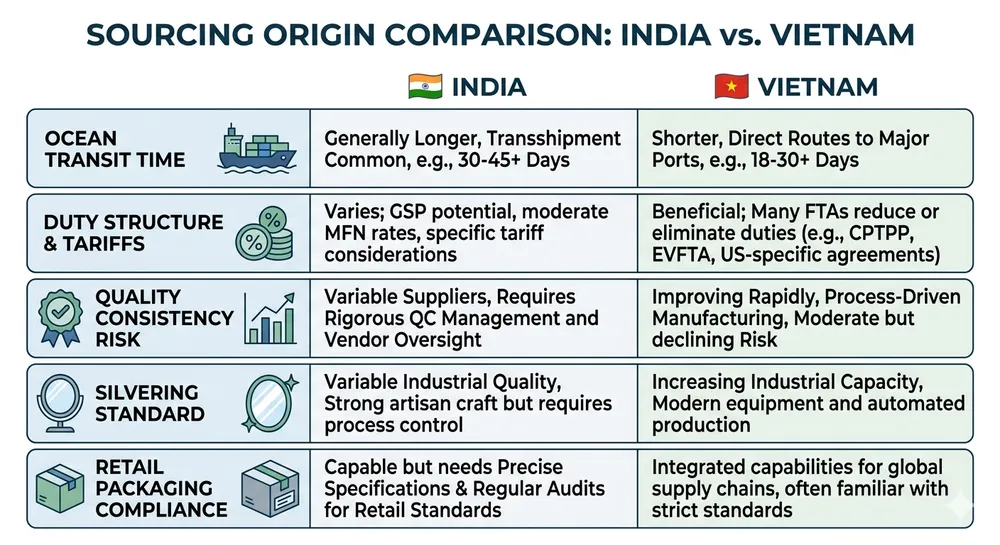
Freight differential. India to US East Coast runs roughly 18–22 days ocean transit from major ports (Nhava Sheva, Mundra). Vietnam to US West Coast is 14–18 days. The difference is modest, but India's port congestion and inland logistics variability add unpredictability that Vietnam's export infrastructure — particularly from Ho Chi Minh City and surrounding industrial zones — handles more consistently for manufactured goods.
Duty structure. Under current trade conditions, Indian decorative mirrors (HS 7009) face MFN duties into the US. Vietnam-origin mirrors benefit from different duty treatment depending on the buyer's market and applicable trade agreements. Your freight forwarder should run the landed-cost calculation for your specific HS code and destination — the numbers shift, and a 2–3% duty difference on a $50,000 order is $1,000–$1,500 that belongs in your margin, not customs.
Quality consistency at scale. This is the harder conversation. Indian decorative mirror manufacturing is fragmented. Many suppliers in the 200–500 MOQ range are assemblers, not integrated manufacturers. When you scale from a 300-piece trial order to a 2,000-piece repeat, the subcontractor chain that produced your samples may not be the same one producing your production run. We see this pattern regularly when buyers come to us after an Indian supplier relationship breaks down at volume — the sample was excellent, the production run had inconsistent silvering or frame finish variation.
Copper-backed silvering and your downstream warranty exposure. Most Indian factories use copper-backed silver coating because it's the domestic market standard and it's cheaper to run. For bathroom mirrors — your highest-moisture application — copper migration causes edge darkening within 18–36 months. If your downstream customers are hotels, residential developers, or retail buyers with return policies, that's a warranty claim waiting to happen. Copper-free silvering costs more per unit but eliminates that failure mode entirely.
Where Indian Supply Makes Sense — and Where It Doesn't
Local and regional sourcing has real advantages. I'd rather say this plainly than pretend factory-direct import is always the smarter answer.
Indian supply works well when:
- You're sourcing for the Indian domestic market or South Asian regional distribution, where local logistics and currency simplify the supply chain
- You need ornate, hand-carved, or artisan-style frames that Indian craft clusters produce at a cost structure Vietnam can't match
- Your order is urgent and small — a 150-piece emergency reorder for a domestic project is faster from a local supplier than waiting for an ocean shipment
- You're testing a new SKU and want to minimize initial capital commitment before committing to a container
Factory-direct import becomes financially smarter when:
- Your repeat order volume exceeds 500 pieces per SKU and you're buying the same SKUs multiple times per year
- Your downstream customers are Western retailers with compliance requirements your Indian supplier can't meet without significant rework
- You need copper-free silvering for moisture-exposed applications and your Indian supplier can't confirm the process
- You need custom frame profiles with engineering support — most mid-tier Indian factories don't have in-house design engineers for OEM development
Livewellcraft as a Factory-Direct Alternative: What the Spec Sheet Actually Shows
We're a mirror factory in Ho Chi Minh, Vietnam. We've been running since 2008 — glass cutting, silvering, frame molding, and assembly under one roof on a 12,000 m² facility. I'm not going to tell you we're better than every Indian supplier on this list. What I can tell you is where our setup specifically addresses the gaps that come up most often when buyers are screening Indian options.
Copper-free silvering, standard. We run copper-free, lead-free silver coating across our production lines. This isn't an upgrade option — it's our standard process. For bathroom mirror programs and hospitality projects, this eliminates the edge-darkening failure mode that copper-backed coating produces in humid environments. Your downstream customers don't file warranty claims on mirrors that hold their coating.
100-piece MOQ on standard models. Our standard MOQ is 100 pieces for existing frame profiles. Most Indian factories in the mid-tier range start at 500–1,000 pieces. If you're building a multi-SKU room mirror program — bathroom, living room, hallway — the difference between a 100-piece and 500-piece MOQ per SKU is the difference between a manageable trial order and a significant inventory commitment before you've tested sell-through.
Vertical integration from glass to retail-ready carton. We cut our own glass, run our own silvering lines, mold our own frames, and pack to retail compliance specs in-house. No subcontractor chain. When your 1,000-unit order ships, the same facility that produced your approved sample produced every unit in that container. Our OEM ODM Capabilities page covers the engineering side — 12 engineers on staff for custom frame profile development, not a design service we outsource.
Retail compliance packaging already built in. We supply Walmart, Wayfair, and Amazon — which means EDI compliance, carton labeling standards, barcode placement, and drop-test packaging are part of our standard workflow, not a special project. If your end customer is a Western retailer, you're not asking us to learn their requirements. We already run to them.
Certifications: ISO 9001:2015, SGS, CE, BSCI. Available on request for your compliance documentation.
Our Decor Mirrors by Room category covers the full room-specific range — Bathroom Decor Mirrors and Living Room Decor Mirrors are the two highest-volume segments for most of our wholesale and retail buyers.
Which Sourcing Route Fits Your Situation
Use this as a quick decision framework, not a definitive answer — your specific order profile, timeline, and downstream customer requirements will always override a general guide.
Stay with an Indian supplier if:
- Your order is under 300 pieces, urgent, and domestic or regional
- You need artisan or hand-carved frame styles that Indian craft clusters produce at competitive cost
- Your downstream market doesn't require Western retail compliance packaging
- You have an existing Indian supplier relationship with a proven track record at your volume
Evaluate factory-direct Vietnam sourcing if:
- Your repeat volume is 500+ pieces per SKU and you're buying multiple times per year
- Your downstream customers are North American or European retailers with compliance requirements
- You need copper-free silvering for bathroom or hospitality applications
- You need OEM frame development with engineering support
- Your current Indian supplier's quality consistency has degraded as volume scaled
Run a parallel sample comparison if:
- You're currently satisfied with your Indian supplier's sample quality but haven't tested at production volume
- You want to benchmark landed cost before your next major PO
- You're adding a new room category (bathroom to living room, or vice versa) and want to evaluate whether your current supplier's spec capability extends to the new category
If you're at the comparison stage, the Room Mirror Suppliers USA article covers the North American distribution landscape and may help you frame the downstream market requirements before you finalize your sourcing decision.
Send your room mirror specs — glass thickness, frame material, target quantity, and destination market — to Request Quote and we'll return a factory-direct quote with production timeline within 48 hours.

![Top 10 Room Decor Mirror Wholesalers in the UK for Import Buyers [2026]](https://www.livewellcraft.com/wp-pages/decor-mirrors-by-room/blog/room-mirror-wholesalers-uk/images/uk-room-decor-mirror-wholesale-supplier-landscape.webp)