A bathroom mirror and a living room mirror share a factory — but almost nothing else in the spec sheet. When buyers ignore that gap, the results show up in returns, overstock, and markdown cycles that eat into margin before the second reorder ever happens.
We see this pattern regularly. A buyer places a mixed-room PO, specs every SKU to the same glass thickness and frame material, and ships into retail. The living room pieces move. The bathroom units sit. Six months later, the buyer is discounting to clear inventory and wondering why the category underperformed. The answer is usually upstream: the wrong spec for the room, priced into the wrong tier, with a frame that doesn't hold up to the environment it was sold into.
This guide walks through how to build a room-segmented mirror assortment that actually sells — matching specs, frame materials, coating grades, and price tiers to each room's real conditions and retail demand patterns.

Why a One-Size-Fits-All Mirror Assortment Underperforms
The core problem is that most buyers think about mirrors as a single category. They're not. Room placement drives three variables that determine whether a unit sells and stays sold: size expectations, frame material durability, and coating grade.
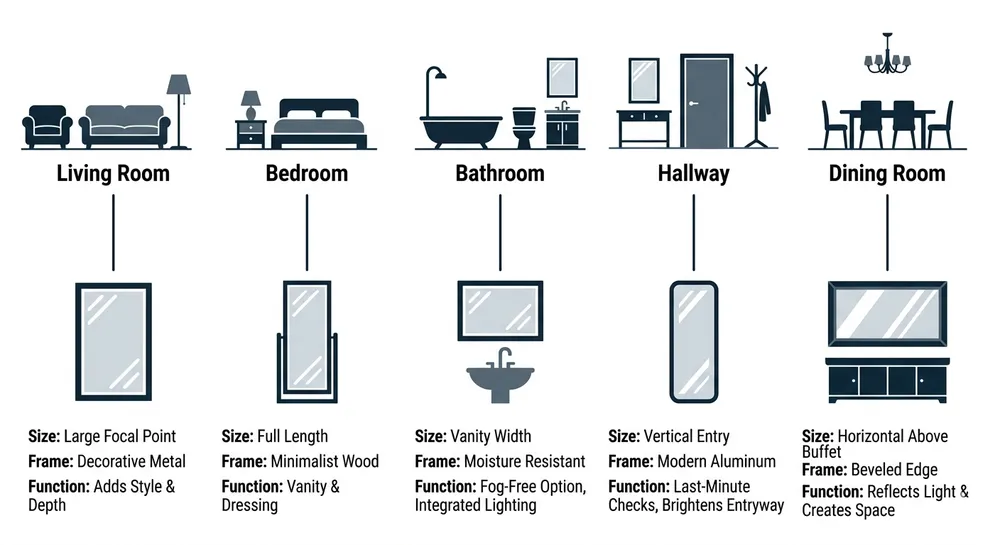
A living room buyer is shopping for a statement piece — larger format, decorative frame, visible in the room's primary sightline. A bathroom buyer is shopping for function first, with moisture tolerance as a non-negotiable. A hallway buyer wants something narrow, vertical, and easy to hang. These aren't style preferences. They're structural differences in what the product needs to do.
When you stock the same frame material across all rooms, you're either over-speccing the living room (paying for moisture resistance you don't need) or under-speccing the bathroom (shipping a frame that will delaminate in 18 months). Either way, your margin or your return rate takes the hit.
The fix is straightforward: build your assortment around room-level spec requirements, not a single product standard. The sections below break down exactly what that looks like for each room category.
Room-by-Room Spec Breakdown
Living room decor mirrors
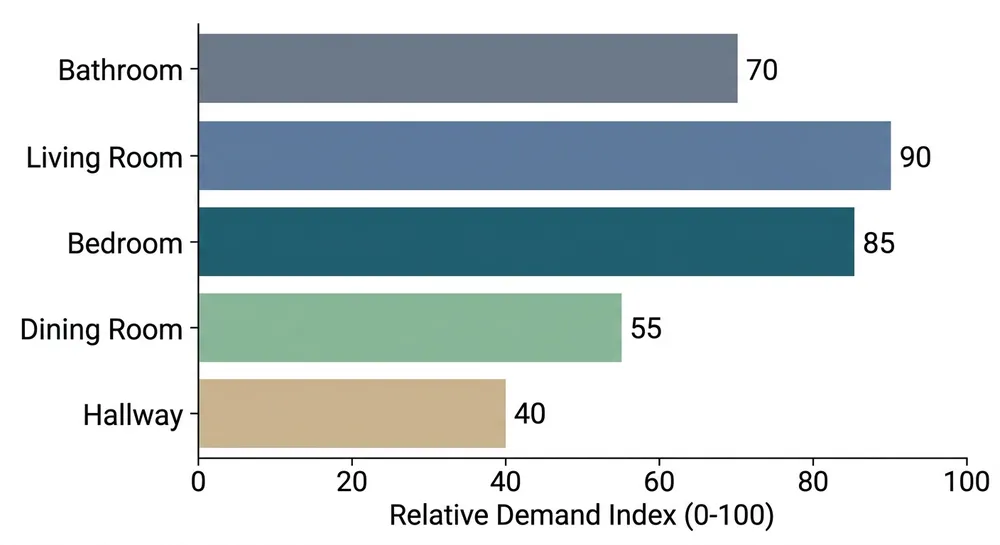
Living room is the highest-margin room category in most retail mirror programs. Buyers are willing to pay for design, and the environment is forgiving — no moisture, no heavy traffic, no impact risk. That means you can run decorative frame materials (resin, MDF with detailed molding, thin metal profiles) without worrying about durability failure.
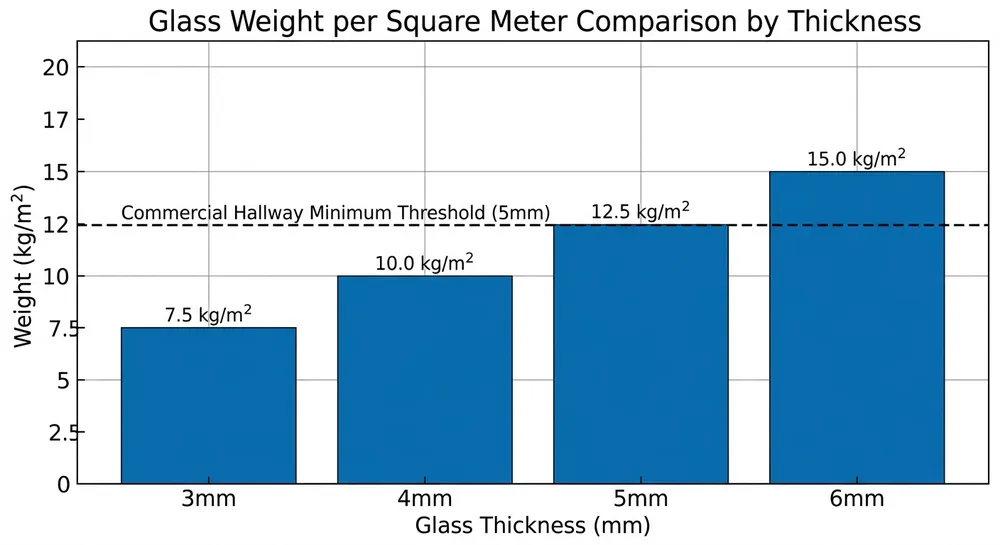
Size range: 24"–48" width is the retail sweet spot for wall mirrors. Oversized formats (48"+ or full-length leaner styles) move well in the mid-to-upper price tier. Glass thickness at 4mm is standard; 5mm adds weight without meaningful optical benefit for this application.
Frame material: MDF with gesso and paint finish, resin casting, or thin-profile metal. Solid wood works but adds cost — reserve it for premium SKUs where the price tier supports it. (We run MDF molding profiles in-house, so custom frame shapes on living room SKUs don't require a separate supplier or extended lead time.)
Target retail price tier: $49–$149 for standard wall formats; $99–$249 for oversized or leaner styles. This is where the category earns its margin — don't compress the price tier by over-indexing on commodity specs.
Internal link: living room decor mirrors
Bathroom decor mirrors
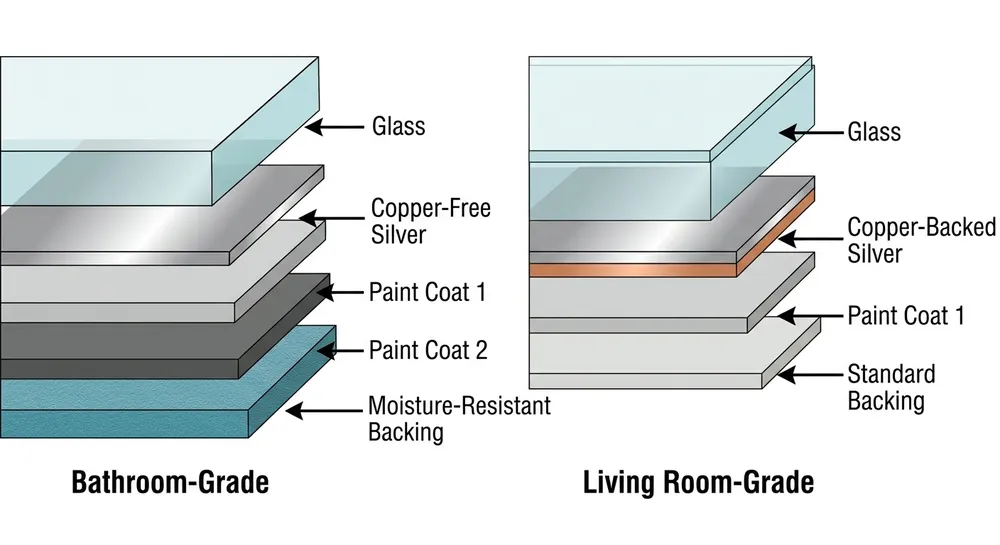
Bathroom is where spec mistakes cost the most. Moisture exposure degrades standard silver coatings from the edges inward — you'll see black spotting within 12–24 months on mirrors that weren't built for the environment. That's a warranty claim, a return, and a lost reorder.
The spec requirement here is copper-free silver coating with sealed edges. Standard copper-backed silvering corrodes faster in humid environments. Copper-free formulations hold significantly longer under moisture exposure — we run copper-free as our default across all production, which means bathroom SKUs don't carry an upcharge for the coating upgrade. That's a meaningful cost advantage when you're building a bathroom-specific line.
Frame material: PVC, aluminum, or moisture-resistant MDF with sealed finish. Avoid raw wood or standard MDF without proper sealing — the frame will swell before the glass fails. Metal frames (brushed nickel, matte black, chrome) are the safest choice for bathroom retail and carry strong sell-through in the $39–$99 tier.
Size range: 18"–36" width covers the majority of vanity mirror demand. Frameless or thin-frame styles move fastest in this category — buyers aren't looking for decorative complexity in the bathroom.
Internal link: bathroom decor mirrors
Bedroom decor mirrors
Bedroom splits into two distinct sub-segments: wall mirrors (typically 24"–36", decorative frame) and full-length floor or leaner mirrors (typically 14"–22" wide × 48"–65" tall). These have different retail price points, different packaging requirements, and different sell-through patterns — treat them as separate SKUs, not variations of the same product.
Full-length mirrors are one of the strongest-performing bedroom SKUs in the $79–$179 retail range. The frame material here matters for perceived value: thin metal profiles (gold, black, silver) photograph well for e-commerce and hold up in transit better than MDF on tall formats. We reinforce the bottom rail on leaner mirrors specifically because the corner takes impact during consumer unboxing — a detail that reduces damage claims without adding meaningful cost.
Wall mirrors for the bedroom follow similar specs to living room, but buyers tend to skew toward softer finishes (antique gold, champagne, warm white) rather than bold decorative profiles. Keep the frame cost moderate — bedroom wall mirrors typically retail $49–$119 and the margin doesn't support premium frame materials unless you're targeting a specific design-forward channel.
Internal link: bedroom decor mirrors
Dining room decor mirrors
Dining room is a smaller volume category but punches above its weight on margin. Buyers in this segment are looking for larger-format mirrors — 36"–60" width, often arched or with ornate frames — that function as focal-point wall decor. The environment is dry, so coating grade is not a concern. Frame complexity is the value driver.
This is where resin casting earns its place. Resin allows detailed ornamental profiles that would be cost-prohibitive in solid wood, at a price point that still supports $99–$299 retail. The trade-off is weight — a 48" resin-framed mirror can run 25–35 lbs, which affects both packaging cost and consumer installation. We account for this in the hardware pack: heavier mirrors ship with wall anchor hardware included, which reduces installation-related returns.
Arched formats are currently the strongest-moving style in this category across our North American accounts. If you're building a dining room SKU for the first time, start with an arched or sunburst profile before testing rectangular formats.
Internal link: dining room decor mirrors
Hallway decor mirrors
Hallway mirrors have the tightest size constraints of any room category. The typical hallway wall is narrow — buyers need 14"–24" width, vertical orientation, and a profile that doesn't project far from the wall. Oversized or deep-frame mirrors don't fit the space and don't sell in this segment.
The retail price tier is lower ($29–$79), which means frame cost needs to be controlled. Thin metal frames and simple MDF profiles with clean finishes are the right call here. Don't over-engineer the frame for a category where the buyer is making a practical purchase, not a design statement.
One thing that does move the needle in hallway: hooks or shelf integration. Mirrors with a small shelf or integrated coat hooks retail at a premium in this category and have strong sell-through because they solve a real functional problem in the space. If you're building a hallway SKU line, at least one functional-hybrid format is worth testing.
Internal link: hallway decor mirrors
Room-to-Spec Comparison Table
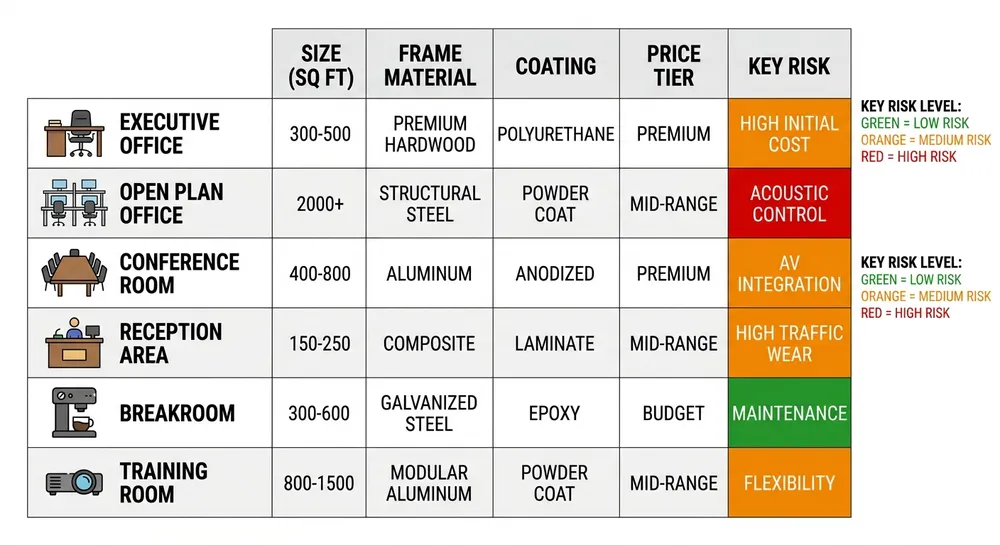
This table maps each room category to the spec parameters that most directly affect retail performance and return rates.
| Room | Typical Size Range | Frame Material | Coating Grade | Target Retail Price | Key Risk |
|---|---|---|---|---|---|
| Living room | 24"–48" W | MDF, resin, metal | Standard silver | $49–$249 | Over-speccing frame cost |
| Bathroom | 18"–36" W | Metal, PVC, sealed MDF | Copper-free silver | $39–$99 | Edge blackening from moisture |
| Bedroom (wall) | 24"–36" W | Metal, MDF | Standard silver | $49–$119 | Frame finish mismatch to channel |
| Bedroom (full-length) | 14"–22" W × 48"–65" H | Metal (preferred) | Standard silver | $79–$179 | Corner damage in transit |
| Dining room | 36"–60" W | Resin, solid wood | Standard silver | $99–$299 | Weight / packaging cost |
| Hallway | 14"–24" W | Thin metal, MDF | Standard silver | $29–$79 | Over-engineering for price tier |
Three Assortment Mistakes That Kill Sell-Through
These are the patterns we see most often when buyers come back after a disappointing first season.
Mistake 1: Ordering bathroom SKUs without specifying moisture-rated coating. Standard silver coating will fail in bathroom environments. The failure timeline depends on ventilation, but 12–24 months is typical for edge blackening in a standard bathroom. By the time the consumer complains, the product is out of warranty and the return lands on the retailer. Specify copper-free silvering explicitly on your PO — don't assume it's the default.
Mistake 2: Using the same frame material across all room categories. MDF is fine for living room and bedroom. It's a liability in bathroom without proper sealing. Metal is safe across all rooms but adds cost that doesn't make sense for every price tier. Match the frame material to the room's environment and the SKU's retail price — don't default to one material because it simplifies your PO.
Mistake 3: Over-indexing on one room category. We've seen buyers build a 12-SKU program that's 10 living room mirrors and 2 bathroom mirrors. Living room is a competitive shelf — you're fighting for placement against dozens of options. Bathroom and hallway have less competition and more consistent demand because the purchase is more functional. A balanced room distribution (3–4 SKUs per room, 2–3 rooms per initial program) typically outperforms a deep single-room bet.
Testing a Room-Based Line Without Full-Container Commitment
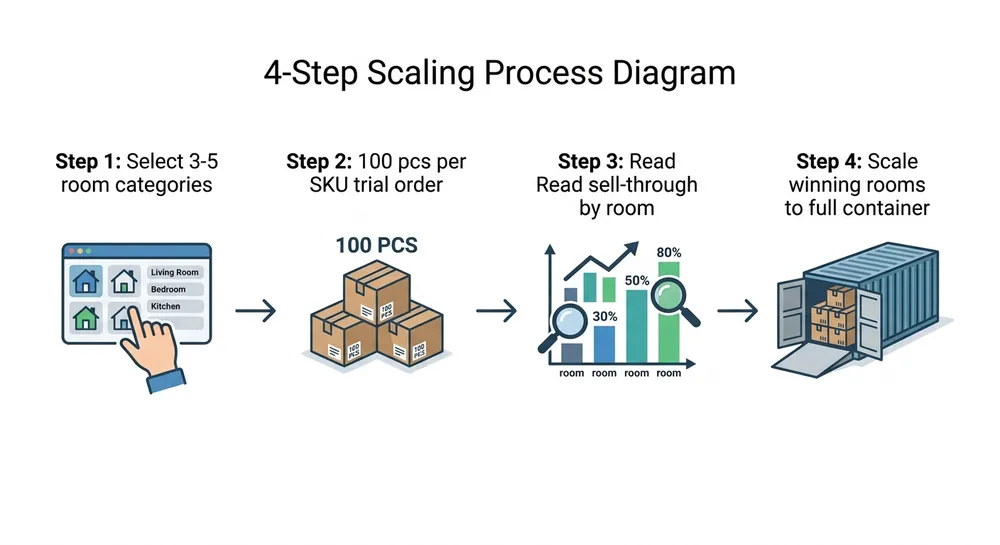
The practical barrier to room-segmented assortment planning is MOQ. If each room category requires a separate minimum order, the entry cost for a 5-room program becomes prohibitive before you've validated any of the SKUs.
Our MOQ is 100 pieces per model for standard configurations. That means you can test a 5-room program — one SKU per room — at 100 units each, for a 500-piece total order. That's a container-efficient quantity that lets you read sell-through data by room before committing to a full reorder.
(Most buyers who run this kind of room-segmented trial find that 2–3 rooms outperform expectations and 1–2 underperform. The data from that first order is worth more than any forecast.)
The other advantage of sourcing all room categories from a single factory: spec consistency across SKUs. When your bathroom mirror and your living room mirror come from different suppliers, you're managing two coating standards, two glass thickness tolerances, two QC processes. When they come from the same production floor, the glass quality, edge finishing, and hardware specs are consistent across your entire program. That matters when you're presenting a cohesive room-based line to a retail buyer.
We produce all frame types — MDF, solid wood, metal, resin — in-house, so a multi-room program doesn't require coordinating across multiple frame suppliers. One PO, one quality standard, one point of contact from quote to container.
Retail Compliance Across a Multi-Room Program
One detail that catches buyers off guard when scaling a room-based program into major retail channels: compliance requirements vary by SKU, not just by channel. A Walmart program requires UPC labeling, specific carton markings, and EDI integration. A Wayfair program has its own packaging and photography standards. When you're running 5–6 room categories, each with its own SKU, the compliance workload multiplies.
We've been supplying Walmart, Wayfair, and Amazon programs since before most of our current buyers started sourcing from Vietnam. EDI capability, UPC assignment, channel-specific inner and master carton specs — these are built into our standard workflow, not add-ons you negotiate separately. For a multi-room program going into a major retail channel, that compliance infrastructure is worth factoring into your supplier selection, not just the unit price.
Frequently Asked Questions
Do I need different glass thickness for different rooms?
For most retail applications, 4mm glass is the right call across all room categories. It's the standard for decorative wall mirrors and balances optical clarity, weight, and cost. The exception is full-length floor mirrors and large-format dining room pieces (36"+ width) — we typically run those at 5mm for structural stability during transit and consumer handling. Going to 5mm on smaller formats adds weight and freight cost without a meaningful quality benefit.
What's the minimum order if I want to test mirrors across three room categories?
100 pieces per model is our standard MOQ for most configurations. A 3-room test program at one SKU per room runs 300 pieces total — manageable for a first order and enough volume to generate real sell-through data before scaling. If you want to test two frame styles per room, that's 600 pieces across 6 SKUs, which typically fills a 20-foot container efficiently depending on mirror size.
How do I specify copper-free silvering on my PO?
Call it out explicitly in your product specification sheet as "copper-free silver coating" or "lead-free, copper-free silvering." Don't assume it's the default — many factories still run standard copper-backed silver unless specified otherwise. At Livewellcraft, copper-free is our production default, so you're covered without a special callout, but it's still good practice to confirm in writing on any bathroom or coastal-market SKU.
Can I source all room categories from a single PO?
Yes, and it's the more efficient approach. A single PO covering multiple room categories means one set of shipping documents, one QC inspection, one container loading schedule. We handle mixed-SKU orders regularly — the production planning is straightforward when all frame types run in-house. The main thing to confirm upfront is that your total quantity per SKU meets the 100-piece minimum.
—
Ready to build a room-segmented mirror program? Browse the full Decor Mirrors by Room category, or go directly to the room pages that match your target assortment: living room decor mirrors, bathroom decor mirrors, bedroom decor mirrors, dining room decor mirrors, hallway decor mirrors. Send us your target room categories, quantities, and price tiers — our team will come back with a spec sheet and quote. Request a quote.