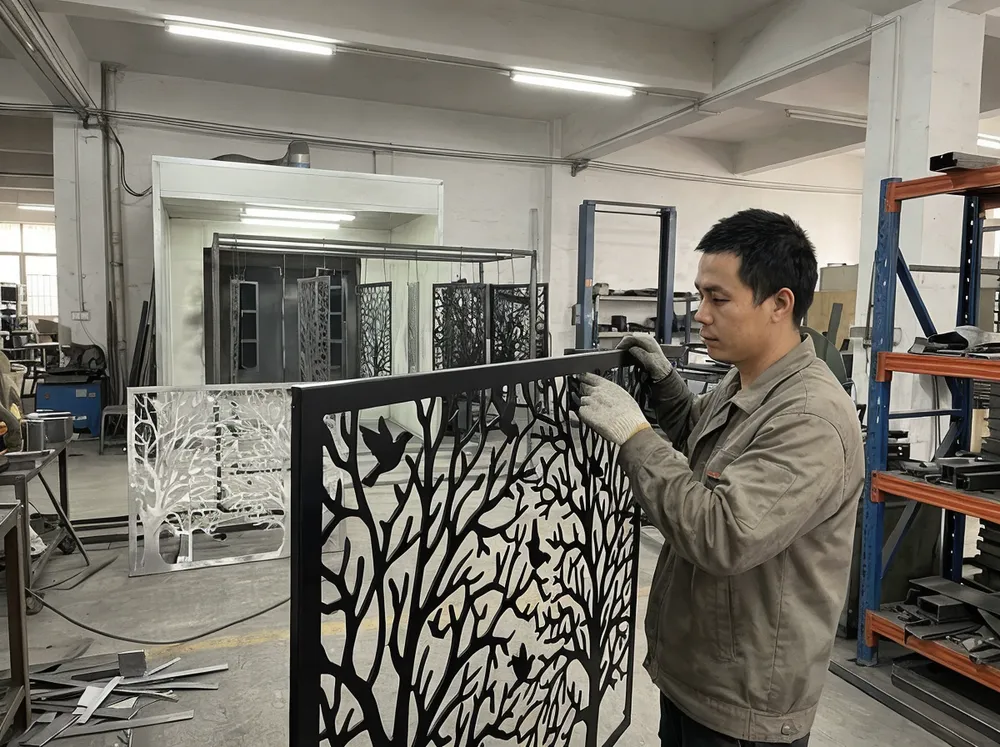
Laser-cut iron and aluminum designs — powder-coated, electroplated, or hand-painted — shipping to hospitality projects, retail programs, and commercial interiors across 30+ countries.
Metal wall arts sit in the segment where your wholesale price is higher than canvas or wood, but your margin percentage is also higher — end buyers perceive metal as a premium material and accept the price point without negotiation. We've watched this category grow faster than any other wall art material in our export markets over the past three years, and the commercial logic is straightforward: metal pieces carry perceived value that justifies premium retail pricing, they generate near-zero warranty claims in commercial installations, and they reorder well because hospitality and corporate buyers replace or expand wall decor on renovation cycles.
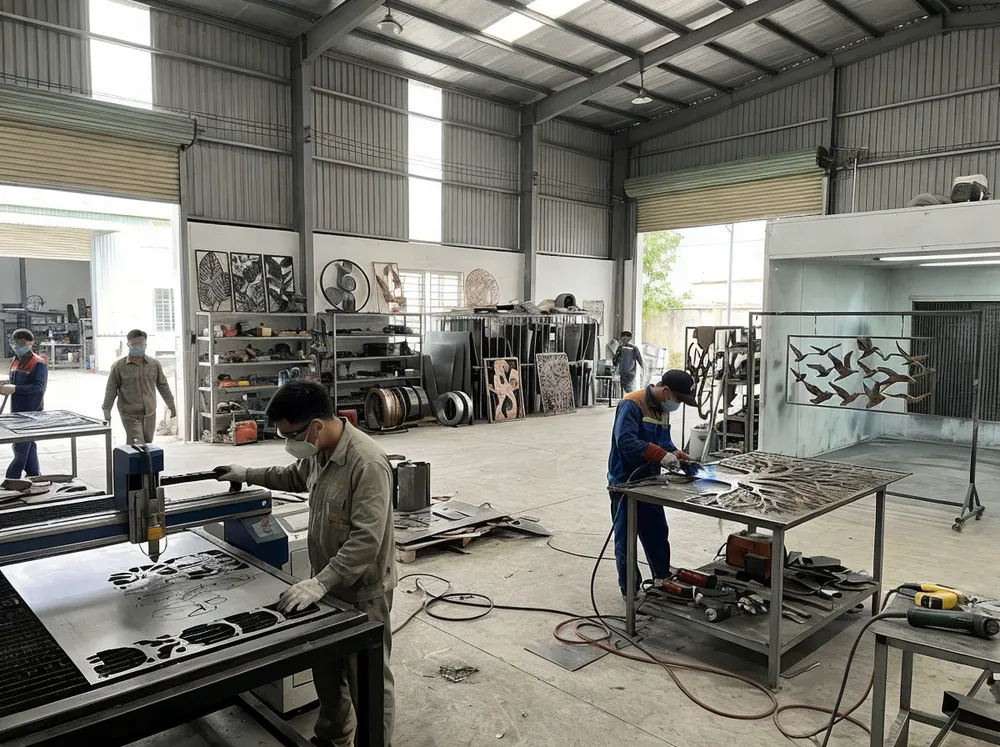
We manufacture metal wall arts on the same fabrication and finishing lines we've used for metal mirror frames since 2008. The powder coating equipment, the welding jigs, the electroplating bath — none of this was purchased for wall art. It was already running at capacity for mirror production, and metal wall art was a natural extension of what the lines could do. That matters to you because the process maturity is 18 years deep, not something we spun up last year to chase a trend.
If you're sourcing metal wall art for hospitality projects, retail programs, or commercial interiors, this page covers the exact specs, finish options, production process, and order parameters you need to evaluate whether we're the right metal wall arts manufacturer for your business.
Premium perception allows pricing without negotiation
Commercial installations stay problem-free
Hospitality buyers expand on renovation schedules
Same lines running since 2008 for mirror frames
These are the production parameters for our metal wall art line. If you're building a comparison sheet across suppliers, this table gives you the numbers.
| Parameter | Specification |
|---|---|
| Base metals | Iron (cold-rolled steel sheet), aluminum |
| Metal thickness | 0.8 mm, 1.0 mm, 1.2 mm, 1.5 mm |
| Cutting method | Fiber laser cutting (±0.1 mm tolerance) |
| Forming methods | Laser cut flat, bent/folded, stamped relief, hand-shaped dimensional |
| Surface finishes | Powder coat, electroplate (chrome, brass, black nickel), hand-paint, combination |
| Powder coat thickness | 60–80 μm (automated line, monitored per batch) |
| Salt spray resistance | 500+ hours (ASTM B117) |
| Standard size range | 30×30 cm to 120×120 cm |
| Custom sizing | Any dimension within structural limits — we advise on reinforcement above 100 cm span |
| Weight per piece | 1.5–12 kg depending on size, thickness, and design complexity |
| Mounting hardware | Sawtooth hangers, D-rings, French cleats, or keyhole slots — configured per piece weight and your market's wall type |
| Joining methods | MIG/TIG welding, riveting, mechanical fasteners (method selected by design geometry) |
For pieces over 90 cm on any axis, we default to 1.2 mm thickness and add a rear support brace. It's a small cost addition that eliminates flex and keeps the piece flat on the wall over time — something your hospitality clients will appreciate when pieces hang in high-traffic corridors.
The category page covers our full material comparison across all five wall art types — canvas, wood, metal, acrylic, and abstract canvas.
View All Wall Arts by MaterialSend it over — we'll confirm feasibility and quote within 48 hours. Our engineering team reviews every custom specification request.
Submit Your SpecificationsMost metal wall art suppliers describe the finished product. We'll walk you through what happens on our floor, because the production choices we've made are directly connected to the quality consistency and cost structure you receive.
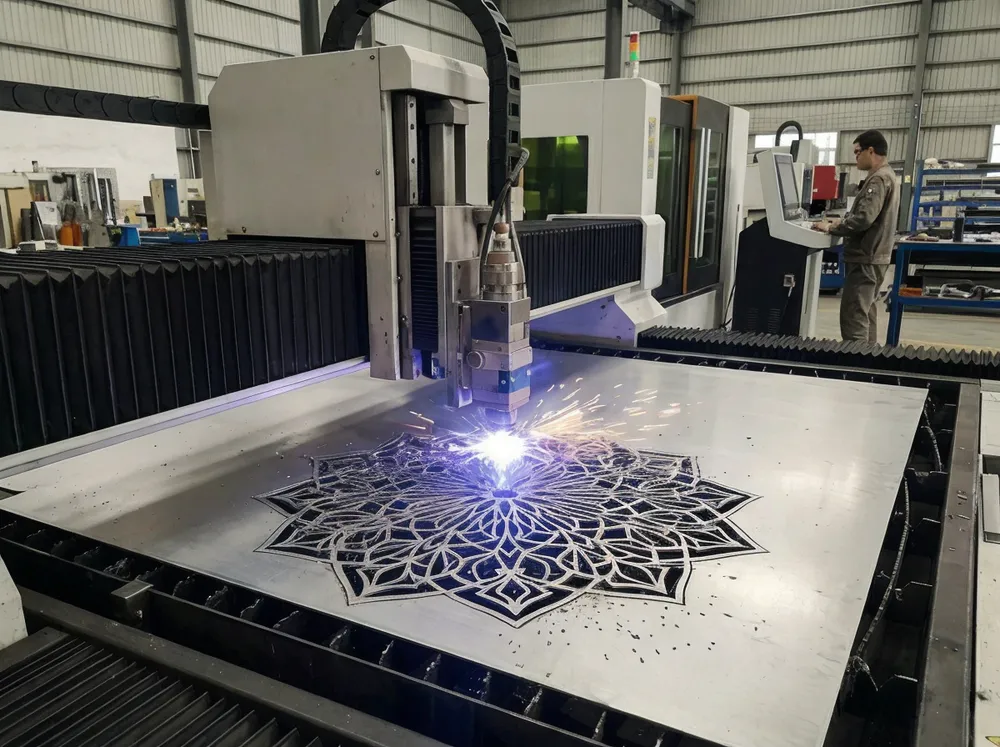
We cut metal wall art designs on fiber laser machines, not stamping dies. Dies make sense at very high volumes — 10,000+ identical pieces — because the per-unit cost drops once the die is paid off. But most of our metal wall art buyers order 300–2,000 pieces per design, often across multiple designs per order.
At those volumes, laser cutting is more cost-effective for you because there's no $2,000–$5,000 die charge amortized into your unit price. It also means design changes between orders cost nothing — you send a new vector file, we cut it. No retooling, no die modification fees.
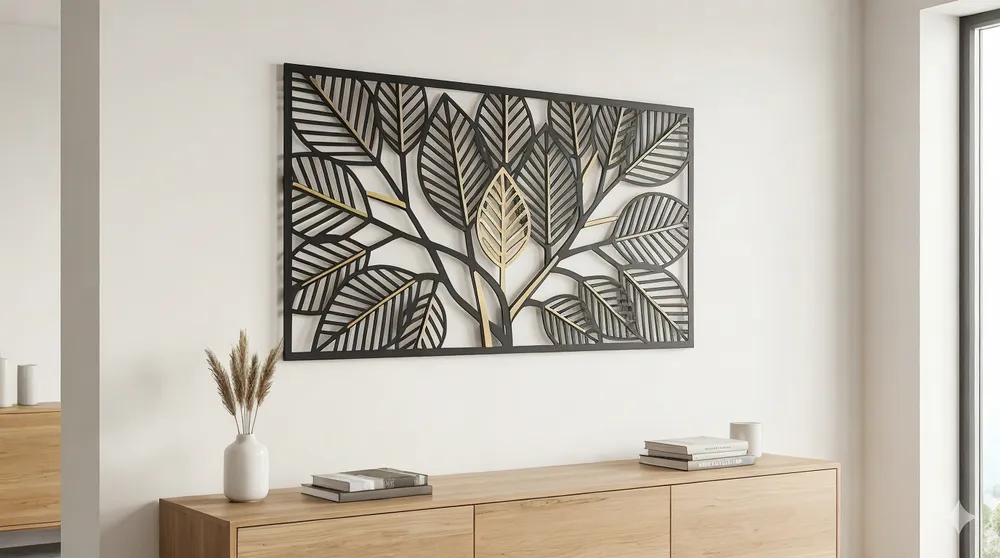
The fiber laser holds ±0.1 mm cutting tolerance on iron and aluminum sheet, so intricate designs — leaf patterns, geometric lattice, script lettering — come off the table clean without manual grinding.
That precision matters when you're ordering 1,000 units of a design with fine detail: unit 1,000 is identical to unit 1, and your downstream buyer sees consistent quality across every piece they unpack.
We do maintain stamping dies for a handful of high-volume designs that reorder consistently — if your program hits that threshold, we'll recommend the switch because it drops your unit cost by 15–20%.
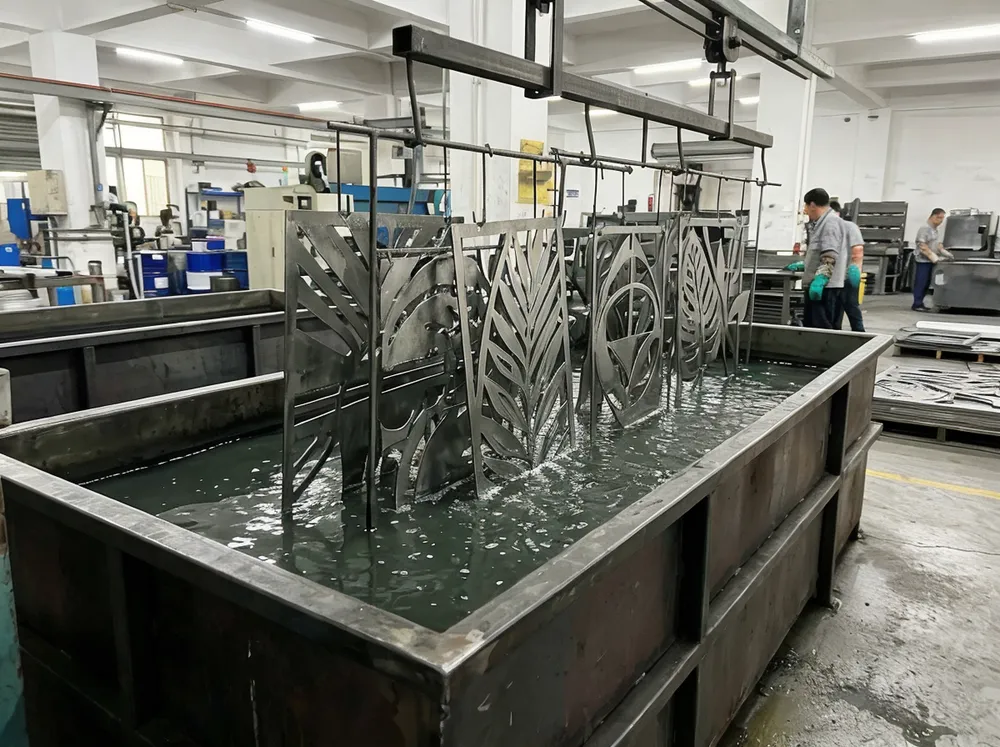
This is the step most buyers never ask about, and it's where a lot of metal wall art quality problems originate. Before any finish goes on — powder coat, electroplate, or paint — every piece runs through a phosphate pre-treatment bath. The phosphate layer creates a micro-rough surface that the powder or plating bonds to mechanically, not just chemically. Without it, you get adhesion failures: powder coat that chips on impact, plating that peels at edges, paint that flakes in humid environments.
We added the pre-treatment step in 2014 after a bad experience with a 3,000-piece hospitality order where the powder coat bubbled in a coastal hotel environment. The root cause was inadequate surface prep. We invested in the phosphate line, and our finish-related return rate dropped to effectively zero.
Your buyers install these pieces in hotels, restaurants, and office lobbies where they stay on the wall for years — the pre-treatment is what makes that possible without warranty callbacks.
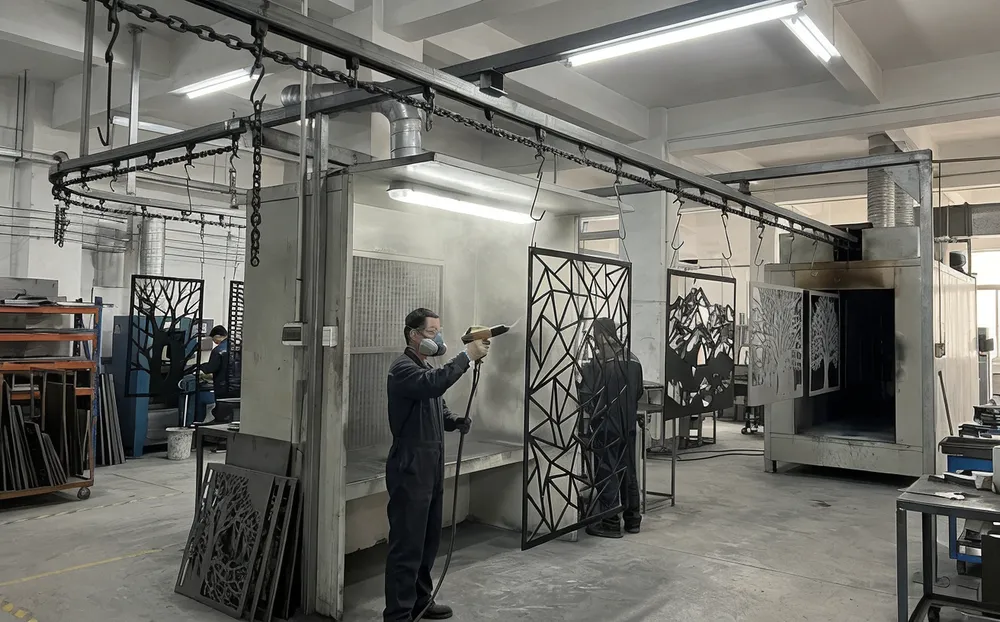
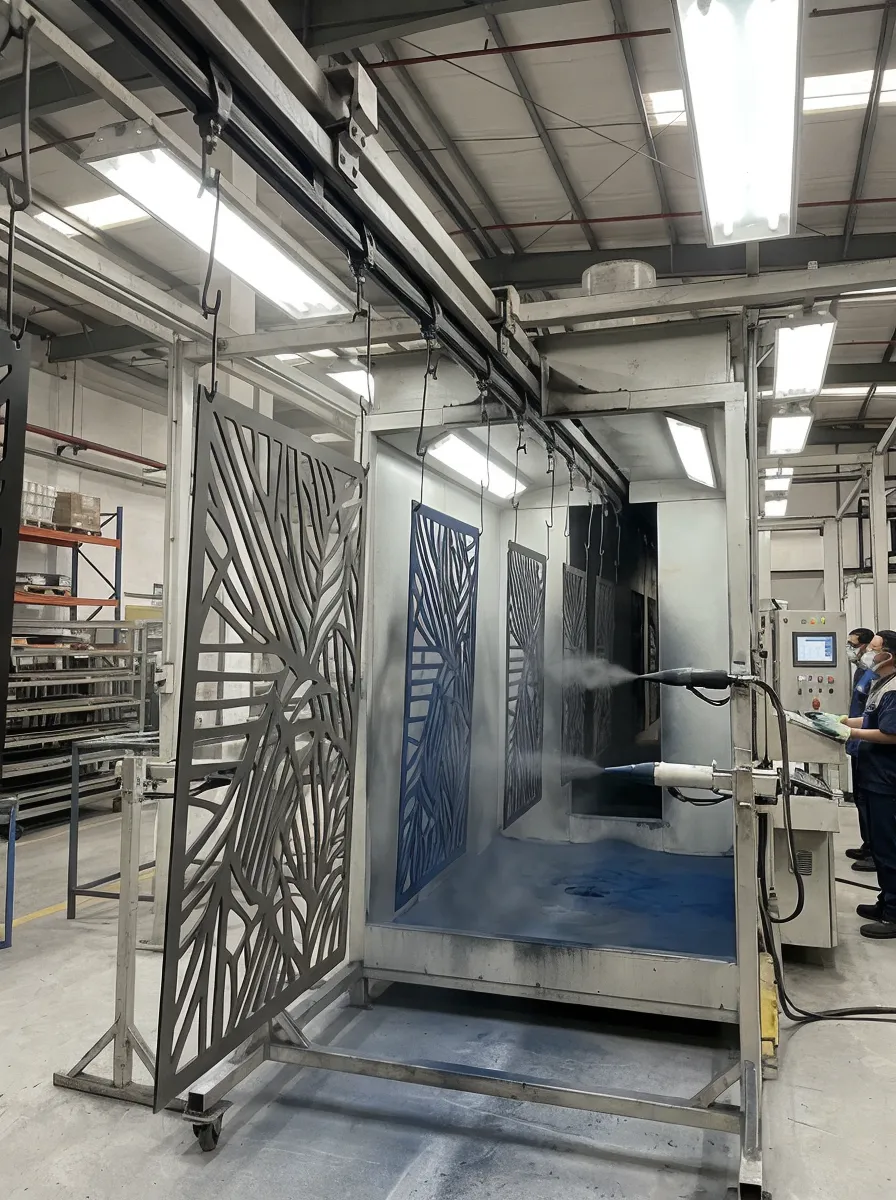
Our powder coating runs on the same automated line we use for metal mirror frames — a line that's been running since 2010 and processes thousands of pieces monthly. The system applies 60–80 μm of powder consistently across each piece, monitored by thickness gauges at the exit of the curing oven. Automated application means no thin spots on edges and no heavy buildup in recesses, which are the two most common defects in hand-sprayed powder coat.
The finish passes 500-hour salt spray testing per ASTM B117. For your coastal, outdoor-adjacent, or high-humidity installations, that's the spec that eliminates corrosion-related claims.
Any RAL or Pantone color match, with matte, satin, or gloss sheen levels available
Masked and sprayed in sequence, adding one production day per additional color
Not every metal wall art piece is powder-coated. Our hand-painting team handles designs that need gradient effects, antiqued patina, metallic leaf accents, or color transitions that powder coating can't achieve. These pieces go through the same phosphate pre-treatment, then receive hand-applied acrylic or enamel finishes sealed with a clear protective topcoat.
Hand-painted pieces carry a higher unit cost and a slightly higher MOQ (200 pieces minimum versus 100 for powder coat), because the labor intensity requires dedicated batch scheduling.
Hand-finished metal wall art retails at 2–3× the price of standard powder-coated pieces
The visual differentiation makes your product line harder for competitors to replicate with commodity sourcing.
Each scenario below is a market segment our existing buyers sell into profitably. We're framing these as commercial opportunities, not decoration ideas.
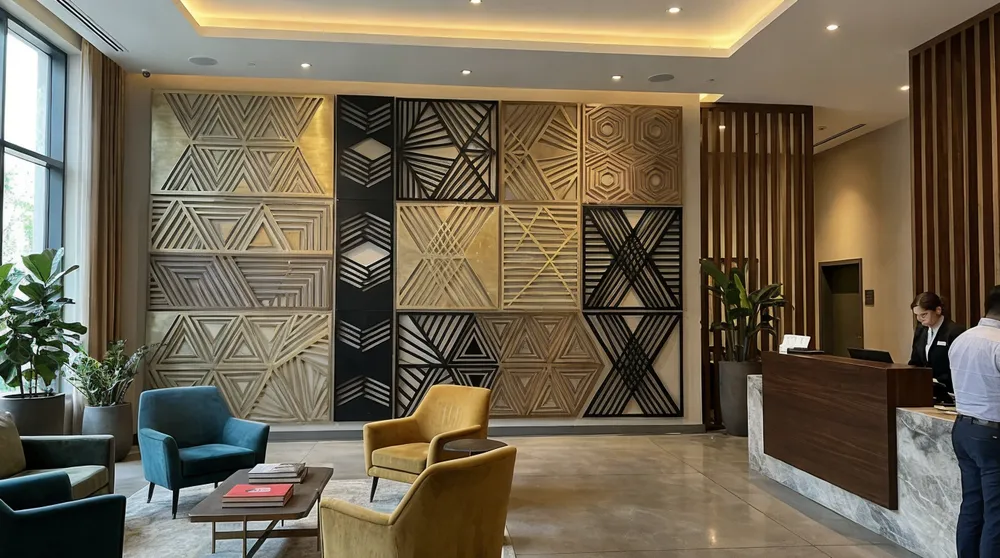
Hotel and resort procurement runs on renovation cycles — typically every 5–7 years for soft goods and wall decor. A single boutique hotel project orders 200–500 metal wall art pieces across lobbies, corridors, guest rooms, and dining areas. Chain hotels multiply that across properties. We've supplied metal wall art for hospitality projects in the Middle East and Southeast Asia where the spec required salt spray resistance (coastal locations) and fire-retardant backing material.
Your commercial advantage:
Hospitality buyers accept premium pricing because they're specifying to an interior designer's vision, not shopping on price. Your margin on a hospitality metal wall art order is typically 40–60% above what you'd earn on the same volume in retail. And the reorder cycle is predictable — when the next property opens or the current one renovates, you're already the approved supplier.
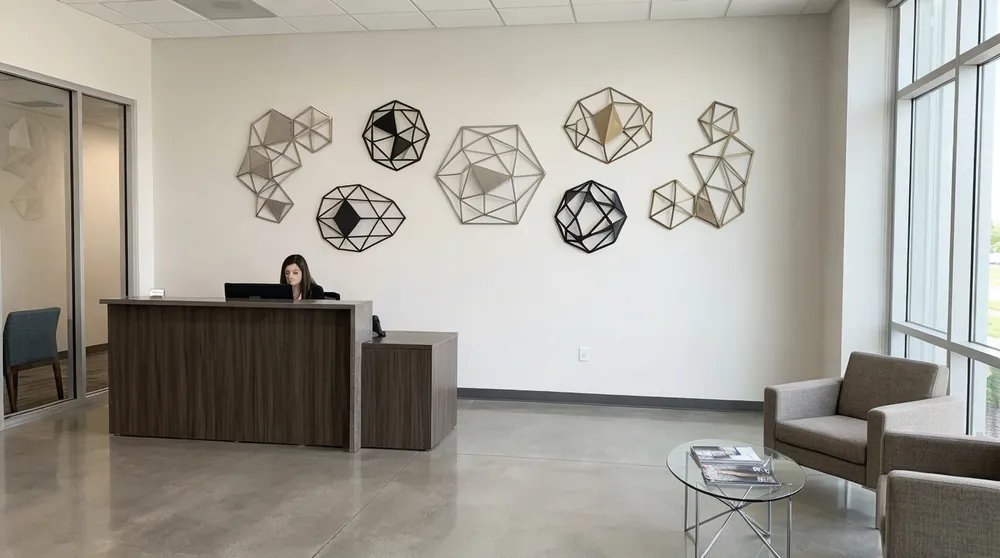
Corporate office fit-outs and medical facility waiting areas need wall decor that reads as professional, withstands cleaning chemicals, and doesn't degrade in climate-controlled environments. Metal checks all three boxes. We produce geometric and abstract metal wall art in muted corporate palettes — brushed nickel, matte black, antique brass — that interior designers specify for these environments.
Order patterns here tend to be project-based: 100–300 pieces per fit-out, with potential for multi-site rollouts if you're supplying a facilities management company or a design firm with a portfolio of corporate clients.
Key selling point for your buyer:
Durability — metal wall art in a medical waiting room doesn't absorb moisture, doesn't harbor bacteria on the surface, and doesn't need replacement after a few years of cleaning.
Metal wall art occupies the $50–$200 retail price tier in North American and European markets — above canvas, competitive with high-end wood. If you're a distributor supplying home decor retailers or running your own e-commerce brand, metal wall art gives you SKUs that justify premium pricing with visible material quality. The weight and rigidity of metal signal value to end consumers in a way that printed canvas doesn't.
We supply metal wall art to buyers selling through Amazon, Wayfair, and independent home decor stores. Our packaging already meets the drop-test and labeling standards these channels require.
Amazon private-label ready:
We handle UPC labeling, branded inserts, and frustration-free packaging configuration — you ship directly from our container to FBA.
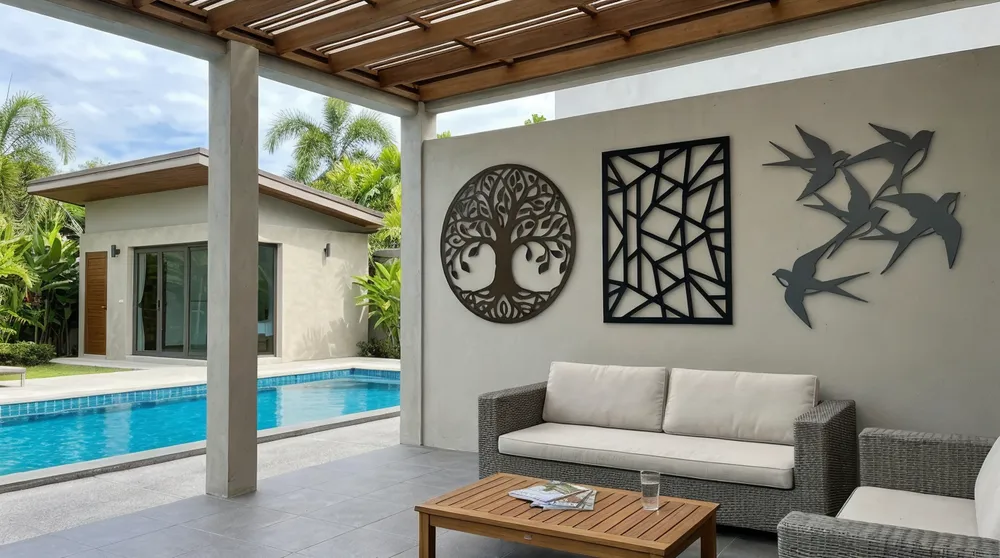
Metal wall art with proper powder coating performs in covered outdoor environments — patios, pool houses, covered terraces, and screened porches. This is a segment that canvas and wood can't serve because moisture and UV exposure destroy those materials within a season.
Our 500-hour salt spray rating and UV-stable powder coat colors mean your buyer can confidently sell metal wall art for outdoor-adjacent use without worrying about fading or corrosion claims.
High-margin segment
This segment is smaller in volume but high in margin — outdoor-rated wall decor commands a premium because fewer products compete in the space.
Targeting one of these segments?
Tell us your market and volume — we'll recommend the right specs and finishes.
We customize metal wall arts across five dimensions. Here's what's adjustable, what's fixed, and how customization affects your order.
| Customization Dimension | What's Possible | Constraints |
|---|---|---|
|
Design/Pattern
|
Any 2D vector design; 3D dimensional pieces from your CAD files or our engineering team's interpretation of your concept sketch | Minimum feature width 2 mm for laser cutting; very fine details below 1.5 mm risk distortion during finishing |
|
Size
|
Any dimension up to 150×150 cm | Pieces over 120 cm on any axis require 1.2 mm minimum thickness and rear bracing; shipping carton size may affect container loading density |
|
Metal Type
|
Iron (standard) or aluminum (lightweight option) | Aluminum costs approximately 30% more per unit; recommended when weight is a constraint for large-format pieces or when your market requires non-ferrous material |
|
Surface Finish
|
Any RAL/Pantone color, matte/satin/gloss, electroplate in chrome/brass/black nickel, hand-painted custom effects | Multi-color powder coat adds 1 day per additional color; hand-paint MOQ is 200 pieces; electroplate limited to pieces under 80 cm due to bath dimensions |
|
Mounting Hardware
|
Sawtooth, D-ring, French cleat, keyhole, or custom bracket | Hardware selection affects maximum supported weight — we'll spec the appropriate hardware based on piece weight and your market's typical wall construction |
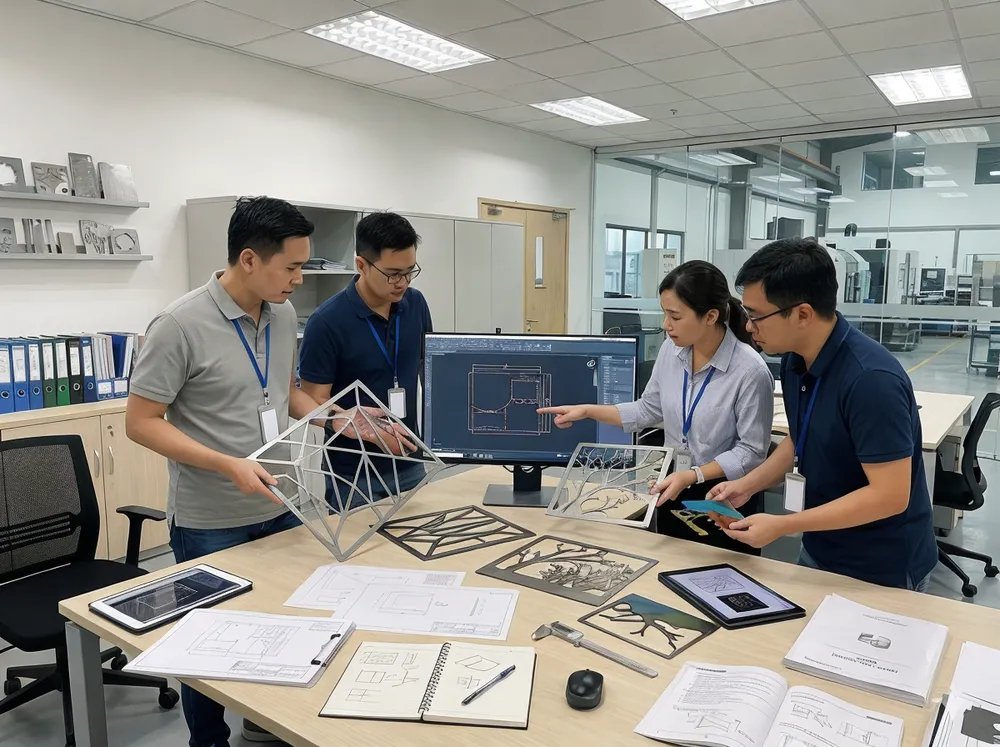
Design setup for a new laser-cut pattern
No charge if you provide a production-ready vector file (AI, DXF, or SVG). If you send a sketch or reference image and need our engineering team to develop the production file, there's a one-time design fee of $50–$150 depending on complexity, credited back on orders over 500 pieces.
Color matching
First sample is included in the sample order. Subsequent color revisions during development are $30 per iteration — this covers the powder batch preparation and curing test.
MOQ by customization level
100
pieces
Standard designs, single powder coat color
200
pieces
Hand-painted or multi-color designs
300
pieces
Fully custom: new pattern + new finish + custom packaging
Ready to customize?
Send your design concept or reference images — our engineering team will confirm feasibility and quote the exact MOQ and unit cost.
Submit Design ConceptMetal wall art ships differently from every other material in our catalog, and we've learned (through some expensive lessons early on) that packaging designed for canvas or wood doesn't protect metal.
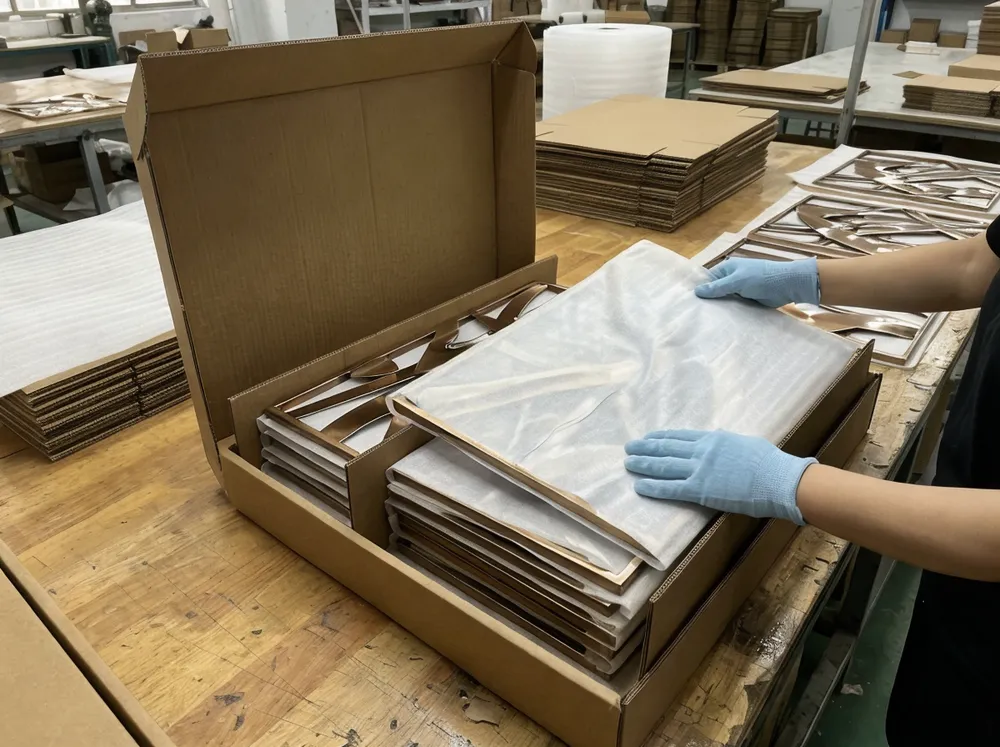
Every metal wall art piece is individually wrapped in PE foam sheeting, then separated by corrugated cardboard dividers inside the master carton. The foam prevents surface-to-surface contact — the single biggest cause of scratch damage during ocean freight.
For electroplated pieces, we add a layer of soft tissue between the foam and the metal surface because electroplated finishes are more susceptible to micro-scratching than powder coat.
We optimize carton dimensions to maximize container utilization for your specific size mix — if you're ordering three sizes, we'll calculate the optimal carton configuration and provide a loading plan before production starts.
For mixed-material containers (metal wall art combined with canvas or acrylic from our other lines), metal cartons load on the bottom tier due to weight, with lighter materials stacked above. We palletize when your destination port or warehouse requires it.
Direct-to-fulfillment configurations
If you're selling through retail channels or e-commerce, we configure individual product packaging with your branding, UPC codes, and assembly/hanging instructions.
Direct to fulfillment: Your units go directly from our container to the fulfillment center without repackaging. We've been doing this for Walmart and Wayfair programs on our mirror lines for years — the process is the same, just adapted for wall art dimensions and weight.
If you're evaluating which wall art material fits your market, here's how metal stacks up against the other four categories we produce. This isn't about which is "better" — it's about which matches your channel, your price tier, and your buyer profile.
| Factor | Metal | Canvas | Wood | Acrylic |
|---|---|---|---|---|
| Wholesale price tier | Mid-to-premium | Entry-to-mid | Mid | Mid |
| Typical retail markup | 2.5–3.5× | 2–2.5× | 2.5–3× | 2–3× |
| Durability / warranty risk | Very low — salt spray tested | Low (but vulnerable to moisture) | Moderate (humidity-sensitive) | Low (no breakage) |
| Container density (40HQ) | 800–1,000 pcs | 2,800–3,200 pcs | 1,200–1,500 pcs | 1,800–2,200 pcs |
| Best-fit channels | Hospitality, commercial, premium retail | Mass retail, e-commerce | Specialty retail, farmhouse/rustic | Modern retail, e-commerce |
| Outdoor-adjacent use | Yes (with powder coat) | No | No | Limited |
Browse our full range of wall art materials:
Metal for your hospitality line, canvas for your retail program — we consolidate into one PO and one container.
For standard residential retail and light commercial use, 0.8 mm iron is sufficient and keeps your unit cost at the lowest tier. For hospitality corridors, restaurant dining rooms, and corporate lobbies where pieces may be bumped by furniture or carts, we recommend 1.0–1.2 mm. For large-format pieces over 80 cm or outdoor-adjacent installations, 1.5 mm provides the rigidity to prevent flex and the material mass to resist wind movement. Aluminum is an alternative when weight matters — it's roughly one-third the weight of iron at equivalent thickness, which reduces your freight cost and simplifies installation on drywall without heavy-duty anchors.
Powder coat is our default recommendation for most applications. It passes 500-hour salt spray testing, offers unlimited color options via RAL/Pantone matching, and costs less per unit than electroplating. Electroplating — chrome, brass, or black nickel — gives you a metallic reflective finish that powder coat can't replicate, which commands higher retail pricing in premium channels. The trade-off: electroplated finishes are more susceptible to fingerprinting and micro-scratching, so they're better suited for decorative installations where pieces aren't frequently touched. We apply a clear lacquer seal over electroplated surfaces to extend service life, but powder coat remains the more durable option for high-traffic environments.
Yes. We produce combination-finish pieces by masking sections during each finishing stage. A common configuration is a matte black powder-coated body with electroplated brass accent elements. The masking process adds one production day and increases unit cost by approximately 15–20% over single-finish pieces. MOQ for mixed-finish designs is 200 pieces.
For an existing design in a single powder coat color, production runs 25–30 days after sample approval, for orders of 500–2,000 pieces. New designs requiring engineering development add 7–10 days for the sample and approval cycle. Hand-painted or multi-finish pieces add 5–7 days to the production timeline. We'll provide an exact production schedule with your quote — the timeline accounts for your specific design complexity, finish type, and order quantity.
We ship pre-production samples for every new design or finish specification. Sample lead time is 10–15 days. You approve the sample — dimensions, finish color, weight, mounting hardware — before we schedule bulk production. For repeat orders on approved designs, we skip the sample stage unless you've requested a modification.
Send us your design files, reference images, or even a competitor's product listing you want to match or improve on. Include your target quantity, preferred finish type, and destination market. Our engineering team will come back with a technical feasibility review, unit pricing at your volume, and a production timeline — typically within 48 hours.
Livewellcraft — Metal wall arts manufacturer, Dong Nai, Vietnam. 12,000 m² integrated facility, ISO 9001:2015 certified, 500-hour salt spray tested finishes.