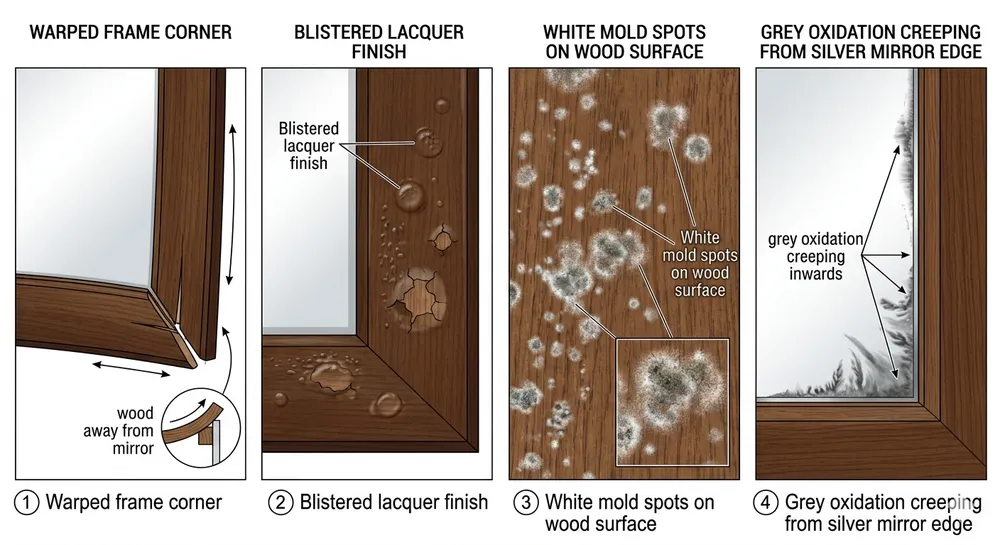
We've opened containers that looked fine on the outside and found warped frames, blistered lacquer, and silver edges gone grey with oxidation. The mirrors weren't broken. They were just unsellable. That's the expensive version of a moisture problem — no obvious transit damage to claim against, just product your buyer won't accept.
Wood frame mirrors are more moisture-sensitive than most buyers realize when they're placing the order. By the time the container arrives at the destination port, the damage is already done. The decisions that prevent it happen weeks earlier, on the production floor and at the packing station.
This guide covers what we actually do at our Wood Decor Mirrors production line — from moisture content testing before frame assembly through container desiccant loading — so you know what to specify and what to verify before your order ships.

What Moisture Actually Does to a Wood Frame Mirror
Warping gets the most attention, but it's not always the first failure. Here's what we see in practice, roughly in order of how quickly each shows up after a humid transit:
Silver edge oxidation — copper-free silver coatings are more stable than traditional copper-backed silver, but the edge seal between the mirror glass and the frame rabbet is still a moisture entry point. Once humidity gets under the backing, you get grey or black oxidation creeping inward from the perimeter. On a 24-inch mirror, even 3–4mm of edge oxidation is visible and unacceptable at retail.
Finish blistering — lacquer and paint finishes on wood frames trap moisture vapor if the substrate wasn't properly sealed before coating. The blister forms between the primer and the topcoat, or between the wood and the primer. It doesn't always appear during production inspection — it can develop in transit when the frame cycles through temperature and humidity changes inside a container.
Frame warping — solid wood frames with moisture content above 14% at packing are a reliable source of warping claims. The wood continues to equilibrate during transit, and if the grain orientation or the joint construction doesn't accommodate movement, the frame pulls out of square. A 2mm warp across a 600mm frame is enough to create a visible gap at the corner mitre.
Surface mold — this one shows up on frames that were packed while the finish wasn't fully cured, or when condensation forms inside the poly bag during a cold-to-warm temperature transition at the destination port. Mold on a lacquered frame is usually superficial, but it's a quality rejection regardless.
Each of these has a different prevention point. Oxidation is controlled at the silvering stage and the edge sealing step. Blistering is controlled at the priming and finishing stage. Warping is controlled at the kiln drying and MC testing stage. Mold is controlled at the curing and packaging stage. None of them are fixed by better outer carton packaging alone.
Moisture Content Thresholds Before Frame Assembly
The single most controllable variable in wood frame moisture protection is the moisture content (MC) of the wood at the time of frame assembly and finishing. We target 8–12% MC for solid wood frame components before they go to the assembly line.
That range isn't arbitrary. Wood at 8–12% MC is in equilibrium with typical indoor environments in North America and Europe (45–55% relative humidity). Frames assembled within this range have minimal residual movement drive — they're not going to continue drying or absorbing moisture significantly once they reach the destination.
Above 14% MC, the risk of warping and joint separation during transit increases substantially. We've seen it. Below 7% MC, the wood is over-dried and becomes brittle at the mitre joints — corner cracking under handling stress becomes more likely.
How we verify it: Every batch of solid wood frame stock gets tested with a pin-type moisture meter before release to the assembly line. We test at least 10% of pieces per batch, sampling from different positions in the stack (surface readings are unreliable — you need to test at mid-depth). Batches that read above 13% go back to the drying room. We don't assemble on a schedule; we assemble when the wood is ready.
(Note: MDF and engineered wood frames behave differently — MDF is dimensionally more stable but absorbs surface moisture faster if the edge sealing is incomplete. We cover that in the frame material selection section below.)

Factory-Side Finishing as the First Moisture Barrier
Packaging is the last line of defense. The first line is the finish on the frame itself.
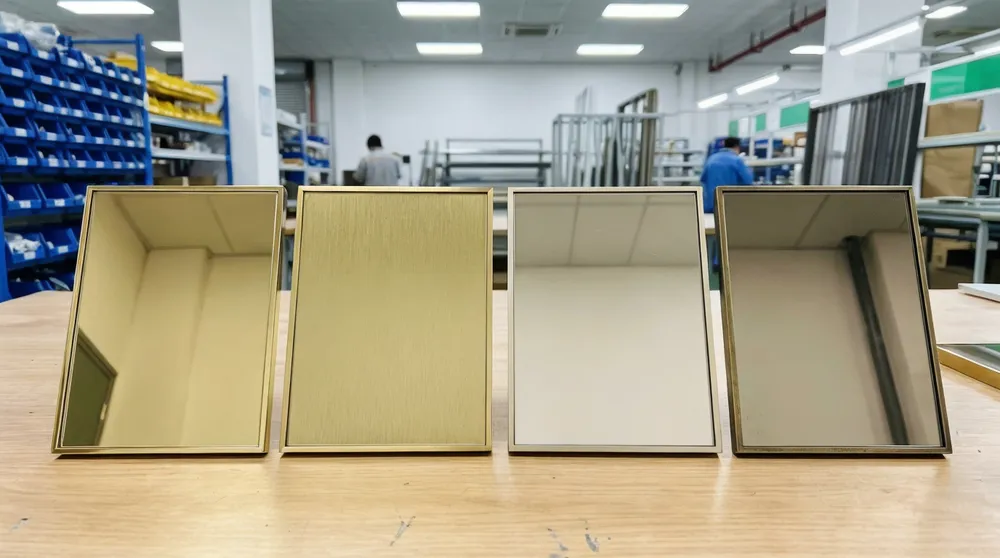
At our facility, solid wood frames go through a multi-coat finishing sequence: sanding to 180-grit, a penetrating wood sealer coat, a primer coat, and then the decorative topcoat (lacquer, paint, or stain-wax depending on the profile). The sealer coat is the moisture barrier — it closes the wood grain before the primer goes on. Skipping it or applying it too thin is where blistering failures start.
We apply the sealer at a wet film thickness that gives us a dry film of at least 25–30μm before priming. On frames with open-grain species (oak, ash), we sometimes do two sealer passes. The extra material cost is minor; the rework cost on a blistered finish is not.
For the topcoat, we run lacquer at 40–60μm dry film thickness. Thinner than 40μm and the moisture vapor permeability goes up. Thicker than 70μm and you start getting adhesion issues at the mitre joints where the film bridges the gap. (We found that range through trial and error on a batch of oak frames going to a Florida distributor — the humidity cycling in that market is unforgiving.)
Edge sealing on the mirror glass is a separate step that often gets missed in supplier audits. The rabbet channel where the mirror glass sits inside the frame is a moisture entry point. We apply a bead of neutral-cure silicone along the back edge of the glass-to-frame interface before the backing board goes on. This seals the silver edge from humidity ingress. It adds about 90 seconds per unit on the assembly line. Buyers who've had oxidation claims on previous orders understand immediately why this step matters.
Our copper-free silvering process also contributes here. Traditional copper-backed silver uses a copper interlayer that can corrode and accelerate edge oxidation when moisture is present. Copper-free silver eliminates that corrosion pathway — the silver layer bonds directly to the glass with a protective topcoat. It's more stable in humid transit conditions and in coastal retail environments where your buyers are selling.
ISPM-15 Compliance for Solid Wood Frame Components
If your order includes solid wood frame components — not MDF, not engineered wood, but actual solid timber — ISPM-15 applies to the wood packaging materials and, depending on the importing country's regulations, may apply to the solid wood product components themselves.
ISPM-15 (International Standards for Phytosanitary Measures No. 15) requires that solid wood be heat-treated to a core temperature of 56°C for a minimum of 30 continuous minutes to eliminate wood-boring pests. The treatment must be performed by an approved facility and the wood must be marked with the IPPC stamp.
For mirror frames, the practical implication is this: if your frame uses solid wood moulding (not MDF or finger-jointed composite), confirm with your supplier that the wood stock was sourced from ISPM-15 compliant treated material, or that the finished frames will be treated before export. Most importing countries in North America, Europe, and Australia enforce this. A container held at customs for phytosanitary inspection is a 2–4 week delay and a demurrage bill.
We source our solid wood frame stock from suppliers with documented heat treatment certification. For orders where the buyer's destination country requires product-level ISPM-15 documentation (not just packaging), we can provide the treatment certificates with the shipping documents.
MDF and HDF frame components are exempt from ISPM-15 — the manufacturing process (high heat and pressure bonding) already eliminates pest risk. This is one practical reason some buyers specify MDF frames for markets with strict phytosanitary enforcement: simpler compliance, no treatment certificates to manage.
Export Packaging Protocol: Shrink Wrap, Desiccant, and Container Loading
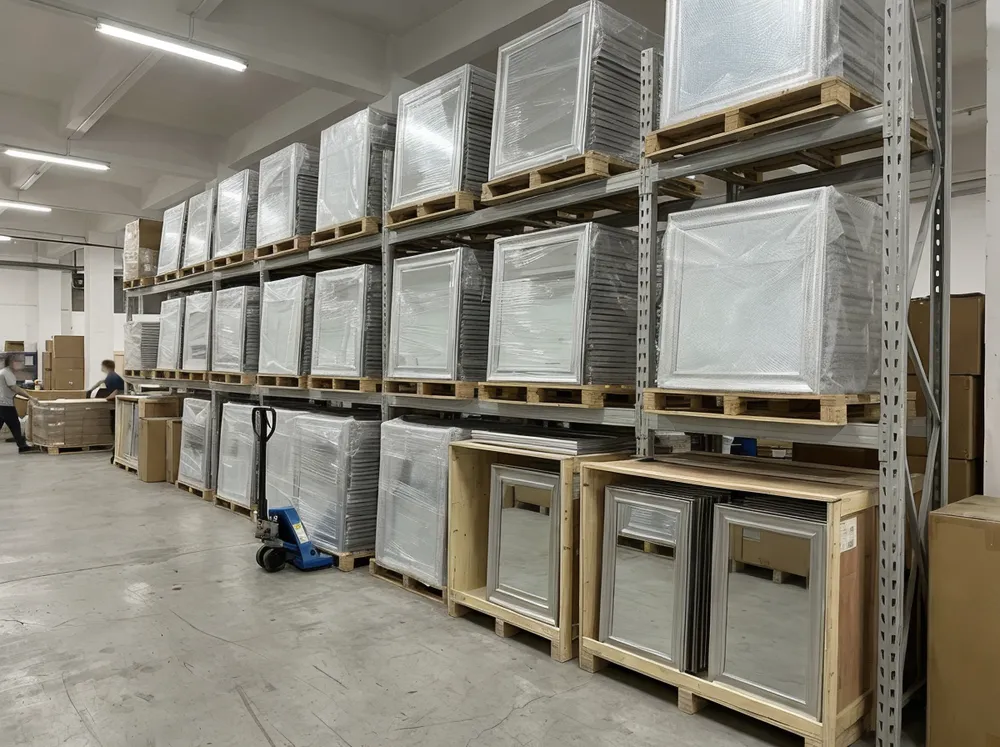
Getting the frame finish right is necessary but not sufficient. A well-finished frame packed into a humid container without desiccant will still arrive with problems. Here's the packaging sequence we use for wood frame mirror export orders:
Unit-level protection:
- Individual poly bag (minimum 0.05mm PE film) heat-sealed around each mirror unit
- Corner foam protectors on all four frame corners
- For high-value or large-format frames: additional stretch wrap over the poly bag before boxing
Carton-level:
- Double-wall corrugated carton (minimum 5-ply for frames over 600mm)
- Foam sheet lining on all six interior faces
- Silica gel desiccant inside each carton — we use 1 unit (30g) per 0.03 m³ of carton volume as a baseline, adjusted upward for orders shipping to high-humidity destinations (Southeast Asia, Middle East, Gulf ports)
Container-level:
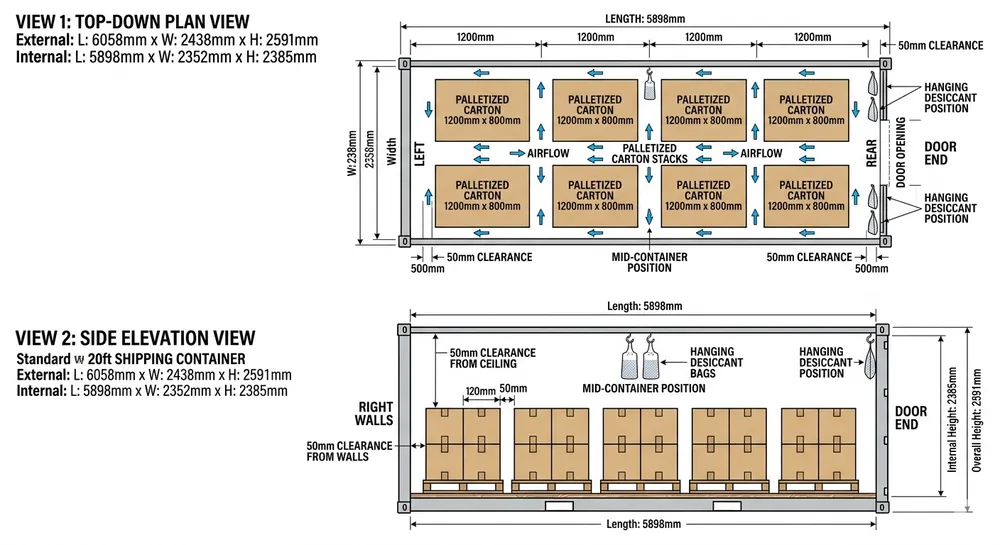
- Container desiccant hanging bags (calcium chloride type, not silica gel — calcium chloride has higher absorption capacity for long ocean transits)
- We load 6–8 hanging bags per 20-foot container, positioned at the container door end and mid-container
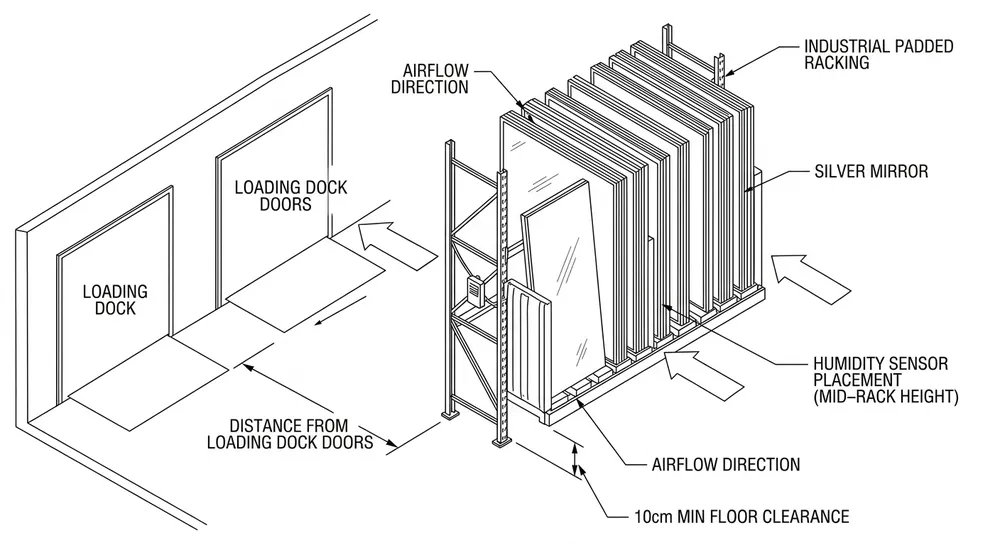
- Cartons are stacked on pallets with at least 50mm clearance from the container walls to allow air circulation
- Containers are inspected for pre-existing moisture damage (rust streaks, wet floor) before loading — we reject containers with visible moisture history
(One thing we've learned from shipping to the Middle East: containers transiting through the Suez corridor in summer go through significant temperature swings — cold nights at sea, hot days at port. That thermal cycling drives condensation inside the container even when the cargo was packed dry. The calcium chloride bags handle this better than silica gel for transits over 20 days.)
What to Specify in Your Purchase Order to Prevent Moisture Claims
Most moisture damage claims we've seen from buyers sourcing elsewhere come down to the same gap: the PO specified the product but not the process controls. By the time the container arrives, there's no way to know whether the wood was tested, whether the sealer coat was applied, or whether desiccant was loaded.
Here's what to include in your PO or supplier quality agreement for wood frame mirror orders:
| Specification Point | What to Require |
|---|---|
| Wood MC at assembly | ≤12% MC, verified by pin meter, batch records available |
| Sealer coat | Penetrating wood sealer, minimum 25μm DFT before primer |
| Topcoat DFT | 40–60μm lacquer or equivalent |
| Edge sealing | Neutral-cure silicone bead at glass-to-frame rabbet |
| ISPM-15 | Treatment certificate for solid wood components (if applicable) |
| Unit packaging | Heat-sealed PE poly bag + corner foam protectors |
| Carton desiccant | Silica gel, minimum 30g per 0.03 m³ carton volume |
| Container desiccant | Calcium chloride hanging bags, 6–8 per 20ft container |
| Pre-shipment inspection | MC spot-check on packed units, desiccant loading verification |
Asking for batch MC records and desiccant loading photos as part of your pre-shipment documentation is not unusual — any factory that's been doing export work seriously will have this. If a supplier can't provide it, that's useful information before the container ships.
For buyers working with us, these controls are part of our standard export QC process for Wood Decor Mirrors. We include MC test records and packaging photos in the pre-shipment inspection report as standard practice.
When MDF or Resin Frames Are the Better Call
Solid wood frames have real commercial appeal — the grain texture, the weight, the premium positioning. But for certain destination markets and order profiles, MDF or resin frames are the lower-risk choice from a moisture standpoint, and worth considering when you're building your SKU mix.
MDF frames are dimensionally stable — they don't warp the way solid wood does because there's no grain direction. The moisture risk with MDF is surface absorption if the edge sealing is incomplete, but that's a finishing quality issue, not a material instability issue. For buyers selling into markets with high ambient humidity (Southeast Asia, coastal Middle East), MDF frames with fully sealed edges and a quality topcoat often arrive in better condition than solid wood frames at the same price point. They're also ISPM-15 exempt, which simplifies documentation.
Resin frames are the most moisture-inert option. Cast resin doesn't absorb water, doesn't warp, and doesn't have grain joints that can open under humidity cycling. The trade-off is weight (resin is heavier than MDF per unit volume) and the fact that resin frames don't take stain finishes — you're limited to paint and metallic finishes. For ornate profile designs going to humid markets, resin is often the right answer.
The decision usually comes down to your target retail price point and the finish aesthetic your market expects. We can walk you through the cost and durability trade-offs across frame types — there's more detail in our wood vs metal vs resin frames comparison if you want to work through the options before specifying your order.
Pre-Shipment Moisture Checklist
Run through this before your wood frame mirror order loads:
- [ ] Wood MC records confirm ≤12% at assembly (batch documentation available)
- [ ] Sealer coat applied and DFT verified before primer
- [ ] Topcoat DFT within 40–60μm range
- [ ] Glass-to-frame edge sealed with neutral-cure silicone
- [ ] ISPM-15 treatment certificates obtained (solid wood components)
- [ ] Units individually poly-bagged and heat-sealed
- [ ] Corner foam protectors on all units
- [ ] Silica gel desiccant loaded in each carton
- [ ] Container inspected for moisture history before loading
- [ ] Calcium chloride hanging bags loaded in container
- [ ] 50mm wall clearance maintained in container stacking
- [ ] Pre-shipment photos of desiccant loading provided
This checklist is also useful as a supplier audit tool — go through it with a new supplier before your first order ships, not after your first claim.
Frequently Asked Questions
What moisture content should wood mirror frames be at before packing?
Target 8–12% MC for solid wood frame components. Above 14% MC, warping and joint separation risk increases significantly during ocean transit. We test at mid-depth with a pin meter — surface readings underestimate actual MC in freshly dried stock.
Does copper-free silvering actually reduce moisture damage risk?
Yes, in a specific way. Traditional copper-backed silver has a copper interlayer that corrodes when moisture reaches the edge, accelerating the grey/black oxidation you see creeping inward from the frame rabbet. Copper-free silver eliminates that corrosion pathway. It doesn't make the mirror waterproof, but it removes one of the faster failure mechanisms at the glass-frame interface.
Do I need ISPM-15 certification for wood mirror frames?
It depends on the frame construction. Solid wood moulding frames require ISPM-15 heat treatment documentation for most North American, European, and Australian import destinations. MDF, HDF, and resin frames are exempt. If you're unsure about your destination country's requirements, ask your supplier for the frame material specification and check with your freight forwarder before the order ships.
What's the difference between silica gel and calcium chloride desiccant for container shipping?
Silica gel works well at unit and carton level — it absorbs moisture vapor at moderate humidity levels and is safe around finished goods. Calcium chloride has much higher absorption capacity and continues working at high relative humidity levels, making it better suited for container-level protection on long ocean transits (20+ days). We use both: silica gel inside cartons, calcium chloride hanging bags in the container.
Can I specify moisture protection requirements in my purchase order?
Yes, and you should. The key points to specify: MC ≤12% at assembly with batch records, sealer coat DFT minimum, edge sealing at the glass-frame rabbet, desiccant loading quantities, and pre-shipment documentation including MC spot-check results and packaging photos. Suppliers who've been doing serious export work will have no problem meeting these requirements — and will have the records to prove it.
—
If you're sourcing wood frame mirrors for markets where moisture in transit is a real concern, send us your destination market, frame profile preferences, and order volume. Our engineering team will specify the right frame treatment, coating system, and packaging configuration — and provide the pre-shipment documentation your QA process requires. Request a quote with your project details, or browse our full range of Decor Mirrors by Material & Frame to compare frame options before you specify. “`