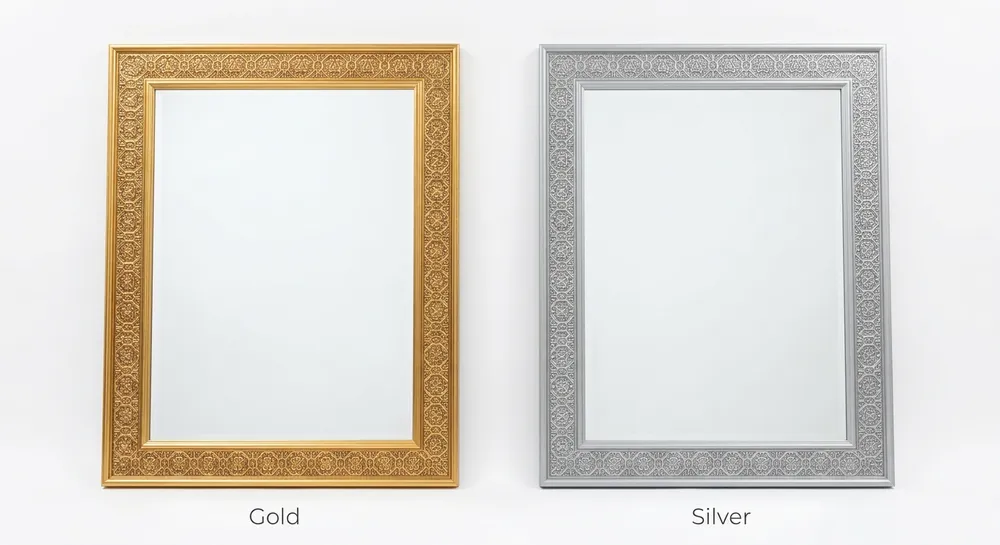
Here's the question we get from US distributors more than almost any other: Should I stock gold or silver? It sounds like an interior design question. It isn't. It's a margin and inventory risk question — and the answer depends on your channel, your price point, and how much trend exposure you're willing to carry.
The short verdict: gold moves faster in retail and hospitality right now, but silver carries lower sourcing risk and broader channel fit. Neither finish is universally better. The right answer is almost always a split assortment — and the ratio depends on where you're selling.
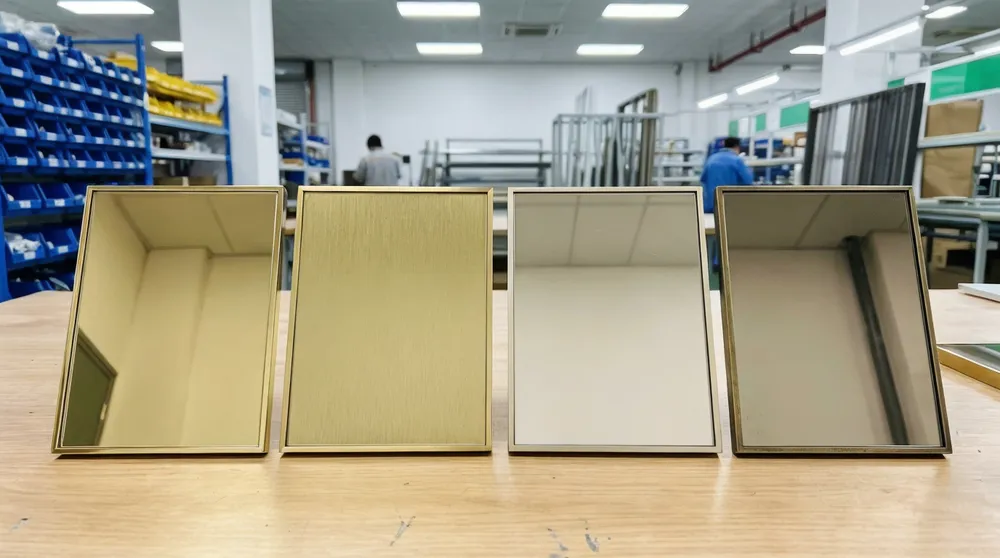
We've been finishing mirror frames in both gold and silver at our Ho Chi Minh facility since 2008. We run electroplating, powder coat, and multi-coat paint systems in-house, so the cost and durability differences between these two finishes aren't theoretical for us. This comparison is built on what we actually see coming off our lines and what our US buyers report back on sell-through.

How These Finishes Are Actually Made — and Why It Matters for Your Order
Gold and silver aren't just color choices. They're different production processes with different cost structures, different durability profiles, and different failure modes in transit.
Gold finishes on metal frames are typically electroplated — a zinc or iron base frame goes through a copper strike, then a brass or gold-tone plating bath. The result is a warm, slightly reflective surface with good depth. On MDF or resin frames, gold is applied as a multi-coat paint system: primer, base coat, metallic topcoat, and a UV-protective lacquer. We run both processes here. The electroplated route costs more per unit — the plating bath chemistry, the pre-treatment steps, and the longer line time add up. On a standard 24×36" metal frame, electroplating adds roughly 15–20% to frame production cost versus a powder-coated silver equivalent.
Silver finishes are more forgiving to produce. On metal frames, silver powder coat is our standard — automated line, 60–80μm consistent thickness, 500-hour salt spray rating. On MDF and resin, silver is a simpler paint system than gold because the metallic base coat requires less color-matching precision. (Gold tone is notoriously variable — warm gold, champagne gold, antique gold, brushed gold all read differently under different lighting, and buyers have strong opinions. Silver is more consistent across batches.) The result: silver frames typically cost less to produce, have more predictable batch-to-batch color consistency, and are easier to spec for repeat orders.
The practical implication for your sourcing: if you're building a high-volume, repeatable SKU program, silver is lower-risk. If you're chasing a trend-driven retail moment or a hospitality project spec, gold is worth the premium.
US Market Sell-Through: Which Finish Actually Moves
We ship to distributors and retailers across North America, and the feedback we get on sell-through is consistent enough to be useful.
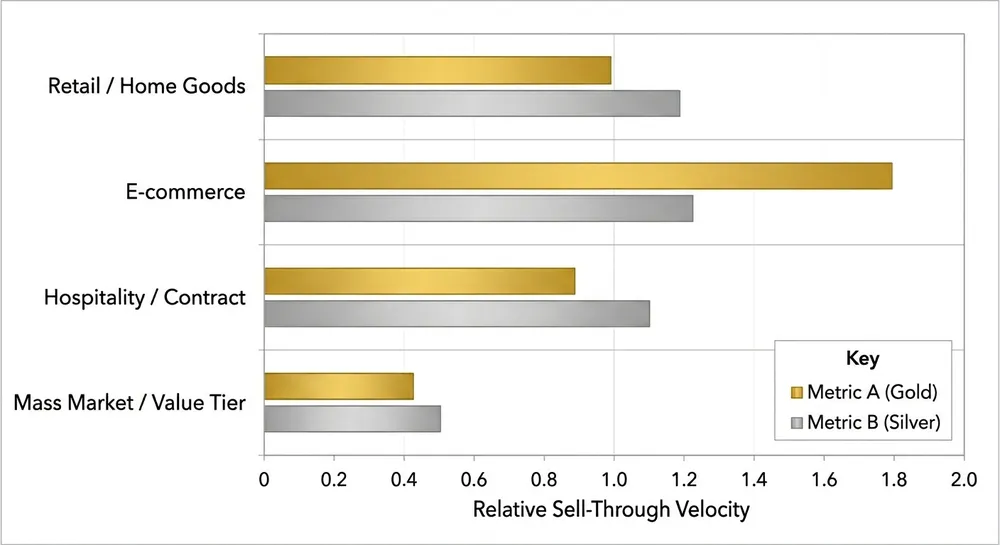
Gold has been the faster mover in retail and e-commerce since roughly 2021. The warm-tone interior trend — warm wood, terracotta, brass hardware — pulled gold mirrors into mainstream retail assortments. Wayfair, Amazon, and mid-tier home goods retailers have all expanded their gold mirror SKU counts. Our US retail buyers report gold frames turning faster than silver in the $49–$149 price band, particularly in oval, arch, and ornate rectangular profiles.
Silver holds its ground in three specific channels: contract/hospitality, coastal and contemporary residential, and the value-tier mass market. Hotel and multifamily project specifiers often default to silver or brushed nickel because it reads as neutral and coordinates with chrome fixtures. Contemporary coastal design — still a strong segment in California, Florida, and the Pacific Northwest — skews silver and white. And at the $29–$59 price point in mass-market retail, silver remains the dominant finish because it photographs cleanly and doesn't carry the "trendy" risk that gold does for buyers managing 18-month inventory cycles.
The honest picture: gold is hotter right now, but it's also more trend-dependent. Silver is slower but stickier — it doesn't spike, but it doesn't crater either. For a distributor building a catalog that needs to perform across two or three selling seasons, that stability has real value.
Head-to-Head: Finish Specs That Affect Your Landed Cost and Warranty Risk
This is the comparison most sourcing guides skip. The finish choice doesn't just affect aesthetics — it affects your freight cost, your return rate, and your reorder reliability.
| Dimension | Gold (Electroplated / Multi-coat) | Silver (Powder Coat / Paint) |
|---|---|---|
| Production cost premium | +15–20% vs silver equivalent | Baseline |
| Color consistency batch-to-batch | Moderate — gold tone varies by process | High — silver powder coat is stable |
| Scratch resistance | Moderate — electroplate can show micro-scratches | Good — powder coat is harder surface |
| Tarnish / oxidation risk | Low with UV lacquer topcoat | Very low — powder coat is sealed |
| Transit damage visibility | Higher — gold shows handling marks more readily | Lower — silver hides minor scuffs |
| Packaging requirement | Corner protection + foam wrap recommended | Standard corner protection sufficient |
| Reorder color match | Requires finish spec lock (Pantone or RAL reference) | Easier — standard silver powder is consistent |
| Trend sensitivity | High — warm-tone trend dependent | Low — neutral, multi-cycle stable |
| Hospitality spec acceptance | Growing, especially boutique hotel | Strong, especially contract/multifamily |
The packaging point is worth expanding. Gold frames — especially electroplated metal — show fingerprints and handling marks more than silver. We've had buyers come back after their first container asking why their gold mirrors had more transit claims than expected. The answer is almost always packaging: gold needs individual foam sleeve wrapping plus corner protectors, not just the standard carton. We build that into our export packing spec automatically now, but if you're sourcing gold frames elsewhere, ask specifically about their packing method. (We've seen competitors ship gold frames in the same carton spec as silver — the claim rate difference is significant.)
The Hidden Cost: Finish Durability in the Field
Your downstream customers — the end retailers or hospitality operators — will judge your product on how it looks six months after installation, not six minutes after unboxing. That's where finish durability becomes your warranty exposure.
Electroplated gold on metal frames is durable when the pre-treatment is done correctly. The failure mode we see most often — both on our own QC line and in field returns — is adhesion failure at weld seams and frame joints. If the frame isn't properly cleaned and pre-treated before plating, the plating lifts at stress points within 6–12 months. We grind and chemically treat every weld joint before the frame enters the plating line. Not every factory does this. When you're evaluating a gold mirror supplier, ask for their pre-treatment process spec — specifically whether they treat weld joints separately before plating.
Multi-coat gold paint on MDF frames has a different failure mode: topcoat yellowing under UV exposure. A gold frame in a south-facing retail display or a sunlit hotel corridor can shift noticeably in tone within a year if the UV lacquer isn't adequate. We use a two-layer UV topcoat on all our gold MDF frames — it adds cost, but it's the difference between a frame that holds its color for three years and one that generates warranty calls at month 14.
Silver powder coat on metal is the most durable finish we run. The automated line gives us consistent 60–80μm thickness, and the cured surface is harder than electroplate. Salt spray performance exceeds 500 hours, which covers coastal retail environments without issue. For silver MDF frames, the paint system is simpler and the failure modes are fewer — the main risk is edge chipping if the MDF substrate isn't properly sealed before painting, which is a substrate prep issue, not a finish issue.
The commercial implication: gold requires more QC diligence from your supplier, and more packaging investment from both sides. Silver is more forgiving. If you're sourcing from a factory you haven't audited, silver is the lower-risk starting point.
Assortment Strategy: When to Stock Both, When to Commit to One
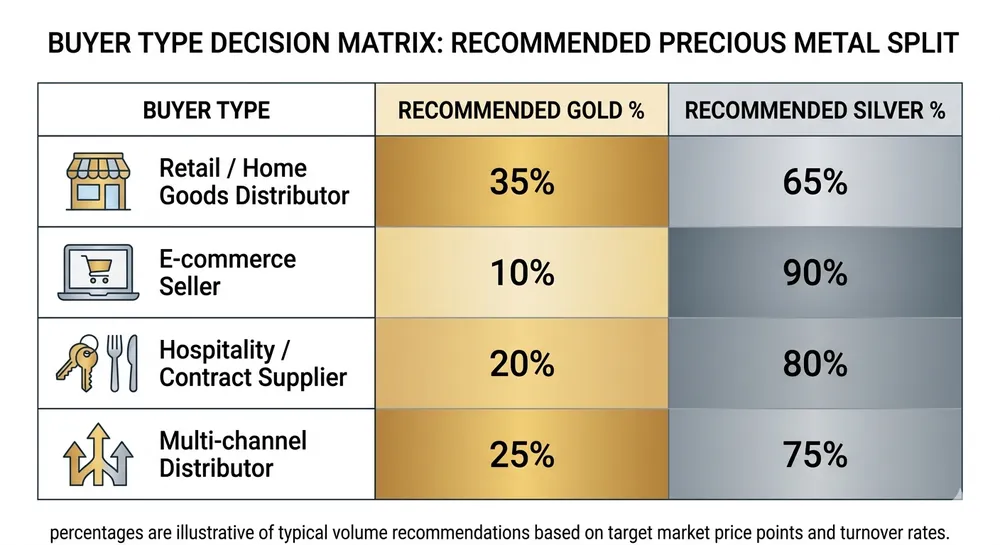
Most of our US distributor accounts run a split assortment. The ratio varies, but a common starting point is 60% gold / 40% silver for retail-focused buyers, and 40% gold / 60% silver for buyers with significant hospitality or contract exposure.
The case for committing to gold only: you're selling into a specific retail channel where warm-tone is dominant, your buyers are reordering the same SKUs, and you have enough volume to absorb the higher unit cost. Some of our West Coast retail accounts have gone gold-heavy and it's worked — but they're in markets where the trend has been consistent for several years.
The case for committing to silver only: you're primarily a contract/hospitality supplier, your buyers spec by finish code and need color consistency across large project quantities, and trend risk is a real concern for your inventory planning. Silver is the safer single-finish bet for contract-heavy distributors.
The case for a split assortment — which is what we recommend for most buyers entering or expanding in this category: you don't have to guess the trend. With MOQs starting at 100 pieces per SKU, you can run a trial order of both finishes on the same frame profile, test sell-through with your accounts, and reorder the winner at volume. We've had buyers start with 100 units each of gold and silver on the same 24×36" arch mirror, sell through the gold in six weeks and the silver in twelve, and use that data to set their container ratio. That's a much better decision than committing to 500 units of one finish based on a trend article.
Scenario Verdicts: Which Finish Wins for Your Specific Situation
Scenario 1: You're stocking a 200-unit opening order for a regional home goods chain. Gold wins. Retail buyers in this segment are actively looking for warm-tone mirrors in the $79–$129 retail price range. Gold arch and oval profiles are moving. The higher unit cost is absorbed by the retail markup, and the trend is established enough that you're not early-adopting risk. Specify electroplated gold on metal for the best margin-to-durability ratio, and confirm the supplier's packing spec includes individual foam wrapping.
Scenario 2: You're supplying a 150-room hotel renovation project. Silver wins. Hospitality specifiers default to neutral finishes that coordinate with chrome and brushed nickel fixtures. Silver powder coat on metal frames gives you the color consistency you need across a large project quantity, the durability to survive housekeeping cycles, and the finish stability for a property that won't renovate again for seven years. Gold is gaining ground in boutique hotel projects, but for a standard renovation spec, silver is the lower-risk choice.
Scenario 3: You're a new distributor building your first decorative mirror catalog. Split assortment wins. Start with 100 units each of gold and silver on two or three frame profiles — an arch, a rectangular, and an ornate style. Run them through your accounts for one quarter. The sell-through data you collect is worth more than any trend forecast. Gold Decor Mirrors and Silver Decor Mirrors are both available at 100-piece MOQ per SKU — you're not committing to a container to get the answer.
Scenario 4: You're an e-commerce seller managing a lean SKU count. Gold wins on velocity, silver wins on stability. If you can only stock one finish, gold will likely turn faster in the current market. If you need a finish that performs consistently across seasons without markdown risk, silver is safer. Most successful e-commerce mirror sellers in our network run both — gold as the primary SKU, silver as the secondary.
What to Verify When You Source Either Finish
The finish name on a spec sheet doesn't tell you much. Here's what actually matters when you're evaluating a supplier for gold or silver mirror frames:
For gold electroplated frames:
- Ask for the pre-treatment process spec — specifically whether weld joints are treated before plating
- Request a salt spray test result (minimum 200 hours for indoor decorative use)
- Ask for a UV lacquer spec on MDF frames — confirm it's a two-layer system
- Request a color reference (Pantone or RAL) and confirm batch-to-batch tolerance
- Ask about their packing spec for gold frames specifically — individual foam sleeve is the standard
For silver powder-coated frames:
- Request the powder coat thickness spec — 60–80μm is the standard for decorative frames
- Ask for salt spray test results — 500 hours is achievable and should be the baseline
- Confirm MDF substrate sealing process if ordering MDF frames
- Ask about color consistency across production batches — silver powder is generally stable, but confirm the supplier uses a consistent powder supplier
For both finishes:
- Request a pre-production sample before committing to a full order
- Confirm the supplier's QC process includes 100% visual inspection — finish defects that pass QC are your problem, not theirs
- Ask about their packaging spec for export — corner protection, foam wrapping, and carton compression strength all affect your claim rate
We hold ISO 9001:2015 certification and run 100% visual inspection on every unit before it loads. SGS and BSCI audit reports are available on request. For buyers who want to verify finish specs before ordering, we can provide pre-production samples with finish reference cards showing the exact color and surface treatment used on your order.
Frequently Asked Questions
What is the MOQ for gold and silver mirror frames at Livewellcraft? 100 pieces per SKU for standard frame profiles in both gold and silver finishes. This applies to both electroplated metal frames and multi-coat MDF frames. Custom frame profiles or non-standard sizes may require higher minimums — contact us with your specs for confirmation.
Does gold electroplating tarnish over time on decorative mirrors? With a proper UV lacquer topcoat, no — not under normal indoor conditions. The tarnish risk on gold-plated frames comes from inadequate sealing, not from the plating itself. Frames without a UV topcoat, or with a single thin lacquer layer, can show oxidation in humid environments within 12–18 months. Our gold frames use a two-layer UV topcoat specifically to prevent this. If you're sourcing from another supplier, ask for their topcoat spec and a humidity chamber test result.
Which finish is easier to reorder consistently — gold or silver? Silver is more consistent batch-to-batch. Silver powder coat uses a standardized powder chemistry that produces predictable color across production runs. Gold tone — especially warm gold and champagne gold — varies more between batches and between suppliers. For repeat-order programs where color consistency matters, lock in a Pantone or RAL reference on your first gold order and confirm the supplier can hold that spec on reorders.
How does finish choice affect container loading and freight cost? Gold frames require more protective packaging — individual foam sleeves plus corner protectors — which reduces carton density slightly compared to silver frames with standard corner-only protection. The difference is typically 5–8% fewer units per container for gold versus silver on the same frame profile. Factor this into your landed cost calculation when comparing the two finishes at volume.
Can I order both gold and silver finishes on the same frame profile? Yes. We run both finishes on most of our standard frame profiles. Ordering both finishes on the same profile is a common approach for buyers testing market response — same frame, same size, two finishes, 100 pieces each. It simplifies your product photography and makes sell-through comparison clean. Browse the full range at Decor Mirrors by Material & Frame or request a quote with your target profile and we'll confirm availability in both finishes.