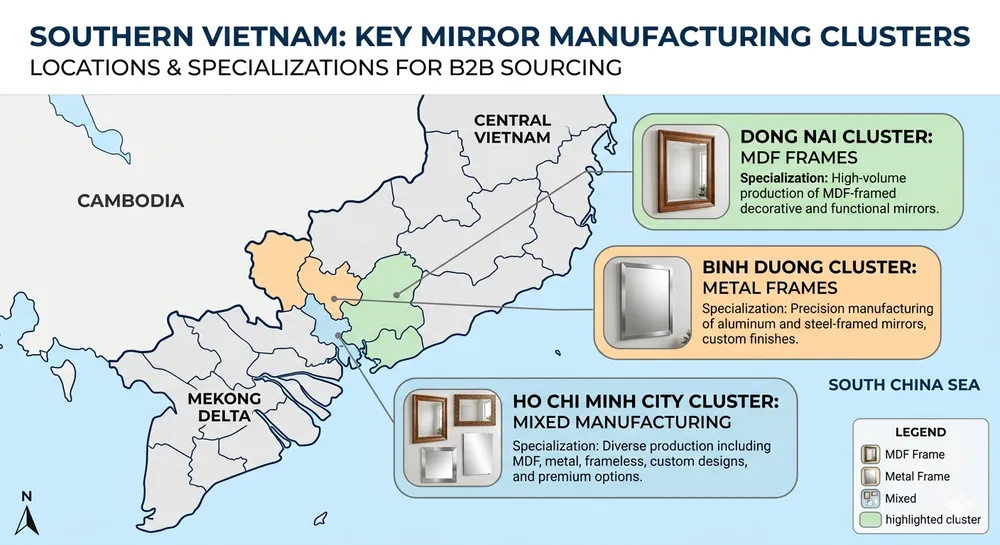
Vietnam's decorative mirror export sector has matured considerably since the mid-2010s. What used to be a handful of small workshops supplying regional traders has grown into a concentrated cluster of factories — mostly in Dong Nai, Binh Duong, and Ho Chi Minh City — capable of handling retail-ready OEM orders for North American and European buyers. Labor costs remain 30–40% below comparable Chinese facilities, raw material access (MDF, aluminum extrusion, resin casting) is well-established, and the port infrastructure at Cat Lai and Cai Mep handles container exports to the US West Coast in 18–22 days.
The challenge for import buyers isn't finding a Vietnam mirror supplier — directories list dozens. The challenge is separating factories with genuine vertical integration and export-grade QC from trading companies and assembly operations that outsource the hard parts. Frame finishing failures, silver coating delamination, and inconsistent joint tolerances are the three defect categories we see most often on re-import claims, and they almost always trace back to a supplier who outsourced either the silvering or the frame molding step.
This list covers 10 real manufacturers operating in Vietnam's framed decorative mirror space. Where we have direct production knowledge, we've included it. Where we don't, we've kept descriptions conservative and sourcing-relevant rather than inflating capability claims.
What Separates a Real Mirror Factory from a Trading Operation
Before the list, a quick framework — because the supplier type determines your risk profile more than any single spec.
Vertical integration is the clearest signal. A factory that cuts its own glass, runs its own silvering line, molds or extrudes its own frames, and assembles in-house controls every defect point. A trading company or light-assembly operation buys silvered glass from one supplier, frames from another, and puts them together — which means finish color matching, dimensional tolerances, and coating adhesion are all outside their direct control.
Ask any candidate supplier these four questions before you shortlist them:
- Do you cut and silver your own glass on-site, or do you buy pre-silvered glass?
- Do you produce your own frames (mold, extrude, or machine), or do you source finished frames?
- What is your silvering process — conventional copper-backed or copper-free?
- Can you provide SGS or third-party audit reports, not just self-declared certifications?
The answers sort the field quickly. Most trading companies will hedge on questions one and two. On question three: copper-free silvering matters if you're selling into the EU or targeting buyers with RoHS-adjacent environmental requirements — it's a process spec most suppliers don't publish, but it's worth asking for directly.
For a deeper look at how frame material choice affects your landed cost and downstream margin, see our guide on choosing frame materials.
How We Evaluated These Manufacturers
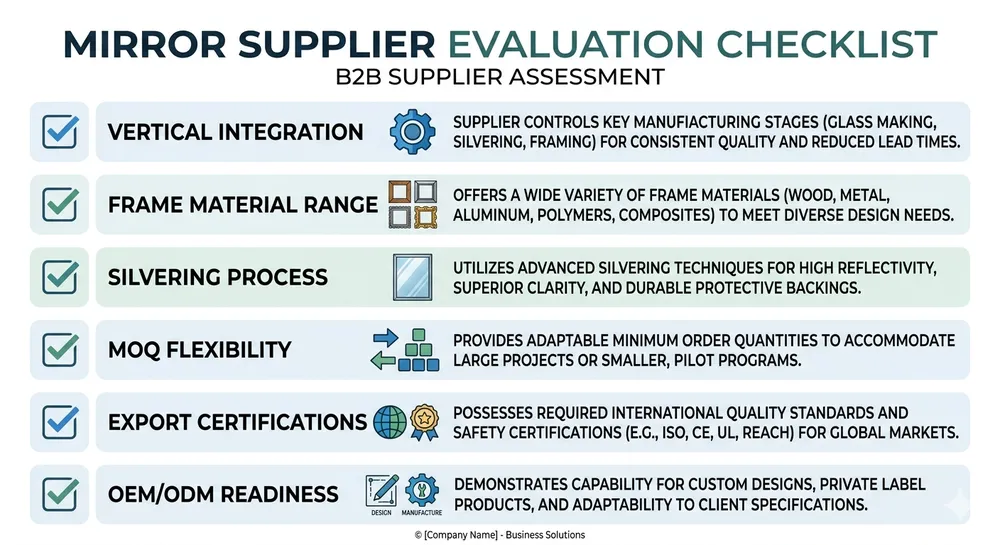
The 10 companies below were selected based on verifiable presence — official company websites, export records, and where applicable, direct production knowledge. We evaluated each on:
- Vertical integration depth — glass processing, silvering, frame production, and assembly under one roof vs. outsourced stages
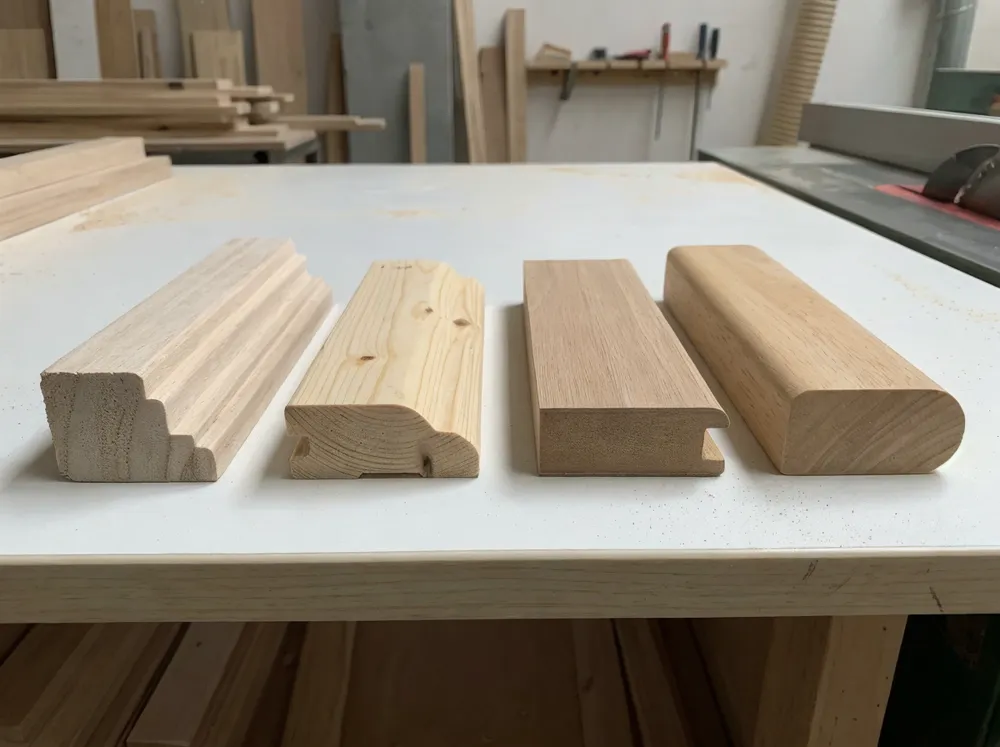
- Frame material range — wood, MDF, metal (aluminum/iron), resin, or multi-material capability
- Silvering process — copper-free vs. conventional, and whether EU-compliant coating specs are published
- MOQ flexibility — standard model minimums and OEM/custom thresholds
- Export certifications — ISO 9001, BSCI, CE, SGS, and retail compliance (EDI, Walmart/Wayfair standards)
- OEM/ODM readiness — in-house engineering, custom profile capability, and packaging support
No paid placement. Livewellcraft is included in this list and identified as such — we're one of the manufacturers, not a neutral ranking agency.
The 10 Manufacturers
1. Livewellcraft (CÔNG TY TNHH LIVEWELL CRAFT VN)
Location: Dong Nai, Vietnam Website: livewellcraft.com Frame materials: Wood, MDF, metal, resin Certifications: ISO 9001:2015, SGS, CE, BSCI
We run a 12,000 m² facility in Dong Nai with 6 production lines and 150 staff — glass cutting, silvering, frame molding, and final assembly all under one roof. Annual output is around 400,000 pieces. Our default silvering process is copper-free, which meets EU environmental standards and is documented in our SGS audit reports.
The frame side is where we've invested most heavily. Our 12-person engineering team has developed 200+ custom frame profiles across MDF, solid wood, aluminum, and resin — so if you're sourcing a custom profile rather than a catalog item, we can develop it without sending you to a third-party mold shop. MOQ on standard models starts at 100 pieces, which is lower than most factories in this segment will quote. (We set that threshold deliberately — a 100-piece trial order is enough to test sell-through with your retail accounts before committing to a full container.)
We supply distributors, retailers, and hospitality project buyers in North America, Europe, Australia, Southeast Asia, and the Middle East. Walmart, Wayfair, and Amazon supplier compliance — including EDI — is part of our standard export process.
For buyers comparing frame material options across our product range, the Decor Mirrors by Material & Frame category covers our full lineup.
—
2. Gương Việt (Vietnam Mirror JSC)
Location: Ho Chi Minh City, Vietnam Website: guongviet.com.vn Frame materials: MDF, aluminum Certifications: ISO 9001
Gương Việt is one of the longer-established mirror manufacturers in southern Vietnam, operating since the early 2000s. Their core volume is in MDF-framed bathroom and decorative mirrors for the domestic market and regional Southeast Asian export. They run their own silvering line and do in-house MDF frame production, which gives them reasonable process control on their standard catalog. OEM capability exists but is limited to profile modifications within their existing tooling — fully custom profiles require external mold sourcing.
—
3. Minh Long Mirror (Công ty Gương Minh Long)
Location: Binh Duong, Vietnam Website: guongminhlong.com Frame materials: Wood, MDF Certifications: ISO 9001
Minh Long focuses on wood and MDF framed mirrors for the mid-market domestic and ASEAN export segments. Their wood frame production is handled in-house with a dedicated carpentry line, which is less common among Vietnam mirror factories — most source pre-cut wood components externally. Lead times on standard wood-framed models run 35–45 days. Export volume to North America and Europe is limited compared to their domestic and regional business.
—
4. Saigon Mirror & Glass (Công ty Kính Gương Sài Gòn)
Location: Ho Chi Minh City, Vietnam Website: kinh-guong.com Frame materials: Aluminum, metal Certifications: ISO 9001
Saigon Mirror & Glass specializes in aluminum and metal-framed mirrors, with a stronger presence in commercial and architectural applications than in decorative retail. Their glass processing capability is solid — they run float glass cutting and beveling in-house. Frame production is aluminum extrusion-based, which suits commercial specifications but limits decorative profile variety. For buyers sourcing metal-framed decorative mirrors at volume, they're a credible option; for ornate or multi-finish decorative frames, their catalog is narrow.
—
5. Viet Mirror Factory (Xưởng Gương Việt)
Location: Dong Nai, Vietnam Website: vietnammirror.vn Frame materials: MDF, resin Certifications: SGS
Viet Mirror Factory operates in the Dong Nai cluster with a focus on MDF and resin-framed decorative mirrors for export. Their resin frame capability is worth noting — resin casting allows more ornate profile shapes than MDF routing or aluminum extrusion, and it's a material that suits the mid-to-upper decorative segment well. Silvering is done in-house. MOQ on standard resin-framed models is reported at 200–300 pieces. OEM support is available for color and finish variations; fully custom profile development requires longer lead times.
—
6. An Phat Mirror (Công ty Gương An Phát)
Location: Binh Duong, Vietnam Website: guonganphat.com Frame materials: MDF, wood Certifications: ISO 9001, BSCI
An Phat operates a mid-size facility in Binh Duong with a production focus on MDF and wood-framed decorative mirrors. BSCI certification makes them a viable option for European buyers with social compliance requirements. Their export markets are primarily Europe and Australia. Glass silvering is in-house; frame production is a mix of in-house MDF routing and externally sourced wood components. Standard MOQ is around 300 pieces.
—
7. Hung Thinh Mirror (Công ty Gương Hưng Thịnh)
Location: Ho Chi Minh City, Vietnam Website: guonghungthinhvn.com Frame materials: Aluminum, MDF Certifications: ISO 9001
Hung Thinh has been operating in the HCMC mirror market for over 15 years, primarily serving domestic retail and light export. Their aluminum-framed mirror line is their strongest export product — consistent profiles, reasonable finish quality, and competitive pricing on standard sizes. MDF-framed decorative models are available but represent a smaller share of their output. OEM capability is limited to standard size and finish customization.
—
8. Phu Quy Mirror (Công ty Gương Phú Quý)
Location: Ho Chi Minh City, Vietnam Website: guongphuquy.com Frame materials: Wood, MDF, metal Certifications: ISO 9001
Phu Quy covers a broader frame material range than most HCMC-based factories, with wood, MDF, and metal-framed mirrors in their catalog. They supply both domestic retail and export channels. Their multi-material capability is useful for buyers who want to consolidate SKUs across frame types with a single supplier. Production scale is mid-size; lead times on mixed-material orders can extend to 50–60 days depending on frame component sourcing.
—
9. Thanh Trung Mirror (Công ty Gương Thanh Trung)
Location: Binh Duong, Vietnam Website: guongthanhtrung.com Frame materials: MDF, resin Certifications: ISO 9001, SGS
Thanh Trung is a Binh Duong-based factory with a focus on MDF and resin decorative mirrors for the mid-market export segment. SGS certification supports their export credibility. Their resin frame line handles ornate decorative profiles that are difficult to achieve in MDF alone — a useful capability for buyers targeting the home décor retail segment where profile complexity drives perceived value. Standard MOQ is 200–500 pieces depending on frame complexity.
—
10. Dong Nai Mirror & Decor (Công ty Gương Trang Trí Đồng Nai)
Location: Dong Nai, Vietnam Website: guongdongnai.com Frame materials: Wood, MDF, aluminum Certifications: ISO 9001
Dong Nai Mirror & Decor operates in the same provincial cluster as Livewellcraft, with a product focus on wood, MDF, and aluminum-framed decorative mirrors. Their wood frame production is in-house, which is a differentiator in the Dong Nai cluster. Export markets include Southeast Asia and limited North American volume. OEM support covers standard customization; full custom profile development is available on larger runs.
—

Side-by-Side Sourcing Matrix
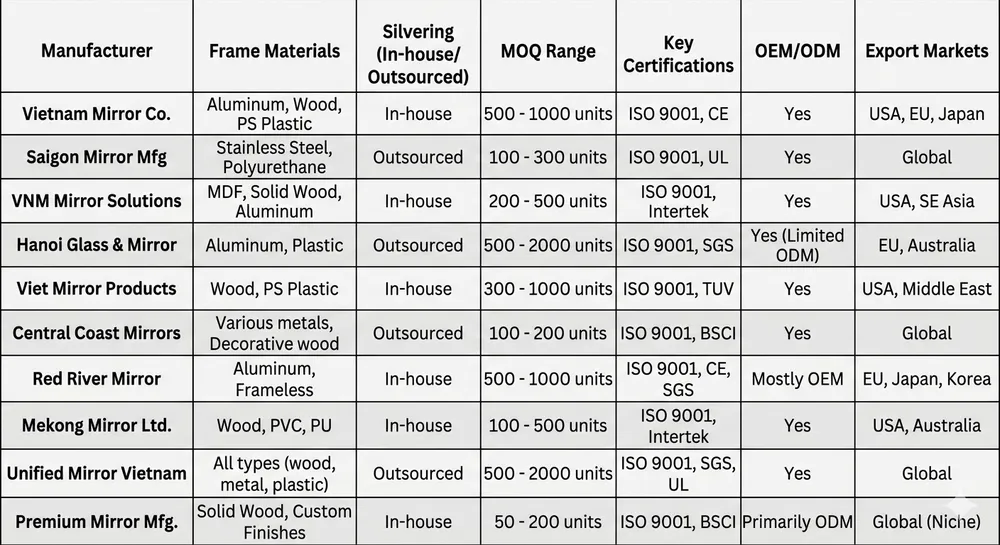
| Manufacturer | Frame Materials | In-House Silvering | MOQ (Standard) | Key Certifications | OEM/ODM | Primary Export Markets |
|---|---|---|---|---|---|---|
| Livewellcraft | Wood, MDF, Metal, Resin | Yes (copper-free) | 100 pcs | ISO 9001, SGS, CE, BSCI | Full custom | NA, EU, AU, SEA, ME |
| Gương Việt | MDF, Aluminum | Yes | ~200 pcs | ISO 9001 | Limited | SEA, domestic |
| Minh Long Mirror | Wood, MDF | Yes | ~300 pcs | ISO 9001 | Limited | SEA, domestic |
| Saigon Mirror & Glass | Aluminum, Metal | Yes | ~500 pcs | ISO 9001 | Standard sizes | Commercial/architectural |
| Viet Mirror Factory | MDF, Resin | Yes | 200–300 pcs | SGS | Finish/color | NA, EU |
| An Phat Mirror | MDF, Wood | Yes | ~300 pcs | ISO 9001, BSCI | Standard | EU, AU |
| Hung Thinh Mirror | Aluminum, MDF | Yes | ~300 pcs | ISO 9001 | Limited | Domestic, light export |
| Phu Quy Mirror | Wood, MDF, Metal | Partial | ~300 pcs | ISO 9001 | Standard sizes | Domestic, SEA |
| Thanh Trung Mirror | MDF, Resin | Yes | 200–500 pcs | ISO 9001, SGS | Finish/color | EU, SEA |
| Dong Nai Mirror & Decor | Wood, MDF, Aluminum | Yes | ~300 pcs | ISO 9001 | Standard | SEA, limited NA |
The Cost of Convenience: Local Distributor vs. Factory-Direct
If you're currently buying framed mirrors through a local importer or distributor, the convenience is real — shorter reorder cycles, no container minimums, someone local to call when there's a problem. For urgent small fills or emergency replacements, that model makes sense and we'd tell you to use it.
Where it compresses your margin is on repeat volume. A local distributor buying from a Vietnam factory at FOB pricing and reselling to you is typically adding 25–40% to the landed cost. On a $15 FOB mirror, that's $3.75–$6.00 per unit sitting in someone else's margin. At 1,000 units per order, that's $3,750–$6,000 per container that stays in your P&L if you source direct.
The break-even point for most buyers is somewhere around 300–500 units per SKU per order cycle. Below that threshold, the logistics overhead of direct import (freight forwarding, customs brokerage, container coordination) often offsets the unit cost savings. Above it, factory-direct economics are almost always better — and the quality control is tighter because you're specifying directly to the factory rather than accepting whatever the distributor has in stock.
(We've had buyers come to us after three years of distributor sourcing, run the numbers on their last 12 months of orders, and find they left $40,000–$80,000 on the table. The math isn't complicated once you do it.)
Common Sourcing Mistakes When Importing Framed Mirrors from Vietnam
Accepting self-declared certifications without audit reports. ISO 9001 certificates are easy to display; SGS or Bureau Veritas audit reports with scope details are harder to fake. Ask for the full audit report, not just the certificate image.
Not specifying silvering process in your PO. If your PO says "mirror" without specifying copper-free silvering, you may receive conventional copper-backed glass — which is fine for most markets but creates problems if your buyers have EU environmental requirements or if you're targeting retail chains with RoHS-adjacent sourcing policies.
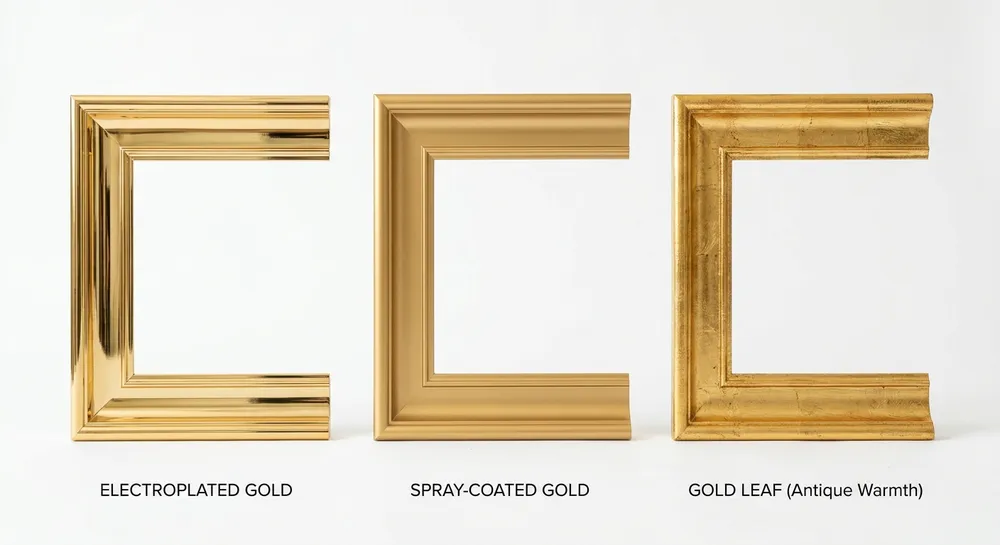
Evaluating frame quality from catalog photos. Frame finish failures — peeling lacquer, color shift between batches, joint separation at corners — don't show up in product photos. Request a physical sample and check the corner joints under light, the finish consistency across the frame face, and the backing board seal. (Corner joint separation is the most common frame defect we see on competitor samples that come through our QC lab for comparison.)
Treating MOQ as a fixed number. Most factories will negotiate MOQ on first orders if you're a credible buyer with a clear product brief and realistic volume projections. The published MOQ is a starting position, not a hard floor.
Skipping factory verification. A video call showing the production floor, a third-party factory audit, or a visit during your first order cycle are all standard practice for serious import buyers. Any supplier who resists a factory audit has something to hide.
For buyers comparing wood, metal, and resin frame options across their product line, our wood vs metal vs resin frames guide covers the cost, durability, and margin trade-offs in detail.
When Local Supply Is the Right Answer
Direct import isn't always the right call. Local supply makes more sense when:
- Order size is below 200–300 units per SKU — container economics don't work at low volumes
- Lead time is under 4 weeks — Vietnam factory lead times run 30–60 days; local distributors can often ship in days
- You need emergency replacement stock — a damaged shipment or unexpected sell-through spike is faster to fill locally
- You're testing a new SKU — before committing to a container, buying 20–50 units from a local importer to test sell-through is a reasonable risk management step
The honest answer is that most buyers use both channels. Local supply for urgent fills and new SKU testing; factory-direct for repeat volume on proven SKUs. The mistake is using local supply for everything because it's easier, and never running the landed cost comparison.
Choosing Your Sourcing Route: A Decision Framework
| Scenario | Recommended Route |
|---|---|
| First-time import, testing a new SKU | Local distributor or 100-piece factory sample order |
| Repeat order, 300+ units per SKU | Factory-direct import |
| Custom frame profile or OEM packaging | Factory-direct only |
| Urgent fill, under 4-week lead time | Local distributor |
| EU market with environmental compliance requirements | Factory-direct, specify copper-free silvering |
| Retail chain compliance (EDI, Walmart/Wayfair standards) | Factory-direct with compliance-capable supplier |
If you're at the stage of comparing frame material options for your product line, the frame decor mirrors category and our OEM/ODM capabilities page cover the customization process in detail — from profile development through sample approval and production.
Frequently Asked Questions
What is the typical MOQ for framed decorative mirrors from Vietnam factories? Standard catalog models typically start at 200–500 pieces at most factories. Livewellcraft's standard MOQ is 100 pieces — we set it there to make trial orders viable without requiring a full container commitment. Custom OEM profiles generally require 300–500 pieces minimum to cover tooling and setup costs.
What certifications should I require from a Vietnam mirror supplier? At minimum: ISO 9001:2015 for quality management, and either SGS or Bureau Veritas audit reports (not just certificate images). For EU markets, ask specifically about copper-free silvering documentation and CE marking where applicable. For US retail chains, BSCI or equivalent social compliance audit is typically required by the retailer.
How do I verify that a Vietnam mirror factory actually produces in-house vs. outsourcing? Ask for a factory video tour showing the silvering line, frame production area, and assembly floor in a single continuous walk-through. Request the factory's business license and production scope documentation. A third-party factory audit (SGS, Bureau Veritas, or similar) is the most reliable verification — budget $300–$500 for an audit and treat it as insurance on your first container.
What is the difference between copper-free and conventional mirror silvering? Conventional silvering uses a copper backing layer over the silver coating to protect against oxidation. Copper-free silvering replaces the copper layer with an alternative protective coating — the result is a mirror that meets EU environmental directives (copper is a regulated substance in some EU waste streams) and typically shows better long-term resistance to edge blackening in humid environments. For buyers selling into EU retail, specifying copper-free is worth the minor cost premium.
What lead times should I expect from Vietnam framed mirror factories? Standard catalog models: 30–45 days from order confirmation. Custom OEM profiles with new tooling: 45–60 days, with the first 2–3 weeks covering sample development and approval. Buyers who build a 60-day buffer into their reorder cycle rarely have stock-out problems; buyers who plan on 30-day lead times consistently run into delays.