A container of 2,000 framed mirrors lands at your warehouse. Your receiving team opens the first pallet and finds corner chips, cracked glass, and frame joints that separated somewhere in the Pacific. The claim process takes six weeks. Your customer's launch date has passed. The replacement order costs you the margin on the original.
We've been shipping mirrors since 2008 — roughly 400,000 pieces a year to North America, Europe, Australia, and the Middle East. Early on, we had breakage rates that would make any buyer nervous. We've since brought that number below 0.5% on standard ocean freight runs, and the fix wasn't one thing. It was a packaging system built around how mirrors actually fail in transit.
This guide covers that system: the materials, the specs, the frame-specific adjustments, and the container loading logic. If you're qualifying a mirror supplier or reviewing your current packaging spec, this is what to check.
—
The Three Ways Mirrors Break in Transit — and Why Generic Fragile-Item Guides Miss Them
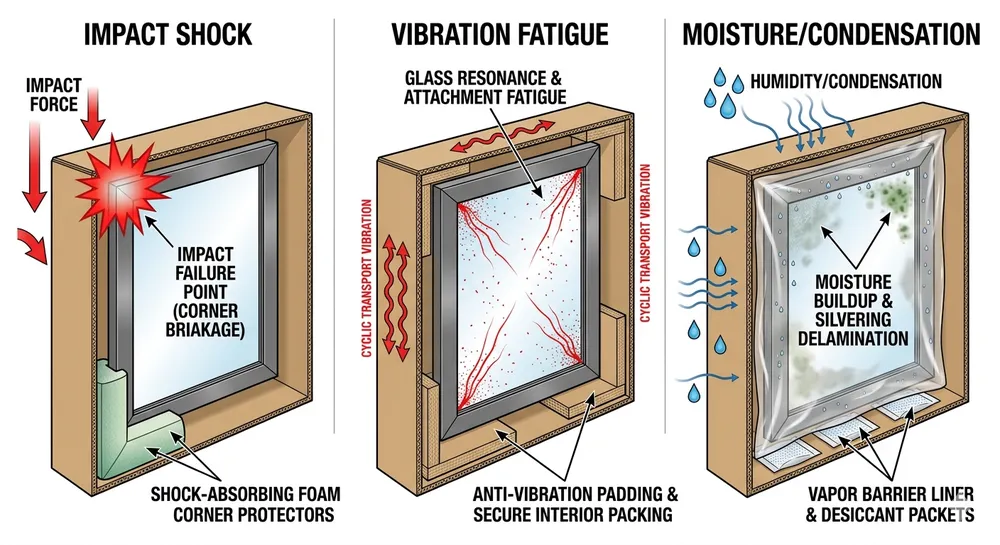
Most shipping guides treat glass as glass. Framed decorative mirrors have three distinct failure modes, and each one requires a different packaging response.
Impact shock is the obvious one — a carton dropped during port handling or forklift transfer. The glass fractures, or the frame corner takes a direct hit and the joint cracks. This is what corner protectors and foam density are designed to absorb.
Vibration fatigue is less obvious but accounts for a significant share of the damage we see on long-haul ocean routes. A 40-foot container on a vessel vibrates continuously for 20–30 days. If the mirror isn't immobilized inside the carton — meaning it can shift even 2–3mm — the frame corners work against the carton walls repeatedly. Wood frame joints loosen. Resin corners develop hairline cracks. The glass doesn't shatter; it arrives with edge chips that only show up under inspection lighting.
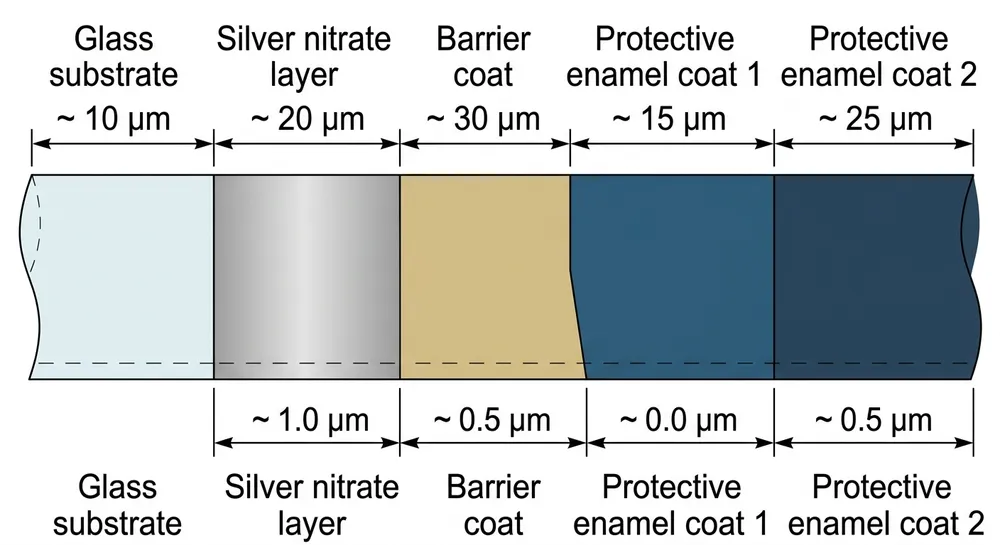
Moisture and condensation is the failure mode almost no packaging guide addresses for mirrors specifically. A sealed container moving from a humid port (Ho Chi Minh City, Guangzhou) to a cold destination (Rotterdam in January, Chicago in February) experiences significant internal temperature swings. Condensation forms on glass surfaces and inside carton walls. For mirrors, this matters beyond the obvious rust risk on metal frames — moisture that reaches the silver coating causes edge blackening and delamination. We've seen containers arrive with structurally intact mirrors that failed QC because the silver had started lifting at the edges. (This is one reason we switched to copper-free silvering — it's more resistant to moisture-driven edge oxidation, which reduces coating claims independent of physical breakage.)

—
Packaging Bill of Materials by Mirror Size Bracket
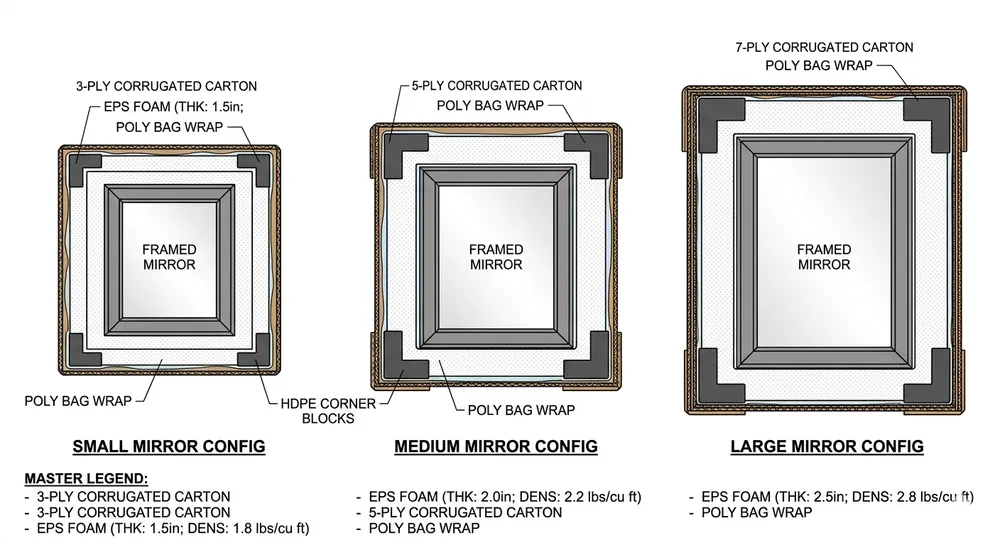
The right spec depends on mirror size. We use three brackets internally, and the material requirements step up meaningfully between them.
Under 60cm (smallest dimension)
These are your accent mirrors, small decorative rounds, and compact rectangular frames. They're light enough that impact shock is the primary risk — vibration fatigue is less of a concern because the mass is low.
| Component | Spec |
|---|---|
| Inner foam | 20–25 kg/m³ EPE, 20mm each side |
| Corner protectors | Molded EPE or cardboard tri-corner, 50mm leg |
| Carton | B-flute double wall, 3-ply minimum |
| Poly bag | 0.05mm PE, sealed |
| Desiccant | 1× silica gel sachet (5g) per carton |
At this size, we typically pack 2–4 units per master carton depending on frame depth, with a cardboard divider between units. The divider matters — without it, units shift against each other and the frame corners do the damage.
60–100cm (longest dimension)
This is the highest-volume bracket for most of our wholesale buyers — standard rectangular wall mirrors, arched frames, and mid-size decorative pieces. Both impact and vibration are real risks here.
| Component | Spec |
|---|---|
| Inner foam | 25–30 kg/m³ EPE, 30mm each side |
| Corner protectors | Molded EPE corner cap, 80mm leg minimum |
| Carton | BC-flute double wall, 5-ply |
| Frame face protection | 3mm foam sheet over mirror face, taped |
| Poly bag | 0.06mm PE, heat-sealed |
| Desiccant | 2× silica gel sachets (10g each) per carton |
Individual cartons at this size. No multi-pack. The carton wall needs to be strong enough to take a stacking load of 6–8 cartons without compressing the foam insert — BC-flute handles this; B-flute alone doesn't.
Over 100cm (longest dimension)
Large format mirrors — full-length floor mirrors, oversized decorative pieces, large arch frames. These are the highest-risk units in any container. The glass area is large, the frame is heavy, and the leverage on corner joints during vibration is significant.
| Component | Spec |
|---|---|
| Inner foam | 30–35 kg/m³ EPE or PE foam, 40mm each side |
| Corner protectors | Rigid EPE or expanded polystyrene (EPS) corner block, 100mm leg |
| Carton | BC-flute or EB-flute double wall, 5-ply, reinforced with H-tape on all edges |
| Frame face protection | 5mm foam sheet + cardboard overlay on mirror face |
| Poly bag | 0.08mm PE, heat-sealed |
| Desiccant | 4× silica gel sachets (10g each) per carton |
| Strapping | PP strap, 2 bands per carton |
At this size, we also add a foam plug between the mirror back and the carton rear wall. Large mirrors flex slightly under vibration — the rear plug prevents the back of the frame from repeatedly contacting the carton wall and wearing through.
—
Step-by-Step Packing Sequence from Assembly Line to Sealed Carton
The sequence matters as much as the materials. We've seen buyers source the right foam and the right carton and still get damage because the assembly order was wrong — foam inserted after the mirror instead of the mirror placed into pre-cut foam, for example, which leaves gaps at the corners.
1. Pre-cut foam inserts to mirror dimensions Foam should be cut to fit the specific mirror SKU, not trimmed on the line. A 5mm gap between the foam edge and the mirror frame is the maximum tolerance. More than that and the mirror can shift under vibration.
2. Poly bag first Wrap the mirror in the poly bag before it goes into foam. The bag is a moisture barrier, not a scratch protector — it needs to be sealed before the mirror contacts any foam surface. Foam is slightly hygroscopic; an unsealed bag lets moisture wick through.
3. Place mirror face-down into bottom foam half Face down means the mirror glass is against the foam, not the frame back. The glass surface is the most vulnerable to contact damage. The foam face layer should be the higher-density piece.
4. Add face foam sheet For the 60–100cm and over-100cm brackets, lay the foam sheet over the mirror back before placing the top foam half. This prevents the frame hardware (D-rings, wire, wall brackets) from pressing into the carton top under stacking load.
5. Set corner protectors Corner protectors go on after the foam halves are in place, not before. They should grip the foam corners firmly — if they're loose, they'll migrate during transit and leave the actual frame corners unprotected.
6. Close and tape carton H-tape pattern on top and bottom flaps. Single-line center tape is not sufficient for mirrors over 60cm — the flap gap is a weak point under drop impact. For large-format mirrors, add edge tape on all four vertical seams.
7. Place desiccant sachets Inside the carton, not inside the poly bag. The sachets absorb moisture from the carton interior air space. Placing them inside the sealed poly bag does nothing.
8. Label and orient arrow "This Side Up" and fragile arrows on all four vertical faces. This sounds obvious, but we've seen containers where cartons were loaded on their sides because the loading crew couldn't read the label language. Use pictogram arrows, not text-only labels.
—
Frame-Specific Packaging Adjustments
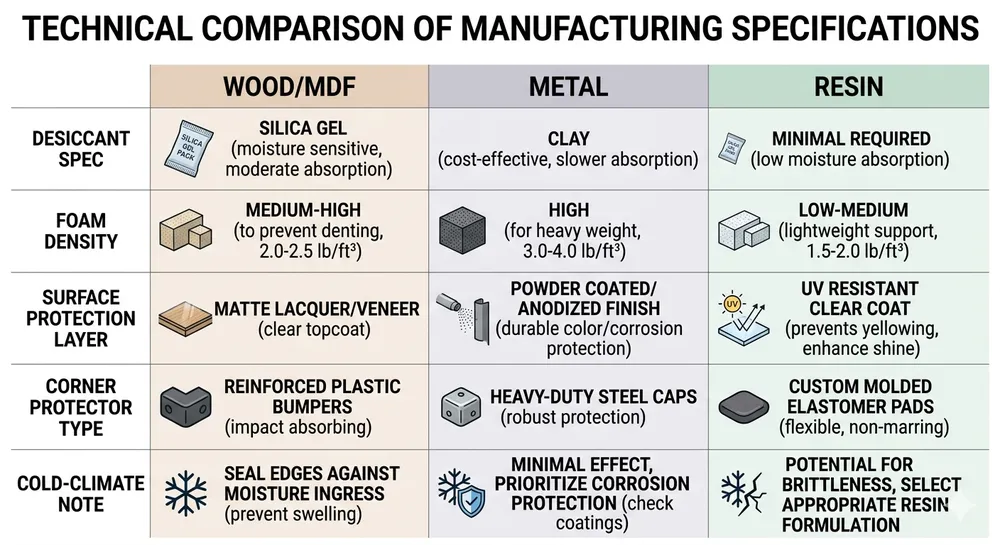
The frame material changes the failure risk profile, which changes the packaging priority. This is the section most generic shipping guides skip entirely.
Wood and MDF frames
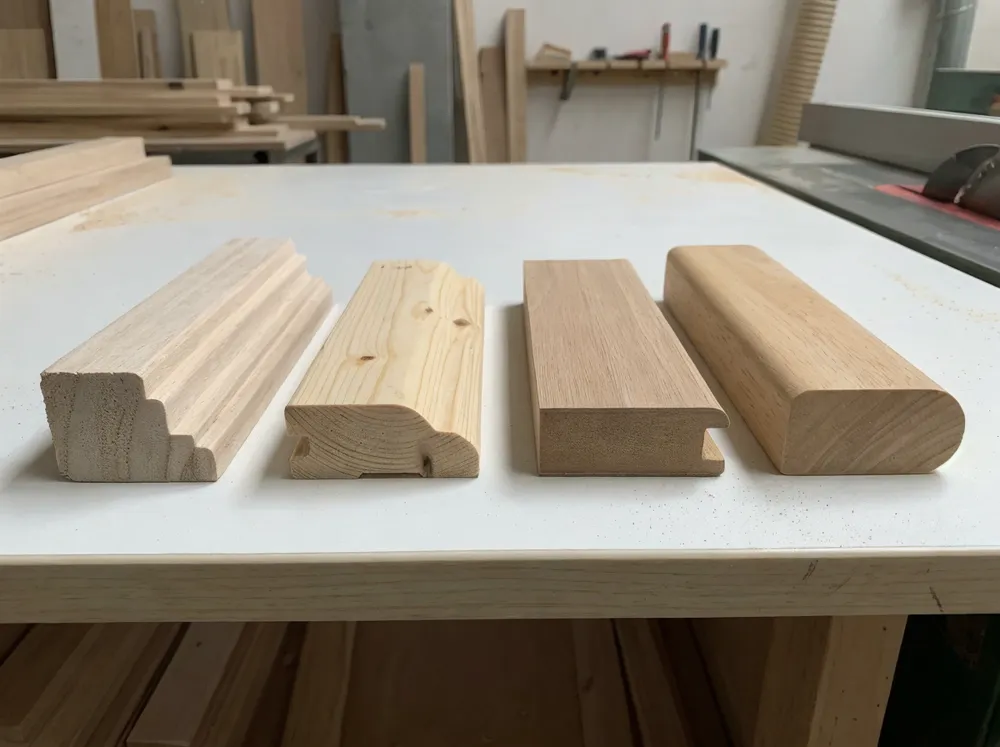
Wood frames are the most forgiving under impact but the most vulnerable to moisture. MDF in particular absorbs humidity and swells — a frame that fits perfectly in the carton at origin can be tight enough to stress the glass by the time it reaches a humid port.
Adjustments:
- Increase desiccant load by 50% vs. the standard spec for the size bracket
- Ensure the poly bag seal is heat-sealed, not just folded — MDF moisture absorption happens through the carton wall and the bag is the last line of defense
- For painted wood frames, add a thin tissue paper layer between the foam face and the frame surface — foam can leave pressure marks on soft paint finishes over 30-day voyages
If you're sourcing wood-frame mirrors and your supplier isn't specifying desiccant quantity by frame material, that's a gap worth flagging. See our notes on choosing decor mirror frame materials for more on how wood species and MDF grade affect moisture sensitivity.
Metal frames (powder coat and electroplate)
Metal frames are the most impact-resistant but the most vulnerable to surface contact damage. Powder coat scratches against foam under vibration if the foam density is too low — the foam surface abrades the coating rather than cushioning it.
Adjustments:
- Minimum 25 kg/m³ foam on all contact surfaces — softer foam compresses and allows micro-movement
- For electroplated finishes (chrome, gold, antique brass), add a non-woven fabric layer between the foam and the frame surface — electroplate is thinner than powder coat and scratches more easily
- Corner protectors must be rigid enough that they don't compress under stacking load — for metal frames, EPS blocks outperform molded EPE at the corners
Resin and composite frames
Resin frames are brittle at low temperatures. A container moving through northern European ports in winter can see internal temperatures drop below 5°C, and resin becomes significantly more impact-sensitive at that range.
Adjustments:
- Increase corner protector leg length by 20mm vs. standard spec — the extra standoff distance absorbs more of the impact energy before it reaches the frame corner
- For intricate resin profiles (carved details, ornate moldings), wrap the frame perimeter in bubble wrap before the poly bag — the carved details are stress concentration points under vibration
- Note the destination climate in your packaging spec. A resin mirror going to Dubai in August has a different risk profile than the same mirror going to Oslo in December.
(We've had buyers ask why we specify different packaging for the same SKU going to different markets. This is why — the frame material and the destination climate together determine the real risk, not just the mirror size.)
—
Container Loading Plan: Pallet Configuration and Stacking Limits
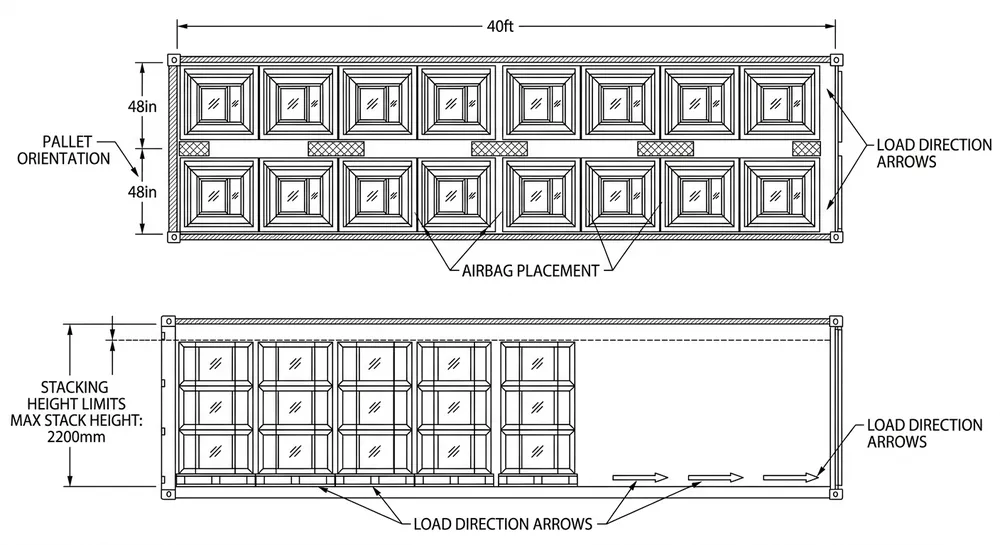
Getting the carton spec right and then loading the container wrong is a common failure point. We've seen well-packaged mirrors arrive damaged because the loading pattern put too much stacking weight on bottom cartons, or because cartons were loaded horizontally when the foam insert was designed for vertical orientation.
Pallet configuration
Standard export pallet: 1,100mm × 1,100mm (EUR pallet) or 1,200mm × 1,000mm depending on destination market. We use 4-way entry pallets for all mirror shipments — 2-way entry limits forklift access at destination warehouses and increases the risk of carton damage during unloading.
Carton orientation on pallet: always vertical, with the "This Side Up" face matching the pallet top. Mirrors should never be palletized on their face or back — the foam insert is designed to support the mirror in vertical orientation, and horizontal loading transfers the stacking load to the glass surface rather than the frame perimeter.
Pallet wrap: stretch film, minimum 4 passes, with a cardboard top cap before wrapping. The top cap distributes the stretch film tension evenly — without it, the film pulls the top cartons inward and can compress corner protectors.
Stacking limits by size bracket
| Mirror size | Max cartons per pallet column | Max pallet height | Notes |
|---|---|---|---|
| Under 60cm | 8 cartons | 1,600mm | 2 columns per pallet typical |
| 60–100cm | 5 cartons | 1,400mm | 1 column per pallet for large frames |
| Over 100cm | 3 cartons | 1,200mm | Single column, no cross-stacking |
These limits account for the carton compression strength at the bottom of the stack. BC-flute cartons have a box compression test (BCT) rating of approximately 800–1,200N depending on carton dimensions — at 5 cartons high for the 60–100cm bracket, the bottom carton is carrying roughly 60–80% of its BCT rating, which is the safe working range. Stack higher and you're compressing the foam insert, which defeats the cushioning.
20ft vs. 40ft container loading
For a 20ft container (internal volume approximately 33 CBM usable), a typical load of 60–100cm framed mirrors on standard pallets runs 400–600 units depending on frame depth. For a 40ft container (approximately 67 CBM usable), 900–1,400 units in the same size bracket.
Dunnage placement: airbags between pallet rows, not between individual cartons. Airbags at 80–90% inflation — over-inflated airbags exert lateral pressure on cartons and can compress corner protectors. Leave 50–80mm between pallet rows for airbag placement; tighter than that and the airbags can't do their job.
For mixed-SKU containers (multiple mirror sizes in one load), load heaviest/largest pallets against the container walls and lighter pallets in the center. Never stack a large-format mirror pallet on top of a small-mirror pallet — the weight distribution is wrong and the large cartons overhang the small ones.
—
Humidity and Condensation Control for Long-Haul Ocean Freight
This section is worth reading carefully if your mirrors are moving on routes with significant temperature differentials — Asia to Northern Europe, Asia to the US East Coast in winter, or any route that passes through the tropics.
A sealed 40ft container is not a stable environment. The steel walls conduct temperature changes rapidly, and the air inside cycles through condensation and evaporation as the container moves through different climate zones. This is sometimes called "container rain" — moisture that condenses on the container ceiling and drips onto cargo. It's more common than most buyers realize, and it's not covered by standard marine insurance unless you can prove the container was defective.
Desiccant sizing for ocean freight
The standard silica gel sachets we specify per carton handle moisture at the individual unit level. For full-container loads on long-haul routes (over 20 days), you also need container-level desiccant.
Container desiccant strips (calcium chloride, 1kg absorption capacity per strip) should be hung from the container ceiling rails — typically 4–6 strips for a 40ft container on a 25–30 day route. These absorb the bulk moisture before it can condense on carton surfaces. The per-carton silica gel handles residual moisture that gets through.
For routes under 15 days, container-level desiccant is optional. For routes over 20 days, it's not optional — it's the difference between a clean container and a container with water-stained cartons and silver edge damage.
Vapor barrier liner
For high-value mirror shipments or routes with extreme temperature differentials, a container liner (polyethylene vapor barrier, 0.1mm minimum) inside the container walls adds another layer of protection. This is more common on electronics shipments but we've used it on large-format mirror orders going to Scandinavian markets in winter. The liner cost is roughly $80–120 per 40ft container — on a 1,000-unit order of large mirrors, that's under $0.15 per unit.
Ventilation vs. sealing
Standard shipping containers have ventilation plugs. For mirror shipments, seal them. Ventilation that makes sense for dry goods (it prevents moisture buildup from the cargo itself) works against you for mirrors — it lets humid port air in during loading and unloading at intermediate stops. Sealed containers with proper desiccant loading outperform ventilated containers on mirror shipments consistently.
For more on how moisture affects specific frame materials in transit, see our guide on wood mirror moisture protection.
—
Packaging Cost Structure: What the Spec Actually Costs Per Unit
Most buyers don't get a packaging cost breakdown from their supplier — it's buried in the unit price. Here's what the materials actually cost at different order volumes, so you can evaluate whether your current supplier is speccing the right materials or cutting corners to hit a price point.
These are approximate material costs at the factory level (Vietnam sourcing, 2024–2025 pricing):
Under 60cm mirrors
| Order volume | Packaging cost per unit | Notes |
|---|---|---|
| 1,000 pcs | $0.85–$1.10 | Standard B-flute, EPE foam, basic corner caps |
| 5,000 pcs | $0.65–$0.85 | Volume discount on carton and foam |
| 20,000 pcs | $0.45–$0.60 | Custom-cut foam inserts, optimized carton sizing |
60–100cm mirrors
| Order volume | Packaging cost per unit | Notes |
|---|---|---|
| 1,000 pcs | $1.40–$1.80 | BC-flute, 30mm EPE, molded corner caps |
| 5,000 pcs | $1.10–$1.40 | Volume pricing on foam and carton |
| 20,000 pcs | $0.80–$1.05 | Custom tooled foam inserts, optimized carton |
Over 100cm mirrors
| Order volume | Packaging cost per unit | Notes |
|---|---|---|
| 1,000 pcs | $2.20–$2.80 | BC/EB-flute, 40mm EPE, EPS corner blocks, PP strap |
| 5,000 pcs | $1.70–$2.20 | Volume pricing, custom foam |
| 20,000 pcs | $1.30–$1.60 | Full custom tooling, optimized for container density |
If your supplier is quoting packaging costs significantly below these ranges, ask specifically what foam density they're using and what carton flute grade. The two most common cost-cutting moves are dropping from 25 kg/m³ foam to 15 kg/m³ (which looks identical but compresses under vibration) and switching from BC-flute to B-flute on medium-size mirrors. Both save $0.20–$0.40 per unit and both show up as damage claims.
(We've had buyers come to us after a bad container from another supplier. In most cases, the packaging looked fine on paper — the problem was foam density that wasn't specified in the PO and wasn't tested before shipment.)
—
Retail-Ready vs. Bulk-Pallet Packaging Configurations
If your mirrors are going into a retail program — Walmart, Wayfair, Amazon, or a regional chain — the packaging spec has requirements beyond breakage prevention. Retail compliance adds cost and complexity, and it's worth understanding the difference before you finalize your PO.
Bulk-pallet configuration
Standard export packaging as described above. Cartons are plain brown with product labels. No retail barcode placement requirements. No specific carton dimension constraints beyond container optimization. This is the right configuration for distribution centers that repack for retail, for hospitality project buyers, and for wholesale buyers who sell to their own retail customers.
Retail-ready configuration
Retail programs add several requirements on top of the base packaging spec:
Carton dimensions: Walmart and major retailers specify carton dimensions that fit their shelf and pallet systems. This sometimes means a less container-efficient carton size — you may lose 5–8% container utilization compared to a dimension-optimized bulk carton.
Barcode placement: GS1-128 shipping label placement is specified to the millimeter on some programs. The label must be scannable from the pallet without breaking the stretch wrap — which means it goes on the carton face that will be outward-facing on the pallet, and the pallet loading pattern has to be consistent.
Master carton weight limits: Most retail programs cap master carton weight at 20–25kg for ergonomic handling. For large mirrors, this sometimes means one unit per carton even when two would fit — which increases packaging cost per unit.
Inner pack requirements: Some programs require inner packaging that allows the end consumer to open the carton without tools and find the product in retail-ready condition. For mirrors, this typically means a foam insert that doubles as display packaging, which adds $0.30–$0.60 per unit.
We've been supplying Walmart, Wayfair, and Amazon programs since 2015, and the compliance requirements have gotten more specific over time, not less. If you're entering a new retail program, share the routing guide with your supplier before finalizing the packaging spec — retrofitting compliance requirements after the first container is expensive.
For a broader look at our Wall Decor Mirrors range and how different frame types perform in retail programs, that page covers the product specs in detail.
—
Common Packaging Failures and How to Catch Them Before Shipment
These are the failures we see most often when buyers come to us after a bad container from another supplier. Most of them are detectable before the container loads — if you know what to check.
Wrong foam density, correct foam thickness The carton looks right. The foam is the right thickness. But the density is 15 kg/m³ instead of 25 kg/m³. You can't tell by looking. The test: press your thumb firmly into the foam. At 15 kg/m³, it compresses easily and slowly recovers. At 25 kg/m³, it resists and recovers quickly. Ask your supplier for the foam density spec in writing and request a material certificate from the foam supplier.
Corner protectors that don't reach the frame corner Molded EPE corner caps that are sized for a smaller mirror get used on a larger one because the supplier ran out of the right size. The cap sits on the carton corner but doesn't actually contact the frame corner — it's decorative, not protective. Check by pulling the corner cap slightly outward after the carton is packed. It should be snug against the frame corner, not loose.
Unsealed poly bags The bag is there but the seal is folded, not heat-sealed. Moisture gets in during the voyage. Check the seal on a sample carton before the container loads — a heat seal has a visible weld line; a folded seal doesn't.
Insufficient desiccant for route length A 5g silica gel sachet is appropriate for a 7-day regional shipment. It's not appropriate for a 28-day trans-Pacific voyage. Ask your supplier what desiccant spec they're using and match it to your actual route length.
Cartons loaded horizontally Happens at the container loading stage, not the packing stage. The foam insert is designed for vertical orientation. A carton loaded on its side puts the stacking load on the foam face layer instead of the carton walls — the foam compresses and the mirror shifts. Specify vertical loading in your packing instructions and confirm with loading photos before the container seals.
For a full overview of how frame material affects both packaging requirements and long-term durability, the Decor Mirrors by Material & Frame category page covers the material comparison in detail.
—
Packaging Qualification Checklist for Supplier Evaluation
When you're qualifying a new mirror supplier, these are the packaging questions worth asking before you place a trial order. A supplier who can answer these specifically is running a real packaging program; one who gives vague answers is probably using whatever materials are cheapest that week.
- What foam density (kg/m³) do you use for mirrors in the 60–100cm bracket?
- What carton flute grade do you use for individual mirror cartons?
- How do you size foam inserts — custom-cut per SKU or standard sizes?
- What desiccant quantity do you include per carton, and how do you adjust for route length?
- Do you use container-level desiccant on long-haul ocean routes?
- What is your current breakage rate on ocean freight shipments?
- Can you provide a packaging spec sheet with material certifications?
- Do you have retail compliance packaging capability (Walmart, Wayfair, Amazon)?
A supplier who packages 400,000 mirrors a year has answers to all of these. A supplier who doesn't package at scale is figuring it out on your order.
If you're ready to review packaging specs for a specific order, send your mirror dimensions, frame material, destination market, and order volume to Request Quote — we'll return a packaging spec sheet with per-unit cost and a container loading plan.