You're building a mirror program and you need to pick a frame material — or decide how to mix them across your SKU range. Wood, metal, and resin each have a different cost structure, a different freight profile, and a different ceiling on what your retail or hospitality buyers will pay. Pick the wrong one for your channel and you're either leaving margin on the table or absorbing damage claims you didn't budget for.
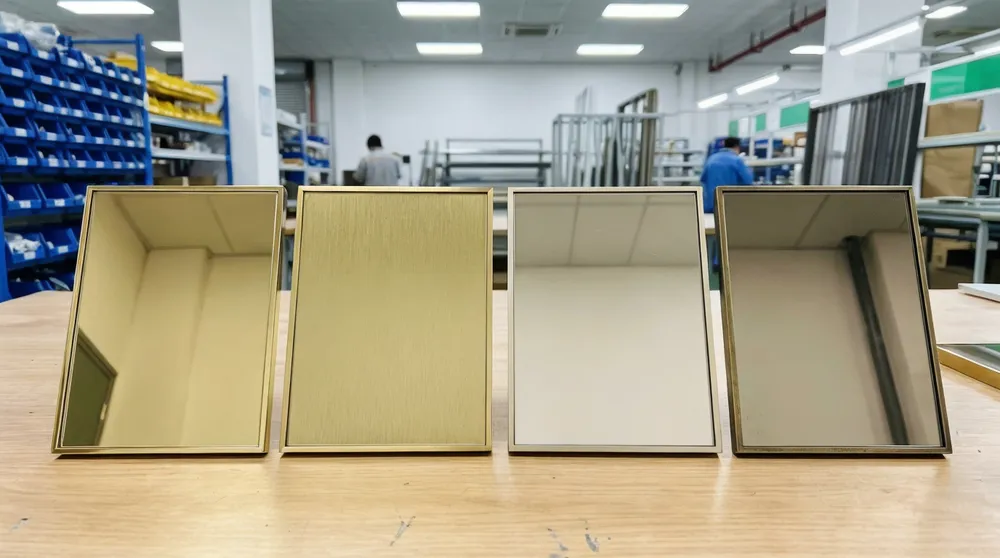
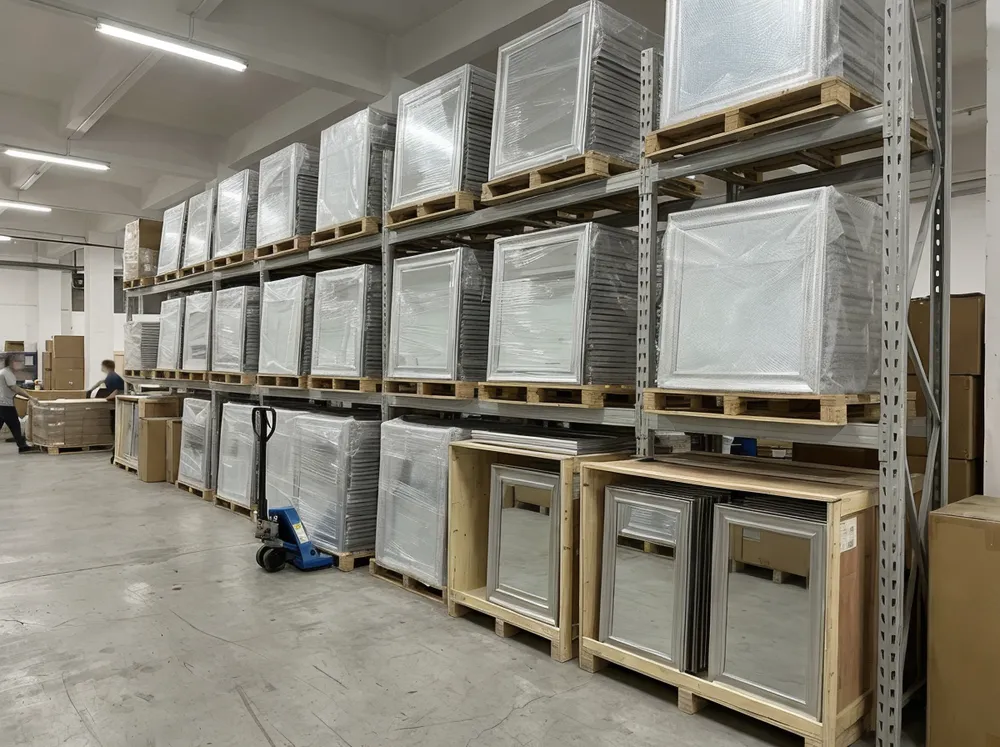
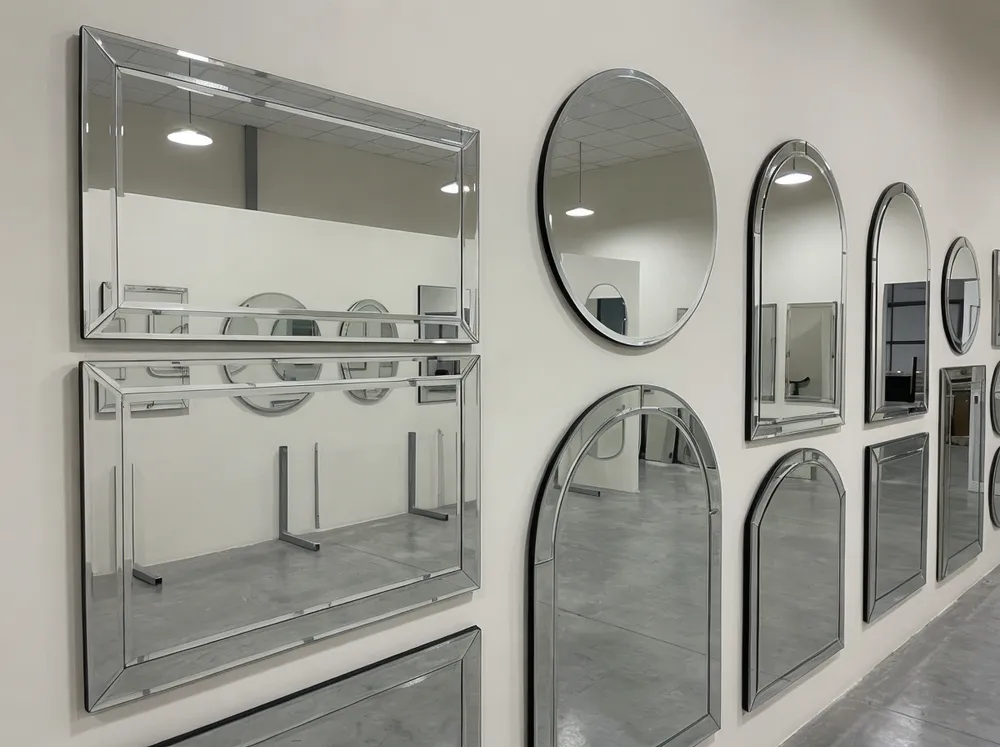
We run all three material lines here at Livewellcraft. Same factory, same QC team, same silvering process behind the glass. That means the comparison below isn't pulled from trade publications — it's pulled from our production floor, our packing records, and the conversations we have with buyers every week about what's working in their market.
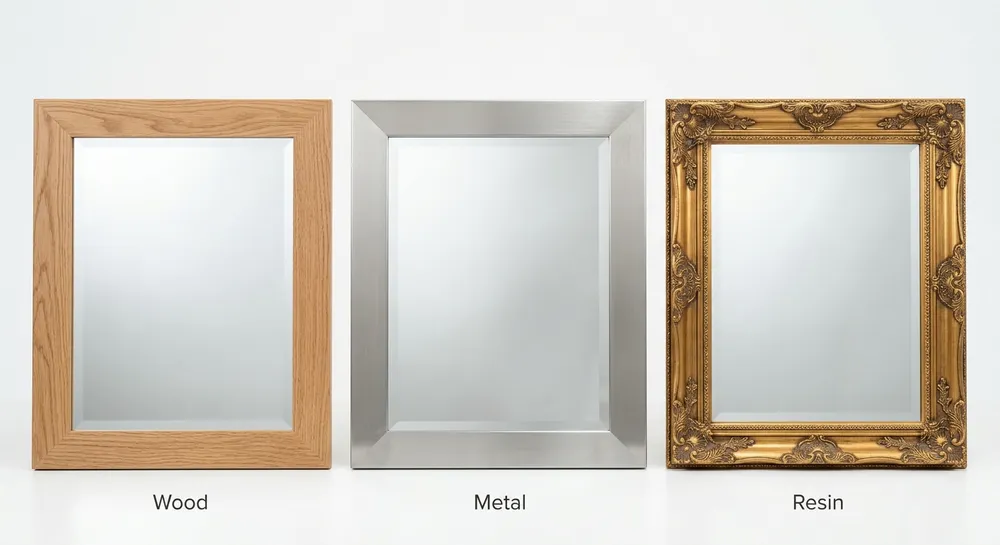
Quick verdict before we get into the detail: wood frames lead on perceived value and margin ceiling; metal frames lead on durability and logistics efficiency; resin frames lead on design flexibility and tooling economics at mid-volume. The right answer depends on your channel, your order size, and how much finish variation your buyers actually need.

What You're Actually Buying: Material Inputs and Production Method
These three materials aren't just aesthetic choices — they're different manufacturing processes with different cost drivers.
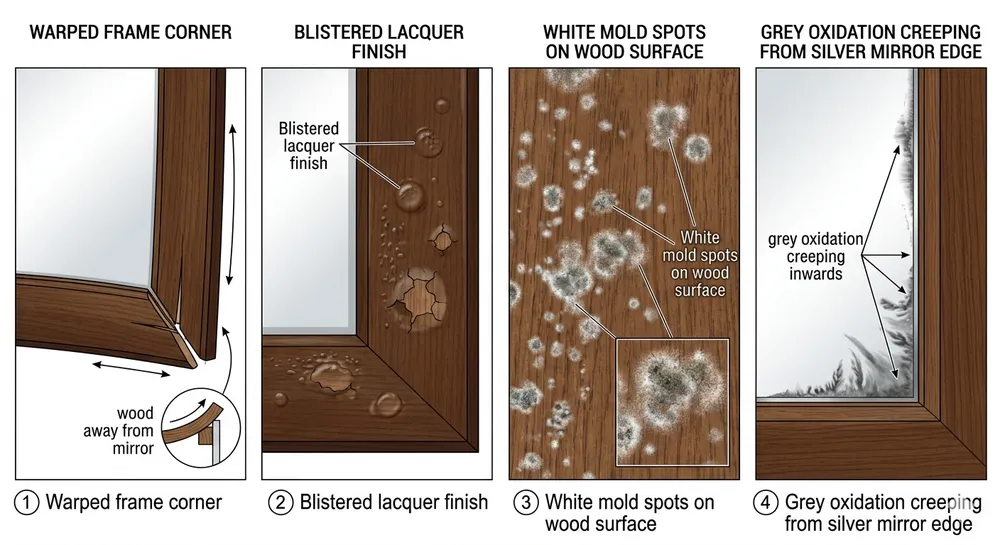
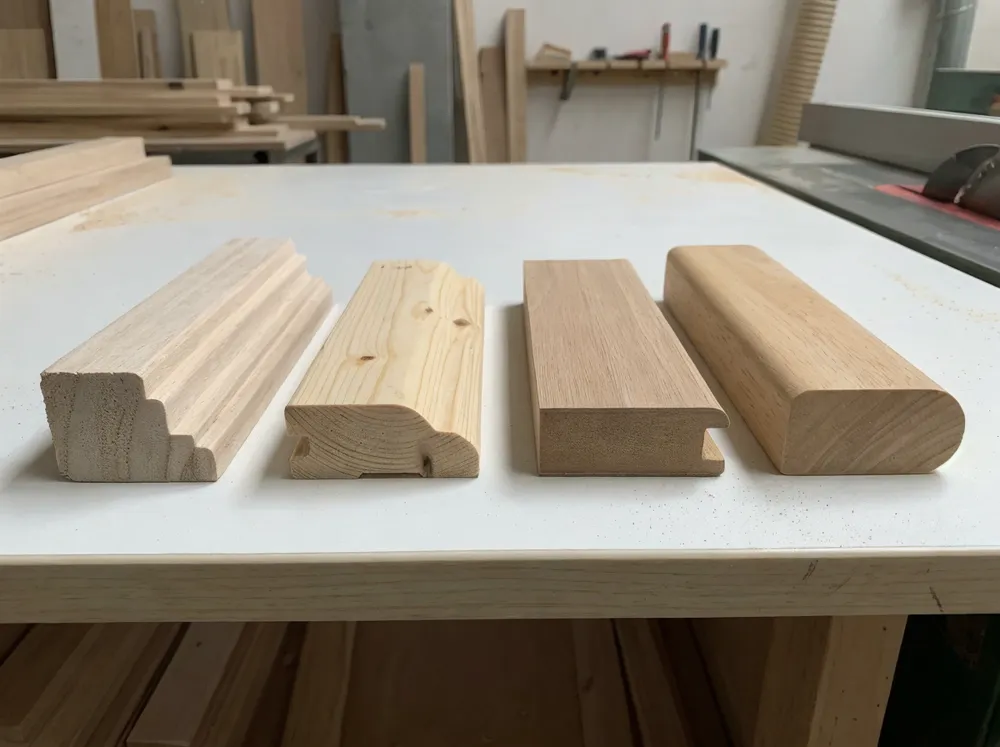
Wood frames at our scale means primarily MDF (medium-density fiberboard) with solid wood used for premium profiles. MDF is stable, machines cleanly, and takes paint and foil wrap consistently. Solid wood adds natural grain character but introduces more variability in moisture content and grain matching across a large batch. We run wood frames through a profile milling line, then through a multi-coat paint or stain system depending on the finish spec. The labor content is higher than metal — sanding between coats, hand-touching joints, color-matching across batches.
Metal frames — we work primarily in iron and aluminum. Iron is heavier but holds complex profiles well and takes powder coat cleanly. Aluminum is lighter, better for coastal or humid-market buyers, and the anodizing options give you a finish range that powder coat can't fully replicate. Metal frames are formed, welded or bent, then run through our automated powder coat line at 60–80μm thickness. The process is more repeatable than wood finishing — less hand labor, tighter color consistency batch to batch.
Resin frames are cast from polyurethane or polyresin molds. The mold is the capital investment — a single profile mold runs $800–$2,500 depending on complexity, and you amortize that across your order volume. Once the mold exists, casting is fast and the detail reproduction is excellent. Ornate profiles that would cost three times as much to carve in wood are routine in resin. The hand-finishing step — sanding cast seams, applying base coat, then decorative finish — adds labor back in, but the design ceiling is higher than either wood or metal for decorative applications.
(We've had buyers try to skip the seam-sanding step to cut cost. It shows up in the finish. We don't offer that option.)
Unit Cost Structure at Wholesale Volumes
This is where most buyers start, and it's also where the comparison gets more nuanced than a simple price-per-unit number.
| Cost Factor | Wood (MDF) | Metal (Iron/Powder) | Resin |
|---|---|---|---|
| Material cost per unit | Low–Medium | Low–Medium | Low (after mold) |
| Tooling / mold investment | Low (profile cutters, shared) | Low–Medium (bending dies) | Medium–High ($800–$2,500/mold) |
| Finishing labor per unit | Medium–High | Low–Medium | Medium–High |
| MOQ for standard profiles | 100 pcs | 100 pcs | 300–500 pcs (mold amortization) |
| MOQ for custom profiles | 200–500 pcs | 300–500 pcs | 500–1,000 pcs |
| Per-unit cost at 1,000 pcs | $8–$18 (frame only) | $7–$15 (frame only) | $9–$20 (frame only) |
| Per-unit cost at 5,000 pcs | $6–$14 | $5–$12 | $6–$15 |
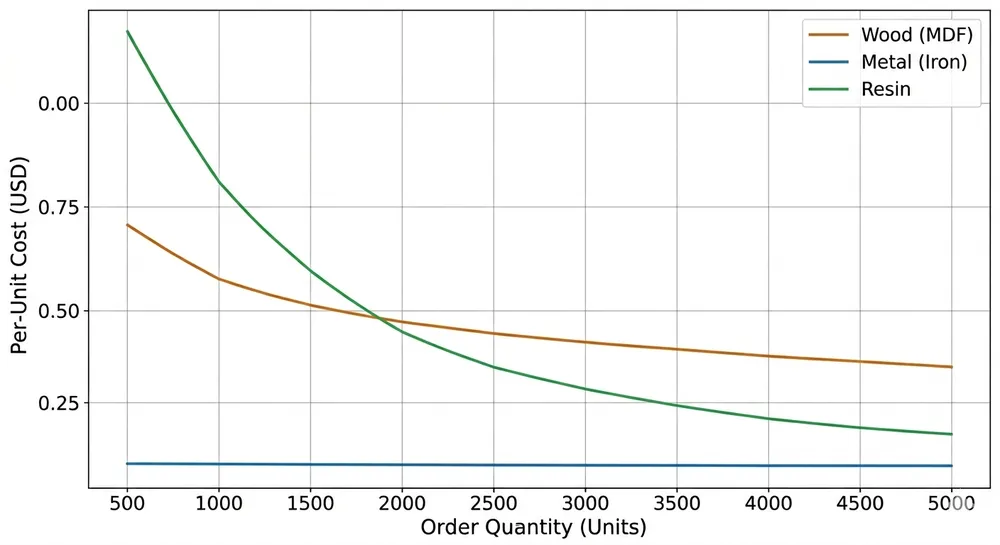
A few things worth unpacking here. The resin mold cost is a one-time investment, but it sits on your first order. At 500 units, a $1,500 mold adds $3/unit to your landed cost. At 2,000 units, it's $0.75/unit. If you're running a resin program at low volume, you're paying for design flexibility you may not be able to price into your retail margin. At 2,000+ units per profile, resin becomes very competitive.
Wood finishing labor is the variable that surprises buyers most. A simple flat-profile MDF frame with a solid paint finish is fast and cheap. A multi-step distressed finish with glaze and hand-wipe? That's 4–5 labor touches per unit, and it shows in the quote. When you're comparing wood frame quotes across suppliers, always confirm the finish spec — two "wood frames" at different prices are often different finish processes, not different material quality.
Metal is the most predictable cost structure of the three. The powder coat line runs at consistent throughput, color changeovers are managed in batches, and there's less hand labor variability. For buyers who need tight cost control across large programs, metal frames are the easiest to budget.
Freight Weight, Fragility, and What It Costs You at the Container Level
This section is where buyers who've been burned before pay close attention.
Frame material affects your freight cost in two ways: weight per unit and damage rate in transit. Both hit your landed cost, but damage rate hits your margin twice — once in the claim, once in the customer relationship.
| Logistics Factor | Wood (MDF) | Metal (Iron) | Metal (Aluminum) | Resin |
|---|---|---|---|---|
| Typical frame weight (medium mirror) | 1.2–2.0 kg | 1.8–3.0 kg | 0.8–1.4 kg | 0.9–1.6 kg |
| Container loading efficiency | Medium | Lower (weight limit) | High | High |
| Fragility in transit | Medium (corner joints) | Low | Low | Medium–High (thin profiles) |
| Packaging requirement | Standard foam corner + carton | Standard | Standard | Reinforced — foam insert required |
| Typical damage claim rate* | 1–3% | <1% | <1% | 2–5% (thin ornate profiles) |
*Based on our export shipment records to North America and Europe over the past three years.
Iron metal frames are the most forgiving in a container. They don't crack, the powder coat is impact-resistant, and a corner bump that would chip a resin frame or split an MDF joint leaves a metal frame with a small scuff at worst. For buyers shipping to markets with rough port handling — parts of Southeast Asia, some Middle East routes — metal frames consistently deliver the lowest claim rates.
Resin is the one that requires the most packaging attention. Thin ornate profiles are brittle at the tips. We use custom foam inserts for resin frames, which adds $0.40–$0.80/unit to packaging cost and reduces how many units fit in a carton. On a 40-foot container, that packaging difference can mean 8–12% fewer units loaded versus a comparable metal frame program. (We've had buyers push back on the foam insert cost. We show them the claim rate data from orders that skipped it. The conversation ends there.)
MDF wood frames sit in the middle. The main failure point is corner joints — if the frame takes a hard impact at the corner, the miter joint can open. We address this with internal corner brackets on all our wood frame profiles, which adds a small cost but drops the joint-failure claim rate significantly.
Finish Range, Perceived Value, and Retail Margin Ceiling
Cost and logistics tell you what you'll spend. This section tells you what you can charge.
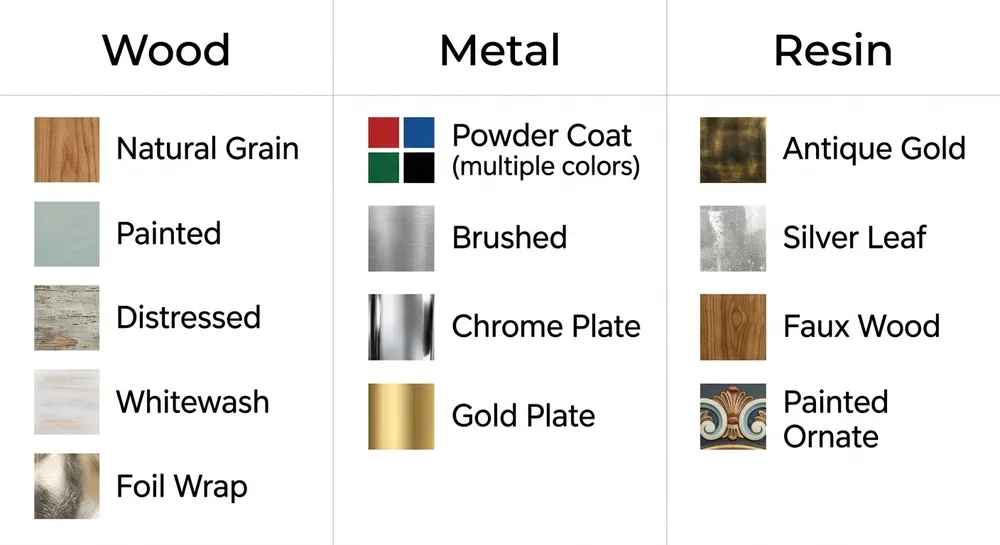
Wood frames carry the highest perceived value in most retail channels — particularly in North America and Europe where natural materials command a premium. A solid wood or high-quality MDF frame with a hand-applied finish can retail at 2.5–4x the frame's production cost in the right channel. Boutique home decor, hospitality procurement, and premium e-commerce (Wayfair upper tier, independent retailers) are all segments where wood frame mirrors hold strong price points. The finish range is wide: natural stain, painted, whitewashed, distressed, foil-wrapped, lacquered.
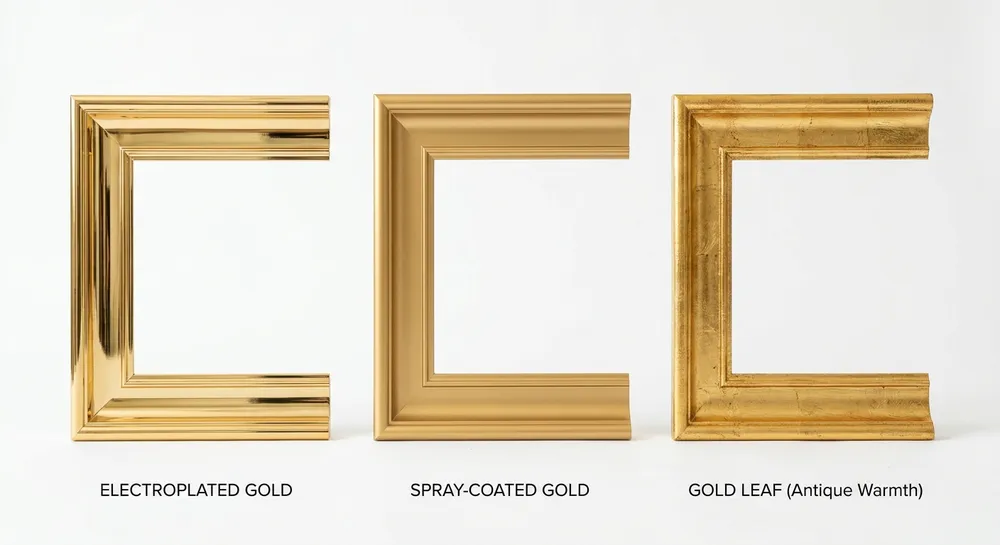
Metal frames have a different value story. The finish range — powder coat in any RAL color, brushed finish, electroplate (chrome, gold, black nickel) — is broad and consistent. Metal frames read as modern and industrial, which is exactly what a large segment of the current market wants. The margin ceiling is slightly lower than premium wood in lifestyle retail, but metal frames move faster, have lower return rates, and are easier to reorder at consistent quality. For buyers building a volume program rather than a premium program, metal often delivers better total margin per container than wood.
Resin frames are the design wildcard. The ornate profiles — carved-look, baroque, heavily detailed — are impossible to replicate in wood at the same price point. A resin frame that looks like hand-carved wood costs 30–50% less to produce than actual carved wood. In the right channel (traditional home decor, hospitality with a classic aesthetic, gift and decor wholesale), resin frames can carry strong retail prices. The risk is that resin finishes — particularly antique gold and silver leaf effects — are more variable than powder coat or paint, and finish consistency across a large batch requires tight QC at the hand-finishing stage.
We run a 100% visual inspection on all resin frames before packing. Color shift and finish inconsistency are the two defects we catch most often at that stage — both are fixable before the unit ships, but they add rework labor that a buyer sourcing from a less rigorous supplier will find in their customer returns instead.
Head-to-Head: The Full Comparison Matrix
| Dimension | Wood (MDF/Solid) | Metal (Iron/Aluminum) | Resin |
|---|---|---|---|
| Unit cost at 1k pcs | $8–$18 | $7–$15 | $9–$20 |
| Unit cost at 5k pcs | $6–$14 | $5–$12 | $6–$15 |
| Tooling investment | Low | Low–Medium | Medium–High |
| MOQ (standard) | 100 pcs | 100 pcs | 300–500 pcs |
| Frame weight | Medium | Medium–High (iron) / Low (aluminum) | Low–Medium |
| Transit damage rate | 1–3% | <1% | 2–5% |
| Finish consistency | Medium (labor-dependent) | High (automated line) | Medium (hand-finish) |
| Design complexity | Medium | Low–Medium | High |
| Perceived value ceiling | High | Medium–High | Medium–High |
| Lead time (standard) | 30–40 days | 25–35 days | 35–45 days |
| Best channel fit | Premium retail, hospitality | Volume retail, modern decor | Traditional decor, gift wholesale |
Lead time note: resin adds hand-finishing time that wood and metal don't require. On a 2,000-unit resin order with a complex ornate profile, plan for 40–45 days production. We can run wood and metal frames in parallel on separate lines, so mixed-material programs don't necessarily extend your overall timeline.
Which Material Wins in Each Buyer Scenario
Scenario 1: Volume Retail Program (1,000–5,000 units per SKU, mid-price channel)
Winner: Metal
You need consistent quality, predictable cost, low damage claims, and easy reorders. Metal frames deliver all four. The powder coat line produces tight color consistency across large batches, the damage rate is the lowest of the three materials, and reordering the same SKU six months later gives you the same result. For buyers supplying mid-tier retail chains or large e-commerce platforms, metal frames are the lowest-risk, most margin-stable choice.
Scenario 2: Premium Home Decor or Hospitality Procurement
Winner: Wood
When your buyer is a boutique retailer, a hotel purchasing manager, or a high-end e-commerce brand, the natural material story matters. Wood frames — particularly solid wood or high-quality MDF with a hand-applied finish — carry a price premium that metal and resin can't match in this channel. The higher finishing labor cost is real, but so is the retail price ceiling. A well-specified wood frame mirror that costs $22 to produce can retail at $85–$120 in the right channel. That margin structure justifies the extra production complexity.
Scenario 3: Decorative or Traditional Aesthetic, Mid-Volume (500–2,000 units)
Winner: Resin
If your market wants ornate, carved-look, or baroque profiles — and you're ordering at volumes where mold amortization makes sense — resin is the only material that delivers that aesthetic at a competitive price. Carved solid wood at the same profile complexity costs 2–3x more. MDF can't hold the fine detail. Resin gives you the design range your buyers want at a price point that protects your margin, provided you're working with a supplier who controls the hand-finishing QC tightly.
(This is the scenario where supplier selection matters most. Resin finish quality varies more across factories than wood or metal. Ask for production samples from the actual mold you'll be ordering from, not showroom samples.)
Scenario 4: Mixed-SKU Program Across Multiple Channels
Winner: Single-source supplier running all three lines
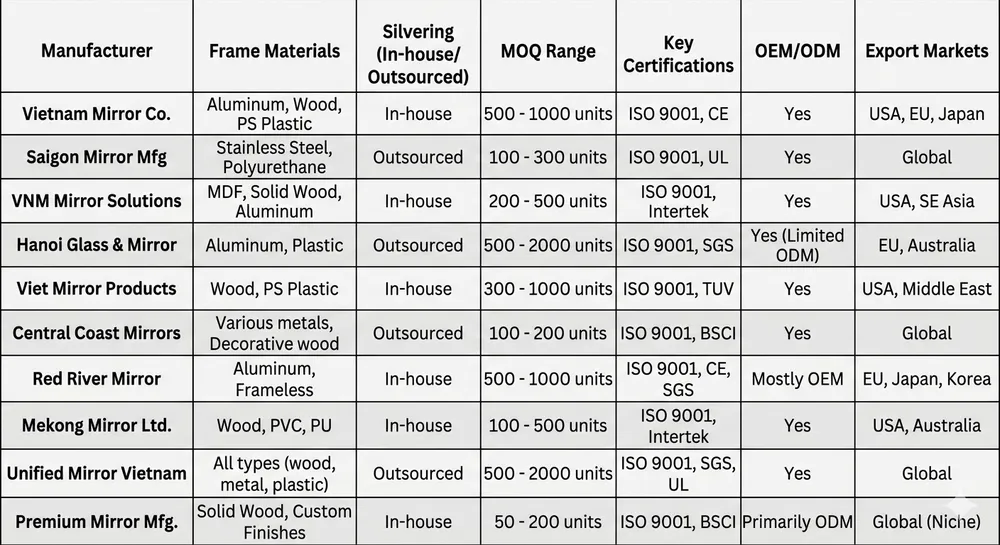
If you're building a mirror program that spans multiple retail tiers or channels — some volume SKUs, some premium, some decorative — the logistics of managing three separate frame suppliers adds cost and risk that buyers often underestimate. Lead time misalignment, inconsistent glass quality across sources, and separate QC standards all create problems at the container level. We run wood, metal, and resin frame lines under one roof, which means your mixed program ships in one container, passes one QC standard, and has one point of contact for any issue. For buyers managing a 10–30 SKU mirror program across channels, that consolidation is worth more than the last dollar of unit cost optimization.
What to Verify When Sourcing Each Material
These are the questions worth asking before you commit to an order — and the answers that separate a reliable supplier from one that will cost you more downstream.
For wood frames:
- Is the MDF E0 or E1 formaldehyde rated? (Required for EU and increasingly for US retail compliance)
- What's the finish process — how many coats, what's the drying method, is there a UV topcoat?
- How are corner joints reinforced? Ask to see a cross-section of the corner construction.
- What's the moisture content spec on solid wood components? (Relevant for markets with seasonal humidity swings)
For metal frames:
- What's the powder coat thickness spec? 60–80μm is standard; below 50μm and you'll see chipping on edges within 12 months.
- Is the pre-treatment phosphate or zinc phosphate? (Zinc phosphate gives better adhesion and salt spray performance)
- For coastal or humid markets: is aluminum available, and what's the anodizing spec?
- What salt spray test hours does the finish pass? Ask for the test report.
For resin frames:
- Who owns the mold — you or the factory? (Critical for reorder security and exclusivity)
- What's the resin formulation — polyurethane or polyresin? (PU is lighter and less brittle; polyresin is denser and heavier)
- How are cast seams finished? Ask to see the pre-finish and post-finish surface under good lighting.
- What's the QC rejection rate at the visual inspection stage? A supplier who can't answer this question hasn't been tracking it.
For a deeper look at wood frame material selection specifically, Solid Wood vs MDF Mirrors covers the MDF vs solid wood trade-off in detail. If you're still working through the broader sourcing decision, Choosing Frame Materials and the Frame Material Sourcing Guide are useful next reads.
Frequently Asked Questions
Which mirror frame material has the lowest damage rate in shipping?
Metal (iron or aluminum) consistently delivers the lowest transit damage rate — typically under 1% on well-packed shipments. The powder coat finish is impact-resistant, and the frame structure doesn't have the brittle failure points that thin resin profiles or MDF corner joints can develop under rough handling. If you're shipping to markets with known port handling issues, metal frames reduce your claim exposure significantly.
What MOQ do I need to make resin frames cost-competitive?
The mold investment is the key variable. At 500 units, a $1,500 mold adds $3/unit to your cost. At 2,000 units, it's $0.75/unit — at that point, resin is cost-competitive with wood and metal for comparable profiles. If you're ordering below 500 units per profile, resin's cost structure works against you unless the design premium justifies it in your retail pricing.
Does frame material affect the mirror's silvering durability?
Yes, indirectly. Frame material affects how well the mirror assembly seals against humidity ingress at the frame-glass junction. Metal frames with tight tolerances and powder-coated edges seal better than poorly finished wood or resin frames. We use copper-free silvering across all our mirror production — it's more humidity-resistant than conventional silver coating — but the frame seal is still the first line of defense. For humid-climate markets (Southeast Asia, coastal US, Middle East), specify aluminum frames or confirm the wood/resin frame has a sealed back panel.
Can I mix wood, metal, and resin frames in one order?
Yes, if your supplier runs all three lines. We do this regularly for buyers building multi-SKU programs. The practical minimum is 100 units per frame style for wood and metal, 300–500 units for resin profiles. Mixed orders ship in one container and go through the same QC process. The main planning consideration is lead time alignment — resin hand-finishing can add 5–10 days versus wood or metal, so we sequence production to hit the same ship date.
What's the realistic retail margin difference between frame materials?
In premium retail channels, wood frames typically support the highest retail-to-cost ratio — 3–4x landed cost in the right channel. Metal frames in modern/industrial aesthetics run 2.5–3.5x in volume retail. Resin ornate frames in traditional decor channels can reach 3–4x when the design is distinctive and the finish quality is tight. The ceiling isn't just the material — it's the channel fit. A wood frame in the wrong channel and a resin frame in the right one will flip those numbers.
Browse the full Decor Mirrors by Material & Frame category to see how each material translates into finished mirror programs, or go directly to Wood Decor Mirrors if wood is your primary focus.