Most sourcing problems with creative wall art don't start on the production floor. They start in the brief. A buyer sends a reference image, a factory quotes something that looks roughly similar, and three months later the shipment arrives with the wrong substrate, a finish that photographs badly, and dimensional elements that didn't survive the container. We've seen this cycle enough times that I want to walk through how creative wall art actually breaks down at the manufacturing level — what the categories are, what drives cost and lead time in each, and how to write a brief that gets you what you actually want.
This isn't a style guide. It's a production and sourcing guide. The aesthetic decisions are yours. The material and spec decisions are where we can help you avoid expensive mistakes.

What "Creative Wall Art" Actually Means at the Factory Level
The term covers a wide range of products, and that range is exactly where sourcing confusion starts. In retail listings, "creative wall art" can mean anything from a printed canvas to a hand-applied resin sculpture. At the factory, the distinction that matters is construction method — specifically, how many materials are combined, whether any element is dimensional (raised off the substrate), and whether the piece includes mirror glass.
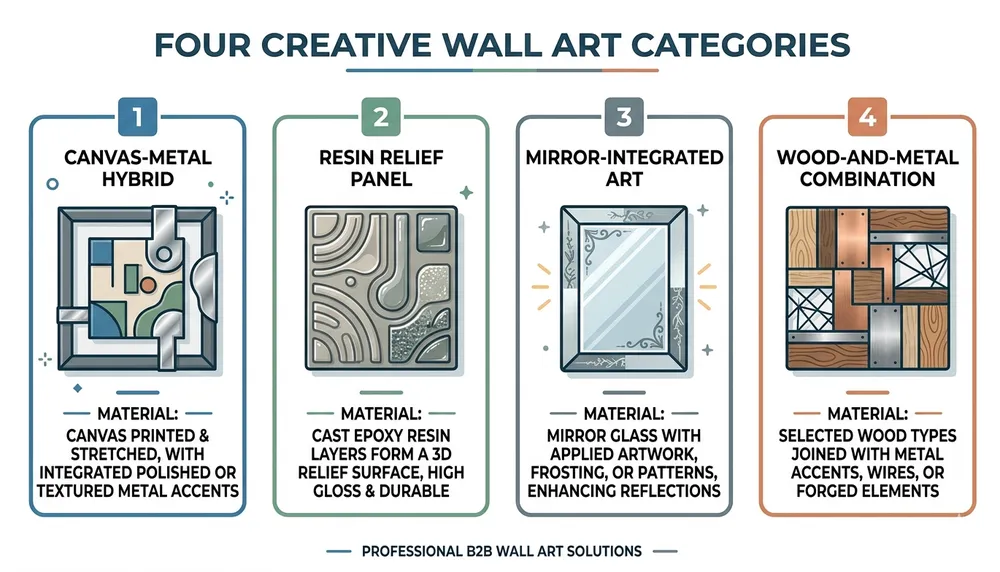
We group our Creative Wall Arts production into five construction categories:
- Canvas-metal hybrids — printed or hand-painted canvas mounted on a metal or MDF frame, sometimes with metal overlay elements
- Resin-relief panels — MDF or wood substrate with poured or molded resin elements creating dimensional texture
- Mirror-integrated art — decorative frames incorporating silvered mirror glass as a design element, not just a functional mirror
- Wood-and-metal combinations — solid wood or MDF panels with laser-cut or fabricated metal components attached
- Hand-painted overlays — base substrate (canvas, wood, or MDF) with hand-applied paint layers, texture medium, or mixed finishing
Each category has different tooling requirements, lead times, fragility profiles, and minimum order logic. Treating them as interchangeable in an RFQ is where most sourcing friction originates.
Material Specs and Production Methods by Category
Canvas-Metal Hybrids
The substrate is typically 280–350 gsm cotton-polyester canvas stretched over an MDF or pine inner frame. Metal overlay elements — usually laser-cut iron or aluminum — are powder-coated separately and attached post-assembly. The finish on the metal component and the canvas treatment need to be specified independently; they go through different production processes.
Weight runs 1.2–3.5 kg depending on frame depth and metal coverage. For retail, this matters: heavier pieces need reinforced hanging hardware, which affects your packaging spec and your end customer's installation experience.
(We run the canvas tension at a consistent 4–6 kg pull force across the frame perimeter — loose canvas is the most common defect we see on competitor samples buyers bring us for comparison.)
Color accuracy between the canvas print and the metal powder coat is the main QC challenge in this category. We match both to a Pantone reference before production starts, and we keep a physical color chip from every approved sample on file for reorder consistency.
Resin-Relief Panels
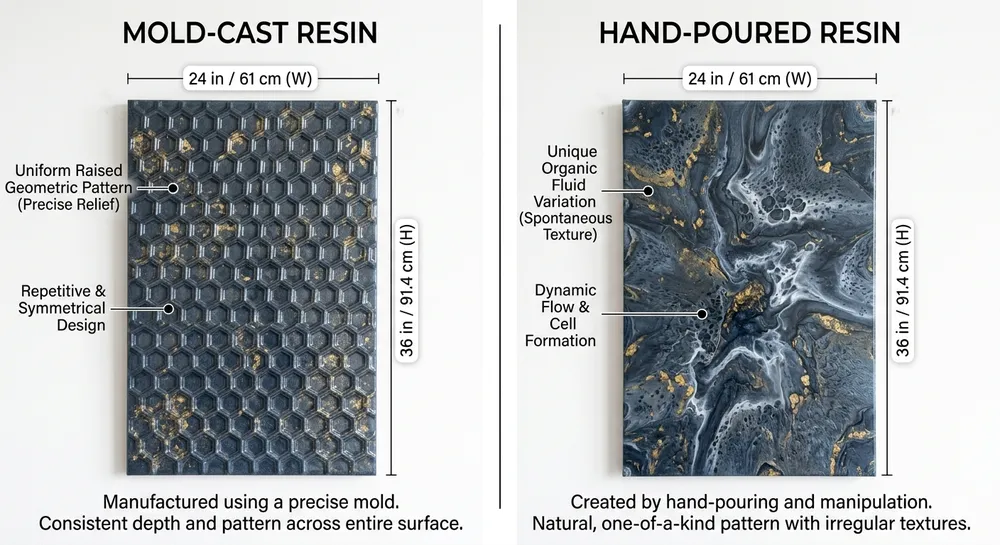
This is the category with the highest design flexibility and the longest lead time for new concepts. The resin elements are either hand-poured into silicone molds or applied freehand by skilled workers — the production method depends on whether you need exact replication across units or are comfortable with natural variation between pieces.
For wholesale orders where consistency matters (retail programs, hospitality projects), we use silicone molds. Mold fabrication adds 15–25 days to the first-order lead time and a one-time tooling cost, but it gives you dimensional consistency within ±1.5 mm across a run. For art-market or boutique retail where variation is a selling point, hand-application is faster to set up and produces pieces that are genuinely unique.
Substrate is typically 18 mm MDF for pieces under 60 cm, moving to 25 mm MDF or solid wood backing for larger formats to prevent warping. Resin elements are sealed with a UV-resistant topcoat — without it, yellowing starts within 12–18 months under retail lighting conditions.
Mirror-Integrated Art
This is where our background as a mirror manufacturer gives us a production advantage most wall art factories don't have. We cut, bevel, and silver the mirror glass in-house — the same lines that produce our decorative mirrors handle the glass components for mirror-integrated art pieces.
The silvering process matters here. We use copper-free silver coating with a multi-layer protective backing. In humid climates — coastal retail markets, Southeast Asia, the Middle East — standard copper-backed mirrors develop edge blackening within 18–24 months. Copper-free backing extends that to 8–10 years under normal conditions. For buyers selling into these markets, that's the difference between zero warranty claims and a returns problem.
Mirror elements in wall art are typically cut to irregular shapes — geometric fragments, organic curves, mosaic tiles — which requires precision glass cutting and edge finishing. We bevel or polish all exposed edges before assembly. Unfinished glass edges are a safety issue and a quality signal; any supplier skipping this step is cutting corners you'll hear about from your customers.
Frame construction for mirror-integrated pieces follows the same logic as our decorative mirror line: MDF core with solid wood or metal overlay, assembled with corner brackets and backing board. The mirror glass is set into routed channels or attached with mirror-safe adhesive, depending on the design.
Wood-and-Metal Combinations
Solid wood or MDF panel as the base, with fabricated metal elements — laser-cut, bent, welded, or cast — attached as dimensional components. The design range here is wide: from simple metal lettering on a wood plank to complex sculptural metal forms on a stained hardwood backing.
Material pairing decisions affect both aesthetics and landed cost. Solid wood (teak, oak, acacia) reads as premium and commands higher retail price points, but adds weight and cost. MDF with wood-grain veneer or paint finish covers most retail price tiers at lower freight cost. We typically recommend MDF for orders targeting mid-market retail and solid wood for hospitality or premium boutique channels.
Metal components are powder-coated or given a patina finish (bronze, antique brass, matte black). Patina finishes require hand-application and add 3–5 days to production. For large runs, powder coat is more consistent and faster; for smaller specialty orders, patina finishes differentiate the product.
(Laser-cut metal tolerances on our line run ±0.3 mm — tight enough that interlocking metal elements fit cleanly without visible gaps, which matters a lot on geometric designs.)
Hand-Painted Overlays
The most labor-intensive category and the one with the most variation in what buyers actually mean when they request it. "Hand-painted" can mean a single artist painting each piece individually, or it can mean a base print with hand-applied texture medium and finishing strokes — two very different cost and consistency profiles.
For wholesale, we typically work with a structured hand-finishing approach: a base layer (print or solid color) is applied consistently across the run, and skilled workers apply texture medium, dry-brush highlights, or accent colors by hand. This gives you the visual character of hand-painted work with enough consistency for retail programs. Pure individual hand-painting is available for smaller runs (typically under 200 units) where price point supports the labor cost.
Substrate options: canvas over MDF frame, solid wood panel, or linen over stretcher bars. Canvas gives the most traditional art appearance; wood panels suit rustic and industrial aesthetics; linen has a finer texture that works well for detailed brushwork.
Spec Table: Creative Wall Art Categories at a Glance
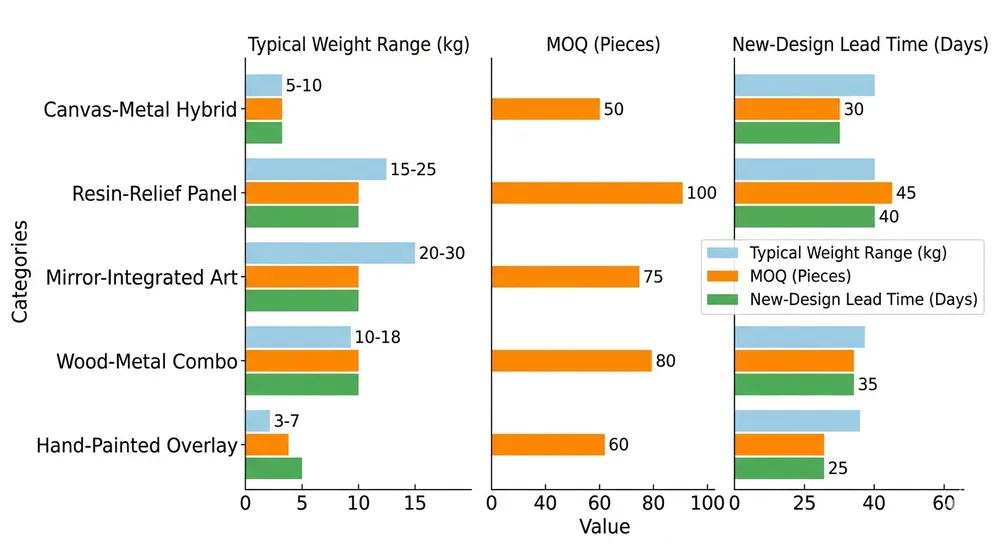
| Category | Primary Substrate | Frame/Structure | Typical Weight | MOQ | Lead Time (new design) | Key QC Point |
|---|---|---|---|---|---|---|
| Canvas-metal hybrid | 280–350 gsm canvas on MDF | MDF inner + metal overlay | 1.2–3.5 kg | 100 pcs | 35–45 days | Color match: canvas print vs. metal powder coat |
| Resin-relief panel | 18–25 mm MDF or solid wood | MDF backing board | 2.0–5.0 kg | 100 pcs (mold) / 50 pcs (hand) | 45–60 days (new mold) | Dimensional consistency ±1.5 mm; UV topcoat coverage |
| Mirror-integrated art | MDF core with mirror glass | MDF + solid wood or metal trim | 2.5–6.0 kg | 100 pcs | 40–50 days | Edge finishing; copper-free silver backing |
| Wood-and-metal combo | Solid wood or MDF panel | Metal components attached | 1.8–4.5 kg | 100 pcs | 35–45 days | Metal fit tolerance; finish consistency |
| Hand-painted overlay | Canvas, wood, or linen | MDF frame or stretcher | 1.0–3.0 kg | 50 pcs | 30–40 days | Finish consistency across run |
All MOQs shown are for standard designs. Custom molds, new tooling, or new color development may adjust minimums — ask us when you submit your brief.
How to Write a Brief That Gets You an Accurate Quote
The most common reason quotes come back wrong — or come back with a wide price range — is an incomplete brief. Here's what we need to quote accurately on any creative wall art design:
Dimensions: Overall size (H × W × D), including any dimensional elements that project from the surface. Depth matters for packaging and container loading calculations.
Material preferences: Which category above fits your concept? If you're not sure, send reference images and we'll recommend the construction method.
Finish requirements: For metal components — powder coat color (Pantone reference preferred), or patina type. For wood — stain, paint, or natural. For canvas — print method (digital or screen) or hand-painted. For mirror — standard or copper-free backing.
Target quantity and order frequency: A 100-unit trial order and a 2,000-unit annual program have different production planning implications. Knowing your volume trajectory helps us recommend the right tooling investment.
Target retail price or landed cost: We work backwards from your margin requirements. If you tell us your target retail price and your market, we can recommend the construction method and material tier that protects your margin.
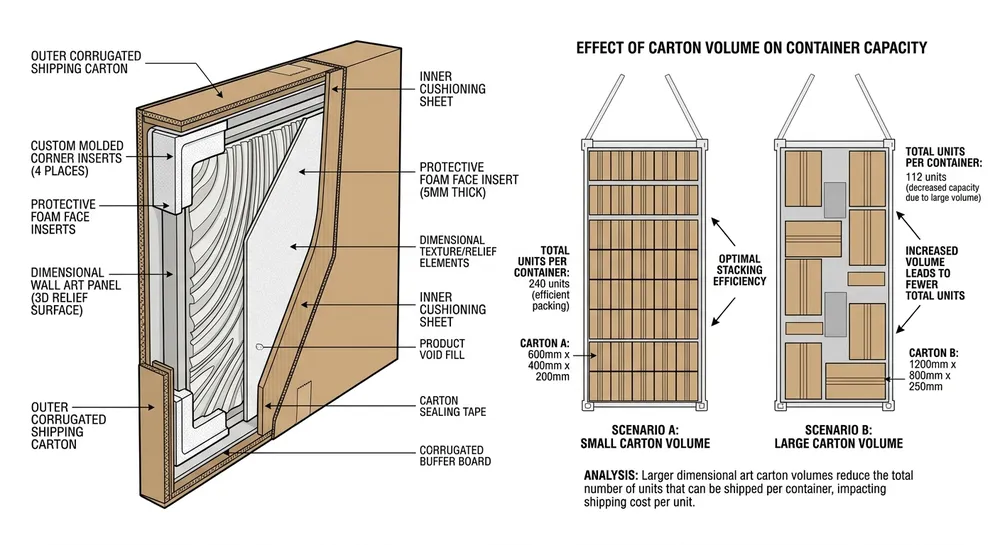
Packaging requirements: Dimensional wall art — especially resin-relief and mirror-integrated pieces — needs custom inner packaging. Standard export carton with foam inserts is our default; retail-ready packaging (window box, branded insert) is available with additional lead time.
For OEM/ODM projects, our 12-person engineering team can develop custom frame profiles, new mold designs, or proprietary finish combinations. We keep CAD files and physical samples from every approved design on file for reorder accuracy.
Sourcing Risks Specific to Mixed Media and Dimensional Wall Art
Fragility in Transit
Dimensional pieces — anything with raised resin elements, protruding metal components, or mirror glass — need packaging engineered for the specific product, not generic foam-in-carton. We design inner packaging for each new SKU before the first production run, testing drop and compression resistance. Buyers who skip this step on their first order often discover the problem when 15% of their shipment arrives damaged.
Mirror-integrated pieces require corner protection and face protection separately. The glass face is the obvious concern, but corner impact on the frame is actually the more common damage point in container transit.
Consistency Across Large Runs
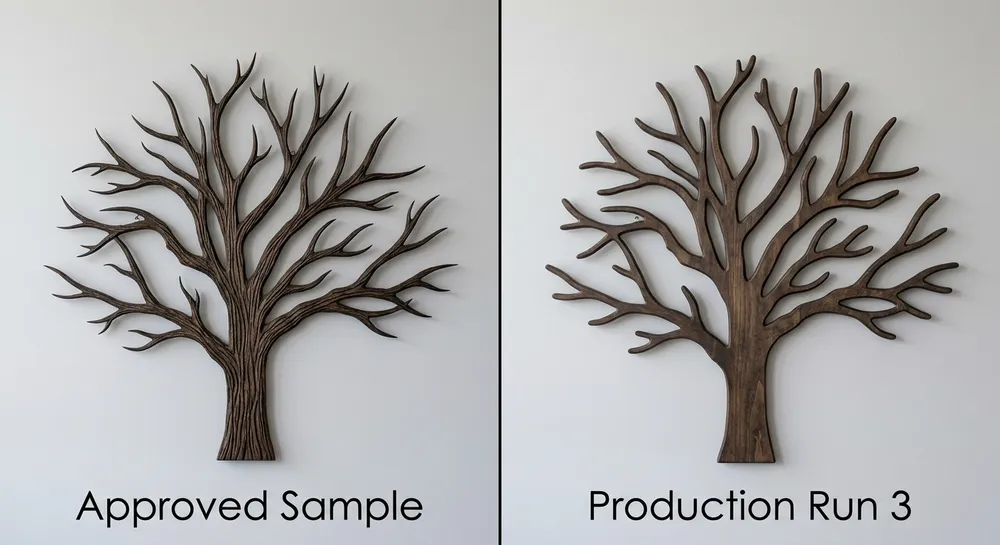
Hand-applied elements — resin pours, painted finishes, patina treatments — naturally vary. The question is whether that variation is within your acceptable range. We establish a "golden sample" before production starts and define the acceptable deviation range with the buyer. QC checks at mid-run and end-of-run compare against the golden sample. Without this step, what you approved in the sample and what ships in the container can diverge significantly.
(We've had buyers come to us after a bad experience with another supplier specifically because of this issue — the sample was beautiful, the bulk order looked like a different product. The fix is a defined tolerance range agreed before production, not after.)
Color and Finish Drift on Reorders
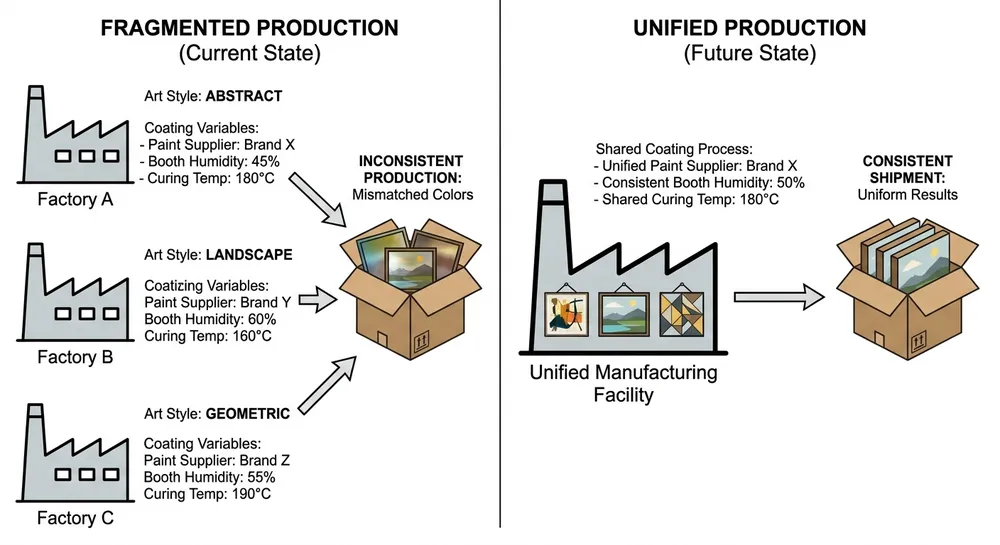
Creative wall art with custom colors or finishes is vulnerable to drift on reorders if the original spec isn't documented precisely. We maintain a physical color chip library and keep finish formulas on file for every approved design. When you reorder, we pull the original spec and match against it before production starts. Ask any supplier you're evaluating how they handle reorder color consistency — the answer tells you a lot about their QC system.
Lead Time for New Tooling
If your design requires a new silicone mold (resin-relief) or custom metal die (laser-cut components), that tooling needs to be factored into your launch timeline. Mold fabrication runs 15–25 days; metal tooling varies by complexity. We quote tooling costs separately and own the tooling on our end — you don't pay storage fees, and reorders don't require new tooling unless the design changes.
Packaging and Container Loading for Creative Wall Art
This section gets skipped in most sourcing conversations and causes problems at the logistics stage. A few practical points:
Dimensional wall art doesn't stack flat. Resin-relief panels and mirror-integrated pieces need individual inner packaging, which increases carton volume significantly compared to flat-frame wall art. A 40-foot container that holds 2,000 units of standard framed wall art might hold 800–1,200 units of dimensional creative wall art, depending on piece size and packaging depth.
We calculate container loading efficiency as part of every quote. If your target landed cost depends on a specific container utilization rate, tell us upfront — we can sometimes adjust packaging design or piece dimensions slightly to improve loading efficiency without affecting the product.
For retail programs with specific carton labeling requirements (UPC, barcode placement, retail-ready packaging), we handle EDI compliance and retail packaging specs. We've supplied Walmart, Wayfair, and Amazon programs and have the compliance documentation workflows in place.
Matching Design Category to Your Market Segment
Different creative wall art categories perform differently across retail channels. This is worth thinking through before you commit to a design direction, because the construction method affects your price point, your margin, and your reorder flexibility.
Mid-market e-commerce (Wayfair, Amazon, regional online retailers): Canvas-metal hybrids and wood-and-metal combinations work well here. They photograph cleanly, ship at manageable weights, and hit retail price points between $45–$120 that move volume. Resin-relief panels can work in this channel at smaller sizes (under 40 cm) where the price point stays accessible.
Specialty and boutique retail: Resin-relief panels and hand-painted overlays are strong here. Buyers in this channel are selling differentiation, and the visible craft element — texture, variation, hand-finishing — supports higher price points and lower price sensitivity. MOQs of 50–100 units fit the buying patterns of independent retailers.
Hospitality and contract: Mirror-integrated art and larger-format wood-and-metal combinations are the main categories here. Projects typically specify by room count, so order volumes are predictable and often large. Consistency across units is the primary requirement — a hotel buying 200 identical pieces for guest rooms needs them to look identical, not "artisanally varied."
Premium gift and home décor wholesale: Hand-painted overlays and resin-relief panels with distinctive subject matter (abstract, botanical, geometric) move well through gift wholesale channels. Price points are higher, reorder cycles are shorter, and buyers in this channel respond to trend-forward subject choices.
Our Wall Arts by Style & Subject category covers the full range of subject and style options across these construction methods. If you're building a new product line, it's worth reviewing what's moving in your target channel before locking in a design direction.
Frequently Asked Questions
What's the minimum order for a completely new creative wall art design?
For designs using existing production methods (no new molds or tooling), MOQ starts at 100 pieces for most categories, 50 pieces for hand-painted overlays. If your design requires a new silicone mold or custom metal tooling, we quote the tooling cost separately — the per-unit MOQ stays the same, but you need to factor tooling amortization into your unit economics. Most buyers in this category start with a 100-unit trial to test sell-through before committing to a full container.
How do you maintain color consistency between my approved sample and bulk production?
We keep a physical color chip and finish reference from every approved sample. For canvas prints, we maintain the print file and color profile. For powder coat and patina finishes, we keep the formula and a physical chip. Before bulk production starts, we run a pre-production color check against the approved reference. Mid-run and end-of-run QC checks compare against the same standard. If you're reordering a design we've produced before, we pull the original spec automatically.
Can you produce creative wall art with both mirror glass and resin elements in the same piece?
Yes — this is actually one of the more interesting design directions we've developed recently. Mirror fragments or geometric mirror tiles combined with resin-relief texture creates a dimensional piece with strong visual depth. The production complexity is higher (glass cutting, silvering, and resin work in the same piece), and lead time for new designs in this category runs 50–65 days. MOQ is 100 pieces. If you have a concept in this direction, send us reference images and we'll assess feasibility and quote accordingly.
What certifications apply to creative wall art for the US and European markets?
Our facility holds ISO 9001:2015, SGS, CE, and BSCI certifications. For the US market, we can provide test reports for formaldehyde emissions (relevant for MDF-heavy constructions) and ASTM hanging hardware load ratings. For the EU market, CE documentation covers the relevant product safety requirements. If your retail program has specific compliance requirements beyond these, tell us at the RFQ stage — we've handled Walmart, Wayfair, and Amazon compliance documentation and can usually accommodate retailer-specific requirements.
How do I handle fragile creative wall art in my own warehouse and fulfillment?
We design the inner packaging to protect the piece through ocean freight and standard warehouse handling. For pieces with mirror glass or significant resin relief, we include corner protectors, face foam, and a "fragile" carton designation. If you're doing direct-to-consumer fulfillment from your own warehouse, let us know — we can adjust the inner packaging to handle the additional handling cycles of individual order picking and last-mile delivery, which is a different stress profile than pallet-in, pallet-out warehouse handling.
—
Ready to spec your next creative wall art program? Share your concept — dimensions, material direction, target quantity, and reference images — and we'll come back with a technical proposal and pricing. Request a quote or browse our existing Creative Wall Arts range to see what's already in production.
For buyers exploring adjacent categories, Abstract Wall Arts and Unique Wall Arts cover subject-specific design directions that can be produced across several of the construction methods described above.