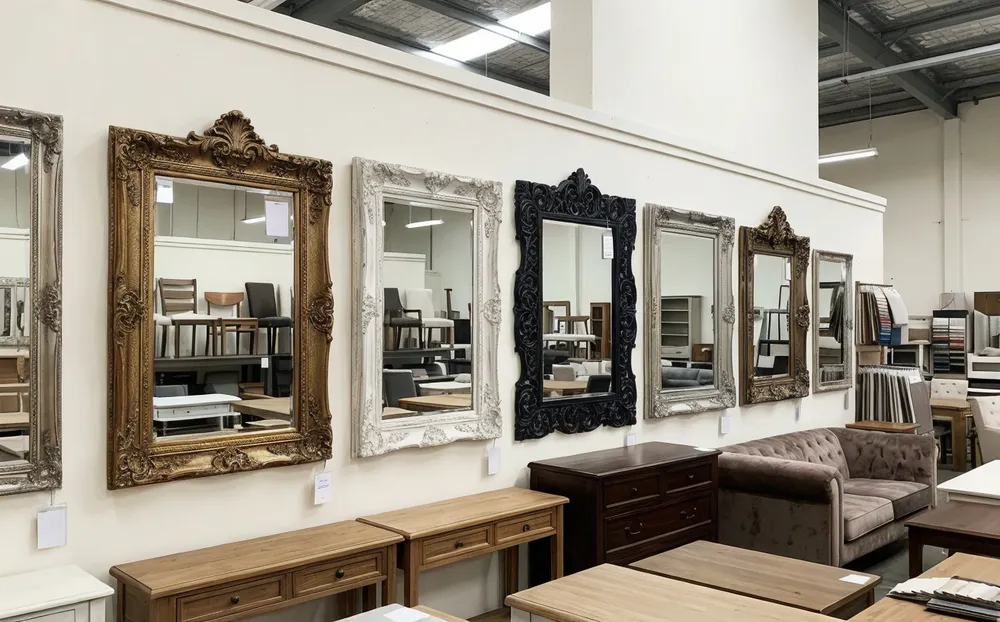
Most framed mirror disputes we see come down to the same root cause: the buyer assumed the factory understood what "standard quality" meant, and the factory built to the cheapest interpretation of the spec sheet. By the time the container arrives, the damage is done — coating peeling at the joints, glass cracked from inadequate edge finishing, backing boards warped from moisture. None of it is hard to prevent. All of it requires knowing which specs to lock down before production starts.
This guide covers the construction specs that actually determine whether your Frame Decor Mirrors survive transit, pass retail inspection, and stay off your returns desk.
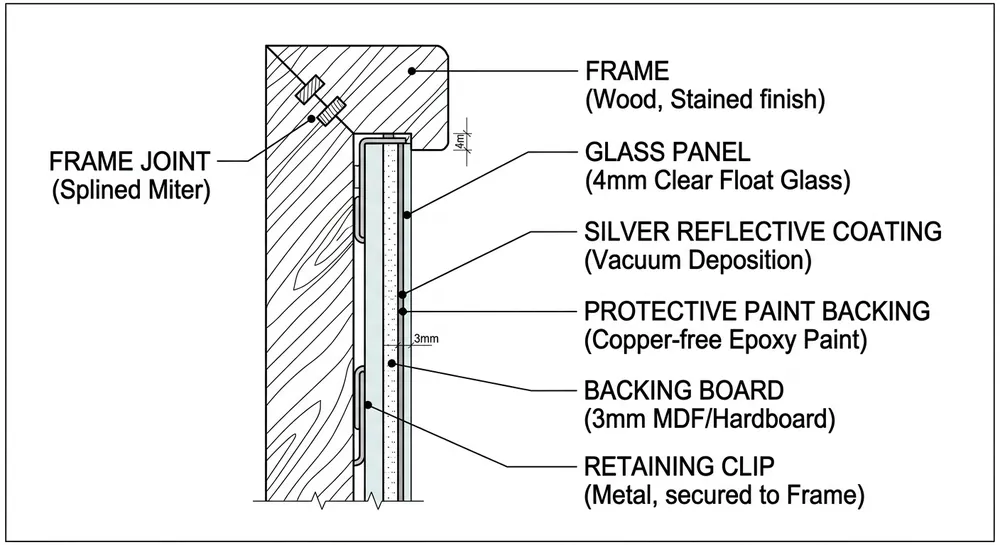
Glass panel specs: thickness, edge finish, and what each costs you in breakage
The glass is where most buyers under-specify. "Standard mirror glass" tells a factory almost nothing — and a factory optimizing for margin will interpret that as the thinnest sheet that technically qualifies.
For framed decorative mirrors, the practical thickness range runs from 3mm to 6mm. Here's how to think about it:
| Glass thickness | Typical application | Breakage risk in transit | Weight impact |
|---|---|---|---|
| 3mm | Small frames under 40cm | Higher — flexes under pressure | Lightest |
| 4mm | Standard retail sizes 40–80cm | Moderate with proper packaging | Balanced |
| 5mm | Large format 80–120cm | Low with corner protection | Heavier |
| 6mm | Oversized / commercial | Very low | Heaviest — affects freight cost |
We run most of our retail-format mirrors at 4mm. For anything going into hospitality projects or large-format retail display, 5mm is the floor we recommend — the extra cost per unit is negligible against a single breakage claim on a 500-unit order.
Edge finishing matters as much as thickness. Raw-cut edges chip under vibration in a container. Specify one of these:
- Flat polish: clean, safe, standard for most framed mirrors where the edge is hidden by the frame rabbet
- Beveled edge: 10mm–20mm bevel at 45°, adds visual value for frameless-look designs or partial-reveal frames
- Seamed edge: light grind to remove sharpness — minimum acceptable for any glass that handlers will touch during assembly
If your spec sheet just says "mirror glass," you will get raw-cut edges on at least some units. We've seen it happen even with suppliers who should know better. Lock the edge finish in writing.
Silvering and coating specs: where the real quality gap lives
This is the section most buyers skip, and it's the one that generates the most warranty claims.
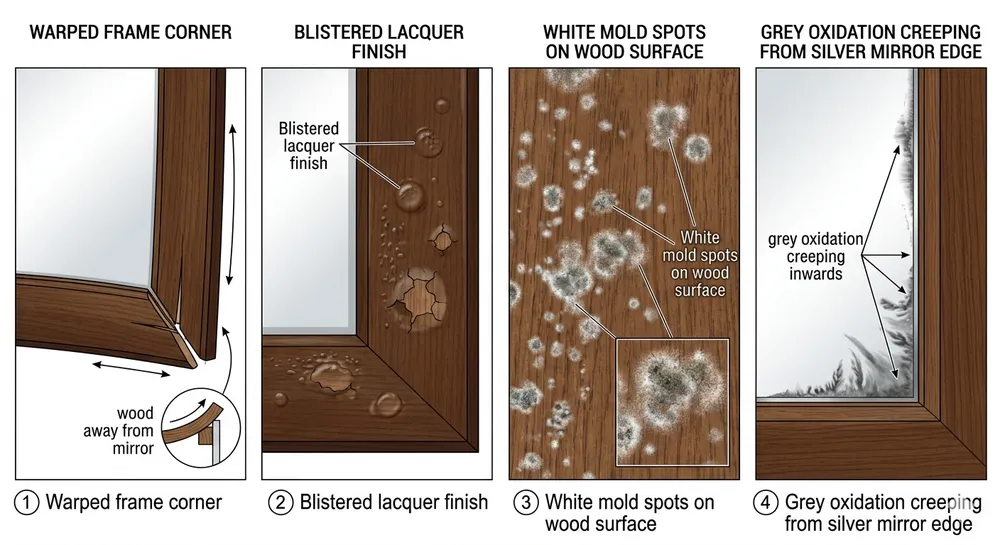
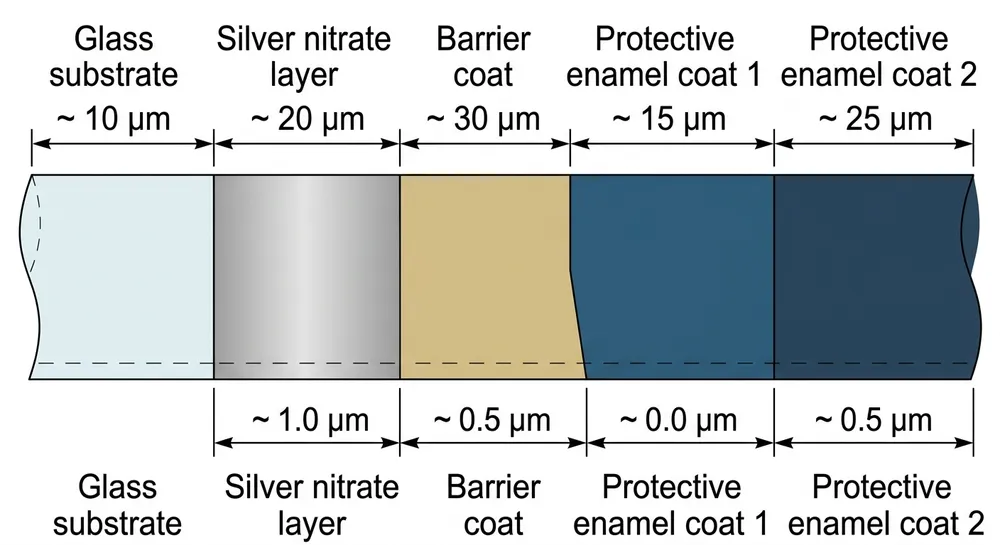
Mirror silvering is a wet chemical process — silver nitrate reduced onto the glass surface, then sealed with a protective paint layer. The difference between a mirror that lasts 10 years and one that starts showing black edge spots in 18 months comes down to two things: whether the process uses copper backing, and how well the protective paint adheres.
Copper-free vs. copper-backed silvering
Traditional silvering uses a copper layer between the silver and the protective paint. Copper improves adhesion but corrodes over time, especially in humid environments — that's the source of the black "foxing" spots you see on older mirrors. Copper-free silvering eliminates that failure mode. We switched our lines to copper-free in 2016, and the difference in long-term adhesion test results was significant enough that we haven't looked back.
If you're selling into coastal markets, humid climates, or bathroom-adjacent applications, copper-free is worth specifying explicitly. Most catalog suppliers won't volunteer this distinction.
Adhesion testing — what to ask for
Silver coating adhesion is tested by cross-cut tape pull (similar to ASTM D3359). A properly coated mirror should show zero silver lift on a 6×6 grid cross-cut test. Ask your supplier whether they test adhesion per batch or per unit. We run 100% unit-level adhesion checks before packing — batch sampling misses the outliers that end up as claims.
Protective paint layer count
The silver sits under two paint layers: a copper-substitute barrier coat and a final protective enamel. Single-coat systems are cheaper and fail faster at the edges where moisture infiltrates. Specify minimum two-coat backing paint, and ask for the dry film thickness — 40–60μm total is a reasonable target for standard decorative mirrors.

Frame construction specs: material, joinery, and finish — the three places factories cut corners
The frame is where the most visible quality variation lives, and where the most sourcing disputes originate. A frame that looks identical in a product photo can be built three completely different ways — and only one of those ways survives a 30-day ocean container.
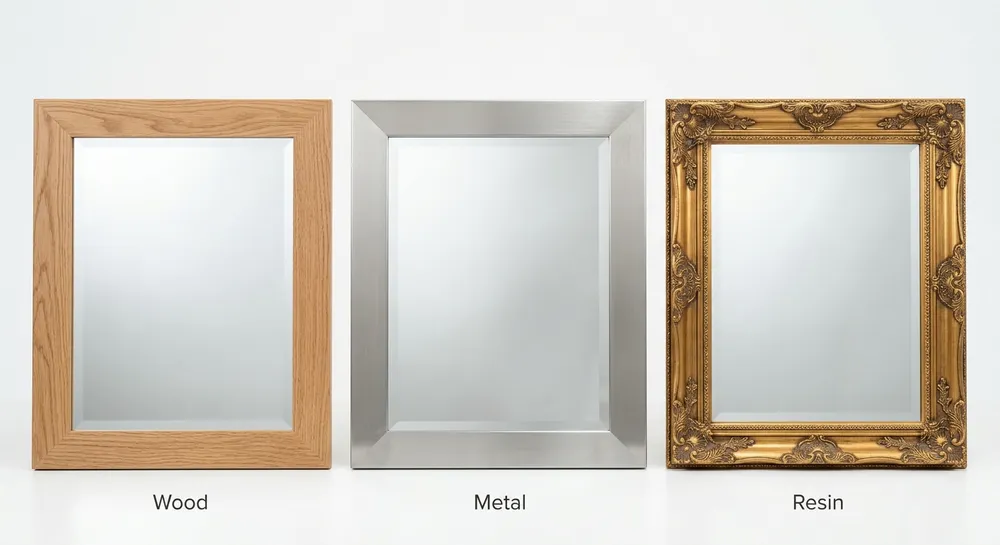
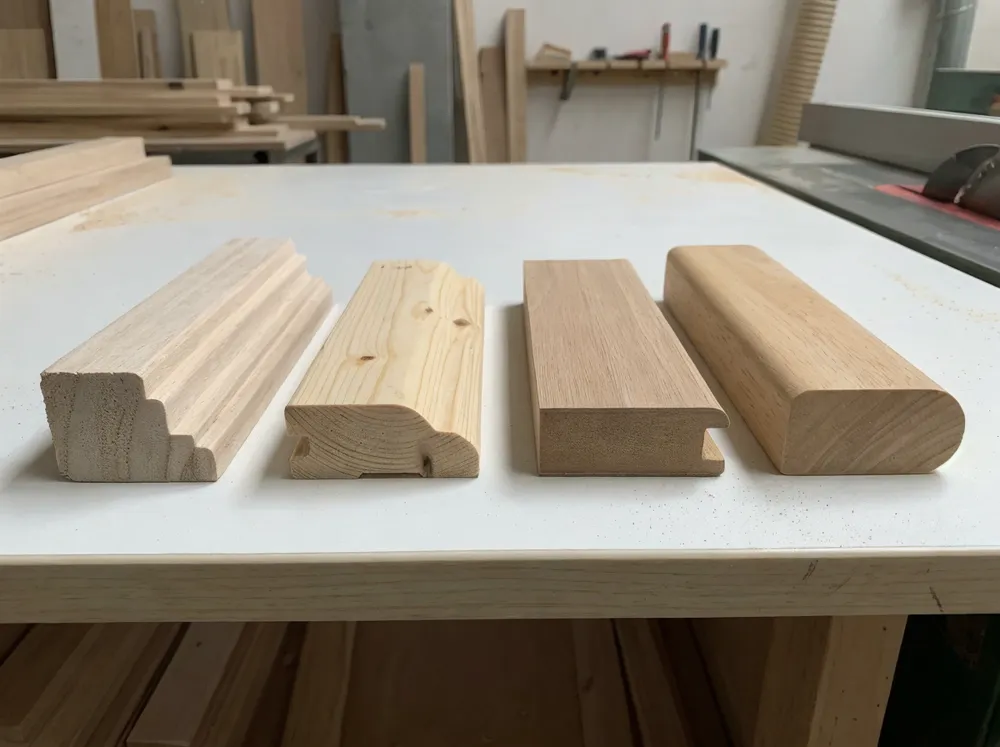
Frame material options and their trade-offs
| Material | Typical profile cost | Moisture resistance | Finish options | Best for |
|---|---|---|---|---|
| MDF | Lowest | Poor without sealing | Paint, foil wrap, gesso | Price-sensitive retail, indoor only |
| Solid wood | Mid–high | Good (species-dependent) | Stain, paint, natural | Premium retail, hospitality |
| Metal (iron/aluminum) | Mid | Excellent | Powder coat, electroplate | Industrial, modern, outdoor-adjacent |
| Resin/polyurethane | Mid | Good | Paint, antique finish | Ornate profiles, high-detail reproduction |
MDF is the most common frame substrate in the decorative mirror category — it machines cleanly, takes paint well, and keeps costs down. The failure mode is moisture: unsealed MDF swells, and swollen MDF at a miter joint is the most common frame failure we see on returned product. If you're specifying MDF frames, require sealed edges and moisture-resistant primer before finish coat. (We use a two-pass sealer on all MDF profiles before any paint goes on — it adds a step, but it's the difference between a frame that survives a humid warehouse and one that doesn't.)
Resin frames are worth understanding if you're selling ornate or antique-style mirrors. The profile detail you can achieve in resin is impossible in MDF or solid wood at the same price point. The trade-off is weight — a heavily detailed resin frame on a large mirror adds meaningful freight cost. We've had buyers switch from resin to high-density polyurethane foam core with resin surface for large formats, which cuts weight by 30–40% without losing the profile detail.
Joint construction — the spec that determines container survival
Miter joints are standard for rectangular frames. The question is how they're reinforced:
- Glue only: adequate for small frames under 40cm, not for anything larger
- Glue + V-nail (corrugated fastener): standard for mid-size frames, good shear resistance
- Glue + corner bracket (metal L-bracket): best for large frames and heavy glass — this is what we use on anything over 60cm
- Dowel + glue: common in solid wood frames, strong but requires precise machining
Specify the joint method in your PO. "Secure joinery" is not a spec — it's an invitation for the factory to use whatever is cheapest that day.
Finish coat specs
For painted frames, specify:
- Primer coat: yes/no, and type (water-based vs. solvent)
- Finish coat count: minimum two for any export product
- Sheen level: matte / satin / gloss
- Color matching: RAL code or Pantone reference, not a photo
For powder-coated metal frames, 60–80μm dry film thickness is the standard range. Below 60μm and you'll see coverage gaps at edges and corners — exactly where moisture gets in. We test coating thickness on every batch with a digital gauge; it takes 30 seconds per frame and catches the outliers before they pack.
For electroplated finishes (gold, silver, bronze), ask for the plating thickness in microns and the base metal. Zinc alloy base with 0.3–0.5μm gold flash is the standard for decorative mirrors — anything thinner will show wear within a year of normal handling.
Backing board and hardware specs: the last line of defense against transit damage
The backing board is the component buyers most consistently under-specify, and it's the one that causes the most moisture-related failures in the field.
Backing board material options
| Material | Moisture resistance | Weight | Cost | Notes |
|---|---|---|---|---|
| Cardboard / grey board | Poor | Light | Lowest | Acceptable only for very small, indoor-only mirrors |
| MDF backing | Moderate | Heavy | Low–mid | Requires sealing; swells if unsealed |
| HDF (high-density fiberboard) | Better than MDF | Moderate | Mid | Better dimensional stability |
| Kraft paper + foam | Poor | Very light | Low | Not suitable for export |
| Plastic composite (PP/ABS sheet) | Excellent | Light | Mid–high | Best for humid markets and bathroom-adjacent use |
For any mirror going into retail distribution or hospitality projects, specify HDF or plastic composite backing. Grey board backing on a 60cm framed mirror going into a Florida retail chain is a warranty claim waiting to happen.
Moisture barrier
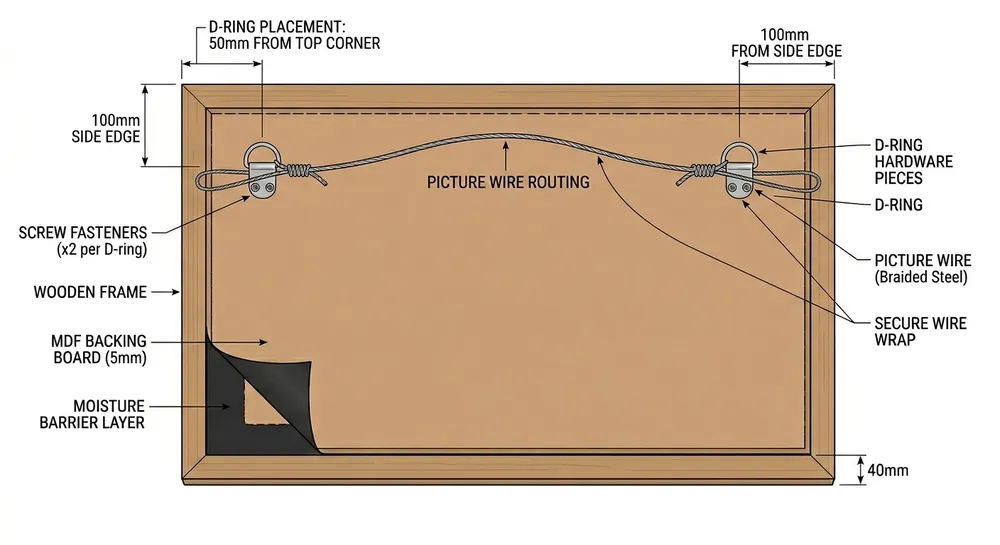
Regardless of backing material, require a moisture barrier layer between the backing board and the silver coating. This is typically a kraft paper or foil layer sealed at the edges. Without it, any moisture that penetrates the frame joint migrates directly to the silver — and that's how you get edge delamination on product that was stored correctly.
Hanging hardware load rating
This is the spec that generates the most liability exposure for distributors and retailers. Specify:
- Hardware type: D-ring, sawtooth, wire, or keyhole plate
- Load rating: minimum 2x the mirror's actual weight (safety factor)
- Fastener type: screws into frame vs. staples — screws only for anything over 3kg
- Wire gauge (if applicable): specify minimum gauge, not just "picture wire"
We rate all hardware at 3x the mirror weight as our internal standard. A 4kg mirror gets hardware rated to 12kg minimum. (We've seen competitors use staple-mounted D-rings on 5kg mirrors — that's not a spec, that's a liability.)
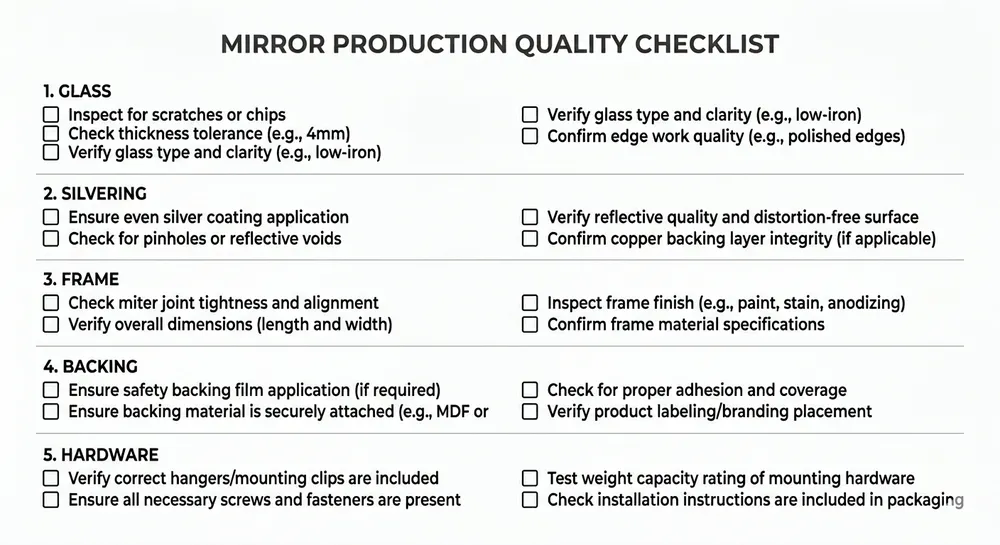
The spec verification checklist: what to put in your PO before confirming production
Most sourcing disputes are preventable at the PO stage. Here's what to lock down in writing before you confirm any framed mirror production run:
Glass
- [ ] Thickness (mm) — specify exact, not "standard"
- [ ] Edge finish type (flat polish / bevel / seamed)
- [ ] Bevel width if applicable (mm)
Silvering and coating
- [ ] Copper-free or copper-backed — specify explicitly
- [ ] Protective paint layer count (minimum 2)
- [ ] Dry film thickness of backing paint (target 40–60μm)
- [ ] Adhesion test method and frequency (per unit vs. per batch)
Frame
- [ ] Substrate material (MDF / solid wood / metal / resin)
- [ ] Joint method and reinforcement type
- [ ] Primer: yes/no, type
- [ ] Finish coat count
- [ ] Color reference (RAL / Pantone — not photo)
- [ ] Coating thickness for powder coat (60–80μm)
- [ ] Plating thickness for electroplate (microns + base metal)
Backing and hardware
- [ ] Backing board material
- [ ] Moisture barrier: yes/no
- [ ] Hardware type (D-ring / sawtooth / wire / keyhole)
- [ ] Hardware load rating (minimum 2x mirror weight)
- [ ] Fastener type (screws vs. staples)
- [ ] Wire gauge if applicable
Packaging
- [ ] Corner protection type
- [ ] Inner carton material
- [ ] Master carton drop-test standard
If a supplier can't confirm these specs in writing before production, that's the answer to your sourcing question.
How vertical production controls spec reliability across every unit
There's a structural reason why spec disputes are more common with trading companies and multi-vendor assemblers than with vertically integrated factories: when different suppliers handle glass, frame, and assembly separately, no single party owns the complete spec. Each vendor optimizes for their own component, and the integration gaps are where failures happen.
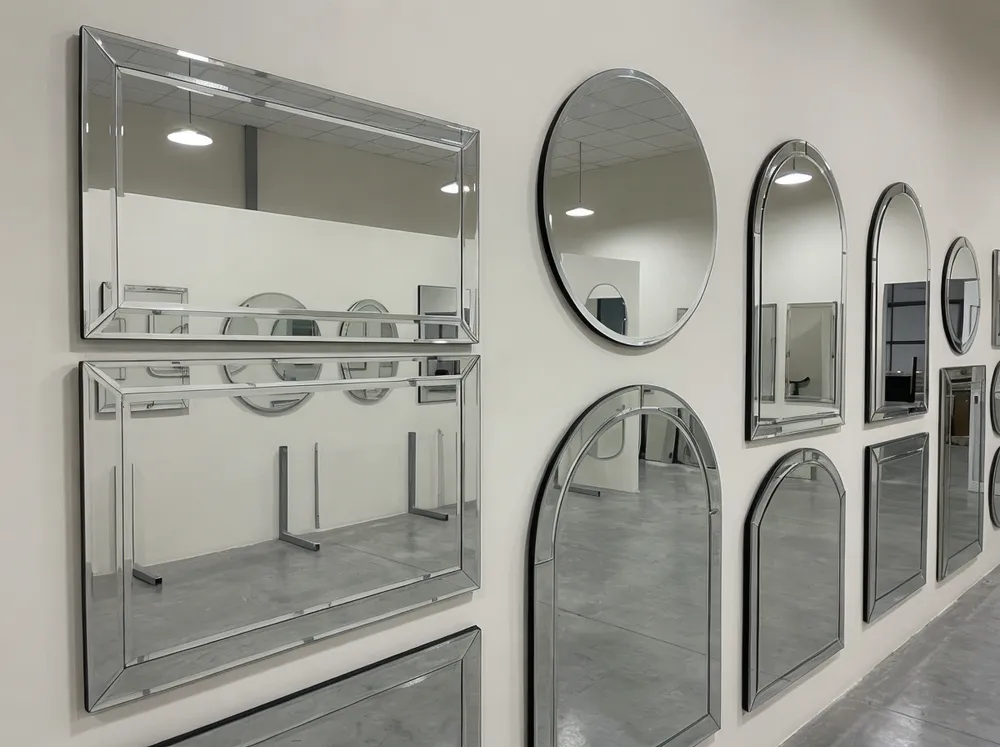
We cut glass, run silvering, mold frames, and do final assembly under one roof on our 12,000 m² facility in Dong Nai. That means when you specify 4mm copper-free glass with flat-polished edges going into an MDF frame with corner-bracket joinery and HDF backing, every step of that spec is executed and inspected by the same team. There's no handoff where a spec gets reinterpreted.
Our 12-person engineering team handles custom frame profile development — if your target retail price requires a specific profile width, finish combination, or joint method, we work that out in sampling before production, not after. For buyers sourcing custom frame mirror orders, this matters: a catalog supplier can't adjust the frame profile to your spec because they don't make the frame. We do.
The 100% visual inspection and silver adhesion testing we run on every unit before packing isn't a marketing claim — it's a process requirement that comes from running our own silvering line. We see every unit. Batch sampling is what you do when you're inspecting someone else's product. (We've had buyers ask why we don't just do AQL sampling to save time. The answer is that our silvering line occasionally produces edge adhesion outliers that only show up under direct light at a specific angle — batch sampling misses them. 100% inspection catches them before they pack.)
For buyers evaluating frame material options across wood, metal, and resin, our engineering team can walk you through the cost-performance trade-offs for your specific target market and price point. The right frame spec for a mid-market US retailer is different from the right spec for a Gulf hospitality project — and those differences show up in the PO, not in a product catalog.
Common failure modes and the specs that prevent them
Understanding why mirrors fail in the field makes the spec checklist above less abstract. These are the failure modes we see most often in returned product and warranty claims:
Edge delamination (silver lifting at mirror perimeter) Cause: moisture infiltration through unsealed frame joints or inadequate backing moisture barrier. Prevention: sealed MDF or HDF backing + moisture barrier layer + two-coat silvering paint at minimum 40μm.
Frame joint separation Cause: glue-only miter joints on frames over 40cm, or MDF swelling from humidity. Prevention: corner bracket reinforcement on frames over 60cm + sealed MDF edges before finishing.
Finish peeling at corners and edges Cause: insufficient primer, single-coat finish, or coating applied over unsealed MDF. Prevention: two-pass sealer on MDF + primer + minimum two finish coats. For powder coat: 60μm minimum dry film thickness.
Glass breakage in transit Cause: undersized glass (3mm on frames over 50cm), raw-cut edges that chip under vibration, inadequate corner protection in packaging. Prevention: 4mm minimum for standard retail sizes + flat-polished or seamed edges + foam corner protection.
Hardware pull-out Cause: staple-mounted D-rings on heavy mirrors, or D-rings positioned too close to the frame edge (less than 25mm from corner). Prevention: screw-mounted hardware on anything over 3kg + D-ring placement at 1/3 height from top.
Each of these is a documented, preventable failure. The spec checklist in the previous section maps directly to these failure modes — every item on that list exists because we've seen what happens when it's missing.
FAQ
What glass thickness should I specify for framed mirrors going into retail distribution?
4mm is the standard for retail-format mirrors in the 40–80cm range. It balances breakage resistance with freight weight. For anything over 80cm, move to 5mm — the incremental cost is small against the breakage risk on a large-format mirror in a retail environment. For small decorative mirrors under 40cm, 3mm is acceptable if the packaging includes adequate corner protection.
What's the difference between copper-free and copper-backed silvering, and does it matter for my market?
Copper-backed silvering uses a copper interlayer that improves initial adhesion but corrodes over time in humid conditions — that's the source of the black edge spots ("foxing") on older mirrors. Copper-free silvering eliminates the copper layer and uses a chemical adhesion promoter instead. For markets with high humidity, coastal distribution, or bathroom-adjacent retail placement, copper-free is worth specifying. For dry-climate indoor retail, the difference is less critical, but copper-free is still the better long-term spec.
How do I verify frame joint quality before committing to a production run?
Request a pre-production sample and do a simple stress test: hold the frame at one corner and apply moderate diagonal pressure. A glue-only miter joint will show flex or audible creak. A properly reinforced joint (corner bracket or V-nail + glue) won't move. Also check the inside corner of the miter under direct light — gaps wider than 0.5mm indicate poor machining or inadequate clamping during assembly. For large-format mirrors, ask the supplier to specify the joint reinforcement method in writing before sampling.
What backing board material should I specify for mirrors going into humid markets?
HDF (high-density fiberboard) is the minimum for humid-market distribution. Plastic composite (PP or ABS sheet) is better if your retail channel includes bathroom-adjacent placement or coastal markets. Grey board and standard cardboard backing are only appropriate for small, dry-climate indoor mirrors. Regardless of backing material, require a moisture barrier layer between the backing and the silver coating — this is the single most effective spec for preventing edge delamination in the field.
What MOQ applies to custom frame profiles and finishes?
For standard catalog profiles with custom color or finish, our MOQ starts at 100 pieces. For fully custom frame profiles (new tooling required), the minimum is typically 300–500 pieces depending on profile complexity. Our engineering team can confirm the exact threshold once we review your profile drawings or reference samples. See our OEM ODM Services page for the full custom development process.
How do I know if a supplier's spec claims are actually enforced in production?
Ask for their QC process documentation, not just their certifications. ISO 9001 tells you they have a quality management system — it doesn't tell you whether they test adhesion per unit or per batch, or whether they use a digital gauge on coating thickness. Ask specifically: "Do you test silver adhesion on every unit or by sampling?" and "What is your coating thickness measurement frequency?" A factory that runs 100% inspection will answer that question immediately. A factory that doesn't will give you a vague answer about "strict quality control."
—
For a detailed technical proposal on your specific frame profile, glass thickness, finish, and quantity requirements, Request Quote — our engineering team will confirm specs and pricing based on your exact configuration. You can also browse our full Decor Mirrors by Material & Frame range to see which frame constructions are available in standard production.