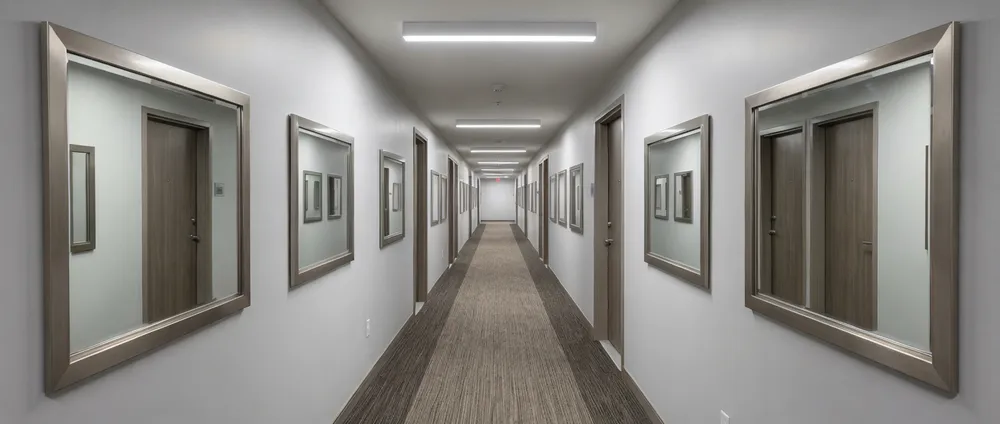
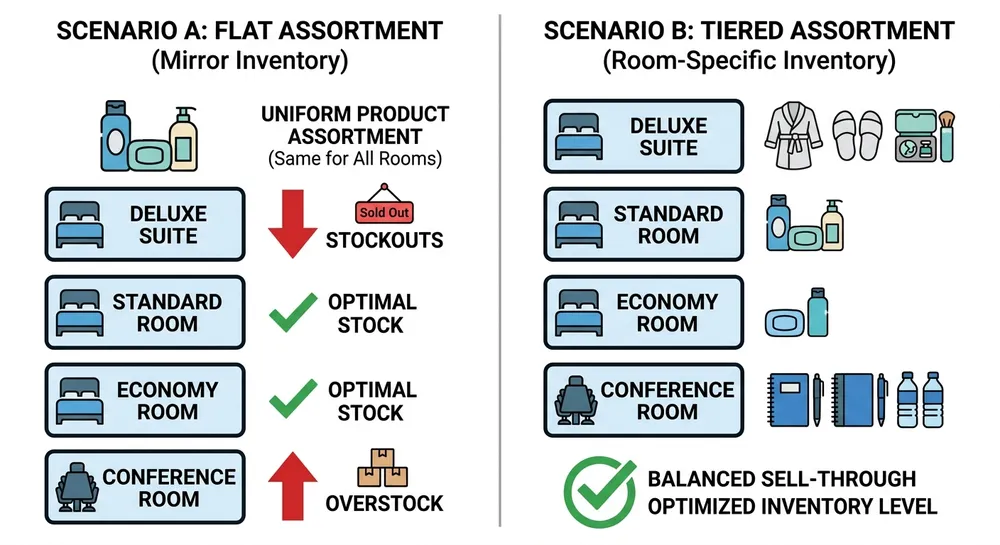
The most common inventory mistake I see from new mirror buyers isn't ordering too many units. It's ordering the wrong mix — a flat assortment that ignores how differently mirrors actually perform by room category.
A buyer comes in wanting to cover "all rooms." They order 500 units split across bathroom, living room, bedroom, and hallway styles, all in the same frame profile, same glass spec, same size range. Six months later, the bathroom SKUs are sold out and the oversized living room panels are sitting in the warehouse because the frame finish doesn't read right for that application. The reorder on bathrooms is delayed because the original MOQ was too high to test quickly. The living room units get marked down.
That's not a demand problem. It's a product line architecture problem — and it's fixable before you place your first order.

Why Room-Agnostic Assortments Create Dead Stock
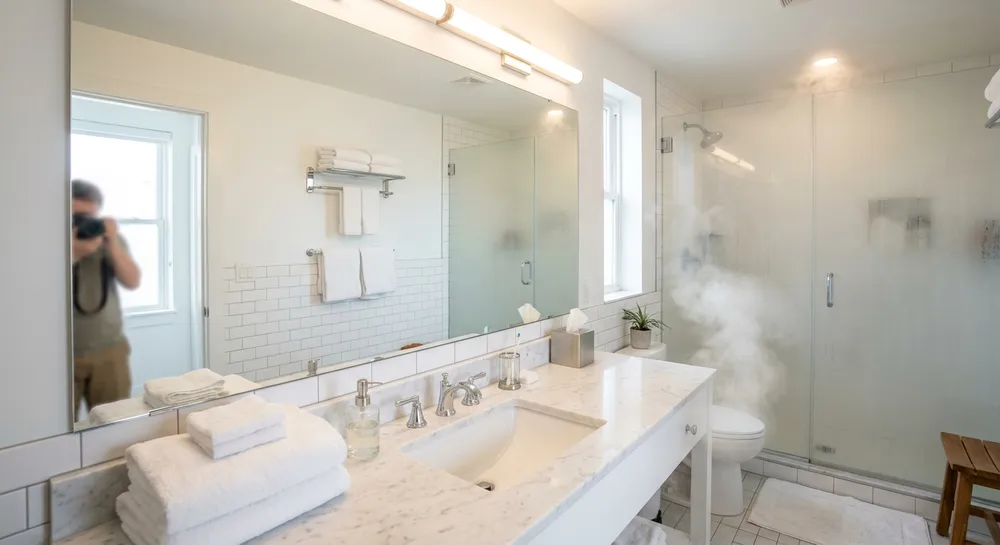
A bathroom mirror and a living room mirror share a factory — but almost nothing else in the spec sheet. The room determines the moisture exposure, the typical size range buyers expect, the frame material that survives the environment, and the price tier your downstream customer will accept.
When you flatten those differences into a single product profile, you're making a bet that one spec fits all rooms. It rarely does. Here's where the divergence actually hurts:
Glass coating: Bathroom mirrors need copper-free, lead-free silvering to resist moisture penetration at the edges. Standard silver coating works fine in a living room or bedroom — but put it in a high-humidity bathroom and you'll see edge blackening within 18 months. That's a warranty claim, not a design choice.
Frame material: MDF frames with standard paint finish are fine for dry rooms. In bathrooms, MDF absorbs moisture at cut edges and swells. Buyers who don't specify moisture-resistant MDF or switch to aluminum or resin frames for bathroom SKUs end up with returns.
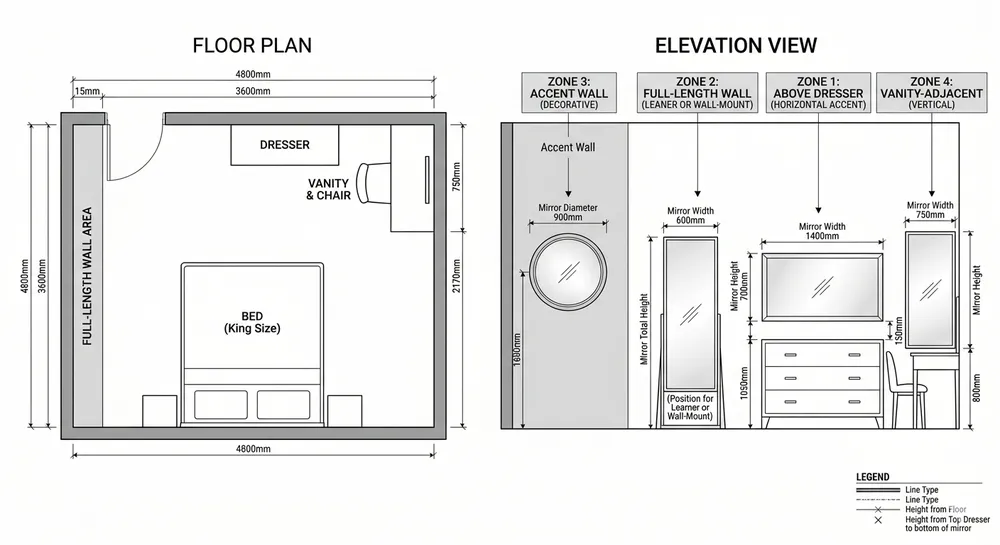
Size range: Living room and dining room mirrors run large — 24"×36" up to 36"×48" and beyond. Bathroom vanity mirrors cluster tighter: 24"×30", 28"×36", 30"×36". Hallway mirrors are tall and narrow. If you order one size range across all rooms, you're either undersized for living rooms or oversized for bathrooms.
Price tier: Buyers in the hospitality segment pay more for bathroom mirrors because the spec requirements are stricter. Retail buyers expect living room mirrors to carry a higher decorative premium. Mixing specs means you can't price-tier correctly — and you leave margin on the table.
The fix isn't complexity. It's a structured spec matrix before you build the SKU list.
Room-by-Room Spec Matrix
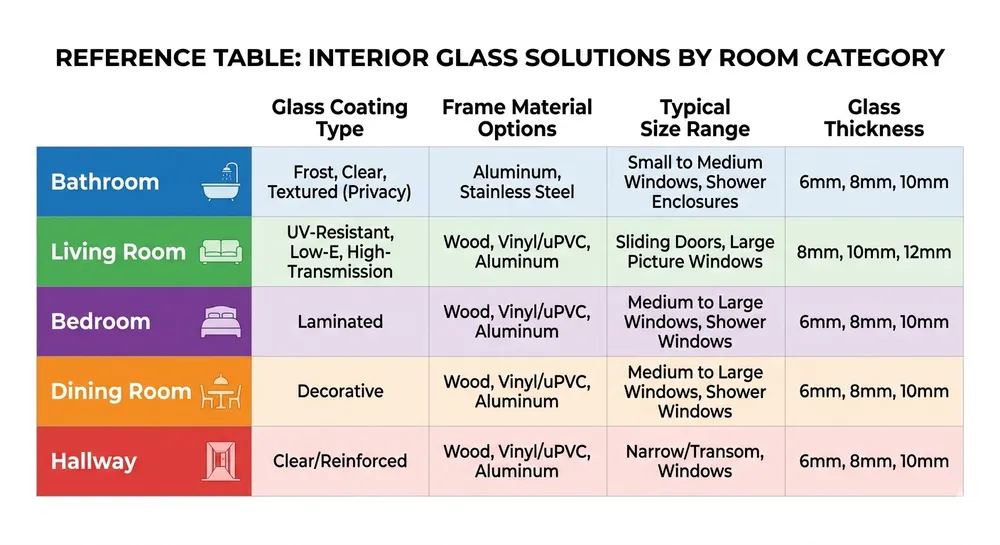
This is the working framework we use when helping buyers build a new room-based decor mirror product line. Each room has a spec floor — the minimum requirements that prevent returns — and a typical size range that drives sell-through.
| Room | Glass Coating | Frame Material | Typical Size Range | Glass Thickness |
|---|---|---|---|---|
| Bathroom | Copper-free, lead-free silver | Aluminum, resin, or moisture-resistant MDF | 24"×30" to 30"×40" | 4mm |
| Living Room | Standard silver | MDF, wood, metal | 24"×36" to 36"×48" | 5mm |
| Bedroom | Standard silver | MDF, wood, resin | 20"×28" to 30"×40" | 4–5mm |
| Dining Room | Standard silver | Wood, metal, resin | 24"×36" to 40"×60" | 5mm |
| Hallway | Standard silver | MDF, metal | 14"×48" to 18"×60" | 4mm |
A few notes from production experience: the 4mm vs. 5mm glass call matters more than buyers expect. Thicker glass adds weight, which changes your hardware spec and your per-carton shipping weight. For hallway mirrors — which are tall and narrow — 4mm is almost always the right call. For large living room panels above 36"×48", 5mm gives the structural rigidity that prevents flex distortion in the frame. (We've had buyers spec 4mm on oversized panels to save cost, then deal with returns because the mirror bowed slightly in transit. The freight savings don't cover the RMA cost.)
Phase Your SKU Rollout — Don't Launch All Rooms at Once
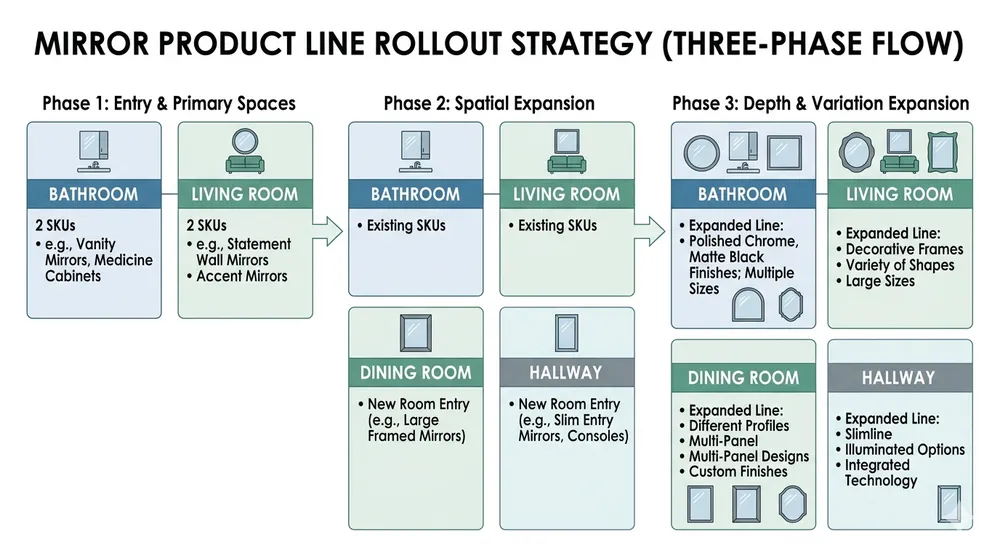
The second structural mistake is launching all five room categories simultaneously. You end up with too many SKUs to manage, too much capital tied up in untested inventory, and no sell-through data to guide your reorder decisions.
The better approach: start with three or four high-velocity room categories, validate demand at low MOQ, then expand based on what actually moves.
Phase 1 — High-demand anchor rooms (launch SKUs):
Start with bathroom decor mirrors and living room decor mirrors. These two categories drive the highest search volume and the most consistent reorder behavior across retail and hospitality channels. Add bedroom decor mirrors if your channel skews residential.
For each room, start with two SKUs: one mid-size (the most common size in that room's range) and one size up. That gives you a price ladder without fragmenting inventory across too many variants.
At 100-piece MOQ per SKU, you can test four SKUs across two rooms for 400 units total — a manageable first order that gives you real sell-through data within 60–90 days.
Phase 2 — Expand based on sell-through data:
Once you have 60 days of sales data, you know which room categories are moving and which sizes within each room are turning fastest. Add dining room decor mirrors and hallway decor mirrors in Phase 2, using the same two-SKU-per-room approach.
By Phase 2, you also have enough volume history to negotiate better pricing on your Phase 1 reorders — and you're not sitting on 90 days of slow-moving hallway inventory while your bathroom SKUs are on backorder.
Phase 3 — Deepen, don't just widen:
The temptation at Phase 3 is to add more rooms. Resist it. Depth in your best-performing rooms — additional sizes, a second frame finish, a premium glass option — generates more margin per SKU than spreading thin across new categories. Add rooms only when your existing categories are consistently selling through at 80%+ within 45 days of receipt.
Shared Frame Profiles Cut Tooling Cost and Simplify Reorders
One of the highest-leverage decisions in building a room-based line is choosing which frame profiles to share across rooms and which to keep room-exclusive. Get this wrong and you end up with five separate tooling setups, five separate reorder minimums, and five separate lead times.
The logic is straightforward: if a frame profile works in both the bedroom and the living room, you don't need two SKUs — you need one frame in two sizes. That consolidates your tooling cost, reduces your supplier's setup complexity, and lets you reorder a single frame profile in mixed sizes rather than managing separate POs per room.
Profiles that share well across rooms:
- Simple flat MDF frames in matte black, white, or natural wood finish — work in bedroom, living room, and hallway without looking out of place in any of them
- Thin metal frames (aluminum or iron) in brushed gold or matte black — cross-applicable in bathroom, bedroom, and hallway
- Resin frames with a plaster or concrete texture — work in living room and dining room, increasingly in bedroom
Profiles that need to stay room-exclusive:
- Ornate carved wood or resin frames — these read as living room or dining room; they look wrong in a bathroom or hallway
- Frameless or minimal-edge designs — these are bathroom-specific in most retail channels; putting them in a living room assortment confuses the buyer
- Oversized decorative panels with gallery-style frames — living room and dining room only; the scale doesn't work in a hallway or bathroom
We run frame tooling in-house across MDF, metal, resin, and wood, so when a buyer wants to test a shared profile across three room categories, we can produce all three in a single production run. That matters for mixed-room orders — you're not waiting on separate tooling setups per room. (This is one of the reasons buyers who start with us on bathroom mirrors end up consolidating their living room and bedroom sourcing here too — one supplier, one QC standard, one shipment.)
For a deeper look at how specs diverge between the two highest-volume categories, see our bathroom vs living room mirror specs guide.
When to Add a New Room vs. Deepen an Existing One
This is the decision that separates buyers who build profitable product lines from buyers who build complicated ones. The question isn't "should we add hallway mirrors?" — it's "does adding hallway mirrors generate more margin than deepening our bathroom assortment?"
Run this check before adding any new room category:
- Sell-through rate on existing rooms: If your current rooms aren't clearing 70%+ within 60 days of receipt, adding a new room doesn't fix the problem — it compounds it. Fix sell-through first.
- Incremental buyer demand: Is your channel actually asking for the new room category? Distributor feedback and retail buyer requests are more reliable signals than category trend reports.
- Shared frame opportunity: If the new room category shares a frame profile with an existing room, the tooling cost is near zero and the reorder is simpler. That's a green light. If it requires a new exclusive frame profile, the economics need to justify the tooling investment.
- MOQ test viability: Can you test the new room at 100–200 units without disrupting your existing reorder schedule? If the new room requires a container commitment before you have sell-through data, wait.
The decision tree is simple: shared frame + existing buyer demand + low MOQ test = add the room. New exclusive frame + no confirmed buyer demand + container MOQ = deepen existing rooms instead.
Most buyers who come to us with overstock problems made the same call: they added rooms before validating demand in their anchor categories. The fix is almost always to pause new room expansion, run a clearance cycle on slow SKUs, and rebuild the assortment from the two or three rooms that actually move.
Common Mistakes That Create Overstock
These show up consistently across buyers at every volume level:
Over-segmenting before validating demand. Launching seven room categories with three SKUs each gives you 21 SKUs to manage before you know which two rooms drive 80% of your revenue. Start narrow.
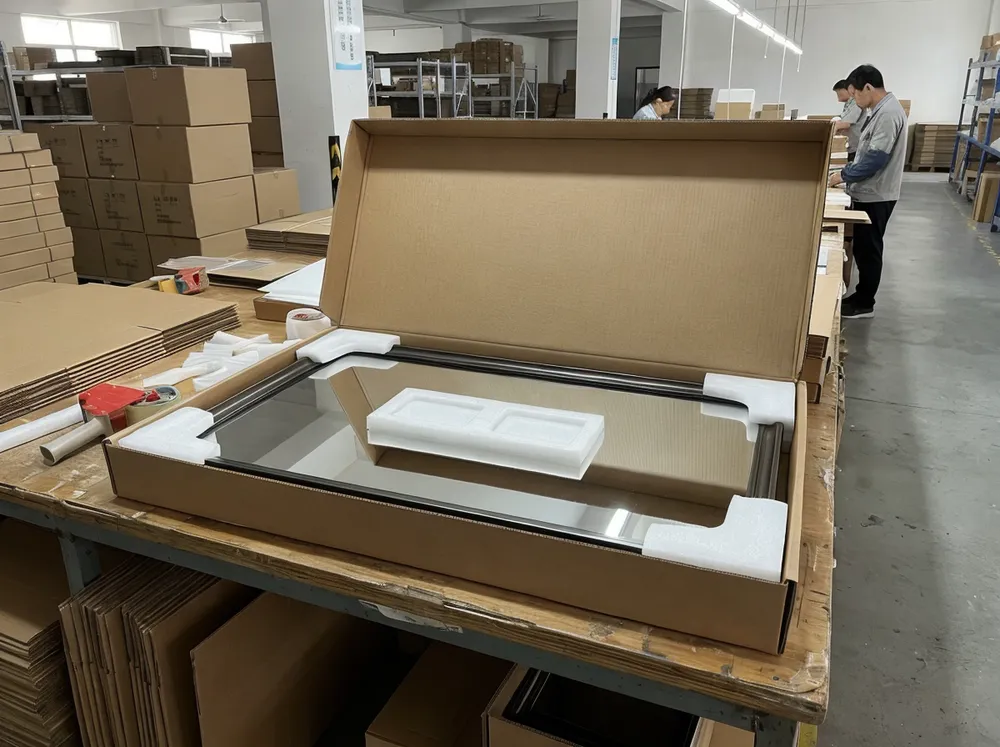
Ignoring packaging differences across rooms. Bathroom mirrors ship in moisture-barrier poly bags inside cartons. Large living room panels need corner protection and foam inserts that add carton volume. If you're planning a mixed-room container, the packaging spec affects your carton count and your container utilization. We build packaging specs per room category — it's not an afterthought.
Ordering full containers on untested SKUs. A 40' container of a new hallway mirror SKU is 800–1,000 units depending on size. If you haven't sold that SKU before, that's a significant inventory risk. Use the 100-piece MOQ to test first, then scale to container quantities on proven SKUs.
Treating all rooms as equal velocity. Bathroom and living room mirrors turn faster than dining room and hallway in most retail channels. Your reorder schedule should reflect that — don't apply the same reorder point to all rooms.
Skipping the coating spec on bathroom SKUs. Standard silver coating in a bathroom is a warranty claim waiting to happen. Copper-free silvering is our default on all bathroom mirror production — it's not a premium option, it's the baseline spec for that room. Buyers who don't specify it explicitly sometimes receive standard coating from other suppliers and don't find out until the returns start.
Sizing Your Initial Order Without Overcommitting
The room mirror sizing guide covers size selection in detail, but from an inventory planning standpoint, the rule is: start with the mid-range size in each room category, not the full size range.
For a Phase 1 order across bathroom and living room:
- Bathroom: 24"×30" and 28"×36" — these two sizes cover the majority of vanity applications in both residential and hospitality channels
- Living room: 24"×36" and 30"×40" — mid-range sizes that work across most wall configurations without the freight premium of oversized panels
At 100 pieces per SKU, that's 400 units total. Manageable to warehouse, fast enough to generate sell-through data, and small enough that if one SKU underperforms, you're not sitting on 500 units of dead inventory.
Once you have 90 days of data, you'll know whether to add the larger sizes (which carry better margin but slower turns) or stay in the mid-range and expand to a second room category instead.
FAQ
What's the minimum order to test a new room category without a container commitment?
Our standard MOQ is 100 pieces per SKU on standard models. For a two-SKU room test (two sizes in one room category), that's 200 units — shippable by LCL without a full container commitment. Most buyers use this for Phase 1 validation before scaling to FCL quantities on proven SKUs.
Do bathroom mirrors require a different supplier than living room mirrors?
Not if your supplier runs copper-free silvering as a standard process. We default to copper-free, lead-free silver coating on all bathroom mirror production — it's built into the spec, not a separate product tier. Buyers who source bathroom and living room mirrors from the same supplier with the same QC standard avoid the spec inconsistency problems that come from splitting the assortment across two factories.
How do I know when a frame profile is safe to share across room categories?
The test is whether the frame reads correctly in both rooms at retail. Simple flat profiles in neutral finishes (matte black, white, natural wood) cross-apply well. Ornate or decorative profiles are room-specific. When in doubt, send us your target rooms and the frame profile you're considering — we'll tell you whether it's been used successfully across those categories in our existing buyer programs.
What causes edge blackening on bathroom mirrors and how do I prevent it?
Edge blackening is oxidation of the silver layer at the mirror's perimeter, caused by moisture penetrating the backing. It's almost always a coating spec problem, not a manufacturing defect. Copper-free silvering with a proper edge sealing process prevents it. If you're seeing edge blackening on bathroom mirrors within 18–24 months, the supplier is using standard silver coating without adequate edge protection. Specify copper-free coating and ask for the backing material spec before ordering.
Can I mix room categories in a single production order?
Yes. Our 6 production lines run mixed room-category orders in a single shipment. A typical mixed order might include bathroom, bedroom, and living room SKUs in one PO — different specs per room, consolidated into one container. We build the room-specific specs (coating, frame, hardware) into the production order at the SKU level, so you're not managing separate POs per room category.
For a full overview of our room-specific mirror programs, visit our Decor Mirrors by Room category page. When you're ready to build your product line, Request Quote with your target room categories, quantity estimates per SKU, and any frame or finish preferences — we'll return a product-line proposal with pricing tiers and a phased production plan.