Livewellcraft

DNOOO blank theme is active for local preview.

Room Decor Mirror Demand Trends Reshaping the US Home Furnishing Market in 2026

The US home furnishing market doesn't move as one block. Bathroom mirror demand runs on renovation cycles and new construction. Living room mirrors track interior design trends and retail channel velocity. Bedroom mirrors follow housing turnover. If you're sourcing decorative mirrors for US distribution or retail placement, treating all room categories the same is how you end up with overstock in one SKU and backorders in another.

We ship to US distributors and retailers year-round. The reorder patterns we see across our room-specific lines tell a clearer story than most published market reports — because reorders reflect what's actually selling through, not what consumers say they want in a survey.

This breakdown covers where US demand is moving by room category in 2026, what's driving each shift, and what those signals mean for your inventory mix and sourcing decisions.
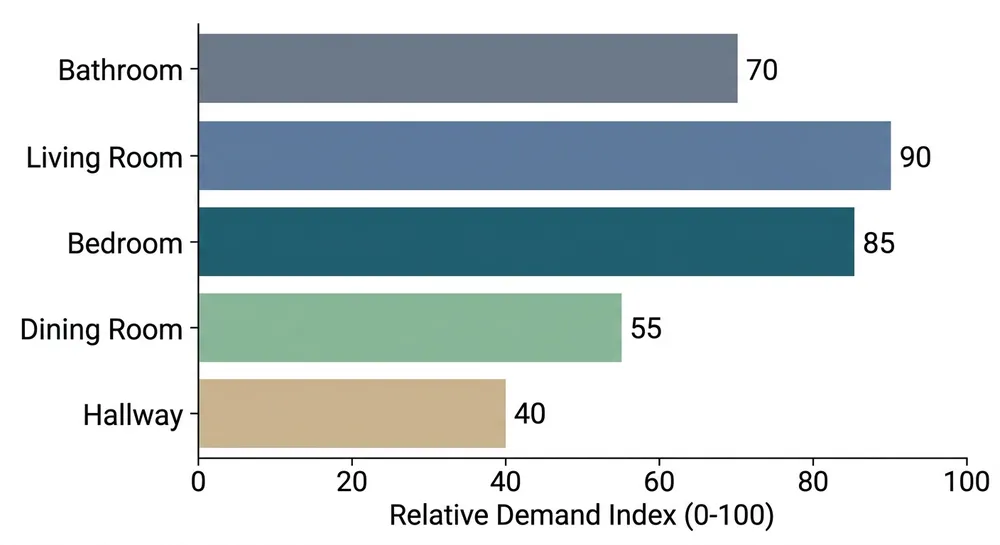
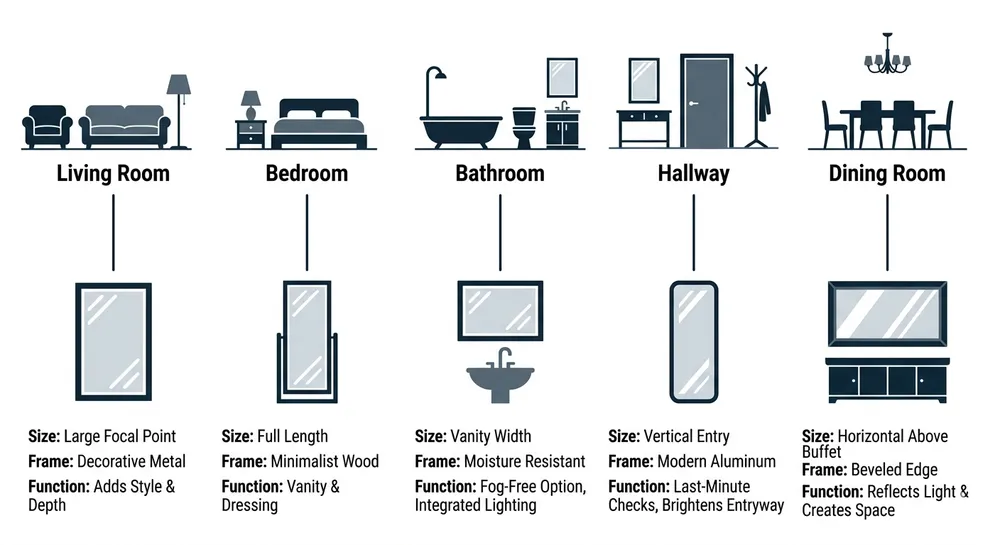
Bar chart comparing relative demand growth across bathroom, living room, bedroom, dining room, and hallway mirror categories in the US market

How US Housing and Renovation Cycles Drive Room-Specific Mirror Volume

Before getting into room-by-room numbers, it helps to understand what's actually moving the market at the macro level — because the same macro signal hits different room categories differently.

US housing starts have been running below historical averages since 2023, constrained by elevated mortgage rates. That suppresses new-construction-driven demand for full-room mirror packages. What it does instead is push spending into renovation: existing homeowners who aren't moving are upgrading in place. Bathroom remodels and living room refreshes are the two highest-frequency renovation categories, which is exactly why those two mirror segments are holding volume while some other home furnishing categories have softened.

The other factor is the retail channel mix. Mass-market retailers (Walmart, Target) and online platforms (Wayfair, Amazon) now account for a larger share of decorative mirror sales than specialty home stores. That shift matters for sourcing because mass and online channels have different velocity profiles — faster turns, tighter margin tolerance, and stronger preference for SKUs that photograph well and ship flat. We've seen this directly in how our US buyers structure their POs: more emphasis on retail-ready packaging, more requests for KD (knock-down) configurations on larger frames, and more attention to carton drop-test compliance.

(We added a dedicated retail compliance review step to our QC process in 2022 specifically because of Wayfair and Amazon requirements — it's now standard on all North America-bound orders.)

The third driver is the hospitality and multifamily sector. Hotel renovation cycles and apartment fit-out projects generate bulk mirror orders that don't show up in consumer trend surveys but are very real in wholesale volume. Bathroom and bedroom mirrors dominate this channel, with consistent spec requirements that make them ideal for repeat OEM programs.

Bathroom Mirrors: The Highest-Volume Room Category, Still Growing

Bathroom mirrors are the single largest room category in US decorative mirror demand, and they've held that position for years. The reasons are structural: every bathroom needs at least one mirror, renovation frequency is high, and the category has expanded well beyond the basic frameless rectangle.

What's changed in 2026 is the spec profile of what's selling. Frameless LED backlit mirrors have moved from a premium niche to a mainstream SKU in the $80–$180 retail price band. Anti-fog coating is now a near-standard expectation in the mid-tier and above. Buyers who were sourcing plain silver-framed bathroom mirrors three years ago are now fielding customer demand for integrated lighting and moisture-resistant finishes.

From a production standpoint, LED bathroom mirrors require a different supply chain than standard decorative mirrors — driver components, wiring harnesses, touch-switch integration. We run these on a dedicated line because mixing them with standard frame production creates scheduling conflicts. The glass spec also differs: bathroom mirrors typically use 5mm float glass with copper-free silver coating for moisture resistance, versus the 4mm glass common in living room decorative frames.

For wholesale buyers, the bathroom category offers strong reorder predictability. Renovation contractors and hospitality buyers tend to standardize on 2–3 SKUs and reorder consistently. The risk is over-speccing: buyers who chase every LED feature end up with a price point that doesn't move at retail. The sweet spot we see from US distributor reorders is a clean rectangular or arch-top mirror, 24"×36" or 30"×40", with anti-fog and basic LED backlight, retailing at $120–$160.

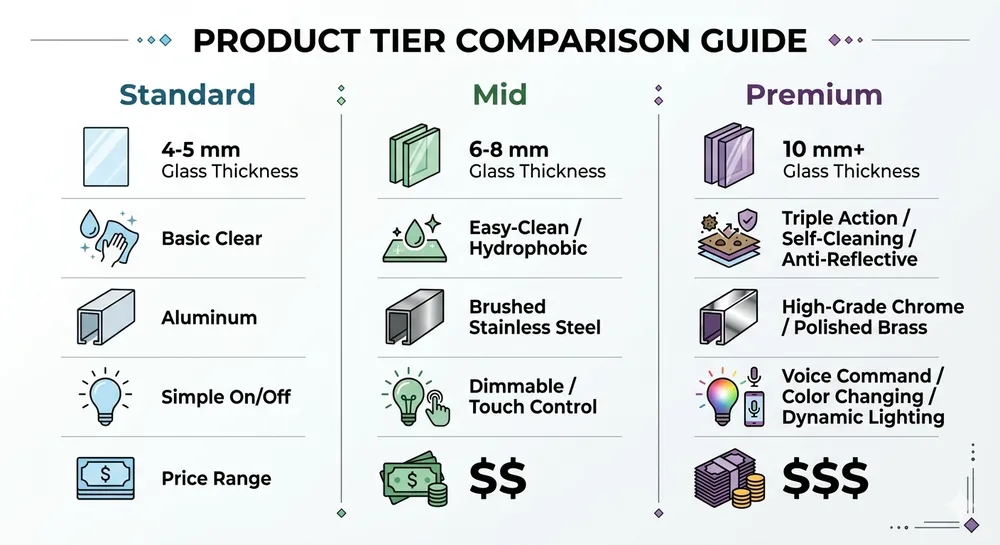
Spec Parameter Standard Tier Mid Tier Premium Tier
Glass thickness 4mm 5mm 5mm
Silver coating Standard Copper-free Copper-free
Frame Aluminum or MDF Aluminum Frameless or metal
LED None Backlit Backlit + dimmer + CCT
Anti-fog No Yes Yes
Typical retail price $40–$80 $90–$160 $180–$350
Spec comparison table visual for bathroom mirror tiers showing glass, coating, frame, and LED feature differences

Explore our full bathroom decor mirrors range for current specs and MOQ options.

Living Room Mirrors: Design-Driven Demand with Strong Margin Potential

Living room mirrors are the second-largest category by volume and the highest-margin opportunity in the decorative mirror segment. The reason is simple: living room mirrors are bought for visual impact, not just function. That gives you room to work with frame design, finish, and size in ways that justify a higher price point.

The dominant trend in 2026 is oversized statement mirrors — arched, sunburst, and irregular organic shapes in the 40"–60" height range. These are driven by interior design content on social platforms, which has accelerated the adoption of design trends that previously took 3–5 years to move from editorial to mass retail. What was a boutique hotel lobby aesthetic in 2022 is now a mainstream Wayfair SKU in 2025.

Frame material preferences have shifted noticeably. Metal frames — brushed gold, matte black, antique brass — have taken share from painted MDF in the living room category. The shift reflects both aesthetic preference and a practical retail consideration: metal frames photograph better in online listings, which matters when 60%+ of decorative mirror sales happen through e-commerce channels.

We've seen this in our own order mix. Three years ago, roughly 70% of our living room mirror frames were MDF-based. Today it's closer to 50/50, and the metal frame orders tend to be larger because buyers are more confident in the sell-through. (The trade-off: metal frame tooling costs more upfront for custom profiles, so buyers who want proprietary designs need to plan for a higher NRE investment.)

For distributors building a living room mirror line, the SKU architecture that's working for our US buyers right now is: one entry-level rectangular metal frame in 24"×36", one arch-top statement piece in 30"×60" or 36"×60", and one decorative accent mirror (sunburst or organic shape) for the $80–$120 retail slot. That three-SKU structure covers the main price bands without over-fragmenting inventory.

See how living room decor mirrors are structured across our current product line, or read our deeper analysis of living room mirror trends for frame and finish specifics.

Bedroom Mirrors: Fastest-Growing Wholesale Reorder Category

Bedroom mirrors are where we've seen the sharpest increase in reorder frequency from US distributors over the past 18 months. The category was historically dominated by full-length floor mirrors and over-dresser styles, but the product mix has broadened considerably.

The growth is coming from two directions. First, the full-length leaner mirror has become a near-commodity SKU — every mass retailer carries one, and the price compression has been significant. That's pushed buyers toward differentiated bedroom mirror formats: arched full-length mirrors with decorative metal frames, wall-mounted full-length mirrors with integrated storage hooks, and oversized rectangular mirrors used as bedroom focal points rather than purely functional dressing mirrors.

Second, the multifamily and hospitality channel has increased bedroom mirror volume substantially. Apartment developers and hotel renovation projects specify bedroom mirrors in quantities of 50–500 units per project, with consistent specs and tight delivery windows. This is a different buyer profile than retail distribution — they care less about design trend and more about spec consistency, lead time reliability, and the ability to reorder the same SKU 12 months later without a spec change.

From a production standpoint, full-length bedroom mirrors (typically 16"×60" to 24"×72") require careful attention to glass handling and packaging. A 24"×72" mirror at 5mm glass weighs roughly 18–22 kg before framing — carton engineering matters a lot for damage rates in transit. We run a separate packaging validation for full-length mirrors because the failure mode (glass breakage in the last mile) is expensive for everyone.

The frame finish preferences in bedroom mirrors skew toward warmer tones than living room: natural wood, rattan-wrapped, and warm metal (gold, brass) outperform the matte black that dominates living room. This is worth noting if you're building a cross-room line — you can't always use the same frame finish across categories and expect consistent sell-through.

Explore bedroom decor mirrors for current sizing options and frame configurations.
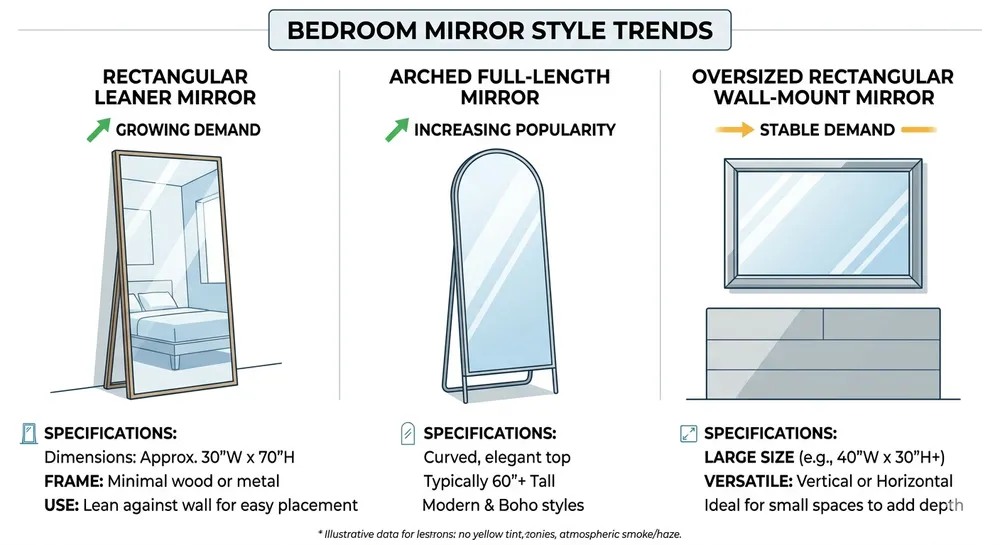
Comparison of bedroom mirror formats showing full-length leaner, arched wall-mount, and oversized rectangular styles with relative demand indicators

Dining Room and Hallway Mirrors: Smaller Volume, Stronger Margin per Unit

Dining room and hallway mirrors don't move the same volume as bathroom or living room, but they punch above their weight on margin. These are typically statement pieces — large, decorative, often with ornate or architectural frames — where design differentiation justifies a higher price point and buyers aren't as price-sensitive as in the commodity bathroom segment.

Dining room mirrors in the US market tend to run large: 36"×48" and above is common, with rectangular and arched formats dominant. The frame aesthetic leans traditional to transitional — carved wood, antique gold, and aged silver finishes still sell well in this category, even as other room categories have moved toward contemporary metal. This is one area where MDF frame molding with decorative finish still has a clear commercial role, because the ornate profiles that work in dining rooms are difficult and expensive to execute in metal.

Hallway mirrors are a different use case. The primary format is tall and narrow — 14"×60" to 18"×72" — and the functional requirement (checking appearance before leaving the house) means full-length visibility matters. The design trend in hallway mirrors has moved toward entryway mirror-and-storage combinations, but pure decorative hallway mirrors with slim metal or wood frames remain a steady wholesale SKU.

For buyers building a multi-room mirror line, dining room and hallway SKUs are worth including not for volume but for average order value. A distributor who can offer a complete room-by-room mirror assortment to a hotel buyer or interior design trade account closes larger POs than one who only covers bathroom and bedroom.

Room-by-Room Demand Summary: Sourcing Signals for 2026

Room Category Demand Level Growth Signal Key Spec Shift Primary Buyer Type
Bathroom High Steady LED + anti-fog mainstream Retail, hospitality, renovation
Living room High Growing Metal frames, oversized formats Retail, e-commerce
Bedroom Medium-High Fast growing Arched/decorative full-length Retail, multifamily, hospitality
Dining room Medium Stable Large format, traditional frames Trade, hospitality
Hallway Medium Stable Slim full-length, entryway formats Retail, trade

The practical read for SKU planning: bathroom and living room justify deeper inventory and faster reorder cycles. Bedroom is worth expanding if you're not already covering the arched and decorative full-length formats. Dining room and hallway are margin contributors that round out a complete room-based assortment.

What Multi-Room Sourcing Actually Requires from a Supplier

Sourcing mirrors across multiple room categories from a single supplier sounds straightforward. In practice, it requires a factory that can handle meaningfully different production specs under one roof — because a bathroom mirror and a living room mirror share almost nothing in the spec sheet beyond the glass itself.

Bathroom mirrors need moisture-resistant silver coating, often LED integration, and aluminum or frameless construction. Living room statement mirrors need decorative frame molding capability, metal fabrication for contemporary profiles, and packaging engineered for large-format pieces. Bedroom full-length mirrors need glass handling infrastructure for heavy panels and carton engineering for last-mile damage prevention. Dining room mirrors need ornate MDF molding capability and decorative finishing.

At Livewellcraft, we run 6 production lines across a 12,000 m² facility specifically because room-specific mirror programs require dedicated line capacity. We don't run bathroom LED mirrors on the same line as large decorative frames — the setup, materials, and QC checkpoints are different enough that mixing them creates quality risk. Our 12-person engineering team handles custom frame profile development across all room categories, so buyers building a multi-room line don't need to manage separate tooling conversations with separate suppliers.

Our 400,000-piece annual capacity means a buyer adding two or three new room categories to their existing program doesn't push us into allocation constraints. We've handled cross-room POs from US distributors that cover bathroom, living room, and bedroom SKUs in a single order — the logistics of coordinating specs, lead times, and container loading across categories is something we manage on our end, not something we hand back to the buyer to figure out.

(One thing we've learned from multi-room POs: the packaging spec review is where most problems surface. Different room categories have different carton requirements, and a buyer who approves specs category by category without a consolidated packaging review ends up with mixed carton sizes that complicate container loading. We now do a consolidated packaging review for any PO covering three or more room categories.)

For buyers evaluating whether to consolidate room-specific mirror sourcing with a single factory, the questions worth asking are: Does the factory have dedicated line capacity for each room category, or does it run everything on shared lines? Does it have in-house glass processing (cutting, silvering, beveling) or does it outsource? Can it show you QC records by room category, not just aggregate pass rates?

We hold ISO 9001:2015 certification with SGS and BSCI audit records available on request — and we can provide room-category-specific QC data for buyers who want to verify consistency across their full assortment.
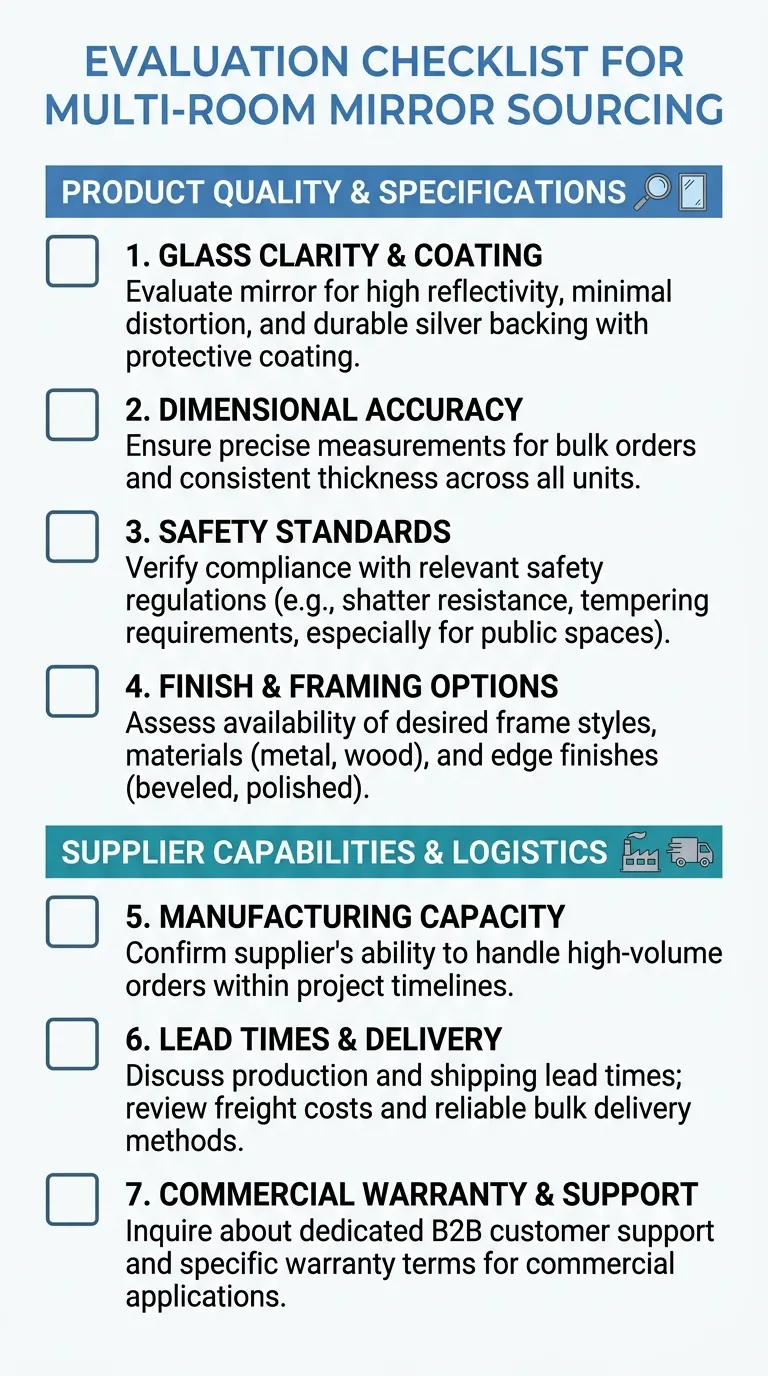
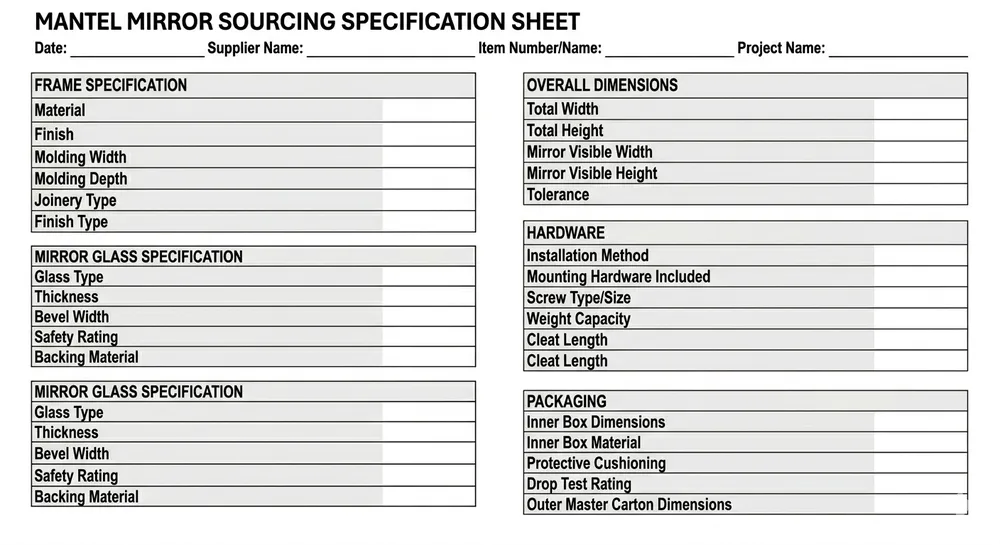
Sourcing checklist for buyers evaluating a multi-room decorative mirror supplier covering production lines, glass processing, QC, and packaging

Translating Trend Data into SKU Decisions

Market trend data is only useful if it connects to a specific sourcing action. Here's how the 2026 demand signals translate into practical SKU planning decisions:

Bathroom: If your current bathroom mirror line is still anchored in plain aluminum-frame rectangles without LED or anti-fog, you're behind the mid-tier demand curve. Adding one LED anti-fog SKU in the 24"×36" or 30"×40" format is the minimum move. MOQ on standard LED bathroom mirrors starts at 100 pieces for our catalog specs; custom sizing or finish requires 200+ pieces.

Living room: The oversized arch trend has legs — it's moved from boutique to mass retail and is still growing. If you don't have an arch-top mirror in the 30"×60" or 36"×60" range with a metal frame option, that's a gap worth filling. Metal frame tooling for a custom profile runs 4–8 weeks for sample development; plan accordingly if you want a proprietary design rather than a catalog spec.

Bedroom: The arched full-length format is the clearest growth opportunity in this category. A 24"×60" or 28"×65" arched mirror with a brushed gold or natural wood frame covers the segment that's growing fastest. Full-length mirrors require a packaging review before finalizing the order — we flag this for every new buyer because it's where damage claims originate.

Dining room / hallway: These categories reward buyers who can offer something beyond the commodity rectangle. An ornate carved-frame dining mirror in the 36"×48" range, or a slim entryway mirror with a shelf or hook detail, gives you a differentiated SKU that holds margin better than a plain frame equivalent.

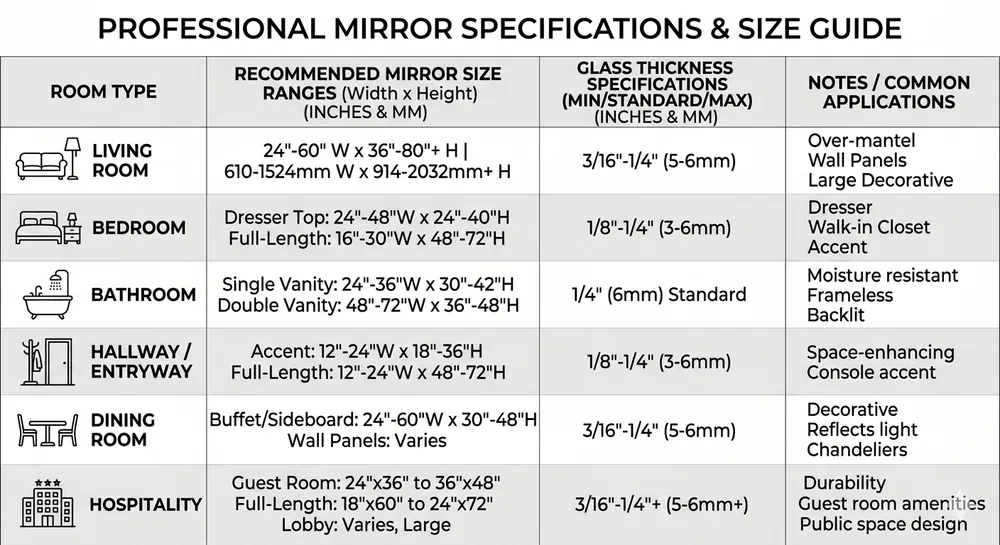
For a complete view of how sizing and spec requirements vary by room, the room mirror sizing guide covers the practical dimensions in detail.

Frequently Asked Questions

Which room mirror category has the highest reorder frequency from US wholesale buyers?

Bathroom mirrors reorder most frequently, driven by renovation project cycles and hospitality fit-outs. Living room mirrors have higher per-unit value but slightly longer reorder cycles because they're more design-trend-dependent. Bedroom full-length mirrors are the fastest-growing reorder category right now, particularly arched formats.

What minimum order quantities apply to room-specific mirror programs?

For standard catalog specs, MOQ starts at 100 pieces per SKU. Custom sizing, proprietary frame profiles, or private-label packaging typically requires 200–500 pieces depending on the complexity of the customization. Multi-room POs that combine bathroom, living room, and bedroom SKUs can often be structured to meet MOQ thresholds across categories without requiring 100+ pieces of every individual SKU — worth discussing during the RFQ stage.

How do frame material preferences differ across room categories?

Bathroom: aluminum and frameless dominate, with some brushed nickel and matte black metal. Living room: metal frames (brushed gold, matte black, antique brass) are growing fastest. Bedroom: warm tones — natural wood, rattan, warm metal — outperform the cooler finishes that work in living rooms. Dining room: MDF with decorative finish (carved, antique gold, aged silver) still holds a clear position. Hallway: slim metal or wood frames, minimal ornamentation.

What's the lead time for a multi-room mirror order covering three or more categories?

Standard catalog specs across multiple room categories: 35–45 days after sample approval and deposit. Custom frame profiles or finishes add 2–3 weeks for tooling and sample development before production begins. We recommend buyers planning a multi-room launch allow 60–75 days from PO to container loading for first-time custom orders.

How do I verify that a supplier's quality is consistent across room categories, not just in one product line?

Request QC records by product category, not just aggregate factory pass rates. Ask specifically for silver coating adhesion test results (relevant for bathroom mirrors) and carton drop-test records (relevant for full-length bedroom and living room mirrors). A factory that can provide category-specific QC data is one that actually runs category-specific inspection — not one that applies the same checklist to every product type.

Browse the full Decor Mirrors by Room range to see how our room-specific lines are structured, or Request Quote with your target room categories and volume estimates — we'll respond within 48 hours with pricing matched to current production schedules.
Hallway Mirror Mounting Safety: Secure Installation for High-Traffic Commercial & Residential Spaces

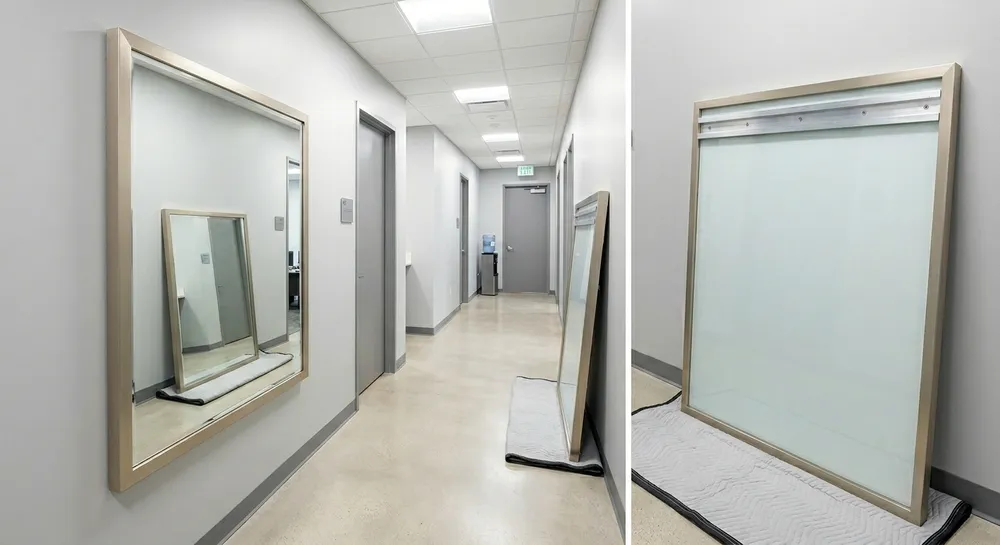
A mirror falls off a hotel corridor wall at 2 AM. Nobody is hurt, but the glass is across the floor, the frame is cracked, and the property manager is on the phone with their supplier before sunrise. The conversation is never pleasant. The mirror was specified correctly for the look — wrong for the load, the wall substrate, and the traffic volume.

We see this pattern more than we'd like. Buyers source mirrors based on dimensions and finish, then leave mounting hardware and backing specs to whoever is doing the installation. In a residential bedroom, that's usually fine. In a commercial hallway with 200 people walking past daily, it's a liability waiting to happen.

This guide covers what actually determines whether a hallway mirror stays on the wall safely — glass thickness, frame weight, backing film, hardware type, and wall substrate — and how to get those decisions made at the sourcing stage rather than on-site.

Large framed mirror mounted securely on a commercial hallway wall with visible French cleat hardware and safety backing film

Why mounting failures happen — and where the decision actually gets made

Most hallway mirror mounting failures trace back to one of three mismatches: the hardware isn't rated for the mirror's actual weight, the anchor isn't matched to the wall substrate, or the glass has no safety backing so a minor impact becomes a shatter event.

None of these are installation errors in the traditional sense. They're specification errors — decisions that should have been made before the order was placed.

A 24×36 inch mirror in a 4mm float glass with a solid wood frame can weigh 18–22 kg depending on frame profile depth. A buyer who specifies "standard hanging hardware" without a weight rating is leaving the installer to guess. If the installer guesses wrong — or uses whatever D-rings came in the box — and the wall is drywall over metal studs rather than solid concrete, the mirror will eventually come down.

The other failure mode is subtler: mirrors that stay on the wall but develop backing delamination over 12–18 months in humid corridor environments. The silver coating lifts, the mirror looks degraded, and the buyer gets warranty calls. That's a sourcing problem too — copper-free silvering with a proper multi-layer protective coating handles corridor humidity; standard silvering doesn't.

(We've had buyers come to us after exactly this scenario — a hospitality chain that sourced 300 corridor mirrors from a different supplier, had 40% show delamination within a year, and needed a full replacement program. The fix was in the coating spec, not the installation.)

Glass thickness and frame weight: the numbers that drive every other decision

Before you can specify hardware, you need to know what the hardware has to hold. That starts with glass thickness and frame construction.

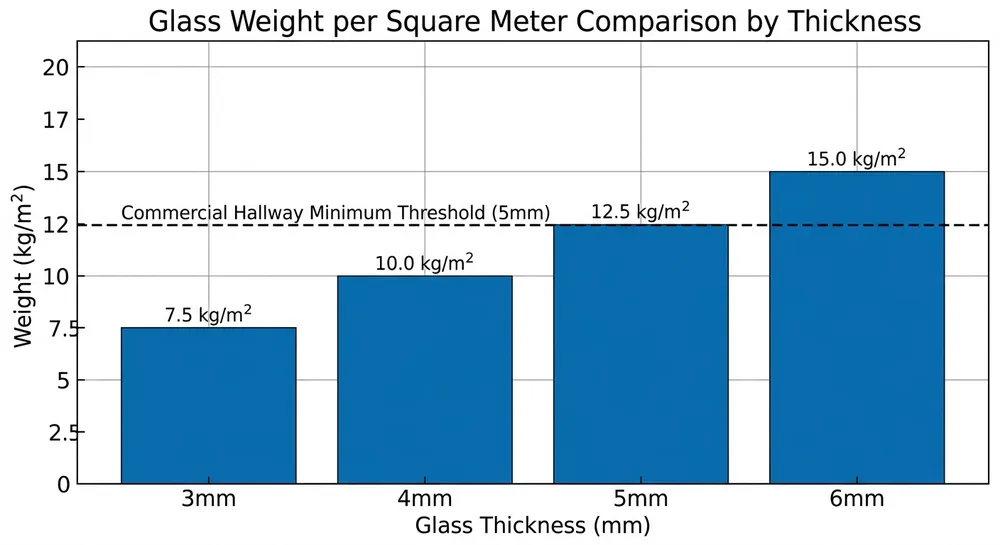
We offer 3mm, 4mm, 5mm, and 6mm float glass across our Hallway Decor Mirrors range. The thickness choice isn't just structural — it directly affects the mirror's total weight and therefore the hardware load rating you need to specify.

Glass thickness Approx. glass weight per m² Typical use case
3mm ~7.5 kg/m² Small accent mirrors, residential, low-traffic
4mm ~10 kg/m² Standard residential and light commercial
5mm ~12.5 kg/m² Commercial hallways, hospitality corridors
6mm ~15 kg/m² High-traffic commercial, oversized formats

For a 600×900mm mirror in 5mm glass, the glass alone is roughly 6.75 kg. Add a solid wood frame with a 45mm profile and you're at 10–13 kg total. Add a metal frame with cast corner joints and you could be at 15 kg or more. Hardware rated at 10 kg is already marginal before you account for dynamic load from a door slamming nearby or someone brushing against the frame.

Our standard recommendation for commercial hallway mirrors over 600mm in any dimension: specify 5mm glass minimum, confirm total assembled weight with us before finalizing hardware specs, and use hardware rated to at least 2× the confirmed weight.

Frame material matters too. Solid wood frames add weight but distribute it evenly across the hanging system. Metal frames — particularly cast zinc alloy corner joints — concentrate weight at the corners, which affects how the hanging hardware needs to be positioned. We can provide assembled weight data for any SKU on request; if you're building an RFQ, ask for it upfront.

Chart comparing mirror glass thickness from 3mm to 6mm with corresponding weight per square meter and recommended application environments

Mounting hardware options: what actually holds in high-traffic environments

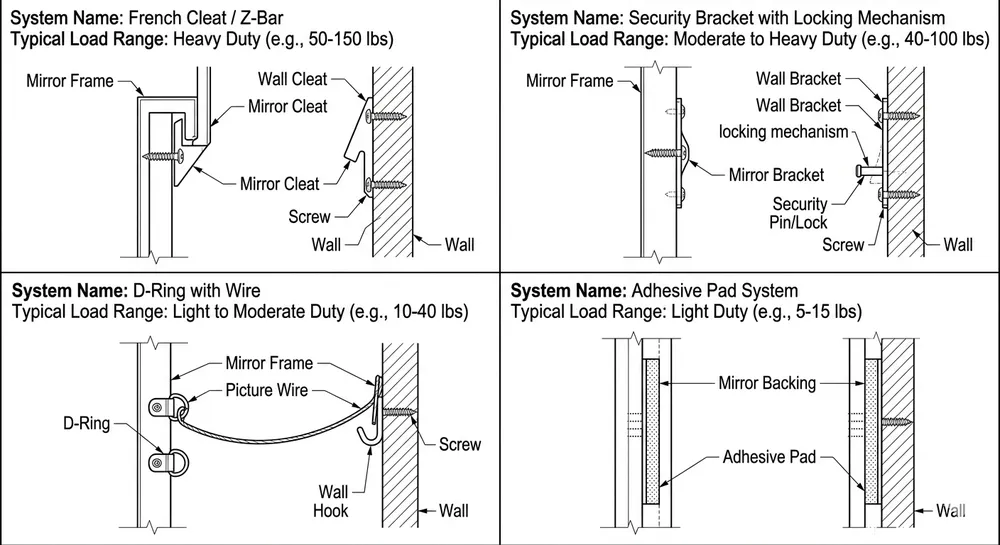
There are four hardware systems worth knowing for hallway mirror applications. Each has a real load ceiling and a real failure mode.

French cleats (Z-bars) The most reliable system for mirrors over 8 kg in commercial settings. A French cleat distributes weight across the full width of the mirror rather than concentrating it at two D-ring points. Properly installed into studs or masonry anchors, a 600mm cleat handles 30–50 kg without issue. The failure mode is installation error — if the wall-side cleat isn't level or isn't anchored into structural material, the whole system is compromised.

We can pre-install the mirror-side cleat at the factory. The buyer or installer sources and mounts the wall-side cleat on-site. This splits the labor cleanly and ensures the mirror-side hardware is correctly positioned relative to the frame's center of gravity.

Security brackets (anti-theft / anti-tip) Standard in hospitality and commercial retail. A security bracket uses a locking mechanism that requires a tool to remove — the mirror can't be lifted off the wall by hand. Load ratings vary by manufacturer, but 20–40 kg per bracket pair is typical for commercial-grade hardware. We integrate security bracket mounting points at the factory on request; the buyer specifies the bracket system they're standardizing on, and we position the receiver plates accordingly.

D-rings and wire systems Fine for residential mirrors under 8 kg. For anything heavier or in a commercial corridor, D-rings are the wrong tool. The wire concentrates load at two small points, the D-ring screws pull out of the frame over time under vibration, and there's no anti-tip protection. We still ship D-rings as standard on smaller residential SKUs, but for commercial orders we recommend upgrading to cleats or security brackets at the factory stage.

Adhesive mounting systems Command-strip style adhesives have a place in residential settings where wall damage is a concern. For commercial hallways, they're not appropriate for mirrors over 5 kg. Adhesive bond strength degrades with humidity and temperature cycling — exactly the conditions in a busy corridor near an entrance. We don't recommend adhesive-only systems for any commercial hallway mirror application.

Side-by-side diagram comparing French cleat, security bracket, D-ring, and adhesive mounting systems for hallway mirrors with load ratings

Wall substrate matching: the variable most buyers ignore

Hardware load ratings are tested against ideal substrates. Real hallways are not ideal substrates.

The four substrates you'll encounter in commercial and residential hallway installations:

Concrete and masonry — the most forgiving. Expansion anchors or sleeve anchors rated for the mirror weight, installed at the correct embedment depth, will hold reliably for years. The main failure mode here is using drywall anchors by mistake when the wall looks like it might be concrete but isn't solid behind the surface layer.

Brick — similar to concrete but requires attention to mortar joint condition. Anchors into old, crumbling mortar will fail. Anchors into the brick face itself, with the correct drill bit and anchor type, are reliable.

Drywall over wood studs — reliable if the hardware hits the studs. A 600mm French cleat spanning two studs at 400mm centers is solid. A single D-ring between studs, relying on a drywall anchor, is not. For mirrors over 10 kg, stud-mounted hardware is non-negotiable.

Drywall over metal studs — the most problematic substrate for heavy mirrors. Metal studs are thinner than wood and have lower pull-out strength. For mirrors over 15 kg on metal stud walls, toggle bolts or specialized metal-stud anchors are required, and the hardware should span multiple studs where possible. This is common in commercial construction and catches buyers off guard when their standard residential hardware spec doesn't transfer.

When we're working with buyers on commercial hospitality projects, we ask for the wall substrate type upfront. It changes the hardware recommendation, and sometimes it changes the glass thickness recommendation too — a lighter mirror is easier to mount safely on a problematic substrate.

Factory-integrated safety features: what to specify before the order ships

This is where sourcing decisions have the most leverage. Once mirrors are on a truck, your options narrow considerably.

Safety backing film A polyester safety film laminated to the back of the glass holds shards in place if the mirror is broken. In a commercial hallway, this is the difference between a cleanup job and a liability event. We apply safety backing film as a factory option — it adds a small cost per unit but eliminates the risk of glass scatter on impact. For any commercial project with foot traffic, specify it.

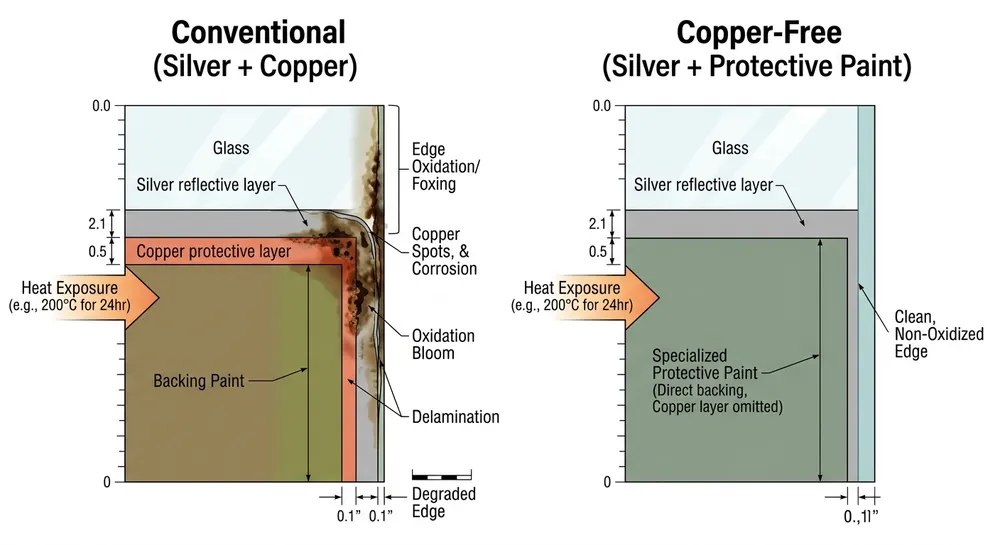
Copper-free silvering with multi-layer protective coating Standard silvering uses copper as a barrier layer between the silver and the backing paint. Copper corrodes in humid environments, which is why you see black edge spots on mirrors in bathrooms and entrance corridors. Our copper-free silvering process eliminates that layer and replaces it with a more stable chemical barrier. Combined with a multi-layer protective backing coat, the result is a mirror that handles corridor humidity without delaminating over a 5–10 year service life. Specify this for any project in a climate-controlled but high-humidity environment — hotel corridors, gym lobbies, apartment building hallways.

Pre-installed hanging hardware We can install French cleats, security bracket receiver plates, or custom hanging systems at the factory before the mirror ships. This matters for two reasons: factory installation is more precise than on-site installation (the hardware is positioned relative to the frame's actual center of gravity, not estimated), and it reduces on-site labor cost for your installer. For large commercial orders — 50 units or more — factory-installed hardware is worth specifying in the RFQ. The per-unit cost is low; the on-site labor savings are real.

Shatter-resistant glass options For the highest-risk environments — children's facilities, psychiatric units, correctional facilities, high-abuse commercial spaces — we can source and process laminated safety glass or acrylic mirror alternatives. These aren't standard stock items, but they're available through our OEM/ODM Custom Mirror Development program. Lead times are longer; the safety profile is substantially better.

(The laminated glass option comes up more often than you'd expect for hospitality buyers — some hotel brands now specify it for all public-area mirrors as a standard safety requirement. Worth checking your end client's spec sheet before finalizing the order.)

Common mounting failures in commercial hallways — and the sourcing fix

These are the failure patterns we hear about most often from buyers who've had problems:

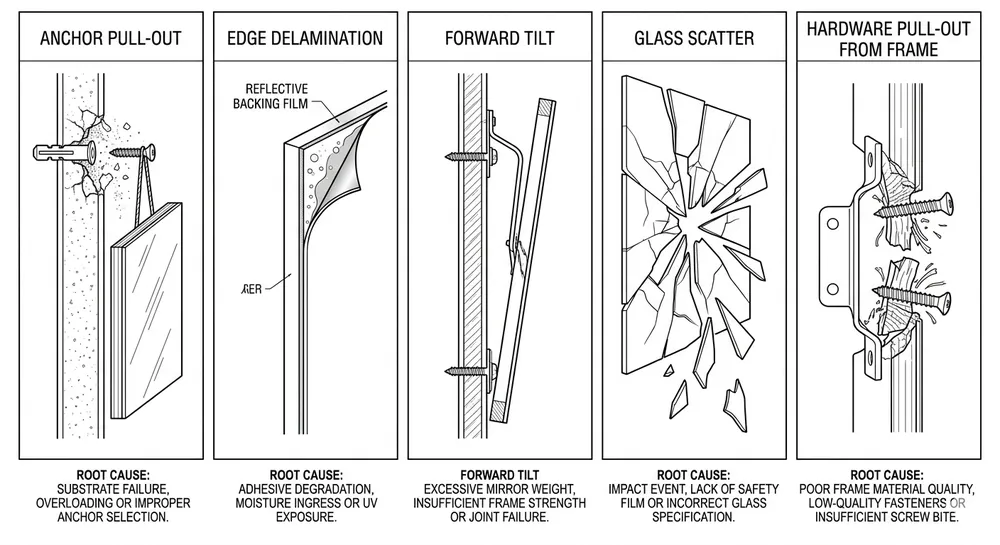
Mirror drops within 6 months of installation Almost always a hardware-to-substrate mismatch. The anchor wasn't rated for the weight, or it wasn't installed into structural material. The sourcing fix: confirm assembled mirror weight before ordering hardware, and specify the wall substrate type so the hardware recommendation is substrate-specific.

Edge blackening within 12–18 months Silvering delamination from corridor humidity. The sourcing fix: specify copper-free silvering and multi-layer protective coating at the order stage. This is a factory-level decision — you can't retrofit it.

Mirror tilts forward over time Usually a single-point hanging system (one D-ring, one hook) that allows rotation. The sourcing fix: specify a two-point hanging system — either a French cleat or two security brackets — that prevents the mirror from pivoting on a single axis.

Glass shatters on minor impact, scatters across floor No safety backing film. The sourcing fix: specify safety backing film for all commercial hallway mirrors. It's a line item in the RFQ, not an afterthought.

Hardware pulls out of frame after repeated vibration D-ring screws installed into frame material that's too thin or too soft. The sourcing fix: for mirrors over 8 kg, specify hardware that's integrated into the frame's structural members, not just the backing board. We reinforce D-ring mounting points on heavier frames as standard practice — but it's worth confirming this is in the spec.

Diagram illustrating five common hallway mirror mounting failure modes with root cause labels and prevention notes

How to specify mounting-ready mirrors in your RFQ

If you're sourcing hallway mirrors for a commercial project or building a retail product line, these are the spec fields that prevent problems downstream.

Glass thickness: State the minimum acceptable thickness. For commercial hallways, 5mm is the floor. For oversized formats (over 900mm in any dimension), 6mm.

Assembled weight: Request confirmed assembled weight per SKU before finalizing hardware specs. Don't estimate from glass weight alone — frame material and profile depth add significantly.

Backing type: Specify copper-free silvering and multi-layer protective coating for any humid or high-traffic environment. Specify safety backing film for all commercial applications.

Hardware type and load rating: Specify the hanging system — French cleat, security bracket, or D-ring — and the minimum load rating. For commercial orders, specify that hardware must be rated to at least 2× the confirmed assembled weight.

Factory-installed hardware: If you want hardware pre-installed, state it in the RFQ. Include the wall-side hardware system you're standardizing on so we can match the mirror-side components.

Packaging for hardware protection: For commercial orders, specify that hanging hardware must be protected during transit — loose hardware that shifts in the box can damage the mirror backing or the frame finish.

A complete RFQ for a commercial hallway mirror program looks something like this:

> 600×900mm hallway mirror, 5mm float glass, copper-free silvering, multi-layer protective backing coat, safety backing film, solid wood frame with 40mm profile, French cleat pre-installed (mirror-side), confirmed assembled weight required before hardware finalization, retail-ready packaging with hardware protected separately.

That spec gives us everything we need to quote accurately and produce a mirror that installs safely without surprises on-site. Compare that to "600×900mm hallway mirror, wood frame, standard hanging hardware" — which leaves four critical safety decisions unresolved.

For buyers building a product line across multiple room categories, our Decor Mirrors by Room section covers how specs diverge by application — hallway mirrors have different requirements than bathroom or bedroom mirrors, and mixing specs across a single PO is a common source of problems.

Mounting height, placement, and clearance: the installation variables that affect safety

Hardware and glass specs handle the structural side. Placement handles the human side.

Mounting height for hallways: The standard range for a full-length or large decorative mirror in a hallway is 1500–1700mm to the mirror's vertical center, measured from finished floor level. This puts the reflective surface at eye level for most adults and keeps the bottom edge above typical impact height from luggage, carts, and children. For hospitality corridors with luggage traffic, bottom edge height of 900mm or above is worth specifying to your installer.

Clearance from doors and corners: A mirror mounted within 300mm of a door swing path is a problem waiting to happen. Door hardware, luggage handles, and cart edges will contact the mirror frame repeatedly. Minimum 400mm clearance from any door swing arc is a reasonable standard for commercial installations.

Multiple mirrors in a corridor: If you're specifying a series of mirrors along a corridor wall, consistent mounting height and equal spacing matter for both aesthetics and safety. Inconsistent heights mean some mirrors are mounted lower — closer to impact height — and inconsistent spacing can create crowding that makes individual mirrors harder to secure properly. We can supply mirrors with pre-marked mounting height references on the backing paper for large commercial orders.

Lighting interaction: Mirrors mounted directly opposite a light source create glare that can be disorienting in a narrow corridor. This is an installation consideration, not a product spec, but it's worth flagging to your end client or installer — a 15-degree angle offset from direct opposition eliminates most glare issues without affecting the mirror's visual function.

FAQ

What glass thickness should I specify for a commercial hallway mirror over 800mm wide?

6mm is the right call for any mirror over 800mm in width or height in a commercial hallway. At that size, 5mm glass is structurally adequate but the total assembled weight — typically 18–25 kg with frame — pushes into territory where 6mm's additional rigidity reduces flex under dynamic load. More practically, 6mm glass is less likely to crack from minor impacts in a high-traffic corridor, which reduces your warranty exposure.

Can safety backing film be added after the mirror is manufactured?

Technically yes, but it's not practical at scale. Aftermarket safety film application requires clean-room conditions to avoid bubbles and adhesion failures, and it voids most manufacturer warranties on the silvering. Specify it at the factory stage — it's a fraction of the per-unit cost compared to a field retrofit or a replacement program.

What's the difference between a French cleat and a Z-bar?

They're the same system with different names. A French cleat (also called a Z-bar or Z-clip) is an interlocking two-piece aluminum extrusion — one piece mounts to the wall, one to the mirror back, and they hook together at a 45-degree angle. The weight distributes across the full cleat length rather than concentrating at two points. For mirrors over 8 kg in commercial settings, it's the most reliable hanging system available.

Do your mirrors ship with hardware included, or does the buyer source hardware separately?

Standard residential SKUs ship with D-rings and wire. For commercial orders, we recommend specifying factory-installed hardware — French cleats or security bracket receiver plates — as part of the OEM/ODM development process. This ensures the hardware is correctly positioned and rated for the confirmed mirror weight. Buyers who source hardware separately sometimes find that off-the-shelf hardware doesn't match the frame's mounting point positions, which creates on-site problems.

What certifications are relevant for commercial hallway mirror safety?

Our mirrors carry ISO 9001:2015, SGS, CE, and BSCI certifications. For specific commercial building code compliance — particularly in North American markets — the relevant standards are ANSI Z97.1 (safety glazing) and CPSC 16 CFR Part 1201 for safety glazing materials. If your project requires certified safety glazing, specify this in your RFQ and we'll confirm whether the glass specification meets the applicable standard or whether laminated safety glass is required.

Hallway Mirror Sizing Guide — How to Spec Narrow-Space Mirrors for Wholesale & Hospitality Projects

Hallway mirrors are one of the most frequently mis-specced SKUs we see in wholesale orders. The buyer pulls a standard 60×80 cm mirror from the catalog, it arrives on site, and the corridor is 90 cm wide. The mirror looks like it was installed by accident. The project manager calls. Nobody wins.

The problem isn't the mirror — it's that hallway sizing follows different rules than every other room type, and most sourcing guides don't address that. This article gives you the dimension logic, the spec table, the frame and glass considerations, and the ordering guidance you need to get hallway mirrors right across a full project or product line.

Why Hallway Mirror Sizing Isn't Just "Smaller Living Room Mirror"

In a living room or bedroom, mirror sizing is mostly aesthetic — you have wall space, you choose proportions. In a hallway, the corridor width is a hard constraint. A mirror that's too wide creates a visual block and, in narrow corridors, a genuine safety hazard when doors swing open. A mirror that's too narrow looks like an afterthought.

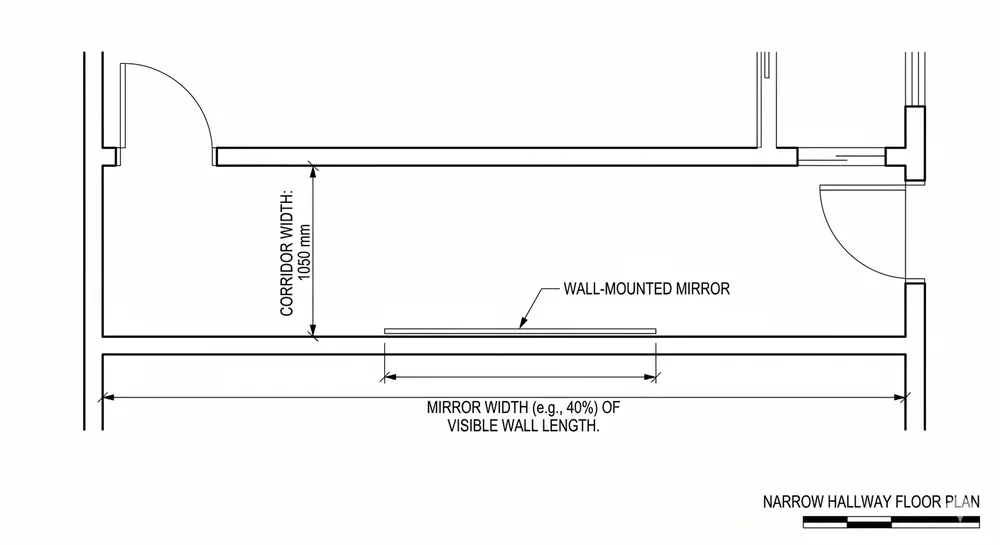
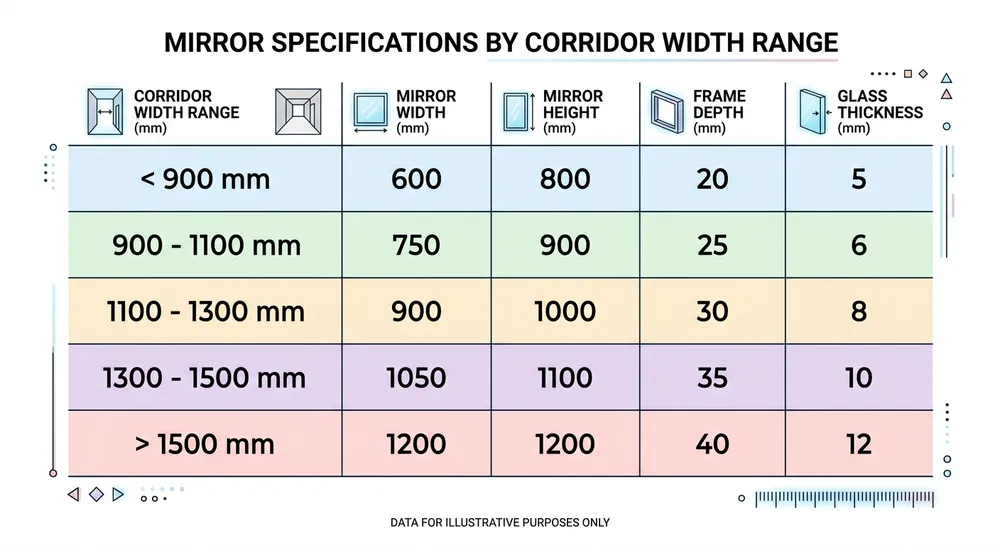
The standard rule we use across hospitality and residential projects: mirror width should be 40–60% of the corridor width, and height should be proportional to ceiling height, typically 90–150 cm for standard 240–280 cm ceilings.

That ratio matters more in bulk orders than in single-unit installs. When you're speccing 80 mirrors for a hotel corridor program, a 5 cm width error across the whole order means 80 remounts or 80 returns. Getting the ratio right at the spec stage is the only way to protect your project margin.

There's also a depth consideration that gets overlooked. Hallway frames need to sit flush or close to flush against the wall — a frame profile that protrudes 4–5 cm is fine in a living room, but in a 90 cm corridor it reduces effective passage width and creates a corner-catch hazard. We typically recommend frame profiles under 3 cm depth for any corridor under 110 cm wide.

Diagram showing recommended mirror width as a percentage of corridor width for narrow hallway installations

Dimension Reference Table — Hallway Width to Mirror Size

This is the table most sourcing guides don't provide. We built it from real project specs across hotel corridor programs, apartment building common areas, and retail fit-outs.

Corridor Width Recommended Mirror Width Recommended Mirror Height Frame Depth (max) Glass Thickness
80–90 cm 35–45 cm 90–120 cm 2.5 cm 4 mm
90–100 cm 40–50 cm 100–130 cm 3.0 cm 4 mm
100–110 cm 45–55 cm 110–140 cm 3.0 cm 4–5 mm
110–120 cm 50–65 cm 120–150 cm 3.5 cm 5 mm
120–150 cm 60–80 cm 130–160 cm 4.0 cm 5 mm

A few notes on how to read this table:

Mirror height is the range that works for standard ceiling heights (240–280 cm). For hospitality projects with higher ceilings — boutique hotels often run 300–320 cm — you can push height to 160–180 cm without losing proportion, but glass weight increases and mounting hardware specs need to follow.

Glass thickness at 4 mm is standard for mirrors under 50 cm wide. Once you cross 50 cm width or 130 cm height, we move to 5 mm as a default — the deflection risk on thinner glass at those dimensions is real, especially in high-traffic corridors where vibration from foot traffic and door slams is constant. (We've seen 4 mm glass develop stress fractures in hotel corridors within 18 months — not a warranty conversation anyone wants to have.)

Frame depth is the full protrusion from wall face to front of frame. This is the spec most buyers forget to ask about until the mirrors are on-site.

Visual chart mapping corridor widths from 80 to 150 cm to recommended mirror dimensions and glass thickness

Frame Profile and Material Specs for Narrow-Format Mirrors

Frame selection for hallway mirrors is a different calculation than for living room or bathroom mirrors. Three factors drive it: depth, weight, and edge durability.

Depth and profile width

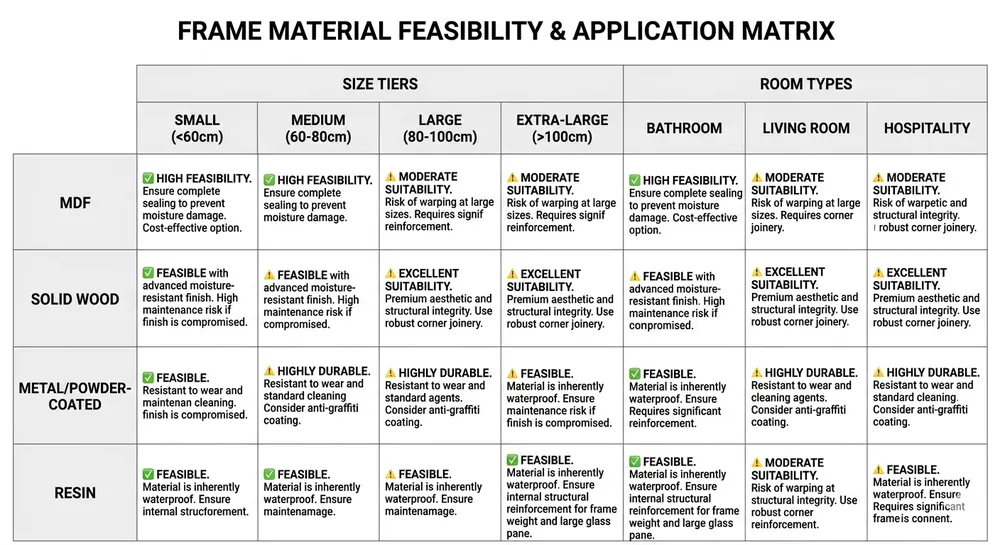
In corridors under 110 cm, a chunky frame profile — say, 6–8 cm wide face — makes the mirror look like it's eating the wall. We typically spec 2–4 cm face-width profiles for narrow hallway formats. That's achievable in MDF, metal, and resin, but each material handles it differently.

MDF profiles at 2–3 cm face width are structurally fine for mirrors up to 50×120 cm. Above that, the frame needs internal corner reinforcement — without it, the joint stress from a tall narrow mirror flexing during transport or mounting can crack the miter. We add a metal corner bracket inside the frame on any MDF piece over 120 cm tall. It adds maybe 80 grams to the unit weight, but it's the difference between a mirror that survives a hotel renovation install and one that doesn't.

Metal frames — typically aluminum or iron — handle narrow profiles better than MDF at taller heights. A 2 cm wide iron frame on a 40×150 cm mirror is structurally sound and looks intentional. The trade-off is weight: iron frames at that height run 3.5–5 kg total, which affects both shipping cost and wall anchor requirements.

Resin frames give you the most profile flexibility for decorative shapes, but resin at narrow widths (under 3 cm) can be brittle at corners. For high-traffic corridors — hotel hallways, apartment building lobbies — we steer buyers toward MDF or metal over resin for anything under 3 cm profile width.

Weight and mounting load

This matters for bulk orders because it affects both freight cost and the hardware spec you need to communicate to your installation team or end customer. A rough guide:

Frame Material Typical Weight (40×120 cm mirror) Wall Anchor Requirement
MDF + glass 4.5–6 kg 2× M6 anchor bolts or D-ring + picture rail
Aluminum + glass 3.5–4.5 kg 2× M5 anchor bolts or keyhole bracket
Iron + glass 5.5–7.5 kg 2× M8 anchor bolts, stud-mount preferred
Resin + glass 4–5.5 kg 2× M6 anchor bolts

For hospitality projects, we include a hardware spec sheet with every order. Your installation contractor needs to know the anchor load before they're on-site — not after.

Glass Spec Considerations for High-Traffic Corridors

Standard float glass works fine for residential hallway mirrors. For hospitality and commercial corridor applications, the spec conversation gets more specific.

Tempered vs. standard glass: Tempered glass is 4–5× stronger under impact and, critically, breaks into small blunt fragments rather than sharp shards. For hotel corridors, apartment building common areas, and any installation where the mirror is at shoulder or head height in a narrow passage, tempered glass is the right call. It adds cost — typically 15–25% over standard glass at equivalent thickness — but the liability reduction for your hospitality buyer is the real value.

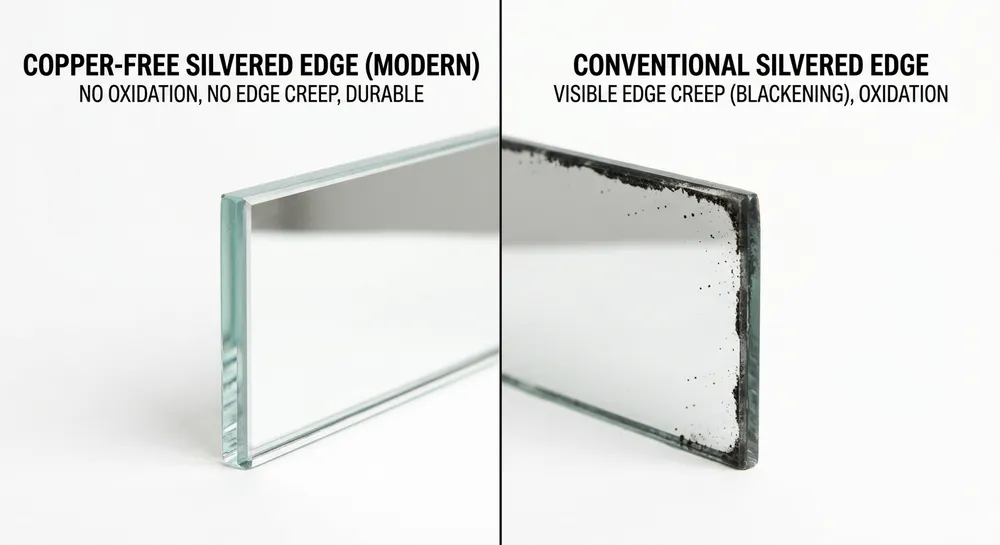
We run copper-free silvering as standard on all our mirrors. In hallway applications specifically, this matters more than buyers often realize. Corridor environments — especially in coastal properties, basement-level hotel floors, or high-humidity apartment buildings — expose mirror backing to more ambient moisture than a bedroom wall. Copper-free silver coating resists edge oxidation significantly better than conventional silvering. The black edge creep you see on older hotel mirrors is almost always a silvering failure, not a glass failure. (We switched our entire production to copper-free silvering in 2017 after seeing too many warranty claims from Gulf region buyers — the humidity there accelerates conventional silver degradation faster than most specs anticipate.)

Mirror backing: For corridor installations, we recommend a full-coverage safety backing film on any mirror over 100 cm tall. If the glass breaks, the film holds the fragments in place. This is standard in most European hospitality specs and increasingly required in North American commercial building codes.

For your Hallway Decor Mirrors sourcing, confirm with us whether your destination market requires tempered glass — some markets mandate it for commercial corridor installations, others leave it to the specifier.

Side-by-side comparison of copper-free silvered mirror edge versus conventional silvered mirror edge showing oxidation difference

Where Buyers Lose Money on Hallway Mirror Orders

Most sourcing mistakes on hallway mirrors fall into three categories, and all three are avoidable at the spec stage.

Ordering standard sizes for non-standard corridors. Most catalog mirrors are sized for living rooms — 60×80 cm, 70×90 cm, 80×100 cm. These proportions look wrong in a 90 cm corridor. Buyers who don't spec to corridor width end up with mirrors that either get returned or get installed anyway and generate complaints from the end customer. The fix is simple: get corridor width measurements before you finalize the PO.

Under-speccing glass thickness on tall formats. A 40×150 cm mirror in 4 mm glass is a liability. At that aspect ratio, the glass deflects under its own weight over time, and vibration stress in a busy corridor accelerates the risk. We won't ship tall narrow formats in 4 mm glass without a written acknowledgment from the buyer — it's not a spec we're comfortable with for commercial applications.

Ignoring packaging for tall narrow formats. A 40×150 cm mirror is awkward to pack. Standard carton dimensions don't accommodate it well, and if the packing isn't designed for the format, corner damage rates go up significantly. We use custom inner foam profiles for tall narrow mirrors — the foam is cut to the exact mirror dimensions, not adapted from a standard template. This adds a small cost per unit but eliminates the corner chip claims that eat into your margin on arrival.

For non-standard dimensions, lead time is also a real consideration. Standard catalog sizes ship from stock or within 25–30 days. Custom dimensions — anything outside our standard size matrix — typically add 10–15 days for frame tooling setup on first orders. Repeat orders of the same custom size run on the same timeline as standard production. If you're planning a hospitality project with a fixed installation date, build that buffer in.

See our Hallway Mirror Mounting & Safety guide for the full hardware and installation spec — it covers anchor types, load ratings, and the backing requirements that affect your installation contractor's work.

MOQ, Lead Time, and Ordering Logic for Non-Standard Hallway Sizes

This is where B2B hallway mirror sourcing diverges most sharply from consumer buying, and where most guides go silent.

Our standard MOQ for hallway mirrors is 100 pieces per SKU. That's low enough to let you test a new narrow-format size with your retail accounts or run a pilot for a hospitality project before committing to a full container. Most of our buyers in this category start with a 100–200 piece trial on a new dimension, confirm sell-through or installation performance, then move to 500–1,000 piece reorders.

For custom dimensions — sizes outside our standard matrix — the 100-piece MOQ still applies, but the first order carries a one-time frame tooling cost. That cost varies by profile complexity: a simple flat MDF profile in a custom width is minimal; a decorative resin profile with a new mold is more significant. We quote tooling separately so you can see exactly what you're paying for.

Container loading efficiency is worth thinking about at the ordering stage. Tall narrow mirrors (40×150 cm and similar) load differently than square-format mirrors. A standard 20-foot container holds roughly 300–350 units of a 40×150 cm mirror depending on packing configuration. A 40-foot container gets you to 650–700 units. If your project or order volume doesn't fill a container, we can consolidate with other SKUs — but it's worth knowing the loading math before you finalize quantities, because partial containers affect your landed cost per unit.

We've shipped hallway mirror programs to hotel groups in Southeast Asia, apartment developers in Australia, and retail distributors across North America. The dimension conversations are always the same: get the corridor width, confirm the frame depth tolerance, decide on glass spec, then lock the PO. The buyers who skip step one are the ones who call us after delivery.

For a broader view of how hallway mirrors fit into a room-by-room product line, the Room Mirror Sizing Guide covers the full spec logic across bathroom, bedroom, living room, and entryway applications — useful if you're building a multi-room assortment.

Speccing Hallway Mirrors for Hospitality Projects: What the Dimension Table Doesn't Tell You

The table above handles standard corridor programs. Hospitality projects add a few layers that are worth addressing directly.

Consistency across units. A hotel with 120 rooms and a standard corridor layout needs 120 mirrors that look identical — same dimensions, same frame finish, same glass clarity. That sounds obvious, but it's where multi-supplier sourcing falls apart. If you're splitting an order across two factories, you'll get two slightly different silver tones, two slightly different frame finishes, and two slightly different glass thicknesses. We run all units from a single project on the same production batch to eliminate that variation.

Finish durability in corridor environments. Hotel corridors get luggage trolleys, housekeeping carts, and constant foot traffic. Frame finishes that look fine in a showroom can chip or scuff within months in that environment. For hospitality, we recommend either a brushed metal frame (aluminum or iron) or a high-density MDF frame with a lacquer topcoat rather than a foil wrap — foil edges lift in humid environments and look worn fast.

Fire and safety compliance. Some markets require mirrors in commercial corridors to meet specific fire-rating or safety glazing standards. This varies by country and building type. We can provide SGS test reports and CE documentation for our glass specs — if your project has specific compliance requirements, send them to us at the RFQ stage and we'll confirm which of our standard specs meet them or what modifications are needed.

Delivery sequencing for phased projects. Large hotel renovations often install in phases — floors 1–5 first, then 6–10. We can hold finished inventory and ship in batches against a master PO. This keeps your storage costs down and ensures the mirrors for phase two match phase one exactly, since they're from the same production run.

Browse our full Decor Mirrors by Room range to see how hallway mirrors fit alongside bathroom, bedroom, and living room programs — useful if you're building a complete room-by-room sourcing package for a hospitality client.

Frequently Asked Questions

What is the standard hallway mirror size for wholesale orders?

There's no single standard — it depends on corridor width. The most common sizes we ship for hallway applications are 40×100 cm, 45×120 cm, and 50×130 cm. These cover the 90–120 cm corridor range that's most common in residential and mid-range hospitality projects. If your corridors are narrower or wider, use the dimension table above to find the right proportions.

What size mirror for a narrow hallway under 90 cm wide?

For corridors 80–90 cm wide, keep mirror width at 35–45 cm. Height can go up to 120 cm without looking out of proportion. Use 4 mm glass and keep frame depth under 2.5 cm. At this corridor width, frame profile matters as much as mirror face dimensions — a bulky frame in a tight corridor is a safety issue, not just an aesthetic one.

Does hallway mirror glass need to be tempered for commercial projects?

For residential installations, standard float glass is generally acceptable. For commercial corridor applications — hotels, apartment building common areas, office lobbies — tempered glass is the right spec. It's stronger under impact and breaks safely. Some markets mandate it for commercial use; others leave it to the specifier. Confirm your destination market's requirements before finalizing the glass spec.

What's the MOQ for custom hallway mirror dimensions?

100 pieces per SKU. Custom dimensions outside our standard size matrix carry a one-time frame tooling cost on the first order, quoted separately. Repeat orders of the same custom size run at standard production pricing.

How does copper-free silvering affect hallway mirror longevity?

Copper-free silvering resists edge oxidation significantly better than conventional silvering in humid environments. For corridor installations — especially in coastal properties or high-humidity climates — it's the spec that prevents the black edge creep that makes mirrors look aged within a few years. We run copper-free silvering as standard on all production.

What packaging is used for tall narrow hallway mirrors?

Tall narrow formats (40×150 cm and similar) use custom-cut inner foam profiles sized to the exact mirror dimensions. Standard foam templates don't protect the corners adequately on these aspect ratios. Each unit is individually wrapped and packed in a double-wall carton. For container shipments, we provide a packing list with exact carton dimensions and loading configuration.

Ready to spec your hallway mirror program? Send your corridor dimensions, target quantities, and finish preferences to our team via the Request Quote page — we'll return a sizing recommendation with pricing and lead time within 48 hours.

“`

How to Source Bedroom Decor Mirrors in Bulk Without Style Inconsistencies

You've placed a 500-unit bedroom mirror order. The first container arrives, you pull samples from three cartons, and the frames don't match. One reads warm champagne gold. Another is closer to brass. The third has a slightly different sheen — same finish name on the spec sheet, visibly different on the shelf. Your retail buyer notices before you do.

This happens more often than suppliers will admit, and it almost never shows up in a factory audit. The inconsistency isn't a quality failure in the traditional sense — the mirrors aren't broken, the glass isn't scratched. The problem is upstream, baked into how the order was set up and how the production run was controlled. By the time the container ships, there's nothing left to fix.

This guide walks through the production variables that cause style drift in bulk bedroom mirror orders, the sourcing steps that prevent it, and the acceptance criteria you should be holding any supplier to before you sign off on a shipment.

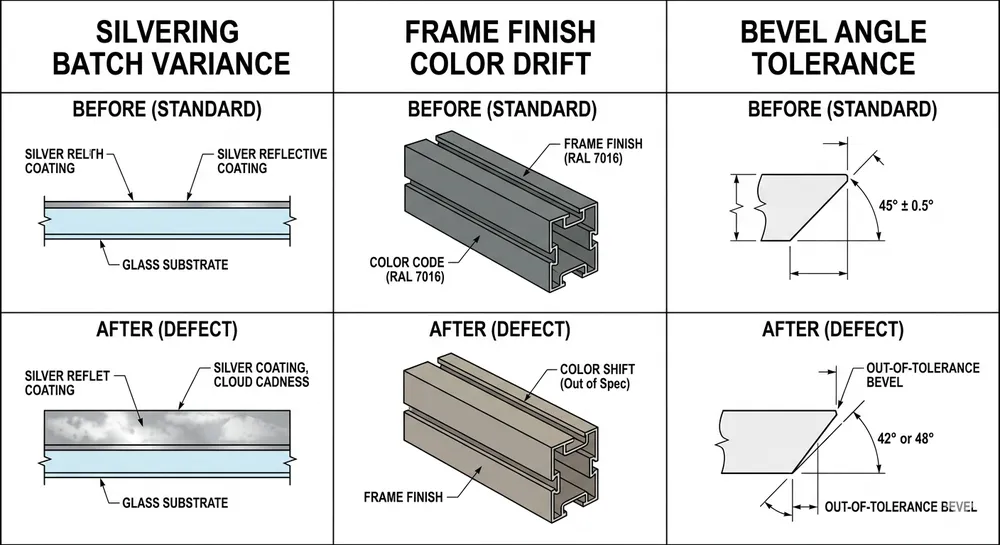
Diagram showing three production variables that cause style inconsistency in bulk bedroom mirror orders: silvering batch variance, frame finish color drift, and bevel angle tolerance

Where style inconsistency actually starts: the three production variables

Most sourcing guides treat mirror quality as a single dimension — is the glass clear, is the frame straight, does the hardware hold. Bedroom mirrors have a different failure mode. The product is decorative. Your buyer is placing it in a room where two or three mirrors may sit in the same sightline. Visible variation between units from the same order is a commercial problem, not just a cosmetic one.

Three production variables drive most of the inconsistency we see in bulk bedroom mirror runs.

Silvering batch variance. Mirror silvering is a wet chemical process — silver nitrate solution applied to float glass, followed by a copper or copper-free protective coating. The reflectivity and tonal quality of the mirror surface depends on solution concentration, application temperature, and line speed. When a large order runs across multiple silvering batches — which happens when a factory doesn't have dedicated line capacity — the mirror tone shifts slightly between batches. On a single unit, you won't notice. Side by side on a retail shelf, the difference is visible. (We switched to copper-free silver coating across all our bedroom mirror lines in 2021 — the process is more stable batch-to-batch and eliminates the greenish tint that copper backing develops over time in humid environments.)

Frame finish color drift. Decorative bedroom mirror frames — whether wood composite, MDF, or metal — go through a finishing sequence: base coat, color coat, topcoat or wax. Each stage has a tolerance window. If the color coat is applied manually or with inconsistent spray pressure, the final color shifts across a production run. Gold finishes are the worst offenders. The difference between "antique gold" and "bright gold" is about 15 seconds of spray time and 5°C of curing temperature. Buyers who specify "gold finish" without a color standard get whatever the line produces that day.

Bevel angle and width tolerance. Beveled bedroom mirrors are a staple of the decorative segment — the angled edge catches light and adds visual weight to the frame. Bevel width and angle are cut during glass processing. On a well-maintained beveling machine, width holds to ±0.5mm and angle holds to ±0.5°. On a machine running without regular calibration, you get ±2mm width variation and visible angle inconsistency across units. The bevel is one of the first things a retail buyer looks at when comparing units from the same SKU.

Why multi-vendor assembly makes this worse

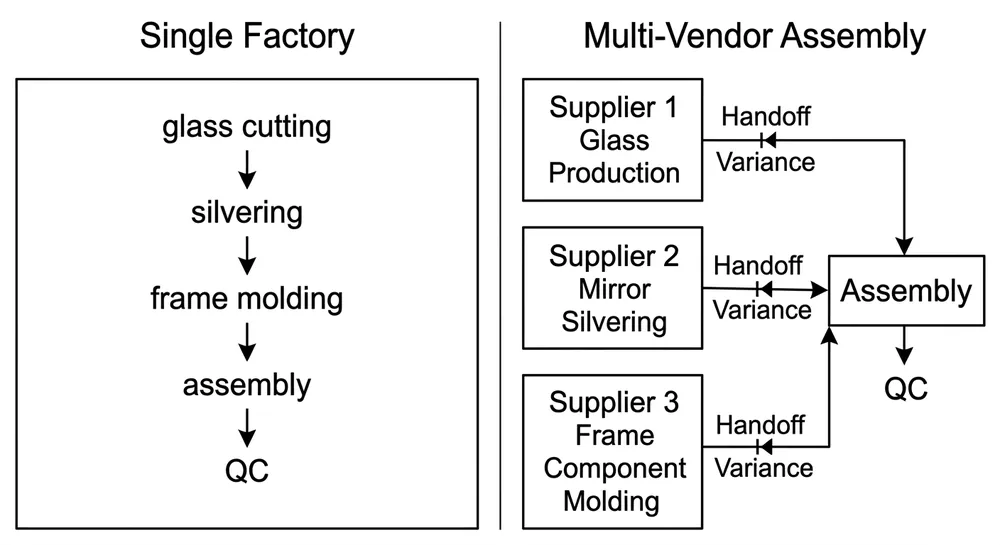
A significant share of "mirror factories" on wholesale directories aren't factories — they're assemblers. They buy glass from one supplier, frames from another, hardware from a third, and put the product together in a warehouse. Each supplier runs their own batch schedule. The glass silvering from Supplier A doesn't get matched to the frame finishing from Supplier B. Nobody owns the consistency of the finished product.

This is the core sourcing risk for bulk bedroom mirror orders. When you split production across vendors, you lose the ability to batch-control the variables that drive style consistency. The frame finisher doesn't know what the glass silvering looks like. The glass cutter doesn't know the bevel spec the frame was designed around. The assembler is working from a purchase order, not a product standard.

Single-facility production eliminates this by default. When glass cutting, silvering, frame molding, and assembly run under one roof on a coordinated production schedule, the same batch of silvered glass goes into the same batch of finished frames. Variation still exists — no production process is perfectly uniform — but it's controlled within a single quality system rather than accumulated across three separate suppliers.

Our 12,000 m² facility in Dong Nai runs the full production chain: glass cutting, beveling, silvering, frame molding, and final assembly. One QC team, one batch schedule, one point of accountability. When a bedroom mirror order ships from here, every unit in that container was built from materials processed in the same production window.

Side-by-side comparison of single-factory mirror production versus multi-vendor assembly showing consistency control points

The sourcing process that prevents style drift

Getting consistency across a bulk bedroom mirror order isn't about finding a better factory and hoping for the best. It's about building the right controls into the sourcing process before production starts. Here's how we walk buyers through it.

Step 1: Write a finish specification, not just a finish name

"Antique gold" is not a specification. A specification looks like this:

  • Base material: MDF frame, 18mm thickness
  • Primer: white water-based, 1 coat
  • Color coat: RAL 1036 Pearl Gold, 2 coats, 60–80μm dry film thickness
  • Topcoat: matte lacquer, 1 coat
  • Acceptable color delta-E: ≤3.0 vs. approved golden sample

Delta-E is the standard colorimetric measurement for color difference. A delta-E of 1.0 is barely perceptible to the human eye. A delta-E of 3.0 is the outer limit of acceptable variation for decorative finishes. Anything above 3.0 is visible on a retail shelf. If your supplier can't tell you what delta-E tolerance they hold, they're not controlling finish consistency — they're hoping it comes out right.

The same logic applies to mirror glass. Specify the silvering standard: copper-free silver coating, minimum 100nm silver layer, salt spray resistance ≥ 96 hours per ISO 9227. These aren't exotic requirements — any serious mirror manufacturer should be able to confirm them.

Step 2: Approve a golden sample before production starts

A golden sample is a single approved unit that becomes the physical reference standard for the entire production run. Every unit in the order is compared against it. This sounds obvious, but a large share of bulk mirror orders skip this step — buyers approve a digital photo or a factory showroom sample that was made under different conditions than the production run.

The golden sample approval process should include:

  • Physical sample shipped to your location (or inspected at factory by your QC agent)
  • Written sign-off on: frame color, mirror tone, bevel width and angle, hardware placement, packaging
  • Sample retained at factory for in-line comparison during production
  • Sample retained by buyer for pre-shipment inspection comparison

Don't approve a sample over video call. The color rendering on a phone camera is not accurate enough for finish approval.

Step 3: Require a pre-production run sign-off

Before the full production run starts, ask for 5–10 units from the first production batch. These should be built using the actual production materials — not the sample batch, not leftover stock. Compare them against the golden sample. Check:

  • Frame color delta-E (visual comparison or colorimeter reading)
  • Mirror tone consistency across units
  • Bevel width measurement (±0.5mm tolerance)
  • Hardware alignment

If the pre-production units pass, production proceeds. If they don't, you've caught the problem before 500 units are built. This is the checkpoint that saves orders.

Step 4: In-line QC during production

For orders above 200 units, in-line inspection matters. A QC inspector on the production floor checks units at regular intervals — typically every 50–100 units — against the golden sample. The checks are fast: frame color, mirror surface, bevel, hardware. The goal is to catch drift before it accumulates across the full run.

What to ask your supplier: "Do you have in-line QC checkpoints during production, and what is the inspection interval?" A factory that can't answer this question specifically is doing end-of-line inspection only — which means problems are found after the damage is done.

Step 5: Pre-shipment inspection with measurable acceptance criteria

The pre-shipment inspection is your last checkpoint before the container loads. Use AQL 2.5 sampling as a baseline — for a 500-unit order, that means inspecting approximately 50 units. The inspection should cover:

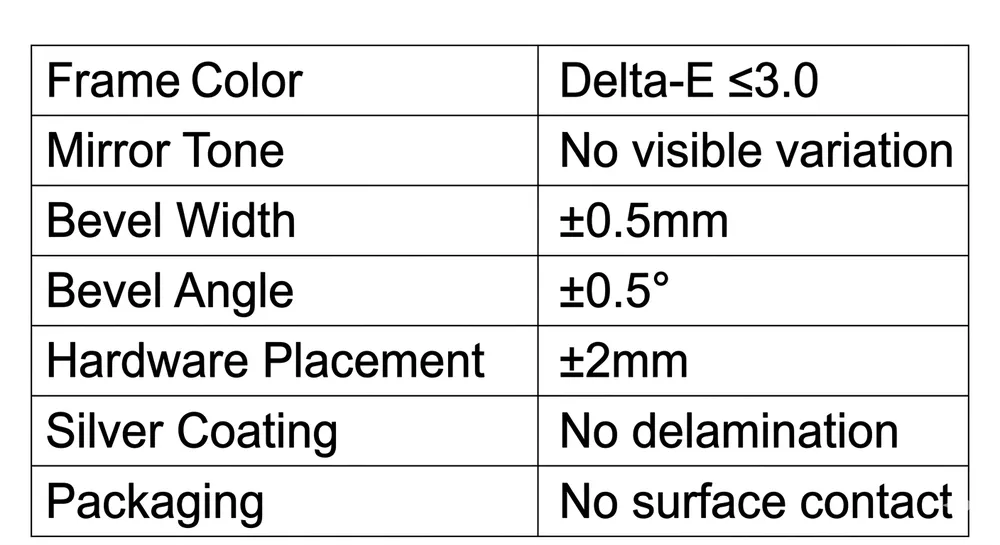
Checkpoint Acceptance Criteria
Frame color Delta-E ≤ 3.0 vs. golden sample
Mirror tone No visible tonal variation between units
Bevel width ±0.5mm vs. spec
Bevel angle ±0.5° vs. spec
Hardware placement ±2mm vs. spec
Silver coating adhesion No delamination on tape pull test
Packaging integrity No surface contact between mirror and carton

The packaging check matters more than most buyers realize. Bedroom mirrors with decorative frames are vulnerable to surface damage during transit — frame finish can transfer to the mirror glass if the inner packaging allows contact. Specify foam separation between the mirror surface and the carton, and check it at pre-shipment.

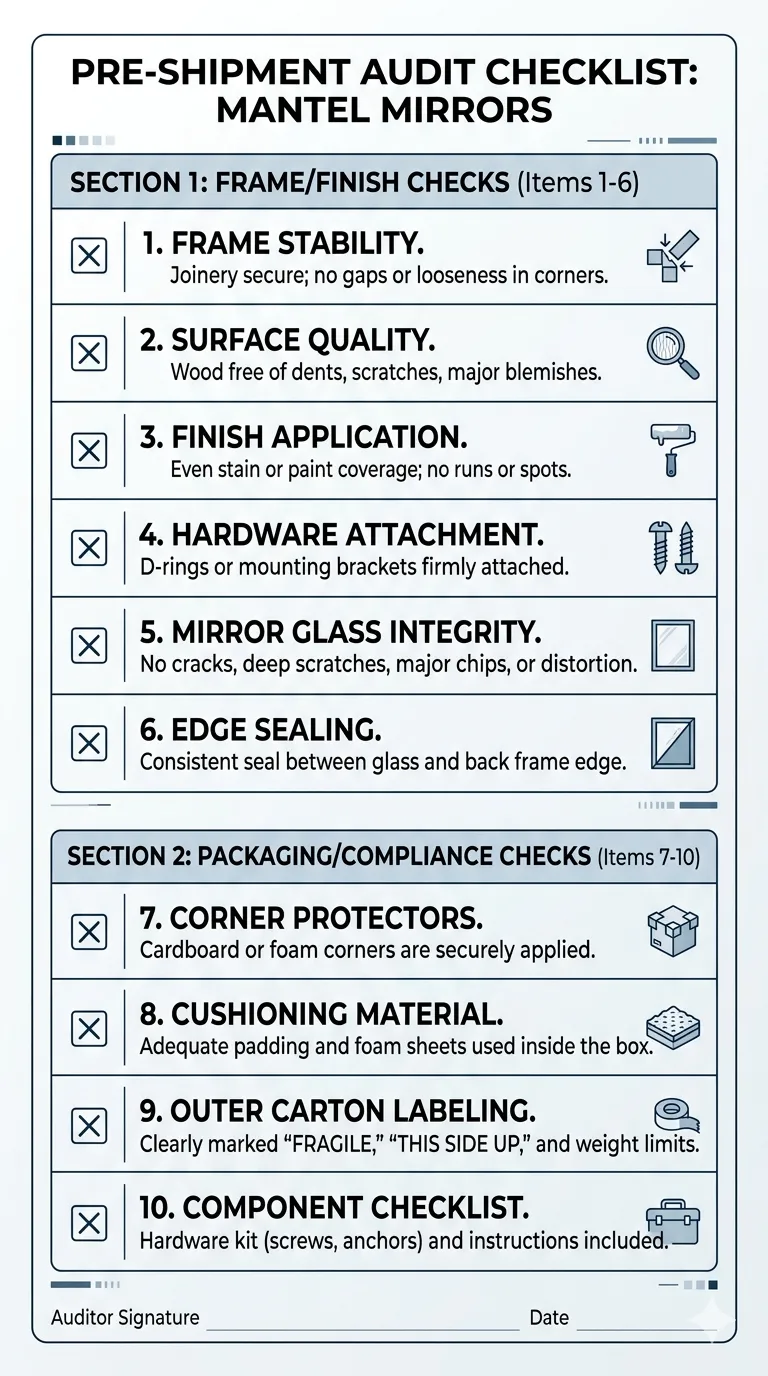
Pre-shipment inspection checklist for bulk bedroom mirror orders showing acceptance criteria for frame color, bevel, silvering, and packaging

Common sourcing mistakes that create the problem

These are the patterns we see repeatedly when buyers come to us after a bad order from another supplier.

Underspecifying finish tolerances. Ordering by finish name without a color standard is the single most common cause of frame color drift. "Champagne gold" means something different to every factory. A RAL code or a physical Pantone chip eliminates the ambiguity.

Skipping golden sample approval. Approving a sample digitally, or approving a showroom sample that wasn't built on the production line, gives you no reference point for the actual run. The golden sample is the contract between you and the factory on what the product looks like.

Ordering across multiple factories to hit a lower price. Splitting a 1,000-unit bedroom mirror order across two factories to get a better unit price is a reliable way to get two visually different products. Even if both factories use the same finish name, the output won't match. If you're building a product line that needs visual consistency across SKUs, single-source it.

Ignoring packaging specs. A mirror that passes QC at the factory can arrive damaged if the packaging isn't right. Bedroom mirrors with ornate frames have protruding elements — carved details, applied moldings — that concentrate pressure during stacking. Specify individual carton weight limits and stacking orientation.

Buyer checklist: what to confirm before placing a bulk bedroom mirror order

Use this before committing to any supplier for a bulk bedroom mirror run:

  • [ ] Supplier runs glass cutting, silvering, and frame finishing under one roof (or can demonstrate batch coordination between facilities)
  • [ ] Supplier can provide copper-free silvering with documented salt spray test results
  • [ ] Supplier holds frame finish to a stated delta-E tolerance (≤3.0 recommended)
  • [ ] Golden sample approval process is standard, not optional
  • [ ] Pre-production run sign-off is available for orders above 200 units
  • [ ] In-line QC inspection interval is defined and documented
  • [ ] Bevel width tolerance is ±0.5mm or better
  • [ ] Pre-shipment inspection uses AQL 2.5 or equivalent sampling
  • [ ] Packaging spec includes foam separation between mirror surface and carton

If a supplier can't confirm the majority of these points, the consistency risk is real. The questions aren't difficult for a factory that actually controls its process — they're only difficult for one that doesn't.

FAQ

What is an acceptable color delta-E tolerance for decorative mirror frames in bulk orders?

For retail-grade decorative mirrors, delta-E ≤ 3.0 is the standard working tolerance. Below 1.0 is imperceptible to most people. Between 1.0 and 3.0 is acceptable for most decorative applications. Above 3.0 is visible on a retail shelf, especially under store lighting. For hospitality projects where mirrors are installed in the same room, tighten the tolerance to delta-E ≤ 2.0 and require colorimeter readings in the inspection report.

How do I know if a mirror supplier is actually manufacturing or just assembling?

Ask for a factory audit report or request a video walkthrough of the production floor. Specifically ask: "Do you cut and silver your own glass on-site?" and "Do you run your own frame finishing line?" A trading company or assembler will either deflect or show you a partner factory. A manufacturer will show you the machines. ISO 9001 certification is a useful baseline, but it doesn't distinguish between a manufacturer and an assembler — the audit question does.

What MOQ makes sense for a first bulk bedroom mirror order with a new supplier?

Start with 100–200 units on a standard model before committing to a large run. This gives you a real production sample to evaluate finish consistency, packaging quality, and lead time reliability without the full exposure of a 500+ unit order. Most serious manufacturers will accommodate a trial run at this scale. If a supplier requires 500 units minimum on a first order with no sample option, that's a risk flag — they're optimizing for their production efficiency, not your sourcing confidence.

Does copper-free silvering actually matter for bedroom mirrors?

For bedroom applications specifically, yes. Copper-free silver coating eliminates the edge blackening that develops over time when copper backing oxidizes in humid conditions. Bedrooms aren't as moisture-intensive as bathrooms, but temperature cycling and humidity variation still occur. Copper-free silvering also produces a cleaner, more neutral mirror tone — relevant for decorative bedroom mirrors where the glass quality is part of the product's visual appeal. Ask your supplier for salt spray test results: copper-free coatings should hold ≥ 96 hours per ISO 9227 without edge deterioration.

If you're building a bedroom mirror program and want to lock down the spec before placing a bulk order, our Bedroom Decor Mirrors page covers the standard configurations we run. For a broader look at how room application affects mirror specs, Decor Mirrors by Room is a useful reference — bedroom and bathroom mirrors share a factory but almost nothing in the spec sheet.

When you're ready to move forward, submit your specs through our RFQ page — frame material, finish, mirror size, bevel requirements, and target quantity — and we'll come back with a technical proposal that includes our consistency guarantees and QC checkpoint plan.

Home Decor Mirrors Product Line Planning — How B2B Buyers Build a Profitable SKU Mix

Most buyers who come to us with a mirror sourcing brief have already made one expensive mistake: they built their first assortment around what looked good in a catalog, not around what sells through at retail and reorders predictably. A bathroom mirror and a living room mirror share a factory floor — but almost nothing else in the spec sheet. Get the room-application logic wrong and you end up with overstock in one category and stockouts in another, plus a frame finish that fails in a humid environment because nobody flagged the coating spec at the RFQ stage.

This guide walks through how we think about Home Decor Mirrors product line planning from the factory side — the four axes that drive SKU selection, the specs that actually matter per room category, and the order structure that lets you test before you commit.

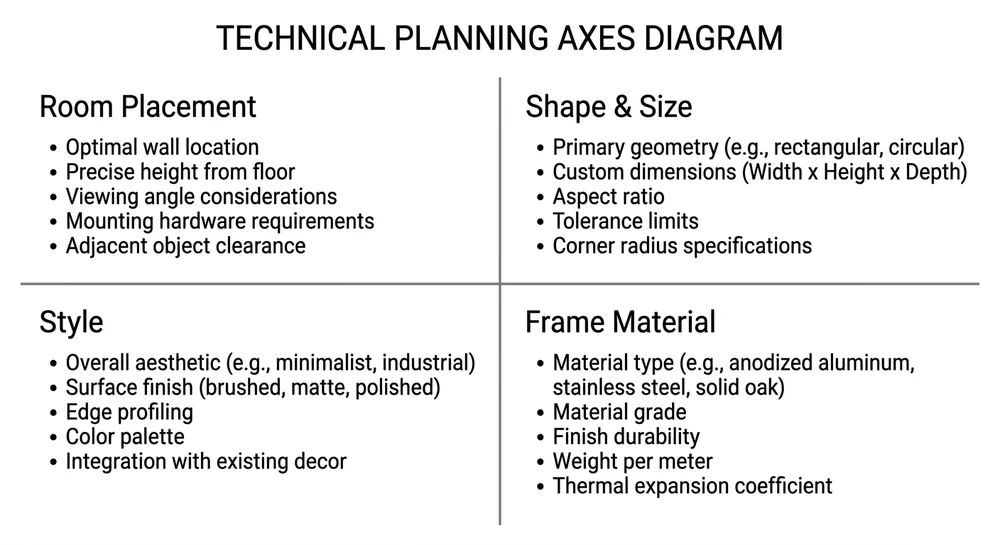
Diagram showing four planning axes for home decor mirror SKU assortment — room placement, shape and size, style, and frame material

The Four Planning Axes: How SKU Decisions Actually Stack

Before you write a single line item on an RFQ, you need a framework. We work with buyers across North America, Europe, and Australia, and the ones who build profitable lines consistently think about their assortment across four axes simultaneously — not sequentially.

Axis 1: Room placement. This is the load-bearing axis. Room determines moisture exposure, typical viewing distance, size expectations, and whether the frame material needs to survive a humid environment. A bathroom vanity mirror and a bedroom full-length mirror are different products in almost every spec dimension.

Axis 2: Shape and size. Round, rectangular, arch-top, irregular — shape drives frame complexity and therefore cost. Size drives glass weight, packaging spec, and container loading efficiency. A 24×36" rectangular mirror loads very differently from a 30" round, and that difference shows up in your landed cost per unit.

Axis 3: Style. Transitional, modern, rustic, glam — style determines frame profile depth, finish type, and which retail channels the SKU fits. Style is also where trend risk lives. We'll come back to this.

Axis 4: Frame material. Wood, MDF, metal, resin, frameless — each material has a different cost floor, lead-time profile, and moisture tolerance. This axis is where most first-time buyers under-specify, and where we catch the most problems before production starts.

The practical implication: a well-built starter assortment doesn't pick one option per axis. It picks a deliberate combination — for example, three room categories × two size tiers × two style directions × two frame materials — and maps those intersections to actual SKUs. That's how you get to a 10–14 SKU mix that covers your market without redundancy.

Room-Based Category Logic: Where Specs Diverge

The Decor Mirrors by Room category structure exists for a reason. Room placement isn't a merchandising label — it's a spec driver. Here's where the differences matter most for sourcing decisions.

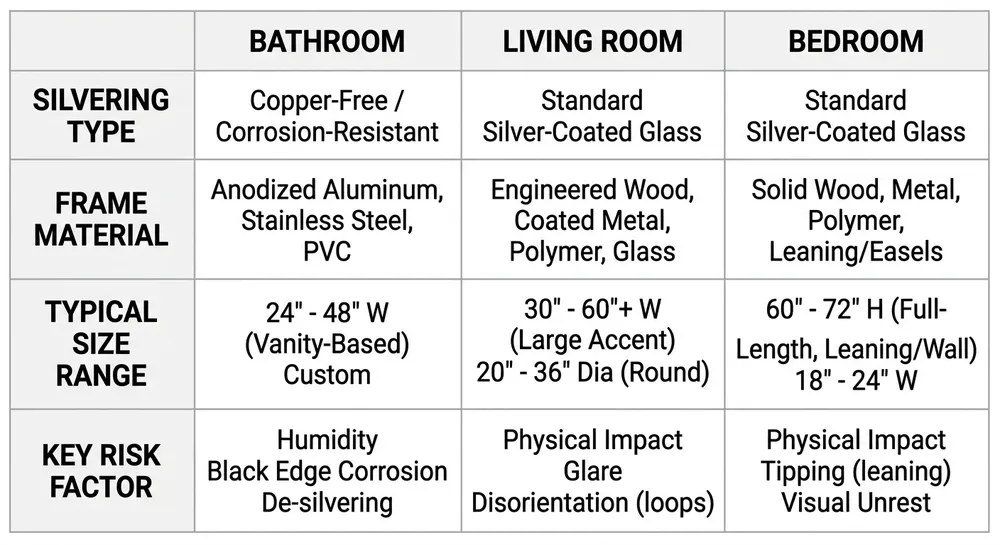
Bathroom mirrors: moisture is the spec, not the style

Bathroom mirrors are the highest-reorder category in our residential line. Vanity replacement, renovation projects, hospitality refits — the demand is steady and the order sizes are predictable. But the spec requirements are unforgiving.

The glass silvering spec is non-negotiable in this category. Standard copper-backed silvering degrades in sustained humidity — you'll see edge blackening within 12–18 months in a bathroom environment, and that generates warranty claims. We run copper-free silvering as our default across the entire line, which means our bathroom mirrors are EU-compliant on the lead and copper restriction side without a spec upgrade or upcharge. For buyers selling into European retail or hospitality, that's a compliance checkbox that's already handled. (We made the switch to copper-free across all production in 2021 — the material cost difference is marginal, and the warranty claim reduction was immediate.)

Frame material for bathroom applications: metal frames with a moisture-resistant powder coat, or frameless designs, are the safe choices. MDF frames need a sealed edge profile and a proper moisture barrier coating — we can do it, but buyers need to specify it explicitly, and the finish options narrow. Wood frames in bathrooms are a risk we flag every time; unless the buyer's end market is a dry climate and the mirror placement is away from direct splash zones, the delamination rate climbs.

Size range for Bathroom Decor Mirrors typically runs 24"–36" width for single-sink vanity, 48"–72" for double-sink. These are the sizes that move at retail and reorder. Going outside this range for a first order is a margin risk — you're betting on a niche before you've validated the core.

Living room mirrors: size and statement drive the margin

Living Room Decor Mirrors are where your margin lives, but also where your inventory risk concentrates. Large-format decorative mirrors — 36"×48" and above, arch-top designs, ornate frame profiles — carry higher retail price points and better gross margin per unit. They also have longer sell-through cycles and are more sensitive to style trends.

The frame profile is the product in this category. A living room mirror buyer is paying for the visual weight of the frame — the depth, the finish, the profile detail. We run frame profiles from 1.5" flat to 4"+ ornate molding, and the cost difference between a simple 2" flat metal frame and a 3.5" carved resin profile is significant. Buyers need to decide early whether they're building a value-accessible line or a premium statement line, because the frame spec drives the price floor.

Glass spec for living room applications: 5mm float glass is standard for mirrors up to 36" on the long dimension. Above that, we move to 6mm for structural integrity during shipping and wall mounting. The weight difference matters for packaging — heavier glass means more foam protection, which affects your carton cube and container loading count.

Style trend risk is real here. We've seen buyers over-index on a trending frame finish (brushed gold was the obvious one a few years back) and end up with 18 months of slow-moving inventory when the trend cycled. Our recommendation: anchor your living room assortment on 2–3 transitional or classic styles that have 3–5 year shelf life, then add 1–2 trend-forward SKUs at lower initial quantities. Test before you commit volume.

Bedroom mirrors: full-length drives the category

Full-length floor mirrors and leaner mirrors are the bedroom category's commercial core. The size range — typically 14"×48" to 24"×65" — means these are among the most container-efficient mirrors we ship. A 20"×60" leaner in a flat-pack carton loads well, and the retail price point relative to production cost gives buyers reasonable margin.

The hardware spec matters more in this category than buyers expect. A full-length mirror needs a wall-mount bracket rated for the glass weight, or a floor stand with a stable base geometry. We've seen returns driven entirely by inadequate hanging hardware — the mirror itself was fine, the bracket failed. We include weight-rated D-ring hardware as standard on wall-mount bedroom mirrors and test the bracket pull strength before shipment.

Frame material for bedroom mirrors: MDF with a foil wrap or paint finish is the cost-efficient choice for value-tier retail. Solid wood or metal frames move the price point up and suit mid-to-premium channels. The finish options on MDF are wide — we can match most RAL colors and wood-grain foils — so buyers building a coordinated bedroom furniture program can align the mirror finish to their case goods without going to solid wood cost.

Comparison table of mirror spec requirements by room — bathroom, living room, and bedroom — covering silvering, frame material, and size range

Frame Material Trade-offs: Cost Floor, Lead Time, and Moisture Tolerance

Frame material is the axis where sourcing decisions have the most downstream consequences — on cost, on lead time, and on warranty exposure. Here's how the main options stack up from a production standpoint.

Frame Material Cost Tier Moisture Tolerance Lead Time Impact Best Application
Metal (powder coat) Mid High Standard Bathroom, modern living room
MDF (sealed/foil) Low–Mid Medium (sealed) Standard Bedroom value tier, transitional
Solid wood Mid–High Low–Medium +5–7 days (drying) Premium bedroom, rustic living room
Resin/PU Mid High Standard Ornate profiles, glam style
Frameless Low High Standard Bathroom, minimalist

A few notes from production experience:

Metal frames are our most consistent lead-time category. The powder coat line runs at 60–80μm thickness, passes 500-hour salt spray, and the process is automated — batch-to-batch consistency is high. For buyers building a bathroom or modern-style line, metal is the low-risk frame choice.

MDF needs to be specified correctly for humid applications. Unsealed MDF edge profiles in a bathroom environment will swell. We seal the edges and apply a moisture-barrier primer before the finish coat on bathroom-spec MDF frames, but this has to be called out in the order spec — it's not assumed. (We've had buyers come back after their first season with edge-swelling complaints because the spec wasn't locked at RFQ. Now we flag it proactively on every bathroom MDF inquiry.)

Solid wood adds lead time because the timber needs to reach equilibrium moisture content before machining and finishing. We source kiln-dried timber, but the drying and conditioning step adds 5–7 days to the production schedule. For buyers on tight seasonal timelines, this matters.

Resin and PU profiles give you the ornate frame geometry of carved wood at lower cost and with better moisture tolerance. The trade-off is weight — a deep resin profile on a large mirror adds shipping weight. For buyers targeting the glam or maximalist segment, resin profiles are the practical choice for achieving the visual without the solid wood price.

Silvering Spec: The Detail That Determines Warranty Exposure

Most buyers don't ask about silvering until they have a warranty problem. We'd rather you ask before the order.

Standard mirror silvering uses a copper backing layer between the silver and the protective paint coat. Copper-backed mirrors are fine in dry environments. In humid environments — bathrooms, coastal climates, high-humidity retail storage — the copper layer oxidizes at the edges over time, producing the black edge creep that generates returns.

Copper-free silvering eliminates the copper layer and uses an alternative barrier chemistry. The result is better edge stability in humid environments and compliance with EU restrictions on copper and lead in decorative products. We run copper-free as our production default — it's not a premium option, it's just how we make mirrors. For buyers selling into EU retail or building a bathroom-heavy assortment, this is a meaningful compliance and warranty risk reduction that doesn't add cost.

The practical sourcing check: when you're evaluating mirror suppliers, ask specifically whether their silvering is copper-free or copper-backed, and ask for a humidity chamber test result. A supplier who can't answer that question clearly is running copper-backed silvering and probably hasn't tested it in humid conditions.

Order Economics: MOQ Tiers, Mixed-SKU Containers, and the Sample Workflow

This is where product line planning meets sourcing reality. The category logic above tells you what to buy — this section tells you how to structure the order.

MOQ tiers and what they mean for SKU testing

Our standard MOQ is 100 pieces per SKU for catalog models. That's low enough to test a new SKU at retail before committing to full-container volume. For custom frame profiles or non-catalog finishes, MOQ moves to 200–300 pieces depending on the frame complexity — the tooling and setup cost needs to be spread across enough units to make sense for both sides.

The practical implication for line planning: you don't have to commit to 500 units of a new style to find out if it sells. Start at 100, run it through one retail season, and reorder based on actual sell-through data. We see most new buyers in the residential mirror category start with a 3–5 SKU trial order across two room categories, then expand to a full assortment on the second PO.

Mixed-SKU container loading

Vertical integration matters here. Because we handle glass cutting, silvering, frame production, and assembly under one roof, we can run a mixed-SKU order without coordinating across multiple suppliers. A container with 200 units of bathroom vanity mirrors, 150 units of bedroom full-length mirrors, and 100 units of living room arch-top mirrors is a single production run, a single QC process, and a single shipment. You're not chasing three factories and three freight consolidations.

Container loading efficiency varies by mirror size and packaging spec. Flat-pack cartons for frameless and simple-frame mirrors load more efficiently than assembled mirrors in foam-lined boxes. For buyers optimizing landed cost, we can advise on packaging configuration per SKU to maximize container fill rate — it's worth a conversation before you finalize the order spec.

Sample-to-bulk workflow

The standard path: request samples of 2–3 SKUs from our catalog, evaluate finish quality and packaging, confirm the spec, then place the production order. Sample lead time is typically 7–10 days for catalog models. For custom frame profiles, we produce a pre-production sample before committing to full tooling — that step adds time but prevents expensive surprises at bulk delivery.

One thing we've learned from working with retail buyers: sample approval needs to include packaging review, not just product review. The mirror that looks perfect out of the box can arrive at your customer's door with corner damage if the carton spec isn't right. We include packaging drop-test results with our sample documentation for buyers who need it.

Workflow diagram showing the sample-to-bulk ordering process for decorative mirrors — from SKU selection through sample approval to production and shipment

Common Planning Mistakes That Cost Buyers Money

We see the same mistakes often enough that they're worth naming directly.

Over-indexing on trend styles at launch. A new buyer building their first mirror line wants to lead with what's visually exciting. That's understandable. The problem is that trend-forward styles — a specific frame finish, an unusual shape — have shorter sell-through windows and don't reorder as predictably as transitional or classic styles. Build your assortment base on styles with 3–5 year shelf life. Add trend SKUs at 20–30% of your initial volume, not 60%.

Ignoring reorder velocity when selecting SKUs. The mirrors that drive a distribution business aren't always the most visually striking — they're the ones that sell through in 60–90 days and reorder on a predictable cycle. Bathroom vanity mirrors in standard sizes are less exciting than a large ornate living room piece, but they reorder 3–4× per year. A line built around reorder velocity looks different from a line built around catalog appeal.

Under-specifying packaging for the sales channel. A mirror going into a retail store has different packaging requirements than one going into an e-commerce fulfillment center. Drop-test requirements, barcode placement, retail-ready packaging — these need to be specified at the order stage, not retrofitted after the first shipment. We have experience with Walmart, Wayfair, and Amazon compliance requirements; if your target channel has specific packaging standards, tell us at the RFQ stage.

Treating all frame materials as interchangeable. A buyer who specifies "wood frame" without locking the species, moisture content, and finish type is leaving the spec open to interpretation. We'll make a reasonable choice, but it may not be the choice that fits your market or your price point. The more specific your frame spec at RFQ, the fewer surprises at sample review.

Building a Starter Assortment: A Practical 10–12 SKU Framework

For buyers entering the home decor mirror category or expanding an existing line, here's a framework we've seen work across multiple markets.

Tier 1 — Core reorder SKUs (5–6 SKUs): These are your volume drivers. Bathroom vanity mirrors in 24" and 36" widths, copper-free silvering, metal or frameless frame, 2 finish options. Bedroom full-length mirror in one size, MDF or metal frame, 2 finish options. These SKUs should be in your catalog permanently — they reorder predictably and anchor your container economics.

Tier 2 — Margin SKUs (3–4 SKUs): Living room statement mirrors in larger formats — 36"×48" or arch-top designs — with a frame profile that justifies a higher retail price point. 2 style directions (transitional and one trend-adjacent). These carry better margin per unit but slower sell-through. Keep initial quantities conservative.

Tier 3 — Test SKUs (2 SKUs): One trend-forward style at minimum viable quantity (100–150 units). One custom or OEM frame profile if you're building a proprietary line. These are your market intelligence — run them for one season and let the sell-through data tell you whether to scale or rotate.

This structure gives you coverage across room categories, two price tiers, and a built-in mechanism for testing new directions without betting the container on them.

Spec Reference: What to Lock Before You Send an RFQ

When you're ready to move from category plan to actual sourcing inquiry, these are the spec dimensions that need to be confirmed per SKU — not left open.

Spec Dimension Why It Needs to Be Locked Common Default If Unspecified
Glass thickness Affects weight, packaging, and structural integrity 5mm (may be wrong for large formats)
Silvering type Copper-free vs. copper-backed — warranty exposure in humid environments Copper-backed (lower cost, higher risk)
Frame material + species Cost, moisture tolerance, and finish options vary significantly Supplier's choice
Frame finish Color, texture, and durability spec Supplier's standard catalog finish
Hanging hardware Weight rating, bracket type, included vs. separate Minimal hardware, unrated
Packaging spec Drop-test rating, retail-ready requirements, barcode placement Standard export carton
MOQ per SKU Determines whether custom options are viable 100 pcs catalog / 200–300 pcs custom

Locking these dimensions before the RFQ goes out means your quote comes back comparable across suppliers and your sample review has a clear pass/fail criteria. Leaving them open means you're comparing quotes that aren't actually quoting the same product.

For buyers building a multi-room assortment, the Request Quote process works best when you submit your target room categories, preferred frame materials, size ranges, and volume estimates together — we can return a tailored SKU proposal with pricing, MOQs, and lead times that reflects your actual line plan rather than a generic catalog price list.

FAQ: Home Decor Mirror Product Line Planning

What glass thickness should I specify for home decor mirrors?

For mirrors up to 36" on the long dimension, 5mm float glass is standard and sufficient. Above 36" — large living room pieces, full-length bedroom mirrors over 60" — specify 6mm. The weight increase is real (roughly 20% heavier per square foot), which affects your packaging spec and container loading count, but the structural integrity during shipping and wall mounting justifies it. Don't let a supplier talk you into 4mm on a large-format mirror to save cost — the breakage rate in transit goes up and the wall-mount stability goes down.

How do I know if a supplier's silvering will hold in a bathroom environment?

Ask for a humidity chamber test result — specifically, accelerated corrosion testing at 40°C and 95% relative humidity for 240 hours minimum. A mirror that passes this test without edge blackening is suitable for bathroom applications. If a supplier can't provide this data, assume they haven't tested it. Copper-free silvering consistently outperforms copper-backed in this test; it's the spec to request for any bathroom or high-humidity application.

What's the realistic MOQ for a custom frame profile?

For a fully custom frame profile — new tooling, non-catalog geometry — plan for 200–300 pieces minimum per SKU. Below that, the tooling amortization makes the unit cost uncompetitive. If you're testing a custom direction, the practical path is to start with a catalog frame that's close to your target, validate the market, then invest in custom tooling for the reorder. We've helped buyers do this transition on several programs — it's a lower-risk way to build a proprietary line.

Which mirror styles have the best reorder velocity for wholesale distribution?

Transitional styles — clean profiles, neutral finishes like matte black, brushed nickel, or natural wood tones — consistently outperform trend-specific styles on reorder velocity. They fit multiple retail environments, don't date quickly, and your retail customers can reorder them across seasons without a style refresh. In our experience, the top-reordering SKUs in a distributor's line are almost always transitional bathroom and bedroom mirrors, not the statement living room pieces that look best in a catalog.

Can I mix room categories in a single container order?

Yes, and it's often the right move for a first order. A mixed-SKU container across bathroom, bedroom, and living room categories lets you test multiple segments simultaneously without waiting for separate shipments. Because we run all production in-house, a mixed order is a single production schedule and a single QC process. The main constraint is minimum quantities per SKU — each line item still needs to meet its MOQ threshold. We can advise on container loading configuration to maximize fill rate across different carton sizes.

How to Source Mantel Decor Mirrors With Consistent Frame Quality Across Batches

The first batch looks perfect. The second batch ships three months later and the frame finish is half a shade warmer, the profile corners don't sit flush, and two units have visible silvering halos near the bottom edge. Your retail buyer flags it. You're now managing a return authorization, a replacement shipment, and a conversation about whether to keep the SKU in the planogram at all.

This is the most common and most preventable problem in mantel mirror sourcing — and it almost never comes from a single bad batch. It comes from a supplier structure that was never set up to hold consistency across batches in the first place.

This guide walks through exactly what to evaluate, what to specify, and what to require from any supplier before you commit to a mantel mirror program.

Why Batch Consistency Fails — and What It Costs You

Most sourcing guides treat batch variation as a QC problem. It isn't. It's a supply chain architecture problem. By the time a defect shows up in a pre-shipment inspection, the root cause is usually three steps upstream.

Here's the typical failure chain for mantel mirror frame inconsistency:

  1. The factory subcontracts frame molding to an outside profile supplier
  2. That supplier changes their MDF density grade or resin compound between runs — often without notifying the mirror factory
  3. The mirror factory applies the same finish process to a slightly different substrate
  4. The result: finish absorption varies, color shifts, or the profile geometry drifts by 0.5–1.0mm

That 0.5mm drift is invisible in a product photo. It's visible when you stand two units side by side on a retail shelf or in a hotel corridor installation. And by the time you see it, you've already paid for the container.

The commercial cost isn't just the return. It's the SKU credibility with your buyer, the reorder hesitation, and the margin erosion from replacement freight. For a 500-unit mantel mirror program, a single batch inconsistency event can wipe out the margin on the entire order.

Diagram showing the supply chain failure chain that causes mantel mirror frame finish inconsistency across production batches

Frame Material Grading: What to Specify Before You Order

The frame is where most of the variation lives. Mantel mirrors typically use one of four frame constructions — and each has a different consistency profile at scale.

MDF-core with veneer or paint finish The most common construction for mid-market mantel mirrors. MDF density should be specified at 720–780 kg/m³ for stable paint adhesion. Below that range, the surface is too porous and finish absorption varies run to run. Ask your supplier which MDF grade they use and whether they source from a single mill or multiple suppliers. Multi-mill sourcing is a consistency risk you need to know about upfront.

Solid wood (pine, rubberwood, or paulownia) Used in higher-margin rustic and farmhouse profiles. Natural wood has inherent grain variation — that's expected and often desirable. The consistency risk here is moisture content. Wood delivered above 12% moisture content will move after assembly, causing joint gaps and finish cracking within 6–12 months. Require a moisture content certificate from the lumber supplier, not just a visual inspection.

Resin or polyurethane (PU) frame Common for ornate carved profiles. Highly consistent when the mold is well-maintained, but mold wear introduces profile drift over time. Ask how many shots the mold has run and whether the supplier has a mold replacement schedule. A mold past 50,000–80,000 shots on a detailed ornamental profile will show measurable corner rounding.

Metal frame (iron, aluminum) The most dimensionally stable option. Finish consistency depends on the coating process — powder coat or electroplating. Powder coat at 60–80μm gives you consistent color and a 500-hour salt spray result that matters for mantel placement near fireplaces. (We've seen buyers skip the salt spray spec on metal-frame mantel mirrors and then get corrosion complaints from coastal accounts within a year — the heat cycling near a fireplace accelerates it.)

The Supplier Evaluation Checklist: What to Ask Before You Sign a PO

Most buyers evaluate mantel mirror suppliers on price, photos, and a sample. That's not enough for a repeatable program. Here's what to verify:

Frame Production: In-House or Subcontracted?

This is the single most important question. A factory that subcontracts frame molding to an outside profile supplier has a consistency gap built into its structure. When the profile supplier changes their material batch, the mirror factory may not know until the finish looks wrong — and by then, your order is already in production.

Ask directly: "Do you produce your own frame profiles, or do you source them from a third-party molding supplier?"

If the answer is subcontracted, ask for the name of the profile supplier and whether they have a material consistency agreement in place. If they can't answer that question, the risk is real.

At Livewellcraft, frame molding runs in-house on the same 12,000 m² facility as silvering and assembly. When we adjust a profile geometry for a custom OEM order, the change happens on our own equipment, and our QC team validates the updated profile before it enters the production line. There's no handoff gap.

Silvering Process: Copper-Free or Conventional?

For mantel mirrors specifically — placed near fireplaces, radiators, or in rooms with seasonal temperature swings — the silvering process matters more than most buyers realize.

Conventional silver-copper mirror backing is susceptible to edge oxidation when exposed to heat cycling and humidity variation. The copper layer corrodes first, and the result is the dark "foxing" edge that appears 12–18 months after installation. For a mantel mirror in a living room near a working fireplace, that's a warranty claim waiting to happen.

Copper-free silvering eliminates the copper interlayer. The silver layer bonds directly to a protective paint backing, and the edge oxidation resistance improves significantly. Specify copper-free backing for any mantel mirror program where the end placement is near a heat source.

Ask your supplier: "Is your silvering process copper-free, and can you provide a salt spray adhesion test result for the silver coating?" A credible supplier will have this data. A supplier who can't produce it is running a process they haven't validated.

Side-by-side comparison of copper-free and conventional silver mirror backing showing edge oxidation resistance difference

Finish Process Controls: What Tolerances Are Acceptable?

Frame finish consistency requires documented process controls, not just visual inspection. When evaluating a supplier, request their finish specification sheet and look for:

Parameter Acceptable Range
Paint/lacquer film thickness 80–120μm (dry film)
Color delta-E tolerance ≤ 1.5 vs. golden sample
Frame profile dimension tolerance ±0.5mm on width and depth
Corner joint gap ≤ 0.3mm
Silver coating adhesion (cross-cut test) ISO 2409 Grade 0–1

If a supplier can't give you these numbers, they're managing finish quality by eye — which means batch-to-batch variation is a matter of when, not if.

QC Checkpoints to Require in Your Purchase Agreement

A pre-shipment inspection catches problems after they've already been manufactured. The checkpoints that actually protect your program happen earlier.

Pre-Production: Golden Sample Sign-Off

Before production starts, require a golden sample — a physical unit that represents the approved standard for frame profile, finish color, surface texture, and mirror quality. This sample gets signed off by both parties and held at the factory as the production reference.

Without a golden sample, "consistent with previous order" is a verbal agreement with no physical anchor. We've seen buyers skip this step on reorders because the first batch was fine — and then discover that "fine" meant something slightly different to the factory the second time around.

The golden sample should specify:

  • Frame material grade and supplier
  • Finish color code (RAL, Pantone, or factory reference)
  • Acceptable surface texture range (gloss level measurement if applicable)
  • Mirror glass spec: thickness, bevel angle (typically 3°–5° for standard mantel bevels), and edge polish type
  • Packaging spec to prevent transit damage

In-Line Inspection: Frame Profile and Finish Checks

During production, require documented in-line checks at two points:

After frame assembly, before finishing: Verify profile dimensions against the golden sample. Catch geometry drift before the finish is applied — rework at this stage costs far less than after coating.

After finishing, before mirror assembly: Check finish color against the golden sample under standardized lighting (D65 daylight standard is the industry reference). Color checked under factory fluorescent lighting will look different under retail or residential lighting — this is a common source of buyer complaints that never get traced back to the inspection condition.

Pre-Shipment Audit: The 10-Point Check

Before the container loads, a pre-shipment audit should cover:

  1. Frame profile dimensions (sample 10% of units, minimum 20 pieces)
  2. Finish color delta-E vs. golden sample
  3. Corner joint gaps — no visible gaps above 0.3mm
  4. Mirror glass flatness — no visible distortion when viewed at 45°
  5. Bevel consistency — uniform width and angle across the mirror perimeter
  6. Silver edge condition — no oxidation, halos, or black spots within 5mm of edge
  7. Hardware and hanging system — D-rings, wire, or bracket alignment
  8. Packaging integrity — foam corner protection, no compression marks on frame
  9. Carton labeling — SKU, barcode, country of origin compliance
  10. Quantity count vs. packing list
Pre-shipment audit checklist for wholesale mantel mirror orders showing 10 inspection points

Common Sourcing Mistakes That Create Batch Problems

These are the patterns we see most often when buyers come to us after a consistency problem with a previous supplier.

Approving samples without locking the spec sheet. A sample approval without a written spec sheet attached to the PO is an approval of one unit, not of a production standard. The factory will build to whatever they built before — which may drift.

Skipping the frame material question on reorders. Material sourcing changes happen quietly. A factory that used a single MDF supplier for your first order may have switched to a cheaper alternative by your third. Ask on every reorder: "Has anything changed in your frame material sourcing since our last order?"

Relying on photos for color approval. Camera white balance, screen calibration, and JPEG compression all affect how a finish color looks in a photo. Color approval by photo is not color approval. Require a physical sample or a delta-E measurement against a reference.

Ignoring ambient conditions in the coating environment. Paint and lacquer adhesion is sensitive to temperature and humidity during application. A factory coating frames in an uncontrolled environment will produce different results in January versus August. Ask whether the finishing area is climate-controlled. (This sounds like a minor detail until you get a batch with adhesion failures in a humid summer shipment.)

Treating MOQ as a quality signal. Low MOQ doesn't mean lower quality, and high MOQ doesn't mean better consistency. What matters is whether the factory has documented process controls — not how many units they require.

How Vertical Production Reduces Variation

The structural reason most mantel mirror batch problems are hard to solve is that the factory assembling your mirror doesn't control all the inputs. Frame profiles come from one supplier, glass from another, hardware from a third. Each handoff is a potential variation point.

Vertical production — where frame molding, glass cutting, silvering, and assembly all run under one roof — eliminates most of those handoffs. When a profile dimension drifts, the team that cuts the glass and the team that molds the frame are in the same building. The correction happens in hours, not across a supplier communication chain that takes days.

At Livewellcraft, our 12-person engineering team develops custom frame profiles on our own molding equipment. When a buyer needs a specific profile geometry — say, a 65mm flat-face frame with a stepped inner edge for a hospitality project — we cut the tooling, run a sample, and validate the profile before it enters production. The same team that designed it is watching the first production run. That's a different accountability structure than a factory that orders profiles from an outside supplier and hopes they match the spec.

Our silvering line runs in a controlled-environment coating room. Temperature and humidity are monitored during every shift. Silver adhesion is tested by cross-cut (ISO 2409) on every production batch before the glass moves to assembly. If a batch fails the adhesion check, it doesn't move forward — full stop.

For buyers running Mantel Decor Mirrors programs across multiple SKUs, this matters because consistency isn't just about one mirror looking right. It's about the third reorder looking the same as the first sample you approved.

Spec Sheet Template: What to Lock Before Production Starts

A complete mantel mirror spec sheet should cover these parameters. Use this as a starting checklist when building your PO documentation.

Frame Specification

  • Frame material: MDF / solid wood / resin / metal (specify grade)
  • Frame profile dimensions: width (mm) × depth (mm) ± tolerance
  • Corner construction: mitered / splined / doweled
  • Finish type: paint / lacquer / foil wrap / metal coat
  • Finish color reference: RAL / Pantone / factory code
  • Acceptable color delta-E vs. golden sample: ≤ 1.5
  • Dry film thickness: target range (μm)

Mirror Glass Specification

  • Glass thickness: typically 4mm or 5mm for mantel sizes
  • Bevel: yes/no; if yes — bevel width (mm) and angle (°)
  • Edge finish: polished / seamed / beveled
  • Silver backing: copper-free or conventional
  • Silver adhesion standard: ISO 2409 Grade 0–1

Overall Dimensions

  • Overall mirror size: W × H (mm) ± 2mm
  • Viewing area: W × H (mm)
  • Weight: kg (for packaging and hanging hardware spec)

Hardware

  • Hanging system: D-ring / wire / bracket
  • Hardware material and finish
  • Weight rating: minimum 2× mirror weight

Packaging

  • Inner packaging: foam corner protection, cardboard sleeve
  • Carton: double-wall corrugated, minimum 5-ply for units over 5kg
  • Carton labeling: SKU, barcode, country of origin, fragile marking
Mantel mirror sourcing spec sheet template showing frame material, glass, dimensions, hardware, and packaging parameters

Sample Approval Workflow for First-Time Mantel Mirror Buyers

If you're placing a mantel mirror program for the first time with a new supplier, the sample approval sequence matters as much as the spec sheet.

Step 1 — Submit your spec sheet and reference images. Give the supplier your target dimensions, frame material preference, finish reference, and any existing product you're trying to match or improve on. The more specific your brief, the less iteration you'll need.

Step 2 — Review the factory's counter-proposal. A competent supplier will come back with a material recommendation, a profile sketch or CAD drawing, and a sample timeline. If they come back with only a price and a lead time, that's a signal they're not running a structured development process.

Step 3 — Approve the pre-production sample (PP sample). The PP sample is built to your spec sheet. Evaluate it against every parameter on your spec sheet — not just visual impression. Measure the frame profile. Check the finish color under D65 lighting. Inspect the silver edge. Sign off in writing with any corrections noted.

Step 4 — Lock the golden sample. Once the PP sample is approved with corrections incorporated, the factory produces a golden sample that both parties sign. This physical unit is the production reference for every batch going forward.

Step 5 — First production run inspection. For the first production order, require an in-line inspection report at the frame assembly stage and a pre-shipment audit report before the container loads. Both reports should reference the golden sample as the standard.

(Most buyers skip Step 4 because it feels redundant after Step 3. It isn't. The PP sample is a development artifact. The golden sample is a production contract. They serve different functions.)

Connecting Frame Quality to Your Downstream Market

The buyers who run stable mantel mirror programs — consistent reorders, low return rates, strong retail placement — share one characteristic: they treat the spec sheet as a contract, not a suggestion.

For retail distribution, frame consistency directly affects planogram compliance. A frame that's 3mm wider than spec won't fit the shelf slot. A finish that's half a shade off will fail a visual merchandising audit. These aren't aesthetic concerns — they're operational ones that affect whether your SKU stays in the assortment.

For hospitality and project supply, batch consistency across a multi-room installation is non-negotiable. A hotel corridor with 40 mantel mirrors needs all 40 to look like they came from the same mold — because they should have.

For e-commerce, the return rate on decorative mirrors is already elevated because customers are comparing the product to a screen image. A finish inconsistency between the product photo (shot from the first batch) and the delivered unit (from the third batch) is a direct driver of returns and negative reviews.

Understanding mantel mirror dimensions and proportions is the starting point for getting the spec right — but it's the frame quality controls covered here that determine whether that spec holds across every batch you order.

Browse our full Decor Mirrors by Room range to see how we structure product programs across room categories, or go directly to our Mantel Decor Mirrors page for current profiles, finishes, and MOQ options.

Frequently Asked Questions

What is the minimum order quantity for a custom mantel mirror frame profile? We run custom OEM frame profiles from 100 pieces for standard sizes. For a completely new profile requiring new tooling, the practical minimum is 200–300 pieces to amortize the tooling cost without inflating your unit price. Below that threshold, we'd typically recommend adapting an existing profile rather than cutting new tooling.

How do I verify silver coating adhesion before committing to a supplier? Request a cross-cut adhesion test result per ISO 2409. The result should be Grade 0 (no flaking) or Grade 1 (minor flaking at cut edges only). Also ask for a salt spray test result — for copper-free silvering, 500 hours with no edge oxidation is a reasonable benchmark for mantel mirror applications. Any supplier running a validated silvering process will have this data on file.

What causes the dark edge "foxing" that appears on some mirrors after installation? Foxing is edge oxidation of the silver or copper layer, accelerated by humidity and heat cycling. It's most common in conventional silver-copper mirror backing when the edge seal is inadequate or the mirror is placed near a heat source. Copper-free silvering with a properly sealed edge significantly reduces this risk. If you're sourcing for mantel placement near fireplaces, specify copper-free backing explicitly in your spec sheet.

How many production batches can a resin frame mold run before profile drift becomes a problem? For a detailed ornamental profile, mold wear becomes measurable around 50,000–80,000 shots. At that point, corner radii soften and fine detail loses definition. Ask your supplier how many shots their active molds have run and whether they have a mold maintenance or replacement schedule. A supplier who doesn't track this is managing mold life reactively — which means you'll see the drift before they do.

What's the right approach for approving finish color on a reorder without a physical sample? The safest approach is to retain a golden sample from the original approved batch and ship it back to the factory as the color reference for the reorder. If that's not practical, request a delta-E measurement report from the factory comparing the new batch finish to the original color code. A delta-E of ≤ 1.5 is generally imperceptible to the human eye under standard viewing conditions. Approving by photo alone is not reliable.

If you're building or expanding a mantel mirror program and want to lock in frame quality from the first batch, share your spec requirements — frame material, finish, target dimensions, and order volume — through our Request Quote page. We'll come back with a detailed proposal including QC commitments and sample timeline.

“`

Room Decor Mirrors Sizing Guide — Dimensions, Glass Thickness, and Specs by Room Type

A bathroom mirror and a living room mirror share a factory — but almost nothing else in the spec sheet.

That's not a design observation. It's a sourcing reality. Buyers who treat mirror sizing as a single variable across room types end up with spec mismatches, freight surprises, and SKUs that don't move because they're wrong for the application. The dimensions that work in a living room create installation problems in a bathroom. The glass thickness that's fine for a bedroom accent piece is undersized for a full-length hospitality mirror that gets handled daily.

This guide covers standard mirror dimensions, glass thickness ranges, frame material constraints, and the production and freight implications that change when you move from one room category to another. It's written for distributors, retailers, and project buyers who need to spec mirrors correctly before they place an order — not after the container arrives.

We produce Decor Mirrors by Room across all major room categories from our 12,000 m² facility in Dong Nai, Vietnam. Everything in this guide reflects what we actually cut, silver, frame, and ship.

The Spec Table: Standard Mirror Dimensions and Glass Thickness by Room Type

This is the reference most sizing guides skip. Consumer articles talk about proportions and visual balance. What you actually need when writing a PO or briefing your engineering team is a working spec range — dimensions, glass weight, and thickness — by room application.

Room Type Typical Size Range (W × H) Standard Glass Thickness Frame Material Options Notes
Living room 60×80 cm – 90×120 cm 5mm–6mm MDF, wood, metal, resin Larger formats common; 5mm minimum for stability
Bedroom 50×70 cm – 80×100 cm 4mm–5mm MDF, wood, resin Full-length floor mirrors: 45×150 cm, 5mm
Bathroom 50×60 cm – 80×90 cm 4mm–5mm Metal, MDF (sealed) Moisture spec critical; copper-free silvering standard
Hallway / entryway 30×90 cm – 45×120 cm 4mm–5mm Metal, MDF, wood Tall narrow format; weight distribution matters
Dining room 70×90 cm – 100×130 cm 5mm–6mm Wood, metal, resin Often statement pieces; heavier frames common
Hospitality / hotel 60×80 cm – 90×150 cm 5mm–6mm Metal, MDF (sealed) High-use environment; backing and hardware upgraded

A few things worth noting about this table. First, the size ranges reflect what actually moves in wholesale and project channels — not the full theoretical range of what's possible. We can cut glass outside these ranges, but the sizes above are where standard tooling, stock frame profiles, and predictable freight costs align. Second, glass thickness isn't just a structural spec — it affects mirror weight, which affects packaging, freight cost per unit, and installation hardware requirements. A 90×120 cm mirror in 6mm glass weighs roughly 16 kg before framing. That changes your carton spec, your pallet configuration, and your per-unit landed cost.

Chart showing standard decorative mirror dimensions and glass thickness specifications by room type for wholesale buyers

How Room Function Changes the Spec — Beyond Dimensions

Dimensions are the starting point. What actually differentiates a bathroom mirror from a living room mirror at the production level is a set of environmental and use-condition requirements that affect material selection, coating process, and hardware.

Moisture exposure (bathroom and hospitality)

Bathrooms are the most demanding environment for mirror longevity. Steam, cleaning chemicals, and condensation attack the silver layer from the edges inward — a process called "black edge" or silvering deterioration. The fix isn't thicker glass. It's the silvering process and edge sealing.

We run copper-free silvering as our standard process across all production. For bathroom decor mirrors, we add edge sealing with a moisture-resistant backing paint and specify sealed frame profiles — typically powder-coated metal or sealed MDF — that don't absorb humidity. Hospitality buyers often request an upgraded backing spec with an additional protective layer, which adds a small cost but meaningfully extends the mirror's service life in high-use hotel bathrooms. (We've had buyers come back after their first hospitality project asking why their previous supplier's mirrors started showing black edges within 18 months — the answer is almost always an unsealed edge on a standard silvering process.)

For bathroom mirror moisture specs in detail, that's covered separately. The short version for sourcing purposes: specify copper-free silvering and sealed edges on any mirror going into a wet or high-humidity environment.

Weight and wall-load (living room and dining room)

Larger decorative mirrors — the 80×120 cm and above formats common in living rooms and dining rooms — put real load on wall fixings. A 90×120 cm mirror in a 5mm glass with a solid wood frame can weigh 20–25 kg. That's not a problem if the hanging hardware is specified correctly, but it's a sourcing detail that gets missed when buyers focus only on the visual spec.

We specify D-ring hardware rated to the mirror's actual weight, with a safety factor built in. For mirrors above 15 kg, we move to a French cleat or dual-bracket system rather than wire hanging. If your downstream customers are installing into drywall without stud backing, that's worth flagging at the RFQ stage — we can adjust the hardware spec accordingly.

Daily handling (hospitality and retail)

Hotel mirrors and retail display mirrors get touched, bumped, and cleaned far more often than residential pieces. For these applications, we upgrade the backing to a shatter-resistant safety film — a laminated layer bonded to the rear glass surface that holds fragments in place if the mirror breaks. This is standard in most hospitality specifications and increasingly required by retail chains for floor-standing mirrors. It adds roughly 8–12% to the unit cost but eliminates liability exposure from breakage.

Frame Material Constraints by Mirror Size

Frame material selection isn't just aesthetic. At the production level, different frame materials have different structural limits, and those limits interact directly with mirror size.

MDF frames are the most common choice for mid-range decorative mirrors in the 50×70 cm to 80×100 cm range. MDF machines cleanly, takes paint and foil finishes well, and keeps unit costs competitive. The constraint is weight-bearing capacity at larger sizes — an MDF frame on a 90×120 cm mirror needs internal reinforcement (typically a metal bracket system inside the frame channel) to prevent joint failure over time. We add this reinforcement as standard on MDF frames above 80 cm in either dimension.

Solid wood frames handle larger formats better structurally, but they add weight and cost. Wood is the right choice when your buyer is positioning the mirror as a premium piece — the material communicates quality in a way MDF doesn't, and it justifies a higher retail price point. The trade-off is that wood frames require more careful moisture management in transit and storage, particularly for buyers in humid markets.

Metal frames (powder-coated steel or aluminum) are the preferred spec for bathroom and hospitality applications because they don't absorb moisture. They're also the right choice for very large formats — above 90 cm width — where structural rigidity matters more than weight reduction. Metal frames add to the unit weight, which affects freight, but they're the most durable option for high-use environments.

Resin frames are used primarily for decorative profiles that can't be economically produced in wood or metal — ornate moldings, textured surfaces, complex shapes. Resin is lighter than wood at equivalent profile thickness, which helps on larger pieces. The constraint is that resin frames are more susceptible to impact damage in transit, so packaging requirements are higher.

The practical sourcing implication: if you're building a room-based product line that spans multiple size tiers, you may need different frame materials at different size points — not because of aesthetics, but because of structural and environmental requirements. We see this most often with buyers building bathroom and living room collections simultaneously. The bathroom SKUs need metal or sealed MDF; the living room SKUs can use wood or standard MDF. Trying to standardize on one frame material across both categories usually means compromising on one of them.

Matrix showing recommended mirror frame materials (MDF, wood, metal, resin) by mirror size range and room application

Non-Standard Sizes: What Changes in Production and Cost

Standard sizes exist for a reason. When you move outside the ranges in the table above, several things change simultaneously — and buyers who don't account for them end up with higher unit costs and longer lead times than they planned for.

Glass cutting on our automated tables is optimized for standard sheet sizes. Non-standard dimensions increase glass offcut waste, which raises the material cost per unit. A 10% size deviation from a standard cut pattern can increase glass waste by 20–30% depending on the nesting geometry. We absorb some of this on large orders, but on smaller runs it shows up directly in the unit price.

Frame tooling is the bigger variable. Standard frame profiles — the mold that shapes the frame cross-section — are already in our tooling library. If your size requires a new profile, tooling development adds 15–20 days and a one-time tooling cost that typically runs between $300–$800 depending on profile complexity. For buyers ordering 500+ units of a custom size, that cost amortizes quickly. For a 100-unit trial order, it's a meaningful addition to your landed cost per unit.

MOQ implications are real. Our standard MOQ is 100 pieces on existing molds and standard sizes. Non-standard sizes that require new tooling typically carry a higher MOQ — usually 300–500 pieces minimum — to justify the tooling investment. If you're testing a new room category with a non-standard size, the economics work better if you can commit to a larger initial run or accept the tooling cost as a development expense.

Lead time extends by 15–20 days for any order requiring new tooling. On a standard 5,000-piece order, our production lead time is 30–35 days. Add tooling development and you're at 45–55 days. That's not a problem if it's planned for — it becomes a problem when buyers assume standard lead times apply to custom specs.

The practical guidance: if you're building a new room-based SKU, start with sizes that fall within the standard ranges. Test sell-through at standard dimensions before investing in custom tooling. We've seen buyers spend on custom sizing for a new market entry, then discover the standard size would have sold just as well. (The reverse also happens — a buyer finds that a non-standard size is genuinely their market's preference, and the tooling investment pays back within two orders. But verify demand first.)

Packaging and Freight: How Mirror Size Affects Your Landed Cost

This is the section most sizing guides don't cover, and it's where B2B buyers lose money without realizing it.

Mirror size affects freight cost in two ways: direct weight/volume, and packaging efficiency per container. Both matter, and they interact.

Carton configuration by size tier

Small mirrors (under 60 cm in either dimension) can typically be packed 2–4 units per carton with foam corner protection and a corrugated inner divider. Medium mirrors (60–90 cm) go one unit per carton with full-perimeter foam and a double-wall outer carton. Large mirrors (above 90 cm) require custom carton engineering — typically a wooden crate or a reinforced carton with internal foam molding — which adds $3–8 per unit in packaging cost.

The packaging cost per unit is small in isolation. Across a 1,000-unit order of large mirrors, it's $3,000–$8,000 in packaging alone before freight.

Container loading efficiency

A 40-foot container holds roughly 28–33 CBM of cargo. How many mirrors fit depends entirely on carton dimensions, which depend on mirror size. A 60×80 cm mirror in a standard carton loads efficiently — you can typically fit 400–500 units in a 40-foot container. A 90×120 cm mirror in a reinforced carton might load at 150–200 units per container. That's a 2–3x difference in per-unit freight cost for the same container.

Our engineering team routinely re-engineers inner packaging on large mirror orders to improve container loading efficiency. On a recent hospitality project, adjusting the foam profile and carton orientation added an extra layer per pallet and reduced the buyer's per-unit freight cost by roughly 12%. That kind of optimization is only possible when the packaging is designed alongside the product spec — not after the carton is already built.

Breakage rates and glass thickness

Thinner glass (3mm–4mm) is lighter and cheaper, but it's more vulnerable to transit stress — particularly on long ocean freight routes with multiple handling points. We've tracked breakage rates across shipments and the pattern is consistent: 3mm glass in large formats (above 70 cm) shows meaningfully higher breakage rates than 4mm–5mm glass in the same size. The weight saving from 3mm glass rarely justifies the breakage risk on anything above a small accent mirror.

For buyers shipping to North America or Europe from Vietnam, the transit time is 25–35 days with multiple port handlings. Specify 4mm minimum on anything above 50 cm, and 5mm on anything above 80 cm. The weight increase is real, but the reduction in breakage claims pays for it.

Diagram showing mirror packaging configuration and container loading efficiency across small, medium, and large mirror size tiers

How to Specify Mirror Size, Glass Thickness, and Frame Material for an OEM Order

Buyers who send a complete spec brief get faster quotes and fewer revision rounds. Here's what a complete mirror spec looks like at the RFQ stage.

Minimum required information:

  • Mirror dimensions (W × H in mm or cm) — specify glass size, not frame outer dimension
  • Glass thickness (3mm / 4mm / 5mm / 6mm)
  • Edge treatment (straight cut, beveled, polished — and bevel width if applicable)
  • Frame material (MDF / solid wood / metal / resin) and finish (paint color, foil, powder coat, plating)
  • Silvering spec (standard or copper-free — specify if moisture environment applies)
  • Backing requirement (standard backing / safety film / moisture-resistant backing)
  • Hanging hardware (wire / D-ring / French cleat / wall bracket)
  • Packaging requirement (retail shelf-ready / bulk pallet / project delivery)
  • Target quantity and delivery destination

What happens when spec information is missing:

We quote based on assumptions when information is missing, and assumptions add cost. If you don't specify glass thickness, we default to the standard for the size range — which may be heavier than you need, or lighter than your application requires. If you don't specify silvering process, we quote copper-free as standard (which is correct for most applications but adds a small cost premium over basic silvering). If you don't specify packaging, we quote retail-ready cartons — which is more expensive than bulk packing for project delivery.

The fastest path to an accurate quote is a complete brief. For living room decor mirrors or bedroom decor mirrors, we have standard spec templates we can share as a starting point.

Reference samples and approved samples

If you're sourcing a mirror that matches an existing product — a competitor sample, a current supplier's piece, or a retail reference — send us the physical sample or detailed photos with measurements. We'll reverse-engineer the spec, identify the frame profile, and confirm whether it falls within our standard tooling library or requires new development. Most standard decorative mirror profiles are already in our library. Custom profiles that aren't add tooling time and cost, but we'll tell you upfront before you commit.

Non-Standard Sizes, Custom Profiles, and the MOQ Conversation

One question we get regularly: "Can you do [unusual dimension] at 100 pieces?"

Sometimes yes, sometimes no — and the answer depends on whether the size requires new tooling or just a different cut pattern on existing glass and frame stock.

No new tooling required (standard frame profile, non-standard glass cut): We can often accommodate at 100–200 pieces with a modest glass waste surcharge. The frame profile is already in our library; we're just cutting glass to a different dimension. Lead time stays at 30–35 days.

New frame tooling required (custom profile or non-standard frame width): MOQ moves to 300–500 pieces minimum, tooling cost applies ($300–$800 range), and lead time extends by 15–20 days. Below 300 pieces, the tooling cost per unit makes the economics difficult for most buyers.

New glass processing required (unusual edge treatment, non-standard bevel width): Depends on whether our existing grinding and polishing stations can handle the spec. Most standard bevel widths (10mm–25mm) are within our equipment range. Unusual profiles may require a setup fee.

The honest guidance: if you're entering a new room category and aren't sure whether your target size is standard or custom, send us the dimensions before you finalize your product brief. We'll tell you within 24 hours whether it's a standard cut, a glass-only custom, or a full tooling project — and what the MOQ and cost implications are. That conversation costs nothing and saves you from building a product brief around a size that doesn't work at your target volume.

For a full overview of room-specific mirror categories and standard SKU options, see our Decor Mirrors by Room category page. For hallway and entryway mirror sizing specifically, the hallway mirror sizing guide covers the tall-narrow format constraints in more detail.

Frequently Asked Questions

What glass thickness should I specify for a bathroom mirror at wholesale?

4mm minimum for standard bathroom sizes (50×60 cm to 70×80 cm). For larger bathroom mirrors above 80 cm in either dimension, specify 5mm. The thickness matters less for structural reasons in these sizes and more for transit durability — thinner glass in larger formats has higher breakage rates during ocean freight. Pair any bathroom mirror spec with copper-free silvering and sealed edges to prevent moisture-driven silvering deterioration.

Does mirror size affect MOQ at Livewellcraft?

Yes, directly. Standard sizes within our existing tooling library carry a 100-piece MOQ. Non-standard sizes that require new frame tooling move to 300–500 pieces minimum, with a one-time tooling cost. If you're testing a new room category, start with standard dimensions to keep your entry MOQ and lead time at the baseline.

What's the difference between standard and copper-free silvering, and when does it matter?

Standard silvering uses a copper layer between the silver and the protective backing paint. Copper-free silvering eliminates that layer, replacing it with an alternative adhesion process. The practical difference: copper-free silvering holds up better in humid environments (bathrooms, coastal hospitality, humid climates) and meets EU environmental requirements for copper-bearing wastewater. We run copper-free as our default process. For dry-environment applications like living room or bedroom mirrors, the difference in service life is minimal — but copper-free is the right spec for anything going into a wet or high-humidity environment.

How do I calculate how many mirrors fit in a 40-foot container?

Rough calculation: take your carton outer dimensions (L × W × H in cm), calculate carton volume in CBM (divide by 1,000,000), then divide 26–28 CBM (usable container volume after dunnage) by carton CBM. For medium mirrors (60–80 cm) in standard retail cartons, typical loading is 350–450 units per 40-foot container. For large mirrors (90–120 cm) in reinforced cartons, expect 150–220 units. We provide exact container loading calculations with every quote — send us your target dimensions and we'll run the numbers.

What's the lead time for a custom-size mirror order with new frame tooling?

Standard production lead time is 30–35 days on existing molds. Add 15–20 days for new frame tooling development and sampling. Total: 45–55 days from order confirmation to shipment. If your timeline is tight, we can sometimes run tooling development in parallel with material procurement to compress the schedule — ask us at the RFQ stage.

If your sourcing brief is ready, Request Quote and include your room type, target dimensions, glass thickness, frame material preference, and destination market. Our engineering team will return a technical proposal with dimensions, glass and frame specs, and pricing.

Large vs Medium Living Room Decor Mirrors — Which Size Generates Better Sell-Through for Retailers

The Real Question Behind This Size Debate

You're not choosing a mirror size for your own living room. You're choosing which size tier to commit warehouse space, freight budget, and purchase order dollars to — and the wrong call ties up capital in slow-moving inventory for months.

We ship both size brackets every week from our facility in Dong Nai. Large living room mirrors (90–120 cm) and medium living room mirrors (50–80 cm) come off the same production lines, use the same silvering process, and pass the same 100% visual inspection. The difference shows up after they leave our dock: in your container utilization, your breakage claims, your retail price positioning, and ultimately your sell-through rate.

Here's the short version: medium mirrors (50–80 cm) move faster in volume retail — brick-and-mortar chains, Amazon marketplace, and mid-tier e-commerce. Large mirrors (90–120 cm) command higher average order value and work better for hospitality projects, DTC home decor brands, and interior design trade accounts. For most wholesale buyers building a general living room mirror program, a 60/40 medium-to-large ratio is the safer opening assortment. The rest of this article shows you why.

What "Large" and "Medium" Mean on a Purchase Order

"Large" and "medium" mean different things to different suppliers, and vague sizing language on a PO is how you end up with product that doesn't match your listing photos. Let's lock down the specs.

Medium living room decor mirrors: 50–80 cm

  • Overall dimensions typically range from 50 × 70 cm to 60 × 80 cm (rectangular) or 60–80 cm diameter (round)
  • Standard glass thickness: 3 mm silver-coated float glass
  • Frame width: 2–5 cm depending on material
  • Typical unit weight: 3–7 kg depending on frame material
  • Common frame materials: MDF with wrap finish, PS (polystyrene) molding, thin-gauge metal

Large living room decor mirrors: 90–120 cm

  • Overall dimensions typically range from 70 × 90 cm to 90 × 120 cm (rectangular) or 90–120 cm diameter (round)
  • Standard glass thickness: 4 mm silver-coated float glass (we don't recommend 3 mm above 90 cm — deflection risk during transit increases significantly)
  • Frame width: 3–8 cm; wider frames help with structural rigidity at this scale
  • Typical unit weight: 8–18 kg depending on frame material and glass thickness
  • Common frame materials: MDF with veneer or lacquer, metal (iron or aluminum), resin composite

(The jump from 3 mm to 4 mm glass sounds minor, but it adds roughly 2.5 kg per square meter of mirror surface. That weight compounds fast across a 40-foot container.)

Side-by-side dimensional comparison of large 90-120 cm and medium 50-80 cm living room decor mirrors with frame and glass specs labeled

Landed Cost Per Unit: Where the Price Gap Actually Sits

The price gap between large and medium mirrors is not proportional to the size difference. A mirror that's 60% larger in surface area doesn't cost 60% more to produce — it costs more than that, because several cost inputs scale non-linearly.

Glass cost scales roughly with surface area, but the 3 mm to 4 mm thickness jump for large mirrors adds approximately 30% more glass weight per unit. Silvering and coating costs track surface area directly.

Frame cost is where the gap widens. A 90 × 120 cm MDF frame requires thicker stock (15–18 mm vs 10–12 mm for medium) to prevent warping. Metal frames at this size need heavier gauge or internal bracing. Resin frames above 90 cm require reinforced backing structures that medium frames don't need.

Labor per unit runs higher on large mirrors — two-person handling on the assembly line, more careful glass-to-frame fitting, and slower packing. Our medium mirrors average single-operator assembly; large mirrors above 100 cm always require a two-person station.

Cost Factor Medium (50–80 cm) Large (90–120 cm) Impact on Your Margin
Glass (silver-coated float) 3 mm standard 4 mm standard ~30% higher glass cost per unit
Frame material (MDF baseline) 10–12 mm stock 15–18 mm stock Higher material + wider profile needed
Assembly labor Single operator Two-person station ~40% higher labor cost per unit
QC inspection time Standard visual + adhesion test Extended edge-stress + flatness check Longer per-unit QC cycle
Packaging material Single-wall corrugated + corner guards Double-wall corrugated + fullfoam cradle ~2× packaging cost per unit
FOB unit price range (MDF frame) $4.50–$8.00 $9.00–$18.00 Varies by frame complexity and finish

The takeaway: your per-unit cost roughly doubles when you move from medium to large, but your retail price can triple. A 60 × 80 cm MDF-framed mirror that costs you $6.50 FOB might retail at $45–$65. A 90 × 120 cm version at $14.00 FOB can retail at $120–$180. The margin percentage compresses slightly on large mirrors, but the absolute dollar margin per unit is significantly higher.

(We quote both sizes on the same PO regularly — if you're testing a new market, ordering both tiers in one shipment saves you a separate freight cycle later.)

Freight Economics and Container Utilization

This is where many buyers miscalculate. The per-unit FOB price tells you half the story. The other half lives in your freight invoice.

Medium mirrors (50–80 cm) pack efficiently. A standard 60 × 80 cm mirror in retail-ready packaging occupies roughly 0.035–0.045 CBM per unit. In a 40-foot high-cube container (approximately 67 CBM usable), you can load 1,400–1,800 units depending on frame depth and packing configuration. That density means your per-unit freight allocation stays low — typically $0.80–$1.50 per mirror on a Vietnam-to-US-West-Coast lane.

Large mirrors (90–120 cm) eat container space fast. A 90 × 120 cm mirror in double-wall packaging with foam cradle runs 0.08–0.12 CBM per unit. Same container, you're loading 550–800 units. Per-unit freight jumps to $2.00–$4.00 — and that's before you account for the heavier gross weight potentially triggering weight-based surcharges on certain routes.

Freight Factor Medium (50–80 cm) Large (90–120 cm)
CBM per unit (packed) 0.035–0.045 0.08–0.12
Units per 40' HC 1,400–1,800 550–800
Freight per unit (VN → US West Coast) $0.80–$1.50 $2.00–$4.00
Weight risk Rarely triggers weight limits May hit weight cap before volume cap on metal-frame SKUs

For your landed cost calculation: a medium mirror at $6.50 FOB lands at roughly $8.00–$9.00 after freight, duty, and handling. A large mirror at $14.00 FOB lands at $18.00–$22.00. The gap widens after the factory gate, not before.

Bar chart comparing per-unit freight cost for medium 50-80 cm and large 90-120 cm living room mirrors in a 40-foot container

Sell-Through Velocity: Which Size Actually Moves Off Shelves

Sell-through is the number that pays your warehouse rent. We don't have access to your POS data, but we see reorder patterns across hundreds of wholesale accounts — and those patterns tell a consistent story.

Medium mirrors dominate volume channels. Buyers who sell through Amazon, Wayfair Marketplace, Target-tier retail, and regional home goods chains reorder medium Living Room Decor Mirrors at roughly 2–3× the frequency of large mirrors in the same frame style. The reasons are structural, not aesthetic: medium mirrors hit the $39–$79 impulse-buy price band, they ship via standard parcel carriers without oversize surcharges, and they fit the "add to cart" behavior of online shoppers who haven't measured their wall.

Large mirrors win in project and trade channels. Interior designers, hospitality procurement teams, and DTC brands with curated collections reorder large mirrors at higher per-order quantities but on longer cycles — quarterly rather than monthly. These buyers specify exact dimensions, often request custom frame finishes, and accept higher unit costs because the mirror is a statement piece with a $150–$300 retail price point. The sell-through is slower per SKU, but the revenue per unit sold is substantially higher.

Here's what we see in our own order data across the last three years:

Channel Type Winning Size Tier Typical Reorder Cycle Average Order Qty
Amazon / Wayfair Marketplace Medium (50–80 cm) Monthly to bi-monthly 300–1,000 units
Brick-and-mortar home goods chains Medium (50–80 cm) Bi-monthly to quarterly 500–2,000 units
Interior design trade accounts Large (90–120 cm) Quarterly 50–200 units
Hospitality / project buyers Large (90–120 cm) Per-project 100–500 units
DTC home decor brands Mixed, skewing large Monthly 100–500 units

(One pattern we've noticed: buyers who start with medium-only programs almost always add large SKUs within 12 months once their brand gains traction. The reverse — starting large and adding medium — happens less often.)

Packaging Specs and Breakage Risk by Size

Breakage claims are margin killers. A 2% breakage rate on a $6 mirror is annoying. A 2% breakage rate on a $15 mirror is a line-item problem on your P&L. Size directly affects both packaging cost and damage probability.

Medium mirror packaging is straightforward. Single-wall corrugated carton, expanded polystyrene corner guards, and a poly bag for surface protection. We use 3-ply B-flute corrugated for most medium SKUs. The mirror-to-carton weight ratio stays favorable — the packaging adds roughly 15–20% to the product weight. At this size, the glass has enough structural rigidity that standard packaging handles normal freight handling without issues.

Our breakage rate on medium mirrors across all export shipments over the past two years: 0.3–0.5%. That includes ocean freight, last-mile delivery, and everything in between.

Large mirror packaging requires engineering. Double-wall corrugated (5-ply BC-flute minimum), full-perimeter foam cradle, and often a honeycomb cardboard insert for mirrors above 100 cm. Some buyers request wooden crate packing for high-value metal-framed pieces — that adds $2–$4 per unit but drops breakage to near zero. The packaging itself can weigh 30–40% of the product weight at this size.

Our breakage rate on large mirrors: 0.8–1.2% with standard double-wall packaging, dropping to under 0.3% with wooden crate packing.

Packaging Spec Medium (50–80 cm) Large (90–120 cm)
Carton type Single-wall 3-ply B-flute Double-wall 5-ply BC-flute
Internal protection EPS corner guards + poly bag Full foam cradle + honeycomb insert
Packaging weight as % of product 15–20% 30–40%
Breakage rate (standard packing) 0.3–0.5% 0.8–1.2%
Optional upgrade Wooden crate ($2–$4/unit, <0.3% breakage)

The cost of breakage isn't just the lost product. It's the replacement shipment, the customer service time, the negative review on your marketplace listing, and the return logistics. On large mirrors, we recommend budgeting for the upgraded packaging from the start — the $3 per unit pays for itself after your first avoided claim cycle.

Comparison chart showing breakage rates for medium and large living room mirrors with standard versus upgraded packaging

Frame Material Selection Changes by Size Bracket

Frame material isn't just an aesthetic choice — it's a structural and commercial decision that shifts depending on mirror size. What works at 60 cm can fail at 100 cm.

MDF frames are the workhorse for medium mirrors. At 50–80 cm, a 10–12 mm MDF profile with PU wrap or lacquer finish provides adequate rigidity, accepts a wide range of surface treatments (wood grain, marble texture, solid color), and keeps your unit cost in the volume-retail sweet spot. We produce more MDF-framed medium mirrors than any other combination.

At large sizes, MDF needs reinforcement. We increase stock thickness to 15–18 mm and add a rear cross-brace on anything above 90 cm. Without it, the frame can bow over time — especially in humid climates. The thicker stock and bracing add material cost and weight, which is why some buyers switch to alternative frame materials at this size.

Metal frames (iron or aluminum) become more competitive at large sizes. A 20 × 25 mm iron tube frame at 90 × 120 cm weighs less than the equivalent reinforced MDF frame, holds its shape permanently, and gives you a modern/industrial aesthetic that commands premium retail pricing. The trade-off: metal frames cost 30–50% more than MDF at the same size, and they require powder coating or electroplating for corrosion protection. (We run an automated powder line — 60–80 μm consistent thickness, passes 500-hour salt spray test.)

Resin composite frames occupy a middle ground. They can replicate ornate carved profiles that would be prohibitively expensive in solid wood, and they hold up well at large sizes without the weight penalty of thick MDF. Resin is our go-to recommendation for buyers targeting the traditional/transitional decor segment at 90–120 cm — you get the visual weight of a carved frame at roughly 60% of the cost of actual wood carving.

Frame Material Best Size Fit Pros at That Size Watch Out For
MDF (wrap/lacquer) Medium (50–80 cm) Lowest cost, widest finish range Needs reinforcement above 90 cm
MDF (reinforced) Large (90–120 cm) Still cost-effective, familiar supply chain Heavier, humidity-sensitive
Metal (iron/aluminum) Large (90–120 cm) Rigid, lightweight relative to size, premium positioning Higher unit cost, requires coating
Resin composite Large (90–120 cm) Ornate profiles possible, good weight-to-strength Limited to traditional/transitional styles
PS (polystyrene) Medium (50–80 cm) Ultra-low cost, lightweight Not structurally viable above 80 cm

Retail Price-Point Positioning and Margin Architecture

Your retail price point determines your competitive set, your marketplace visibility, and your margin structure. Size is the single biggest lever you have for moving between price bands.

Medium mirrors sit in the $39–$79 retail band for e-commerce and $29–$59 for brick-and-mortar mass retail. At a landed cost of $8–$9, a $49 retail price gives you roughly 80% gross margin before marketplace fees and fulfillment. This is the high-velocity, high-competition zone — you're competing on listing quality, review count, and price. Margin percentage is strong, but you need volume to make the numbers work.

Large mirrors sit in the $99–$199 retail band for e-commerce and $79–$149 for brick-and-mortar. At a landed cost of $18–$22, a $149 retail price gives you roughly 85% gross margin before fees. Fewer competitors operate in this band because the capital commitment per SKU is higher and the logistics are more complex. Your absolute margin per unit is $50–$80 higher than medium mirrors, but your inventory carrying cost per unit is also 2–3× higher.

The margin math favors large mirrors on a per-unit basis. The cash flow math favors medium mirrors on a per-month basis. Your answer depends on your capital structure and sales velocity.

(If you're selling on Amazon specifically, keep in mind that mirrors above 96 cm in any dimension trigger oversize FBA fees. That threshold sits right in the middle of our "large" bracket — a 70 × 90 cm mirror stays in standard-size FBA, but a 90 × 120 cm mirror does not. This single fee boundary changes the margin math significantly for FBA sellers.)

Assortment Strategy: Building a Living Room Mirror Program That Sells

You don't have to choose one size and ignore the other. The better question is: what ratio should your opening order carry?

For volume e-commerce and mass retail: Start with a 60/40 medium-to-large split. Lead your catalog with 3–4 medium SKUs across your best-selling frame styles (round, rectangular, arched) and add 2 large SKUs in your highest-margin frame material. The medium SKUs generate consistent reorders and cover your fixed costs. The large SKUs lift your average order value and give your brand a premium anchor.

For hospitality and project-focused distribution: Flip the ratio to 30/70 medium-to-large. Your project buyers are specifying mirrors for specific wall spaces — lobbies, common areas, model units — and those spaces almost always call for 90 cm or larger. Medium mirrors serve secondary spaces (hallways, guest bathrooms) but won't be the core of your program.

For DTC home decor brands: A 50/50 split works well as a starting point. Your customer is browsing a curated collection, not filtering by price on a marketplace. Both sizes serve different rooms and wall configurations, and your brand storytelling can support premium pricing on both tiers.

Decision matrix showing recommended medium-to-large mirror assortment ratios for e-commerce, hospitality, and DTC sales channels

MOQ and Sample Logic for Testing Both Sizes

You don't need to commit to a full container to figure out which size works for your market. Here's how we structure test orders.

Our standard MOQ is 100 pieces per SKU for any frame profile we already have tooling for. That means you can order 100 medium round mirrors and 100 large rectangular mirrors on the same PO — 200 total units, two size tiers, one shipment. For custom frame profiles that require new mold tooling, MOQ starts at 300 pieces per SKU to amortize the tooling cost.

We ship product samples (typically 1–2 units per SKU) before bulk production on every new buyer relationship. Sample lead time runs 7–10 days for existing mold profiles. You pay for the samples and freight, but we credit the sample cost back against your first bulk order above 500 units.

The smart test approach: order samples of both size tiers in your target frame style, list them simultaneously on your sales channel, and let 60–90 days of sell-through data make the ratio decision for you. We've seen buyers adjust their second order dramatically after real market feedback — sometimes shifting from a planned 50/50 to 80/20 in either direction.

For a deeper look at how room-specific sizing affects your broader Decor Mirrors by Room product strategy, or to explore current Living Room Mirror Trends shaping buyer demand, those resources cover the category-level picture beyond this size comparison.

The Verdict: Size Selection Is a Channel Decision, Not a Product Decision

If you've read this far, you already know the answer isn't "large is better" or "medium is better." The answer is: your sales channel picks the winner.

Stock medium (50–80 cm) if your primary revenue comes from marketplace e-commerce, mass retail placement, or any channel where sub-$80 price points and parcel-friendly shipping drive purchase decisions. Medium mirrors move faster, pack denser, break less, and generate the reorder velocity that keeps your cash flow healthy.

Stock large (90–120 cm) if your primary revenue comes from hospitality projects, interior design trade accounts, or DTC brands where $100+ price points and statement-piece positioning drive purchase decisions. Large mirrors deliver higher absolute margin per unit and face less price competition, but they demand more capital, more warehouse space, and more careful logistics.

Stock both if you're building a living room mirror program with any ambition beyond a single channel. The 60/40 medium-to-large ratio is a proven starting point for general wholesale — adjust based on your first two reorder cycles.

The size you choose determines your freight cost, your breakage exposure, your retail price band, your competitive set, and your reorder frequency. Get the ratio right on your opening order, and the rest of your Living Room Decor Mirrors program builds from a position of data, not guesswork.

Top 10 Room Decor Mirror Suppliers in the USA for Wholesale Buyers (2026)

The USA decorative mirror market runs on a layered supply chain that most buyers only partially understand. You have domestic distributors holding inventory in New Jersey and California warehouses, trading companies importing from Asia with a 20–35% markup baked into the FOB price, and a small number of factory-direct options that ship container loads straight from the production floor. Each model has a real use case. The problem is that most toplist articles don't tell you which model you're actually looking at — so you end up comparing a domestic stocking distributor against a factory-direct importer as if they're the same kind of supplier. They're not.

This guide covers 10 real suppliers available to USA wholesale buyers in 2026. We've organized them by supplier type so you can match the sourcing model to your actual buying situation — whether that's a 50-unit reorder you need in two weeks or a 2,000-unit container program you're building for a retail chain.

Before the list, a quick note on how we evaluated these suppliers: we looked at publicly available information on MOQ, product range, certifications, and supply chain model. Where factory-level detail wasn't publicly confirmed, we've kept descriptions conservative. We haven't invented capabilities or certifications.

What Separates a Reliable Mirror Supplier from a Catalog Vendor

Most buyers screen on price first and discover quality problems later — usually when a container arrives with silver bleed, delaminating backing, or frames that don't match the approved sample. Here's what actually matters at the sourcing stage:

Silvering process and backing protection. Standard mirrors use a silver nitrate coating over float glass, sealed with copper sulfate and then paint. The copper layer is the weak point — it oxidizes at the edges over time, producing the black edge creep you see on cheaper mirrors after 18–24 months in humid environments. Copper-free silvering eliminates that failure mode. Ask any supplier whether their silver line is copper-free before you commit to a bathroom or hospitality program. (We switched our entire line to copper-free in 2016 after seeing edge oxidation complaints from a Gulf Coast hotel buyer — it's not a premium option for us anymore, it's the baseline.)

Frame construction and finish adhesion. Decorative mirror frames are typically MDF, solid wood, PS (polystyrene) foam molding, or metal. Each has a different failure profile. MDF swells in high-humidity rooms. PS foam molding is lightweight and cost-effective but can't be refinished. Solid wood holds up but adds weight and cost. Ask for the frame substrate, not just the finish description.

MOQ and program flexibility. A supplier with a 500-unit MOQ per SKU is structurally incompatible with a boutique retailer building a 10-SKU room mirror assortment. Know your volume before you start conversations — it filters out half the list immediately.

Retail compliance documentation. If you're supplying Walmart, Target, HomeGoods, or any major chain, you need BSCI, REACH, Prop 65, and potentially CA65 documentation. Not every supplier carries these. Asking upfront saves weeks of back-and-forth after samples are approved.

Lead time reliability, not just quoted lead time. The number on the quote sheet means nothing without a track record. Ask for references from buyers in your segment, or look for suppliers with verifiable export history to major retail channels.

Checklist of key evaluation criteria for wholesale room decor mirror suppliers including MOQ, silvering process, and retail compliance

The 10 Suppliers: Who They Are and What Model They Run

1. Fetco Home Decor — Domestic Distributor, Illinois

Website: fetcohome.com

Fetco has been distributing decorative home accessories including wall mirrors from their Illinois base for decades. Their catalog covers a wide range of frame styles — metal, wood, and composite — targeting gift, home décor, and specialty retail channels. They operate as a domestic stocking distributor, which means shorter lead times for reorders and no container minimums. MOQ is accessible for smaller buyers. The trade-off: you're buying from inventory, not specifying production, so customization depth is limited and unit cost reflects the domestic distribution margin.

2. Umbra — Design-Led Wholesale Supplier, USA/Canada

Website: umbra.com

Umbra is a design-focused home accessories brand with a strong wholesale program for retailers and interior trade buyers. Their mirror range skews contemporary and design-forward — frameless, geometric, and modular formats that perform well in boutique retail and hospitality FF&E. They manufacture in Asia and distribute through North American wholesale channels. MOQ varies by product. Not a factory-direct option, but their retail-ready packaging and brand recognition carry margin value for certain buyer segments. (Their mirror category has expanded significantly in the last three years — worth checking if your buyers skew design-conscious.)

3. Howard Elliott Collection — Wholesale Décor Distributor, USA

Website: howardelliott.com

Howard Elliott is a well-established wholesale home furnishings and décor distributor with a substantial mirror catalog — wall mirrors, floor mirrors, and decorative accent mirrors across traditional, transitional, and contemporary styles. They serve interior designers, furniture retailers, and hospitality buyers. Domestic stocking model with warehouse fulfillment. Strong on style breadth; less suited for buyers who need custom sizing or private-label programs.

4. Mirrorize Canada / USA Operations — Specialty Mirror Supplier

Website: mirrorize.ca

Mirrorize operates as a specialty mirror supplier with both retail and wholesale channels, covering standard and custom-cut decorative mirrors. Their range includes frameless, beveled, and framed wall mirrors. They serve both residential and commercial buyers. Custom sizing is available, which differentiates them from pure catalog distributors. Lead times on custom orders are longer than stocking items. Worth evaluating if your program requires non-standard dimensions.

5. Reflection Glass Industries — Commercial Mirror Fabricator, USA

Website: reflectionglass.com

Reflection Glass is a domestic glass fabricator and mirror manufacturer serving commercial and architectural markets. Their focus is on large-format, custom-cut, and specialty mirror applications — gym mirrors, salon mirrors, architectural installations. Less relevant for decorative frame mirror programs, but a strong option if your buyers are in fitness, hospitality renovation, or commercial interior segments where custom glass dimensions and domestic fabrication matter.

6. Spancraft Glass — Domestic Mirror Manufacturer, Wisconsin

Website: spancraft.com

Spancraft manufactures mirrors and glass products domestically in Wisconsin, serving both retail and commercial channels. Their product range includes wall mirrors, medicine cabinet mirrors, and custom glass. Domestic production means shorter lead times and easier quality escalation, but unit costs are higher than import options. A credible choice for buyers where domestic origin is a procurement requirement or where lead time predictability outweighs unit cost.

7. NeuType — Direct-Import Mirror Brand, USA Market

Website: neutypecraft.com

NeuType has built a significant presence in the USA decorative mirror market through Amazon and DTC channels, with a wholesale program available to retailers. Their range covers full-length, arched, and wall mirrors in metal and wood frames. They source factory-direct from Asia and pass some of that cost efficiency to wholesale buyers. MOQ is relatively accessible. The limitation: they operate as a brand, not a factory, so customization and private-label options are restricted.

8. Coaster Company of America — Furniture & Mirror Wholesale Distributor

Website: coasterfurniture.com

Coaster is one of the larger domestic wholesale distributors of furniture and home décor, with a mirror category that covers accent mirrors, dresser mirrors, and wall mirrors across a wide style range. They serve furniture retailers, online sellers, and interior trade buyers. Domestic warehouse stocking, accessible MOQ, and broad catalog depth make them a practical option for buyers building multi-SKU room mirror assortments. Not a customization-capable supplier.

9. Privilege International — Wholesale Home Décor Distributor, USA

Website: privilegeinternational.com

Privilege International distributes decorative home accessories and mirrors to wholesale buyers across the USA. Their catalog includes wall mirrors in various frame styles and sizes. They operate as a domestic importer-distributor, holding inventory for faster fulfillment. Suitable for buyers who need catalog variety without container-level commitments. Custom programs are not their model.

10. Livewellcraft — Factory-Direct Mirror Manufacturer, Vietnam (Exporting to USA)

Website: livewellcraft.com

We're the only factory on this list. Everything else here is a distributor, brand, or domestic fabricator — we're the production source. Our 12,000 m² facility in Dong Nai, Vietnam runs 6 dedicated production lines with 150 workers and ships roughly 400,000 pieces a year to buyers in North America, Europe, and Australia. We've been doing this since 2008.

The practical difference: when you order from a domestic distributor, you're buying from their inventory at their margin. When you order from us, you're specifying production — frame profile, glass thickness, silvering spec, finish, packaging — and your container ships directly from our floor. No trading company layer, no markup sitting between your PO and the production decision.

Our copper-free silvering line is the detail most buyers notice first when they start asking technical questions. Standard silver-copper-paint construction oxidizes at the edges in humid environments — bathrooms, coastal properties, hotel corridors. Copper-free construction eliminates that failure mode at the source. We run 100% visual inspection on every unit before it loads, and our silver coating adhesion testing is part of the standard QC protocol, not an optional audit.

For buyers supplying major retail channels, we carry ISO 9001:2015, SGS, CE, and BSCI certifications, and we have direct experience with Walmart, Wayfair, and Amazon supplier compliance requirements including EDI. MOQ starts at 100 pieces for standard models — low enough for a boutique buyer to run a trial program, high enough that we're not a sample shop.

Comparison matrix of USA room decor mirror supplier types showing domestic distributor vs trading company vs factory-direct on MOQ, lead time, customization, and landed cost

Domestic Wholesale vs. Factory-Direct: Where the Economics Diverge

Local distributors solve a real problem: you can reorder 50 units in two weeks without a container. That convenience has genuine value for certain buying situations — urgent restocks, small-format retail programs, emergency project fills. We're not going to pretend otherwise.

The economics shift when you're running a repeat-volume program. A domestic distributor's landed cost already includes their import margin (typically 30–50% over FOB), domestic warehousing, and fulfillment overhead. For a $25 FOB mirror, you might be paying $38–45 at the distributor wholesale level. At 500 units per order, that spread is $6,500–10,000 per container that stays in the distribution chain instead of your margin.

Factory-direct import adds lead time — typically 45–60 days from order confirmation to port of destination, versus 1–2 weeks from a domestic distributor. It also requires container-level planning and a longer cash cycle. Those are real costs. The question is whether the unit cost savings and customization control justify them at your order volume.

A rough framework:

  • Under 100 units, urgent timeline: domestic distributor is almost always the right answer
  • 100–500 units, standard styles, no customization: either model works — compare landed cost carefully
  • 500+ units, repeat program, or any customization requirement: factory-direct economics are hard to ignore
  • Retail compliance required (Walmart, Target, major chains): verify certification documentation regardless of supplier model

The other factor buyers underestimate is quality control visibility. With a domestic distributor, your QC happens at receiving — you find problems after the product is already in the country. With factory-direct, you can specify QC checkpoints, request pre-shipment inspection reports, and catch problems before they load. For a hospitality buyer putting 800 mirrors into a hotel renovation, that difference matters.

Coating Durability as a Sourcing Benchmark

Most toplist articles skip this entirely, so it's worth spending a moment on it. Mirror quality isn't just about frame finish — the glass backing is where long-term performance diverges between suppliers.

Standard mirror construction: float glass → silver nitrate coating → copper sulfate layer → protective paint. The copper layer is the industry standard, but it's also the failure point. Copper oxidizes when moisture penetrates the edge seal, producing the black edge creep that makes a mirror look aged within two years in a bathroom or coastal environment.

Copper-free construction replaces the copper layer with an alternative barrier coating. The result is significantly better edge durability in humid environments — relevant for any buyer supplying bathroom mirrors, hotel rooms, spa facilities, or coastal residential projects.

When you're evaluating any supplier on this list — or any supplier not on this list — ask one question: is your silvering process copper-free? If they don't know the answer, that tells you something about how close they are to the production floor.

We use copper-free silvering across our full decorative mirror range. It's not a premium tier — it's how we build every unit, because the warranty claim cost of edge oxidation isn't worth the material savings.

Room-Specific Specs That Change Your Supplier Requirements

This is where a lot of buyers lose money: ordering the same mirror spec across multiple room categories when the application requirements are actually different. A bathroom mirror and a living room mirror share a factory — but almost nothing else in the spec sheet.

Bathroom mirrors: copper-free silvering is non-negotiable for any program with a quality guarantee. Frame substrate matters — MDF swells in steam environments. Specify moisture-resistant MDF or aluminum frames for bathroom programs. Glass thickness of 4–5mm is standard; thinner glass increases breakage risk during installation.

Living room and entryway mirrors: larger format, heavier frames, and wall-mounting hardware become the critical spec. D-ring and French cleat mounting systems need to be rated for the mirror weight with a safety factor. Frame finish durability matters more than moisture resistance here.

Bedroom and dresser mirrors: often paired with furniture, so finish matching and consistent color batches across a program matter. If you're supplying a furniture retailer, ask about color batch consistency across production runs — this is where cheaper suppliers create problems.

Hospitality and contract: volume, consistency, and documentation. Every mirror in a 200-room hotel needs to look identical. That requires tight production controls, not just a good sample. Ask for production batch QC reports, not just pre-shipment inspection.

For buyers building multi-room programs, our Decor Mirrors by Room category covers the full spec breakdown by room type — it's a useful reference when you're building a PO that spans bathroom, bedroom, and living room SKUs in a single order.

Supplier Comparison at a Glance

Supplier Type MOQ Customization Retail Compliance Best For
Fetco Home Decor Domestic distributor Low Catalog only Standard Gift/specialty retail reorders
Umbra Brand/wholesale Medium Limited Standard Design-forward retail
Howard Elliott Domestic distributor Low–Medium Catalog only Standard Style-breadth assortments
Mirrorize Specialty supplier Low–Medium Custom sizing Standard Non-standard dimensions
Reflection Glass Domestic fabricator Medium Custom glass Standard Commercial/architectural
Spancraft Glass Domestic manufacturer Medium Limited Standard Domestic-origin requirement
NeuType Import brand Low Brand SKUs only Standard Amazon/DTC channel buyers
Coaster Company Domestic distributor Low Catalog only Standard Multi-SKU furniture retail
Privilege International Domestic distributor Low Catalog only Standard Catalog variety, fast fill
Livewellcraft Factory-direct 100 pcs Full OEM/ODM ISO, SGS, CE, BSCI Repeat programs, retail compliance, custom
Decision flow diagram for wholesale buyers choosing between domestic mirror distributors and factory-direct import based on order volume and customization needs

How to Run a Credible RFQ Process for Room Mirrors

Most buyers send vague inquiries and get vague quotes back. The suppliers who respond fastest to a well-structured RFQ are usually the ones with real production capability — because they can actually answer specific questions.

When you contact any supplier on this list, send these details upfront:

  1. Room type and application — bathroom, living room, hospitality, retail display
  2. Mirror dimensions — width × height in inches or cm, and whether custom sizing is needed
  3. Frame material preference — metal, wood, MDF, PS molding, or open to recommendation
  4. Finish and color — or reference a sample/image if you have one
  5. Glass spec — standard clear, bronze tint, antique effect, or copper-free silvering requirement
  6. Target quantity — initial order and expected annual volume
  7. Packaging requirement — master carton only, retail-ready, or specific retail compliance packaging
  8. Destination port — for landed cost comparison between domestic and import options
  9. Compliance documentation needed — BSCI, REACH, Prop 65, CA65, or retailer-specific requirements

Sending this upfront cuts the back-and-forth from three weeks to three days. It also immediately separates suppliers who can actually handle your program from those who will stall on every detail.

For factory-direct sourcing, also ask for: a pre-production sample policy, QC checkpoint documentation, and a reference from a buyer in a similar channel. Any factory with real export experience will have all three ready.

If you're evaluating Livewellcraft alongside domestic options, the most useful comparison is landed cost at your target volume. We can return FOB pricing within 48 hours on a structured RFQ — enough detail to run a real landed cost calculation against your current domestic supplier. Visit our About Livewellcraft page for a full overview of our production setup, or go directly to Request Quote with your room type, dimensions, and target quantity.

When Local Supply Is Still the Right Answer

Factory-direct import isn't always the smarter choice. Here's when domestic suppliers on this list are genuinely the better option:

Urgent small orders. If you need 30 mirrors for a project that starts in three weeks, no factory-direct option helps you. A domestic distributor with warehouse stock is the only answer.

Unpredictable reorder patterns. If your volume is inconsistent and you can't commit to container-level planning, domestic stocking distributors give you the flexibility to reorder on short notice without tying up capital in inventory.

First-time category entry. If you're adding mirrors to your product line for the first time and aren't sure which styles will move, buying from a domestic distributor's catalog lets you test the market without a production commitment. Once you know what sells, factory-direct economics make more sense.

Compliance timing pressure. If a retail buyer has given you a 30-day compliance deadline and you don't have time to run a factory audit, a domestic supplier with existing compliance documentation is the lower-risk path.

The honest answer is that most serious wholesale buyers end up running both models simultaneously — domestic distributors for fast-turn replenishment and emergency fills, factory-direct for their core repeat programs where volume and margin justify the planning overhead. That's not a compromise; it's a mature supply chain strategy.

How to Select Room-Specific Decor Mirrors That Move Faster Off Retail Shelves

A bathroom mirror and a living room mirror share a factory — but almost nothing else in the spec sheet. When buyers ignore that gap, the results show up in returns, overstock, and markdown cycles that eat into margin before the second reorder ever happens.

We see this pattern regularly. A buyer places a mixed-room PO, specs every SKU to the same glass thickness and frame material, and ships into retail. The living room pieces move. The bathroom units sit. Six months later, the buyer is discounting to clear inventory and wondering why the category underperformed. The answer is usually upstream: the wrong spec for the room, priced into the wrong tier, with a frame that doesn't hold up to the environment it was sold into.

This guide walks through how to build a room-segmented mirror assortment that actually sells — matching specs, frame materials, coating grades, and price tiers to each room's real conditions and retail demand patterns.

Diagram showing different mirror types mapped to living room, bedroom, bathroom, hallway, and dining room applications

Why a One-Size-Fits-All Mirror Assortment Underperforms

The core problem is that most buyers think about mirrors as a single category. They're not. Room placement drives three variables that determine whether a unit sells and stays sold: size expectations, frame material durability, and coating grade.

A living room buyer is shopping for a statement piece — larger format, decorative frame, visible in the room's primary sightline. A bathroom buyer is shopping for function first, with moisture tolerance as a non-negotiable. A hallway buyer wants something narrow, vertical, and easy to hang. These aren't style preferences. They're structural differences in what the product needs to do.

When you stock the same frame material across all rooms, you're either over-speccing the living room (paying for moisture resistance you don't need) or under-speccing the bathroom (shipping a frame that will delaminate in 18 months). Either way, your margin or your return rate takes the hit.

The fix is straightforward: build your assortment around room-level spec requirements, not a single product standard. The sections below break down exactly what that looks like for each room category.

Room-by-Room Spec Breakdown

Living room decor mirrors

Living room is the highest-margin room category in most retail mirror programs. Buyers are willing to pay for design, and the environment is forgiving — no moisture, no heavy traffic, no impact risk. That means you can run decorative frame materials (resin, MDF with detailed molding, thin metal profiles) without worrying about durability failure.

Size range: 24"–48" width is the retail sweet spot for wall mirrors. Oversized formats (48"+ or full-length leaner styles) move well in the mid-to-upper price tier. Glass thickness at 4mm is standard; 5mm adds weight without meaningful optical benefit for this application.

Frame material: MDF with gesso and paint finish, resin casting, or thin-profile metal. Solid wood works but adds cost — reserve it for premium SKUs where the price tier supports it. (We run MDF molding profiles in-house, so custom frame shapes on living room SKUs don't require a separate supplier or extended lead time.)

Target retail price tier: $49–$149 for standard wall formats; $99–$249 for oversized or leaner styles. This is where the category earns its margin — don't compress the price tier by over-indexing on commodity specs.

Internal link: living room decor mirrors

Bathroom decor mirrors

Bathroom is where spec mistakes cost the most. Moisture exposure degrades standard silver coatings from the edges inward — you'll see black spotting within 12–24 months on mirrors that weren't built for the environment. That's a warranty claim, a return, and a lost reorder.

The spec requirement here is copper-free silver coating with sealed edges. Standard copper-backed silvering corrodes faster in humid environments. Copper-free formulations hold significantly longer under moisture exposure — we run copper-free as our default across all production, which means bathroom SKUs don't carry an upcharge for the coating upgrade. That's a meaningful cost advantage when you're building a bathroom-specific line.

Frame material: PVC, aluminum, or moisture-resistant MDF with sealed finish. Avoid raw wood or standard MDF without proper sealing — the frame will swell before the glass fails. Metal frames (brushed nickel, matte black, chrome) are the safest choice for bathroom retail and carry strong sell-through in the $39–$99 tier.

Size range: 18"–36" width covers the majority of vanity mirror demand. Frameless or thin-frame styles move fastest in this category — buyers aren't looking for decorative complexity in the bathroom.

Internal link: bathroom decor mirrors

Bedroom decor mirrors

Bedroom splits into two distinct sub-segments: wall mirrors (typically 24"–36", decorative frame) and full-length floor or leaner mirrors (typically 14"–22" wide × 48"–65" tall). These have different retail price points, different packaging requirements, and different sell-through patterns — treat them as separate SKUs, not variations of the same product.

Full-length mirrors are one of the strongest-performing bedroom SKUs in the $79–$179 retail range. The frame material here matters for perceived value: thin metal profiles (gold, black, silver) photograph well for e-commerce and hold up in transit better than MDF on tall formats. We reinforce the bottom rail on leaner mirrors specifically because the corner takes impact during consumer unboxing — a detail that reduces damage claims without adding meaningful cost.

Wall mirrors for the bedroom follow similar specs to living room, but buyers tend to skew toward softer finishes (antique gold, champagne, warm white) rather than bold decorative profiles. Keep the frame cost moderate — bedroom wall mirrors typically retail $49–$119 and the margin doesn't support premium frame materials unless you're targeting a specific design-forward channel.

Internal link: bedroom decor mirrors

Dining room decor mirrors

Dining room is a smaller volume category but punches above its weight on margin. Buyers in this segment are looking for larger-format mirrors — 36"–60" width, often arched or with ornate frames — that function as focal-point wall decor. The environment is dry, so coating grade is not a concern. Frame complexity is the value driver.

This is where resin casting earns its place. Resin allows detailed ornamental profiles that would be cost-prohibitive in solid wood, at a price point that still supports $99–$299 retail. The trade-off is weight — a 48" resin-framed mirror can run 25–35 lbs, which affects both packaging cost and consumer installation. We account for this in the hardware pack: heavier mirrors ship with wall anchor hardware included, which reduces installation-related returns.

Arched formats are currently the strongest-moving style in this category across our North American accounts. If you're building a dining room SKU for the first time, start with an arched or sunburst profile before testing rectangular formats.

Internal link: dining room decor mirrors

Hallway decor mirrors

Hallway mirrors have the tightest size constraints of any room category. The typical hallway wall is narrow — buyers need 14"–24" width, vertical orientation, and a profile that doesn't project far from the wall. Oversized or deep-frame mirrors don't fit the space and don't sell in this segment.

The retail price tier is lower ($29–$79), which means frame cost needs to be controlled. Thin metal frames and simple MDF profiles with clean finishes are the right call here. Don't over-engineer the frame for a category where the buyer is making a practical purchase, not a design statement.

One thing that does move the needle in hallway: hooks or shelf integration. Mirrors with a small shelf or integrated coat hooks retail at a premium in this category and have strong sell-through because they solve a real functional problem in the space. If you're building a hallway SKU line, at least one functional-hybrid format is worth testing.

Internal link: hallway decor mirrors

Room-to-Spec Comparison Table

This table maps each room category to the spec parameters that most directly affect retail performance and return rates.

Room Typical Size Range Frame Material Coating Grade Target Retail Price Key Risk
Living room 24"–48" W MDF, resin, metal Standard silver $49–$249 Over-speccing frame cost
Bathroom 18"–36" W Metal, PVC, sealed MDF Copper-free silver $39–$99 Edge blackening from moisture
Bedroom (wall) 24"–36" W Metal, MDF Standard silver $49–$119 Frame finish mismatch to channel
Bedroom (full-length) 14"–22" W × 48"–65" H Metal (preferred) Standard silver $79–$179 Corner damage in transit
Dining room 36"–60" W Resin, solid wood Standard silver $99–$299 Weight / packaging cost
Hallway 14"–24" W Thin metal, MDF Standard silver $29–$79 Over-engineering for price tier
Comparison chart showing mirror specifications by room type including size range, frame material, and retail price tier

Three Assortment Mistakes That Kill Sell-Through

These are the patterns we see most often when buyers come back after a disappointing first season.

Mistake 1: Ordering bathroom SKUs without specifying moisture-rated coating. Standard silver coating will fail in bathroom environments. The failure timeline depends on ventilation, but 12–24 months is typical for edge blackening in a standard bathroom. By the time the consumer complains, the product is out of warranty and the return lands on the retailer. Specify copper-free silvering explicitly on your PO — don't assume it's the default.

Mistake 2: Using the same frame material across all room categories. MDF is fine for living room and bedroom. It's a liability in bathroom without proper sealing. Metal is safe across all rooms but adds cost that doesn't make sense for every price tier. Match the frame material to the room's environment and the SKU's retail price — don't default to one material because it simplifies your PO.

Mistake 3: Over-indexing on one room category. We've seen buyers build a 12-SKU program that's 10 living room mirrors and 2 bathroom mirrors. Living room is a competitive shelf — you're fighting for placement against dozens of options. Bathroom and hallway have less competition and more consistent demand because the purchase is more functional. A balanced room distribution (3–4 SKUs per room, 2–3 rooms per initial program) typically outperforms a deep single-room bet.

Testing a Room-Based Line Without Full-Container Commitment

The practical barrier to room-segmented assortment planning is MOQ. If each room category requires a separate minimum order, the entry cost for a 5-room program becomes prohibitive before you've validated any of the SKUs.

Our MOQ is 100 pieces per model for standard configurations. That means you can test a 5-room program — one SKU per room — at 100 units each, for a 500-piece total order. That's a container-efficient quantity that lets you read sell-through data by room before committing to a full reorder.

(Most buyers who run this kind of room-segmented trial find that 2–3 rooms outperform expectations and 1–2 underperform. The data from that first order is worth more than any forecast.)

The other advantage of sourcing all room categories from a single factory: spec consistency across SKUs. When your bathroom mirror and your living room mirror come from different suppliers, you're managing two coating standards, two glass thickness tolerances, two QC processes. When they come from the same production floor, the glass quality, edge finishing, and hardware specs are consistent across your entire program. That matters when you're presenting a cohesive room-based line to a retail buyer.

We produce all frame types — MDF, solid wood, metal, resin — in-house, so a multi-room program doesn't require coordinating across multiple frame suppliers. One PO, one quality standard, one point of contact from quote to container.

Process flow diagram showing a 5-room mirror trial order strategy with 100-piece MOQ per SKU before scaling to full container

Retail Compliance Across a Multi-Room Program

One detail that catches buyers off guard when scaling a room-based program into major retail channels: compliance requirements vary by SKU, not just by channel. A Walmart program requires UPC labeling, specific carton markings, and EDI integration. A Wayfair program has its own packaging and photography standards. When you're running 5–6 room categories, each with its own SKU, the compliance workload multiplies.

We've been supplying Walmart, Wayfair, and Amazon programs since before most of our current buyers started sourcing from Vietnam. EDI capability, UPC assignment, channel-specific inner and master carton specs — these are built into our standard workflow, not add-ons you negotiate separately. For a multi-room program going into a major retail channel, that compliance infrastructure is worth factoring into your supplier selection, not just the unit price.

Frequently Asked Questions

Do I need different glass thickness for different rooms?

For most retail applications, 4mm glass is the right call across all room categories. It's the standard for decorative wall mirrors and balances optical clarity, weight, and cost. The exception is full-length floor mirrors and large-format dining room pieces (36"+ width) — we typically run those at 5mm for structural stability during transit and consumer handling. Going to 5mm on smaller formats adds weight and freight cost without a meaningful quality benefit.

What's the minimum order if I want to test mirrors across three room categories?

100 pieces per model is our standard MOQ for most configurations. A 3-room test program at one SKU per room runs 300 pieces total — manageable for a first order and enough volume to generate real sell-through data before scaling. If you want to test two frame styles per room, that's 600 pieces across 6 SKUs, which typically fills a 20-foot container efficiently depending on mirror size.

How do I specify copper-free silvering on my PO?

Call it out explicitly in your product specification sheet as "copper-free silver coating" or "lead-free, copper-free silvering." Don't assume it's the default — many factories still run standard copper-backed silver unless specified otherwise. At Livewellcraft, copper-free is our production default, so you're covered without a special callout, but it's still good practice to confirm in writing on any bathroom or coastal-market SKU.

Can I source all room categories from a single PO?

Yes, and it's the more efficient approach. A single PO covering multiple room categories means one set of shipping documents, one QC inspection, one container loading schedule. We handle mixed-SKU orders regularly — the production planning is straightforward when all frame types run in-house. The main thing to confirm upfront is that your total quantity per SKU meets the 100-piece minimum.

Ready to build a room-segmented mirror program? Browse the full Decor Mirrors by Room category, or go directly to the room pages that match your target assortment: living room decor mirrors, bathroom decor mirrors, bedroom decor mirrors, dining room decor mirrors, hallway decor mirrors. Send us your target room categories, quantities, and price tiers — our team will come back with a spec sheet and quote. Request a quote.