Livewellcraft

DNOOO blank theme is active for local preview.

How to Prevent Silver Decor Mirror Oxidation in Humid Warehouse Conditions

We've seen it happen to buyers who did everything else right. The container arrives, the mirrors look fine on the surface, and three months later the retail returns start coming in — black creeping edges, cloudy patches near the corners, coating that looks like it's dissolving from the inside out. The product wasn't damaged in transit. It oxidized in the warehouse.

Silver mirror oxidation is one of those failure modes that's almost entirely preventable, but only if you control the right variables at the right points in the chain. The problem doesn't start in your warehouse. It starts with the coating spec your supplier used, gets worse if the export packaging is wrong, and finishes the job if your storage environment runs too humid. Fix one layer and ignore the others, and you'll still get claims.

This guide walks through the full chain — from what's actually happening inside the coating stack, to what warehouse conditions you need to hold, to what you should be checking on every incoming shipment.
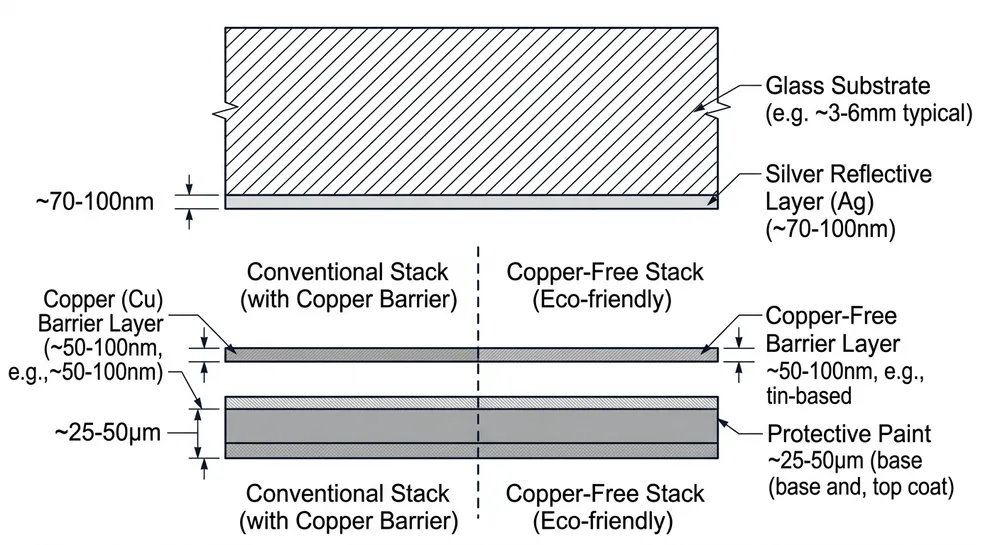
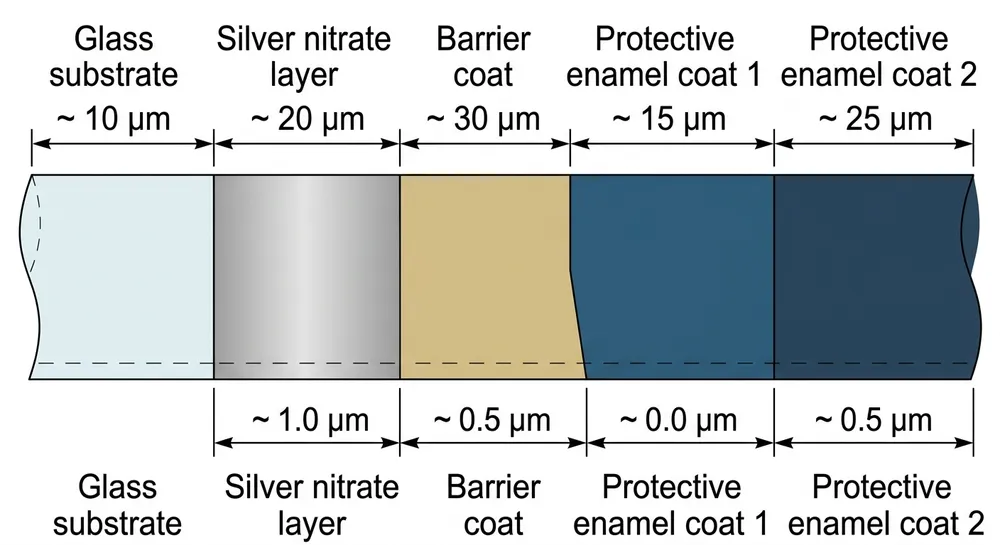
Cross-section diagram showing silver mirror coating layers including glass, silver layer, copper or copper-free barrier, and protective paint backing
Figure 1. The silver mirror coating stack. The barrier layer between the silver and the protective paint is where most oxidation failures originate — copper-based barriers corrode under humidity; copper-free alternatives use tin-palladium chemistry that holds significantly longer.

Why silver mirrors oxidize — the mechanism your supplier won't explain

The silver layer in a decorative mirror is thin. Typically 800–1,000 Å (angstroms) of electroless-deposited silver, sitting directly on the glass. That layer is chemically reactive — it doesn't corrode on its own under normal conditions, but expose it to moisture, sulfur compounds, or chloride ions and the degradation starts fast.

What protects the silver is the barrier layer applied on top of it before the paint backing goes on. This is where most coating failures originate, and it's where supplier specs diverge significantly.

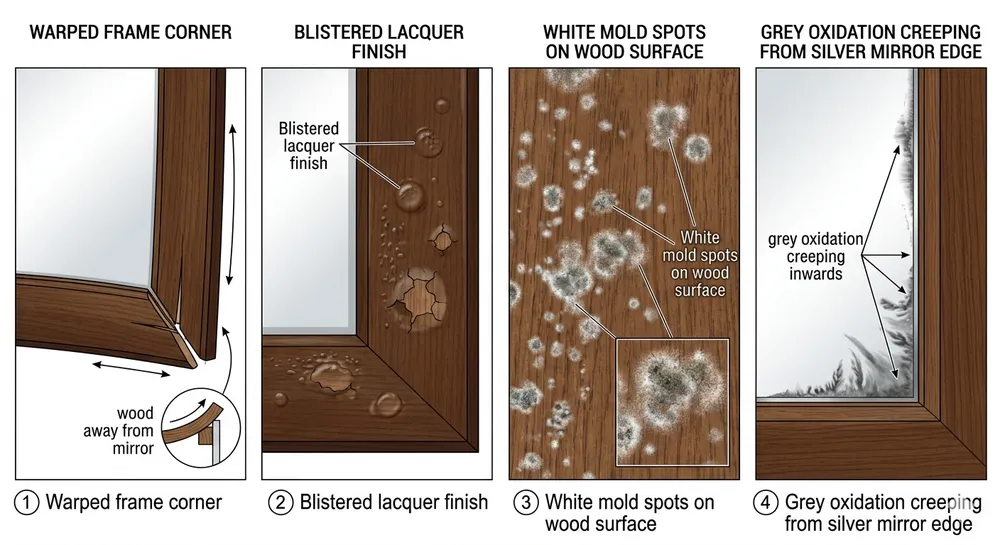
The traditional approach uses a copper barrier — a thin electroless copper deposit over the silver, then one or two coats of protective paint. Copper does provide some galvanic protection, but it has a problem: copper itself corrodes under sustained humidity, and when it does, it creates copper sulfate and copper chloride compounds that migrate laterally under the paint layer and attack the silver from the edges inward. That's the black-edge pattern you see on failed mirrors. It almost always starts at the cut edge, where the copper layer is exposed, and works its way toward the center.

Copper-free silvering replaces the copper barrier with a tin-palladium or organic inhibitor chemistry. There's no copper to corrode, so the lateral migration pathway doesn't exist. The silver layer is still vulnerable at the raw cut edge, but the failure mechanism is slower and more controllable. (We switched our standard production to copper-free silvering several years ago — the difference in long-term adhesion test results was significant enough that we stopped offering copper-backed mirrors as a default option.)

The paint backing matters too. Single-coat paint over copper is the cheapest spec and the most common source of field failures. Two-coat systems — a primer layer plus a topcoat — add meaningful protection, particularly at the edges. For export orders going to humid climates or long-term warehouse storage, two-coat is the minimum we'd recommend specifying.

Warehouse environment: the numbers that actually matter

Once the mirrors are in your facility, the coating is fixed — you can't change what your supplier applied. What you can control is the environment those mirrors sit in.

Silver mirror coatings are sensitive to two variables above everything else: relative humidity (RH) and temperature cycling. High RH accelerates the electrochemical reactions that degrade the silver layer. Temperature cycling — warm days, cool nights — causes condensation to form on mirror surfaces and inside packaging, which delivers moisture directly to the coating.

Practical benchmarks for silver mirror storage:

Parameter Target range Hard limit
Relative humidity 45–60% RH Do not exceed 70% RH
Temperature 15–28°C Avoid sustained temps above 35°C
Temperature swing (daily) < 8°C > 12°C swing risks condensation
Air circulation Moderate — no stagnant zones Avoid direct airflow onto mirror faces

A few things worth noting from experience:

Humidity above 70% RH sustained for more than two weeks is where we start seeing measurable coating degradation on standard copper-backed mirrors in accelerated testing. Copper-free mirrors hold longer, but they're not immune — at 85% RH, even well-specified copper-free coatings show edge effects after 4–6 weeks.

Temperature cycling is underestimated. A warehouse that runs 32°C during the day and drops to 20°C at night creates condensation inside the corrugated packaging. That moisture has nowhere to go. It sits against the mirror backing for hours. Over weeks, it works through the paint layer. We've traced several field failure clusters back to seasonal temperature swings in uninsulated warehouses, not to coating defects.

Direct floor storage is a common mistake. Concrete floors in humid climates wick moisture upward. Mirrors stored flat on pallets directly on concrete will show edge blackening faster than mirrors on racking, even in the same RH environment. Minimum 10 cm clearance from the floor, on racking or pallets with airflow underneath.
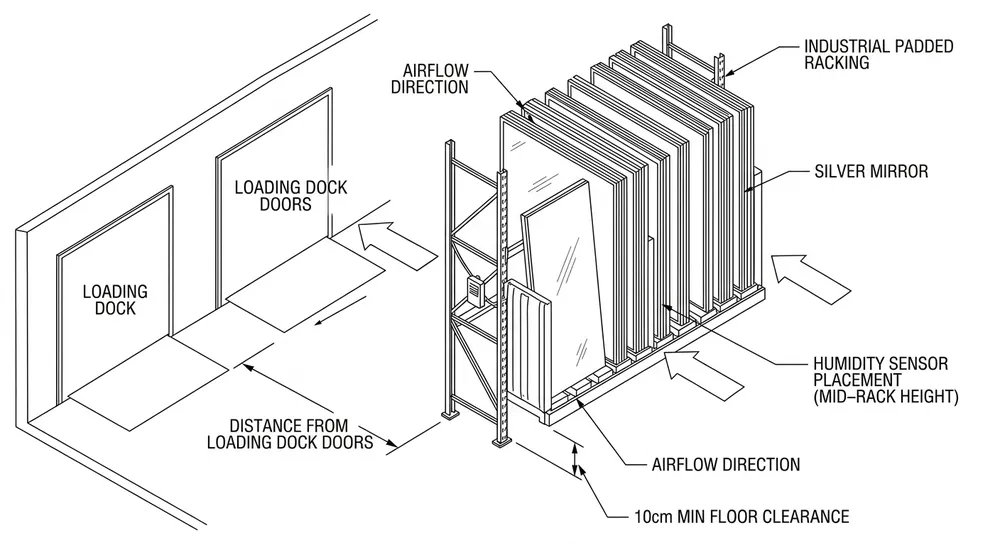
Warehouse racking diagram showing correct silver mirror storage orientation, pallet clearance from floor, and humidity monitoring placement
Figure 2. Correct warehouse storage setup for silver decor mirrors. Vertical orientation on padded racking, minimum 10 cm floor clearance, humidity monitors placed at mid-rack height away from loading doors.

Packaging specs that protect coating during ocean freight

The coating damage that shows up in your warehouse often started on the water. A 30-day ocean transit in a container that heats up to 55°C during the day and cools overnight is a condensation cycle running on repeat. If the packaging doesn't manage that moisture, the mirrors arrive already compromised — you just won't see it for another few weeks.

What to specify from your supplier:

Individual mirror wrapping: PE foam or EPE foam wrap, minimum 3 mm thickness, covering the full mirror face and backing. The foam acts as a moisture buffer and prevents the mirror surface from direct contact with corrugated board, which can transfer moisture and sulfur compounds from the cardboard itself. (Cardboard off-gassing is a real issue — sulfur compounds in recycled corrugated board are a documented cause of silver tarnishing in enclosed packaging.)

Silica gel desiccant: Each carton should contain desiccant rated for the carton volume. For a standard 60×80 cm mirror in a single-unit carton, 2×50g silica gel packets is a working minimum. For double-wall cartons with multiple units, scale accordingly. Specify indicating silica gel (color-change type) so you can check saturation status on arrival without opening every carton.

Edge protection: Cut edges are the most vulnerable point on any silver mirror. Foam corner guards or U-channel edge protectors on all four sides reduce mechanical impact risk and, more importantly, seal the exposed silver edge from direct humidity exposure during transit.

Carton sealing: All carton seams should be taped, not just the top flap. An unsealed bottom seam on a carton sitting in a humid container is an open moisture pathway.

For Silver Decor Mirrors going to high-humidity markets — Southeast Asia, the Gulf, coastal US distribution centers — we add a PE moisture barrier bag around the foam-wrapped mirror before it goes into the carton. It adds cost, but it eliminates the condensation cycle problem almost entirely.

Incoming QC checks for every silver mirror shipment

Don't wait for retail returns to find out your coating spec wasn't met. These checks take under five minutes per unit and will catch the most common failure patterns before the product goes into your inventory.

Visual edge inspection (100% of units, spot-check basis): Look at all four cut edges under good lighting. Healthy silver coating shows a clean, uniform silver-white edge. Early oxidation shows as gray or brown discoloration at the edge, sometimes with a slightly matte texture. Black edges are advanced oxidation — that product should not go to retail.

Tape adhesion test (sample 3–5% of units per shipment): Apply a 5 cm strip of standard 3M 610 tape (or equivalent) to the paint backing, press firmly, and pull at 90°. The paint and silver layer should remain fully adhered to the glass. Any lifting, flaking, or delamination indicates adhesion failure — either the paint spec is wrong, the surface prep was inadequate, or the coating was applied over contaminated glass. Reject the shipment lot and request factory QC documentation.

Humidity indicator check: If you specified indicating silica gel in the cartons, check the color on arrival. Saturated (pink/blue depending on type) desiccant in a sealed carton means the packaging was compromised during transit — either the carton was breached or the desiccant quantity was insufficient. Flag those units for priority inspection.

Corner and edge seal audit: Check that foam corner guards are intact and that the edge protection hasn't shifted during transit. Displaced corner guards mean the cut edge was exposed. Those units need closer visual inspection.
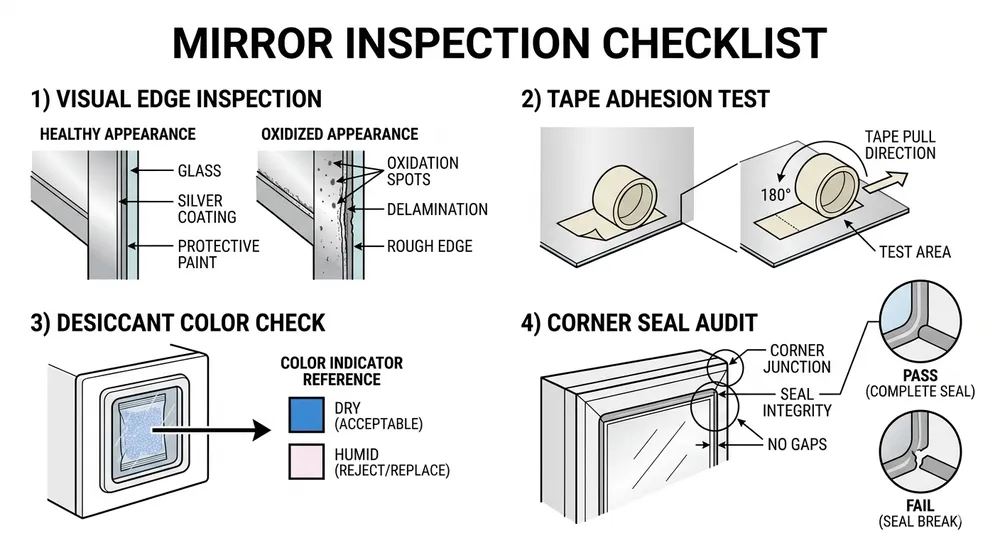
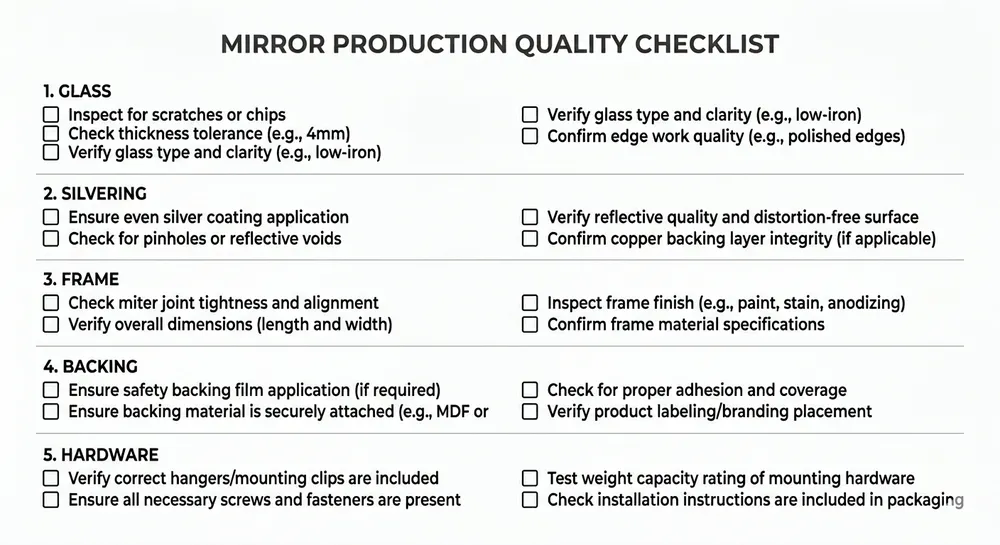
Incoming QC checklist for silver mirror shipments showing edge inspection, tape adhesion test, and desiccant check steps
Figure 3. Four-point incoming inspection protocol for silver mirror shipments. The tape adhesion test catches coating adhesion failures before product enters inventory; edge visual inspection identifies oxidation that started during transit.

What to specify when sourcing — the coating questions that matter

Most buyers ask about price and lead time. The buyers who avoid oxidation claims ask about coating specs. These are the questions worth putting in your sourcing inquiry or supplier audit:

1. Copper-free or copper-backed silvering? This is the single most important spec question. Copper-free silvering costs slightly more but eliminates the primary lateral oxidation pathway. For any order going into humid storage or high-humidity markets, specify copper-free. If a supplier can't confirm their silvering process type, that's a red flag.

2. How many paint coats on the backing? Single-coat is the minimum viable spec for dry, climate-controlled environments. Two-coat (primer + topcoat) is the correct spec for export. Ask for the paint system brand and DFT (dry film thickness) — a properly applied two-coat system should measure 80–120 μm total.

3. What accelerated corrosion testing do they run? EN 1036 (the European standard for silver mirrors) includes a damp heat test at 40°C / 95% RH for 168 hours. A supplier running this test on production batches and keeping records is a different category of supplier from one who doesn't. Ask for the test reports. (We run this test on every production batch at Livewellcraft — if a batch fails, it doesn't ship.)

4. What's the edge sealing process? Some manufacturers apply an additional edge sealant — typically a UV-cured or solvent-based lacquer — to the cut edges before packaging. This is particularly important for copper-free mirrors, where the cut edge is the main vulnerability. Ask whether edge sealing is standard or optional, and specify it for export orders.

5. Can they provide SGS or third-party coating test reports? Factory self-testing is useful. Third-party verification is better. For large orders or new supplier relationships, request SGS or equivalent lab reports on silver adhesion and corrosion resistance.

Our copper-free silvering process is standard on all Livewellcraft export orders, with two-coat paint backing and optional edge lacquer sealing for high-humidity destinations. We keep EN 1036 damp heat test records by production batch — available on request for any order.

The full prevention chain, summarized

Oxidation prevention isn't one fix. It's four control points working together:

  1. Factory coating spec — copper-free silvering, two-coat paint backing, edge sealing for humid markets
  2. Export packaging — PE foam wrap, adequate desiccant, edge protection, sealed cartons
  3. Transit conditions — moisture barrier bags for high-humidity routes, proper container loading to minimize temperature cycling
  4. Warehouse environment — RH held below 60%, temperature swings under 8°C daily, mirrors on racking with floor clearance, no direct floor storage

Miss any one of these and the others can't fully compensate. A well-coated mirror in bad packaging will still fail. A well-packaged mirror in a 75% RH warehouse will still fail. The chain has to hold end to end.

If you're sourcing decorative mirrors by material and frame type and want to verify your current supplier's coating spec, the incoming QC checks above are a practical starting point. If you're evaluating new suppliers, the five specification questions in the previous section will tell you quickly whether a factory understands their own coating process.

For orders where oxidation risk is a real concern — coastal markets, humid distribution environments, long shelf-life retail programs — share your warehouse conditions and target market with us. We'll recommend the right coating configuration and packaging spec for your situation. Request a quote and our engineering team will follow up with specifics.

FAQ

Does copper-free silvering affect reflectivity or visual quality? No. The copper layer in traditional silvering is a barrier coat, not part of the reflective surface. The silver layer itself provides the reflection, and copper-free chemistry doesn't change the silver deposition process. Reflectivity, clarity, and color rendering are identical between copper-backed and copper-free mirrors. The difference is entirely in long-term corrosion resistance.

What RH level is safe for long-term silver mirror storage? Below 60% RH is the practical target for standard copper-free mirrors with two-coat backing. Below 50% RH is better if you're storing product for more than six months before retail. Above 70% RH sustained, even well-specified mirrors will show edge effects within weeks to months depending on packaging quality. If your warehouse runs above 65% RH regularly, invest in dehumidification before the product arrives — retrofitting storage conditions after you have a claim is more expensive.

How do I tell if edge blackening is a coating defect or a storage problem? Coating defects typically appear within the first 30–60 days and affect multiple units from the same production batch in a consistent pattern — same location, same progression. Storage-related oxidation tends to appear later (3–6 months), affects units unevenly based on their position in the warehouse (units near loading doors or on lower shelves fail first), and correlates with seasonal humidity changes. If you're seeing early, batch-consistent failures, push back on the supplier's coating QC. If you're seeing late, position-dependent failures, look at your warehouse environment first.

Is EN 1036 the right standard to reference when specifying silver mirrors? EN 1036 is the European standard for float glass mirrors and includes the damp heat corrosion test most relevant to silver coating durability. It's a reasonable reference standard for any export market. For North American buyers, ASTM C1503 covers silvered flat glass mirrors. Both standards include accelerated corrosion testing — either is a valid basis for supplier qualification. Specifying one of these in your purchase order gives you a documented basis for rejection if the product fails on arrival.

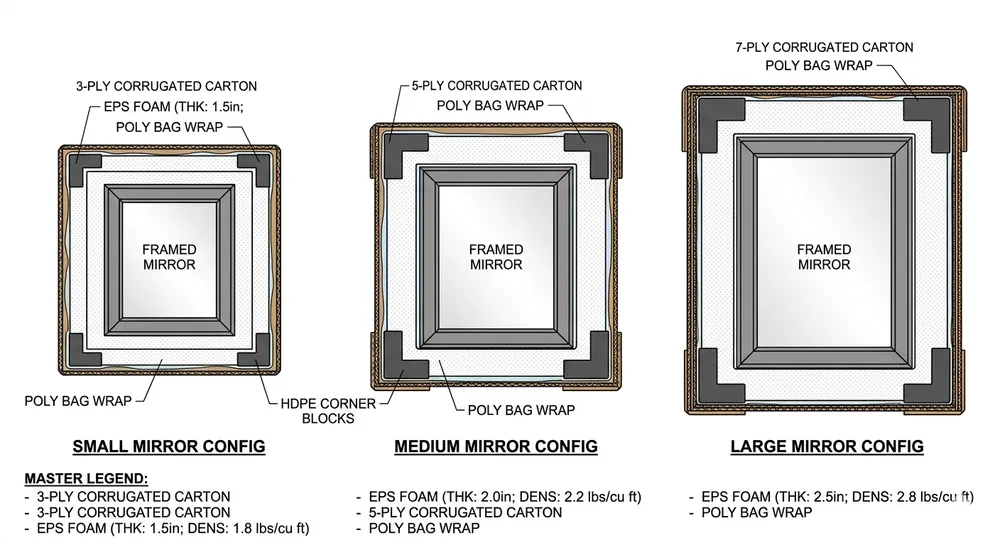
How to Package Wall Decor Mirrors for Safe Container Shipping — Breakage Prevention for Bulk Orders

A container of 2,000 framed mirrors lands at your warehouse. Your receiving team opens the first pallet and finds corner chips, cracked glass, and frame joints that separated somewhere in the Pacific. The claim process takes six weeks. Your customer's launch date has passed. The replacement order costs you the margin on the original.

We've been shipping mirrors since 2008 — roughly 400,000 pieces a year to North America, Europe, Australia, and the Middle East. Early on, we had breakage rates that would make any buyer nervous. We've since brought that number below 0.5% on standard ocean freight runs, and the fix wasn't one thing. It was a packaging system built around how mirrors actually fail in transit.

This guide covers that system: the materials, the specs, the frame-specific adjustments, and the container loading logic. If you're qualifying a mirror supplier or reviewing your current packaging spec, this is what to check.

The Three Ways Mirrors Break in Transit — and Why Generic Fragile-Item Guides Miss Them

Most shipping guides treat glass as glass. Framed decorative mirrors have three distinct failure modes, and each one requires a different packaging response.

Impact shock is the obvious one — a carton dropped during port handling or forklift transfer. The glass fractures, or the frame corner takes a direct hit and the joint cracks. This is what corner protectors and foam density are designed to absorb.

Vibration fatigue is less obvious but accounts for a significant share of the damage we see on long-haul ocean routes. A 40-foot container on a vessel vibrates continuously for 20–30 days. If the mirror isn't immobilized inside the carton — meaning it can shift even 2–3mm — the frame corners work against the carton walls repeatedly. Wood frame joints loosen. Resin corners develop hairline cracks. The glass doesn't shatter; it arrives with edge chips that only show up under inspection lighting.

Moisture and condensation is the failure mode almost no packaging guide addresses for mirrors specifically. A sealed container moving from a humid port (Ho Chi Minh City, Guangzhou) to a cold destination (Rotterdam in January, Chicago in February) experiences significant internal temperature swings. Condensation forms on glass surfaces and inside carton walls. For mirrors, this matters beyond the obvious rust risk on metal frames — moisture that reaches the silver coating causes edge blackening and delamination. We've seen containers arrive with structurally intact mirrors that failed QC because the silver had started lifting at the edges. (This is one reason we switched to copper-free silvering — it's more resistant to moisture-driven edge oxidation, which reduces coating claims independent of physical breakage.)

Diagram showing three mirror transit failure modes — impact shock, vibration fatigue, and moisture condensation — with packaging response for each

Packaging Bill of Materials by Mirror Size Bracket

The right spec depends on mirror size. We use three brackets internally, and the material requirements step up meaningfully between them.

Under 60cm (smallest dimension)

These are your accent mirrors, small decorative rounds, and compact rectangular frames. They're light enough that impact shock is the primary risk — vibration fatigue is less of a concern because the mass is low.

Component Spec
Inner foam 20–25 kg/m³ EPE, 20mm each side
Corner protectors Molded EPE or cardboard tri-corner, 50mm leg
Carton B-flute double wall, 3-ply minimum
Poly bag 0.05mm PE, sealed
Desiccant 1× silica gel sachet (5g) per carton

At this size, we typically pack 2–4 units per master carton depending on frame depth, with a cardboard divider between units. The divider matters — without it, units shift against each other and the frame corners do the damage.

60–100cm (longest dimension)

This is the highest-volume bracket for most of our wholesale buyers — standard rectangular wall mirrors, arched frames, and mid-size decorative pieces. Both impact and vibration are real risks here.

Component Spec
Inner foam 25–30 kg/m³ EPE, 30mm each side
Corner protectors Molded EPE corner cap, 80mm leg minimum
Carton BC-flute double wall, 5-ply
Frame face protection 3mm foam sheet over mirror face, taped
Poly bag 0.06mm PE, heat-sealed
Desiccant 2× silica gel sachets (10g each) per carton

Individual cartons at this size. No multi-pack. The carton wall needs to be strong enough to take a stacking load of 6–8 cartons without compressing the foam insert — BC-flute handles this; B-flute alone doesn't.

Over 100cm (longest dimension)

Large format mirrors — full-length floor mirrors, oversized decorative pieces, large arch frames. These are the highest-risk units in any container. The glass area is large, the frame is heavy, and the leverage on corner joints during vibration is significant.

Component Spec
Inner foam 30–35 kg/m³ EPE or PE foam, 40mm each side
Corner protectors Rigid EPE or expanded polystyrene (EPS) corner block, 100mm leg
Carton BC-flute or EB-flute double wall, 5-ply, reinforced with H-tape on all edges
Frame face protection 5mm foam sheet + cardboard overlay on mirror face
Poly bag 0.08mm PE, heat-sealed
Desiccant 4× silica gel sachets (10g each) per carton
Strapping PP strap, 2 bands per carton

At this size, we also add a foam plug between the mirror back and the carton rear wall. Large mirrors flex slightly under vibration — the rear plug prevents the back of the frame from repeatedly contacting the carton wall and wearing through.

Cross-section diagram of wall mirror packaging layers for three size brackets — under 60cm, 60-100cm, and over 100cm — showing foam thickness, corner protector placement, and carton grade

Step-by-Step Packing Sequence from Assembly Line to Sealed Carton

The sequence matters as much as the materials. We've seen buyers source the right foam and the right carton and still get damage because the assembly order was wrong — foam inserted after the mirror instead of the mirror placed into pre-cut foam, for example, which leaves gaps at the corners.

1. Pre-cut foam inserts to mirror dimensions Foam should be cut to fit the specific mirror SKU, not trimmed on the line. A 5mm gap between the foam edge and the mirror frame is the maximum tolerance. More than that and the mirror can shift under vibration.

2. Poly bag first Wrap the mirror in the poly bag before it goes into foam. The bag is a moisture barrier, not a scratch protector — it needs to be sealed before the mirror contacts any foam surface. Foam is slightly hygroscopic; an unsealed bag lets moisture wick through.

3. Place mirror face-down into bottom foam half Face down means the mirror glass is against the foam, not the frame back. The glass surface is the most vulnerable to contact damage. The foam face layer should be the higher-density piece.

4. Add face foam sheet For the 60–100cm and over-100cm brackets, lay the foam sheet over the mirror back before placing the top foam half. This prevents the frame hardware (D-rings, wire, wall brackets) from pressing into the carton top under stacking load.

5. Set corner protectors Corner protectors go on after the foam halves are in place, not before. They should grip the foam corners firmly — if they're loose, they'll migrate during transit and leave the actual frame corners unprotected.

6. Close and tape carton H-tape pattern on top and bottom flaps. Single-line center tape is not sufficient for mirrors over 60cm — the flap gap is a weak point under drop impact. For large-format mirrors, add edge tape on all four vertical seams.

7. Place desiccant sachets Inside the carton, not inside the poly bag. The sachets absorb moisture from the carton interior air space. Placing them inside the sealed poly bag does nothing.

8. Label and orient arrow "This Side Up" and fragile arrows on all four vertical faces. This sounds obvious, but we've seen containers where cartons were loaded on their sides because the loading crew couldn't read the label language. Use pictogram arrows, not text-only labels.

Frame-Specific Packaging Adjustments

The frame material changes the failure risk profile, which changes the packaging priority. This is the section most generic shipping guides skip entirely.

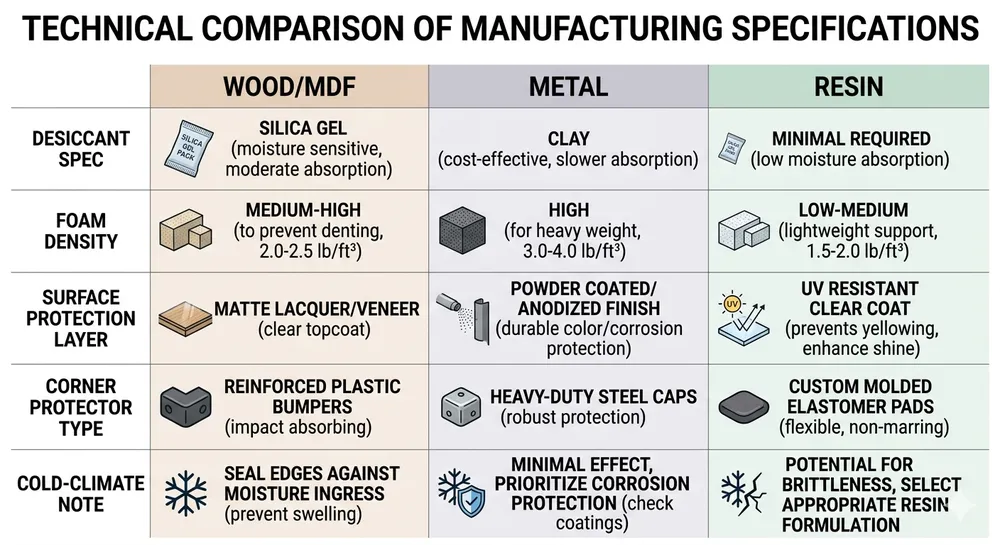
Wood and MDF frames

Wood frames are the most forgiving under impact but the most vulnerable to moisture. MDF in particular absorbs humidity and swells — a frame that fits perfectly in the carton at origin can be tight enough to stress the glass by the time it reaches a humid port.

Adjustments:

  • Increase desiccant load by 50% vs. the standard spec for the size bracket
  • Ensure the poly bag seal is heat-sealed, not just folded — MDF moisture absorption happens through the carton wall and the bag is the last line of defense
  • For painted wood frames, add a thin tissue paper layer between the foam face and the frame surface — foam can leave pressure marks on soft paint finishes over 30-day voyages

If you're sourcing wood-frame mirrors and your supplier isn't specifying desiccant quantity by frame material, that's a gap worth flagging. See our notes on choosing decor mirror frame materials for more on how wood species and MDF grade affect moisture sensitivity.

Metal frames (powder coat and electroplate)

Metal frames are the most impact-resistant but the most vulnerable to surface contact damage. Powder coat scratches against foam under vibration if the foam density is too low — the foam surface abrades the coating rather than cushioning it.

Adjustments:

  • Minimum 25 kg/m³ foam on all contact surfaces — softer foam compresses and allows micro-movement
  • For electroplated finishes (chrome, gold, antique brass), add a non-woven fabric layer between the foam and the frame surface — electroplate is thinner than powder coat and scratches more easily
  • Corner protectors must be rigid enough that they don't compress under stacking load — for metal frames, EPS blocks outperform molded EPE at the corners

Resin and composite frames

Resin frames are brittle at low temperatures. A container moving through northern European ports in winter can see internal temperatures drop below 5°C, and resin becomes significantly more impact-sensitive at that range.

Adjustments:

  • Increase corner protector leg length by 20mm vs. standard spec — the extra standoff distance absorbs more of the impact energy before it reaches the frame corner
  • For intricate resin profiles (carved details, ornate moldings), wrap the frame perimeter in bubble wrap before the poly bag — the carved details are stress concentration points under vibration
  • Note the destination climate in your packaging spec. A resin mirror going to Dubai in August has a different risk profile than the same mirror going to Oslo in December.

(We've had buyers ask why we specify different packaging for the same SKU going to different markets. This is why — the frame material and the destination climate together determine the real risk, not just the mirror size.)

Table comparing packaging adjustments for wood, metal, and resin mirror frames — showing desiccant, foam density, and surface protection differences

Container Loading Plan: Pallet Configuration and Stacking Limits

Getting the carton spec right and then loading the container wrong is a common failure point. We've seen well-packaged mirrors arrive damaged because the loading pattern put too much stacking weight on bottom cartons, or because cartons were loaded horizontally when the foam insert was designed for vertical orientation.

Pallet configuration

Standard export pallet: 1,100mm × 1,100mm (EUR pallet) or 1,200mm × 1,000mm depending on destination market. We use 4-way entry pallets for all mirror shipments — 2-way entry limits forklift access at destination warehouses and increases the risk of carton damage during unloading.

Carton orientation on pallet: always vertical, with the "This Side Up" face matching the pallet top. Mirrors should never be palletized on their face or back — the foam insert is designed to support the mirror in vertical orientation, and horizontal loading transfers the stacking load to the glass surface rather than the frame perimeter.

Pallet wrap: stretch film, minimum 4 passes, with a cardboard top cap before wrapping. The top cap distributes the stretch film tension evenly — without it, the film pulls the top cartons inward and can compress corner protectors.

Stacking limits by size bracket

Mirror size Max cartons per pallet column Max pallet height Notes
Under 60cm 8 cartons 1,600mm 2 columns per pallet typical
60–100cm 5 cartons 1,400mm 1 column per pallet for large frames
Over 100cm 3 cartons 1,200mm Single column, no cross-stacking

These limits account for the carton compression strength at the bottom of the stack. BC-flute cartons have a box compression test (BCT) rating of approximately 800–1,200N depending on carton dimensions — at 5 cartons high for the 60–100cm bracket, the bottom carton is carrying roughly 60–80% of its BCT rating, which is the safe working range. Stack higher and you're compressing the foam insert, which defeats the cushioning.

20ft vs. 40ft container loading

For a 20ft container (internal volume approximately 33 CBM usable), a typical load of 60–100cm framed mirrors on standard pallets runs 400–600 units depending on frame depth. For a 40ft container (approximately 67 CBM usable), 900–1,400 units in the same size bracket.

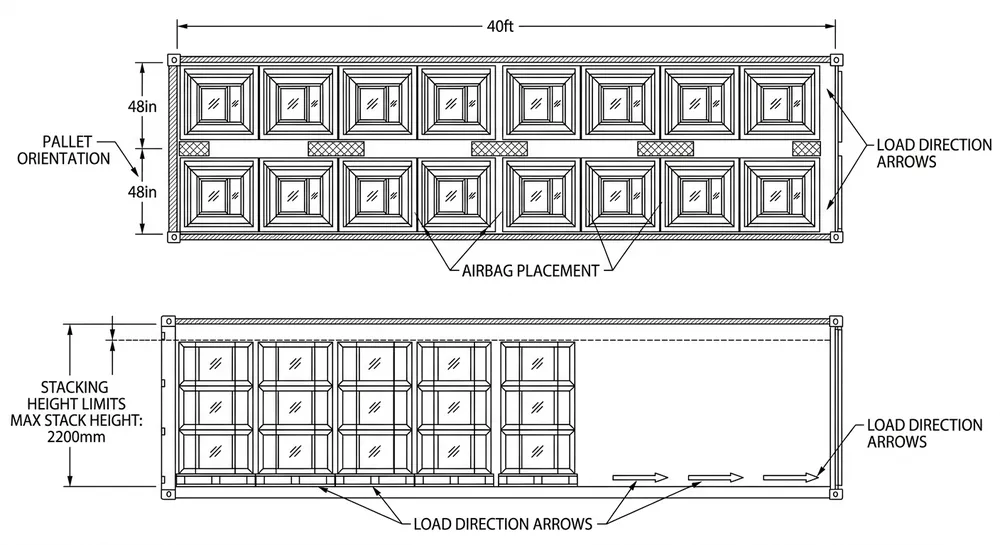
Dunnage placement: airbags between pallet rows, not between individual cartons. Airbags at 80–90% inflation — over-inflated airbags exert lateral pressure on cartons and can compress corner protectors. Leave 50–80mm between pallet rows for airbag placement; tighter than that and the airbags can't do their job.

For mixed-SKU containers (multiple mirror sizes in one load), load heaviest/largest pallets against the container walls and lighter pallets in the center. Never stack a large-format mirror pallet on top of a small-mirror pallet — the weight distribution is wrong and the large cartons overhang the small ones.

Container loading diagram for framed wall mirrors showing pallet orientation, stacking rows, and airbag dunnage placement in a 40ft container

Humidity and Condensation Control for Long-Haul Ocean Freight

This section is worth reading carefully if your mirrors are moving on routes with significant temperature differentials — Asia to Northern Europe, Asia to the US East Coast in winter, or any route that passes through the tropics.

A sealed 40ft container is not a stable environment. The steel walls conduct temperature changes rapidly, and the air inside cycles through condensation and evaporation as the container moves through different climate zones. This is sometimes called "container rain" — moisture that condenses on the container ceiling and drips onto cargo. It's more common than most buyers realize, and it's not covered by standard marine insurance unless you can prove the container was defective.

Desiccant sizing for ocean freight

The standard silica gel sachets we specify per carton handle moisture at the individual unit level. For full-container loads on long-haul routes (over 20 days), you also need container-level desiccant.

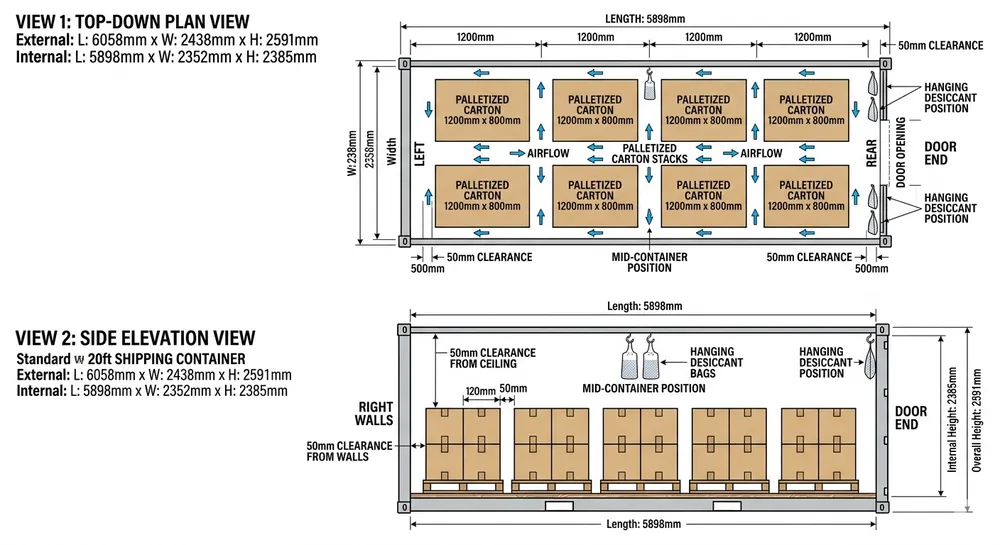
Container desiccant strips (calcium chloride, 1kg absorption capacity per strip) should be hung from the container ceiling rails — typically 4–6 strips for a 40ft container on a 25–30 day route. These absorb the bulk moisture before it can condense on carton surfaces. The per-carton silica gel handles residual moisture that gets through.

For routes under 15 days, container-level desiccant is optional. For routes over 20 days, it's not optional — it's the difference between a clean container and a container with water-stained cartons and silver edge damage.

Vapor barrier liner

For high-value mirror shipments or routes with extreme temperature differentials, a container liner (polyethylene vapor barrier, 0.1mm minimum) inside the container walls adds another layer of protection. This is more common on electronics shipments but we've used it on large-format mirror orders going to Scandinavian markets in winter. The liner cost is roughly $80–120 per 40ft container — on a 1,000-unit order of large mirrors, that's under $0.15 per unit.

Ventilation vs. sealing

Standard shipping containers have ventilation plugs. For mirror shipments, seal them. Ventilation that makes sense for dry goods (it prevents moisture buildup from the cargo itself) works against you for mirrors — it lets humid port air in during loading and unloading at intermediate stops. Sealed containers with proper desiccant loading outperform ventilated containers on mirror shipments consistently.

For more on how moisture affects specific frame materials in transit, see our guide on wood mirror moisture protection.

Packaging Cost Structure: What the Spec Actually Costs Per Unit

Most buyers don't get a packaging cost breakdown from their supplier — it's buried in the unit price. Here's what the materials actually cost at different order volumes, so you can evaluate whether your current supplier is speccing the right materials or cutting corners to hit a price point.

These are approximate material costs at the factory level (Vietnam sourcing, 2024–2025 pricing):

Under 60cm mirrors

Order volume Packaging cost per unit Notes
1,000 pcs $0.85–$1.10 Standard B-flute, EPE foam, basic corner caps
5,000 pcs $0.65–$0.85 Volume discount on carton and foam
20,000 pcs $0.45–$0.60 Custom-cut foam inserts, optimized carton sizing

60–100cm mirrors

Order volume Packaging cost per unit Notes
1,000 pcs $1.40–$1.80 BC-flute, 30mm EPE, molded corner caps
5,000 pcs $1.10–$1.40 Volume pricing on foam and carton
20,000 pcs $0.80–$1.05 Custom tooled foam inserts, optimized carton

Over 100cm mirrors

Order volume Packaging cost per unit Notes
1,000 pcs $2.20–$2.80 BC/EB-flute, 40mm EPE, EPS corner blocks, PP strap
5,000 pcs $1.70–$2.20 Volume pricing, custom foam
20,000 pcs $1.30–$1.60 Full custom tooling, optimized for container density

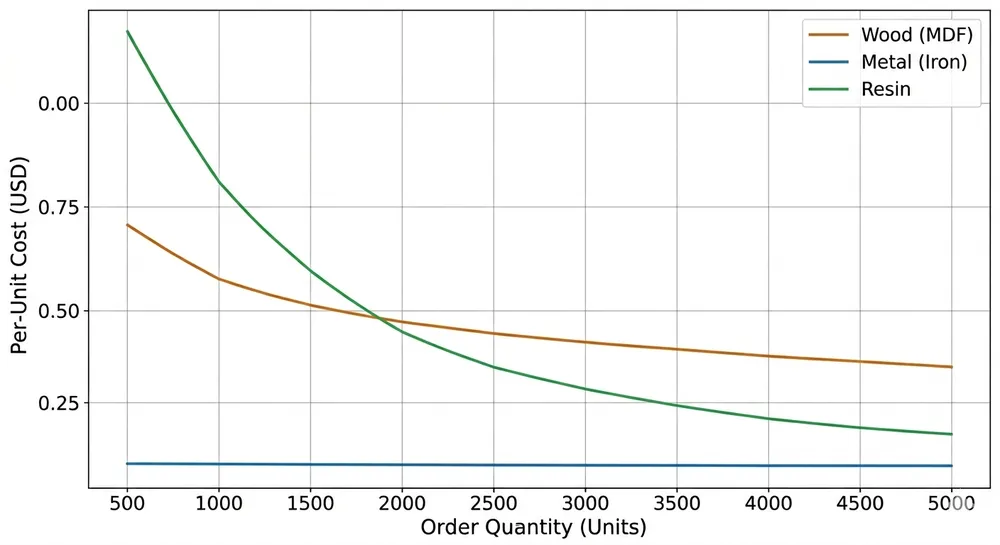
If your supplier is quoting packaging costs significantly below these ranges, ask specifically what foam density they're using and what carton flute grade. The two most common cost-cutting moves are dropping from 25 kg/m³ foam to 15 kg/m³ (which looks identical but compresses under vibration) and switching from BC-flute to B-flute on medium-size mirrors. Both save $0.20–$0.40 per unit and both show up as damage claims.

(We've had buyers come to us after a bad container from another supplier. In most cases, the packaging looked fine on paper — the problem was foam density that wasn't specified in the PO and wasn't tested before shipment.)

Retail-Ready vs. Bulk-Pallet Packaging Configurations

If your mirrors are going into a retail program — Walmart, Wayfair, Amazon, or a regional chain — the packaging spec has requirements beyond breakage prevention. Retail compliance adds cost and complexity, and it's worth understanding the difference before you finalize your PO.

Bulk-pallet configuration

Standard export packaging as described above. Cartons are plain brown with product labels. No retail barcode placement requirements. No specific carton dimension constraints beyond container optimization. This is the right configuration for distribution centers that repack for retail, for hospitality project buyers, and for wholesale buyers who sell to their own retail customers.

Retail-ready configuration

Retail programs add several requirements on top of the base packaging spec:

Carton dimensions: Walmart and major retailers specify carton dimensions that fit their shelf and pallet systems. This sometimes means a less container-efficient carton size — you may lose 5–8% container utilization compared to a dimension-optimized bulk carton.

Barcode placement: GS1-128 shipping label placement is specified to the millimeter on some programs. The label must be scannable from the pallet without breaking the stretch wrap — which means it goes on the carton face that will be outward-facing on the pallet, and the pallet loading pattern has to be consistent.

Master carton weight limits: Most retail programs cap master carton weight at 20–25kg for ergonomic handling. For large mirrors, this sometimes means one unit per carton even when two would fit — which increases packaging cost per unit.

Inner pack requirements: Some programs require inner packaging that allows the end consumer to open the carton without tools and find the product in retail-ready condition. For mirrors, this typically means a foam insert that doubles as display packaging, which adds $0.30–$0.60 per unit.

We've been supplying Walmart, Wayfair, and Amazon programs since 2015, and the compliance requirements have gotten more specific over time, not less. If you're entering a new retail program, share the routing guide with your supplier before finalizing the packaging spec — retrofitting compliance requirements after the first container is expensive.

For a broader look at our Wall Decor Mirrors range and how different frame types perform in retail programs, that page covers the product specs in detail.

Common Packaging Failures and How to Catch Them Before Shipment

These are the failures we see most often when buyers come to us after a bad container from another supplier. Most of them are detectable before the container loads — if you know what to check.

Wrong foam density, correct foam thickness The carton looks right. The foam is the right thickness. But the density is 15 kg/m³ instead of 25 kg/m³. You can't tell by looking. The test: press your thumb firmly into the foam. At 15 kg/m³, it compresses easily and slowly recovers. At 25 kg/m³, it resists and recovers quickly. Ask your supplier for the foam density spec in writing and request a material certificate from the foam supplier.

Corner protectors that don't reach the frame corner Molded EPE corner caps that are sized for a smaller mirror get used on a larger one because the supplier ran out of the right size. The cap sits on the carton corner but doesn't actually contact the frame corner — it's decorative, not protective. Check by pulling the corner cap slightly outward after the carton is packed. It should be snug against the frame corner, not loose.

Unsealed poly bags The bag is there but the seal is folded, not heat-sealed. Moisture gets in during the voyage. Check the seal on a sample carton before the container loads — a heat seal has a visible weld line; a folded seal doesn't.

Insufficient desiccant for route length A 5g silica gel sachet is appropriate for a 7-day regional shipment. It's not appropriate for a 28-day trans-Pacific voyage. Ask your supplier what desiccant spec they're using and match it to your actual route length.

Cartons loaded horizontally Happens at the container loading stage, not the packing stage. The foam insert is designed for vertical orientation. A carton loaded on its side puts the stacking load on the foam face layer instead of the carton walls — the foam compresses and the mirror shifts. Specify vertical loading in your packing instructions and confirm with loading photos before the container seals.

For a full overview of how frame material affects both packaging requirements and long-term durability, the Decor Mirrors by Material & Frame category page covers the material comparison in detail.

Packaging Qualification Checklist for Supplier Evaluation

When you're qualifying a new mirror supplier, these are the packaging questions worth asking before you place a trial order. A supplier who can answer these specifically is running a real packaging program; one who gives vague answers is probably using whatever materials are cheapest that week.

  • What foam density (kg/m³) do you use for mirrors in the 60–100cm bracket?
  • What carton flute grade do you use for individual mirror cartons?
  • How do you size foam inserts — custom-cut per SKU or standard sizes?
  • What desiccant quantity do you include per carton, and how do you adjust for route length?
  • Do you use container-level desiccant on long-haul ocean routes?
  • What is your current breakage rate on ocean freight shipments?
  • Can you provide a packaging spec sheet with material certifications?
  • Do you have retail compliance packaging capability (Walmart, Wayfair, Amazon)?

A supplier who packages 400,000 mirrors a year has answers to all of these. A supplier who doesn't package at scale is figuring it out on your order.

If you're ready to review packaging specs for a specific order, send your mirror dimensions, frame material, destination market, and order volume to Request Quote — we'll return a packaging spec sheet with per-unit cost and a container loading plan.

Framed vs Frameless Decor Mirrors — Which Option Fits Your Retail Program

The question lands in my inbox every week: "Should we go framed or frameless?" Usually it comes from a buyer who's already seen both options at a trade show, has a rough price target, and needs to commit to a container. The answer isn't about aesthetics — it's about what each mirror type costs you across the full supply chain, and which one your end market will actually pay for.

Here's the short version: framed mirrors give you more retail margin headroom and stronger visual differentiation, but they cost more to ship and carry higher breakage risk in transit. Frameless beveled mirrors are leaner on freight and simpler to produce, but they compete on price and leave you less room to move on margin. The right call depends on your price tier, your freight lane, and how much SKU complexity you can manage.

The rest of this article breaks down exactly why — with the production and logistics numbers behind each option.

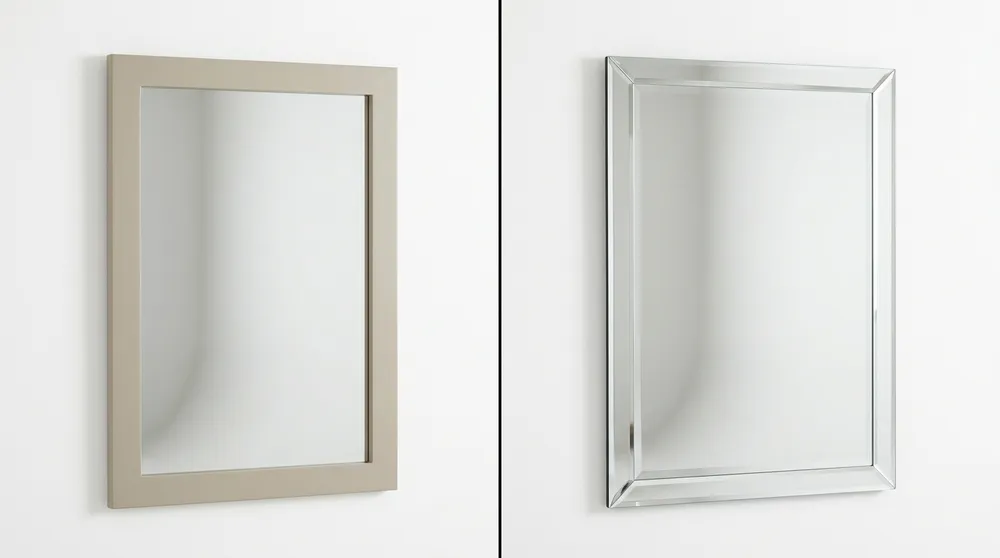
Side-by-side comparison of a framed decorative wall mirror with MDF frame and a frameless beveled edge mirror

What You're Actually Buying: Construction Differences That Drive Cost

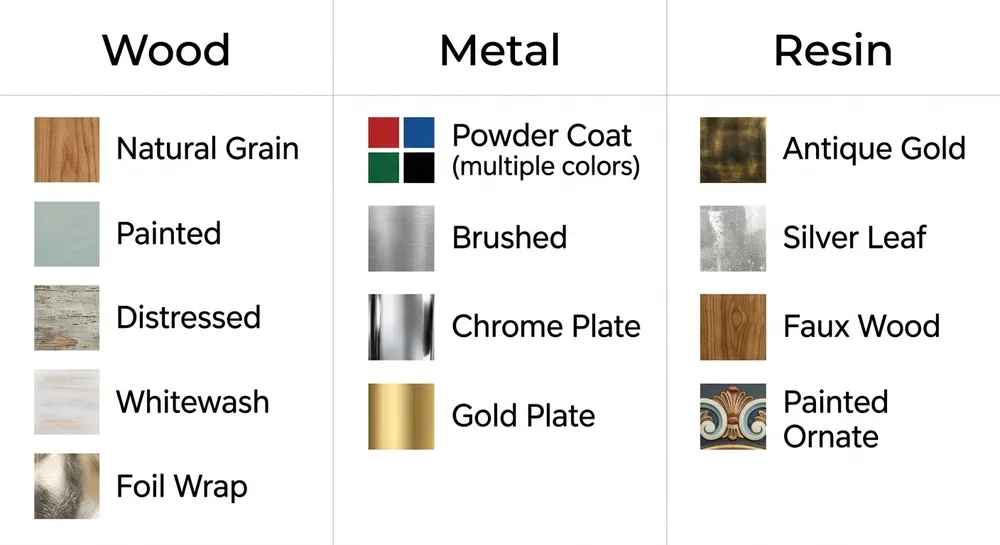
A framed mirror is a glass panel — cut, silvered, and backed — mounted inside or behind a frame profile. The frame is a separate manufactured component: MDF, solid wood, metal tube, or cast resin, finished with paint, foil wrap, powder coat, or electroplate. Assembly adds a step. Packaging adds volume. The frame is where most of the cost variation lives.

A frameless mirror is the glass itself, edge-treated and ready to hang. The standard finish is a beveled edge — typically a 1-inch bevel ground and polished around the perimeter. Some frameless mirrors use a flat polished edge or a seamed edge for lower price points. No frame component, no assembly step, no frame finishing line.

From a production standpoint, frameless mirrors are simpler. We run glass cutting, silvering, and edge processing on a single flow. Framed mirrors require frame fabrication, finishing, and assembly as separate operations — which is why lead times on custom framed profiles run longer than standard frameless SKUs. (On our standard frameless beveled range, we can typically confirm production within 3–5 business days of order. Custom frame profiles need 7–10 days just for frame tooling sign-off before glass production starts.)

The cost difference isn't just the frame material. It's the labor, the finishing line time, the assembly station, and the additional packaging required to protect the frame in transit.

Unit Cost Drivers: Where the Money Goes in Each Option

Cost Component Framed Mirror Frameless Beveled Mirror
Glass processing Same Same
Frame material MDF / wood / metal / resin None
Frame finishing Paint, foil, powder coat, electroplate None
Assembly labor Required None
Edge treatment Basic seam or none Bevel grinding + polishing
Packaging complexity Higher (frame protection) Lower
Carton volume per unit Higher Lower

The bevel on a frameless mirror isn't free — grinding and polishing a clean 1-inch bevel on a 24×36-inch glass panel adds cost relative to a plain seamed edge. But it's still significantly less than sourcing, finishing, and assembling even a basic MDF frame.

Where framed mirrors earn back their cost premium is at retail. A well-finished frame — especially in metal or solid wood — supports a retail price point that a frameless mirror simply can't reach. We've shipped framed mirrors to North American retailers at FOB prices that support $79–$149 retail, while comparable-size frameless beveled mirrors typically land in the $29–$59 retail range. The margin math works differently at each tier.

Freight and Packaging: The Hidden Cost Most Buyers Underestimate

This is where framed mirrors quietly eat into your landed cost, and where a lot of buyers get surprised on their first container.

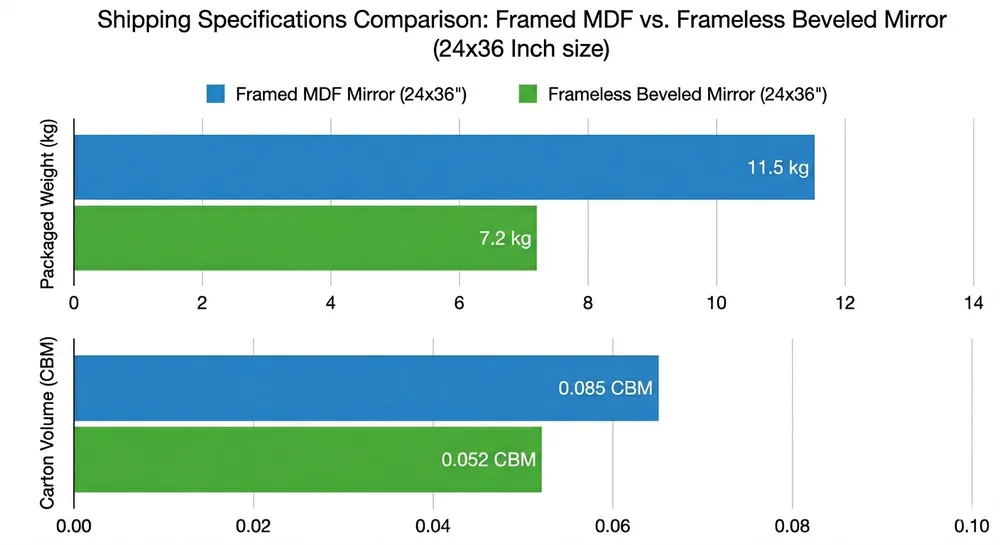
A framed mirror in an MDF frame is heavier than the equivalent frameless mirror — sometimes significantly. A 24×36-inch mirror with a 2.5-inch MDF frame profile can weigh 8–10 kg packaged. The same glass in frameless format runs 4–5 kg. On a 40-foot container, that weight difference compounds across hundreds of units.

Carton dimensions matter just as much as weight. Framed mirrors require corner protection, foam inserts around the frame profile, and often a larger carton footprint to prevent frame-to-glass pressure in transit. Frameless mirrors pack tighter — flat glass with edge protection, smaller carton, better cube utilization in the container.

Bar chart comparing average packaged weight and carton volume per unit for framed vs frameless decorative mirrors

Breakage risk is the other freight variable. Frame profiles — especially MDF with painted or foil-wrapped finishes — are vulnerable to corner impact damage. A corner hit that would leave a frameless mirror intact (glass protected by foam, no protruding frame) can crack an MDF corner joint and delaminate the finish. We've seen damage claims on framed mirrors run 2–3× higher than frameless on the same freight lane when packaging specs aren't tight.

We address this with reinforced corner inserts and double-wall cartons on all framed mirror shipments, but it adds packaging cost. Buyers sourcing framed mirrors from factories that cut corners on packaging — and some do — absorb that damage rate as claims or markdowns. (Ask your supplier specifically how they protect frame corners in transit. If the answer is "foam wrap," push for corner molded inserts. The difference in damage rate is real.)

For buyers shipping to Australia or the Middle East — longer ocean transit, more port handling — the packaging spec on framed mirrors matters even more. We adjust our carton specs by destination lane for this reason.

Retail Positioning: Which Mirror Type Fits Which Price Tier

Frameless beveled mirrors are a commodity at the mid-to-low retail tier. They're clean, versatile, and easy to merchandise, but they don't give your buyer a reason to pay more. The bevel is the only design element, and every supplier offers it. If your retail program is competing on price in the $25–$60 range, frameless works — but your margin is thin and your differentiation is minimal.

Framed mirrors open up the retail price ladder. The frame is the design story: finish, profile shape, color, material texture. A black metal frame reads contemporary. A distressed wood frame reads farmhouse. A resin frame with antique gold finish reads traditional. Each of those positions a different SKU at a different price point, and each gives your retail buyer a reason to display it prominently rather than stack it on a bottom shelf.

For home goods retailers, specialty stores, and hospitality procurement, framed mirrors are the stronger program builder. You can develop a cohesive collection — same glass, different frame profiles — that covers multiple price points and design aesthetics from a single supplier relationship. We do this regularly for North American and European buyers: a core glass size in three or four frame options, each hitting a different retail tier.

For e-commerce programs where photography drives conversion, framed mirrors also photograph better. The frame gives the product visual weight and context. Frameless mirrors can look thin and undifferentiated in product shots unless the photography is very deliberate.

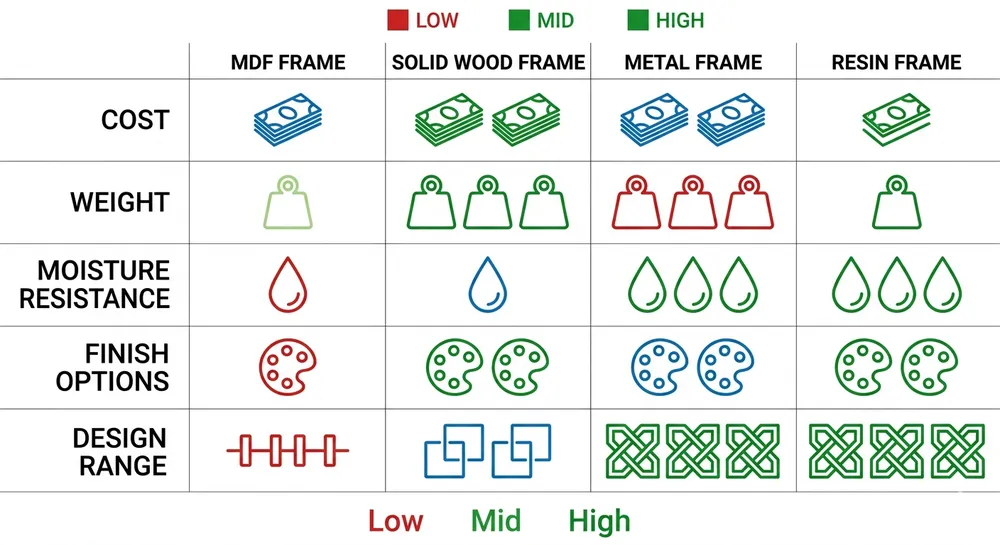
Frame Material Sub-Decision: MDF, Wood, Metal, and Resin

If you've decided framed is the right direction, the frame material is the next decision — and it affects cost, weight, finish options, and durability in ways that matter for your program.

MDF frames are the most common and the most cost-efficient. MDF machines cleanly, accepts paint and foil wrap well, and produces consistent profiles at volume. The limitation is moisture sensitivity — MDF frames in high-humidity environments (bathrooms, coastal markets) can swell and delaminate over time. For dry retail environments and standard home use, MDF is the right call on cost. We run MDF on the majority of our framed mirror volume.

Solid wood frames cost more and weigh more, but they carry a quality signal that MDF can't replicate — especially for buyers targeting the premium or artisan retail segment. Solid wood also takes stain and natural finishes that MDF can't. The trade-off is less dimensional consistency across a large run; wood moves with humidity, and tight mitered corners require more careful QC. (We use finger-jointed solid wood on most of our wood-frame SKUs — it's more stable than single-piece wood and still reads as solid wood to the end buyer.)

Metal frames — typically steel or aluminum tube profiles — are the right choice for contemporary and industrial aesthetics, and they're the most durable option for high-traffic or commercial environments. Metal frames add weight but are essentially immune to moisture and impact damage that would crack MDF. Powder coat finish on metal passes 500-hour salt spray, which matters for coastal retail accounts. The cost premium over MDF is real but supportable at the right retail price point.

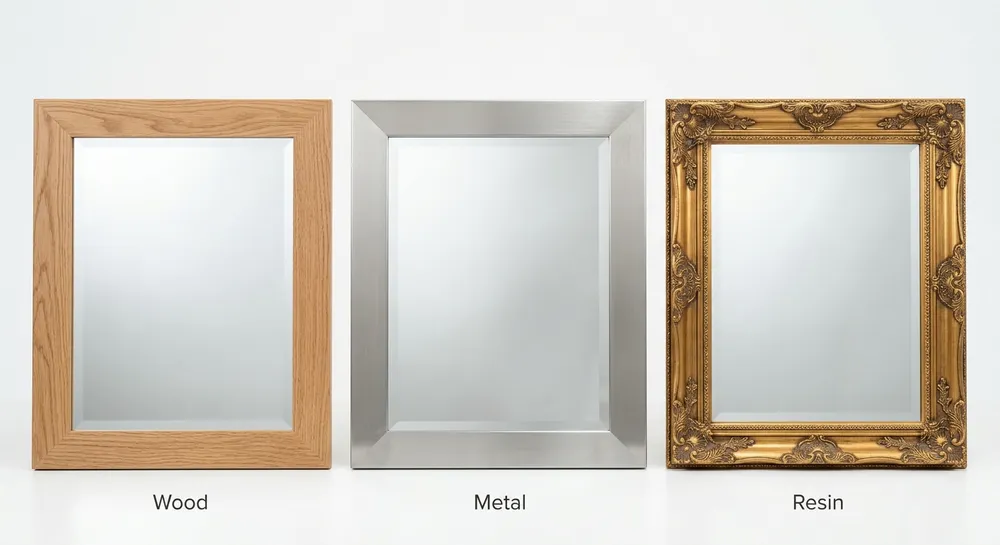
Resin frames give you the most design flexibility at a mid-range cost. Resin can be cast into ornate profiles — carved-look, antique, baroque — that would be prohibitively expensive in solid wood. Finish options include antique gold, silver leaf effect, and multi-tone paint. Resin is heavier than MDF but lighter than metal, and it holds detail well. For traditional and transitional retail programs, resin frames are often the best cost-to-design-value option.

Decision matrix comparing MDF, wood, metal, and resin mirror frames across cost, weight, moisture resistance, and finish options

Head-to-Head Sourcing Matrix

Dimension Framed Mirror Frameless Beveled Mirror
Typical FOB price range Higher — frame material + labor Lower — glass + edge processing only
Retail price potential $49–$199+ depending on frame $25–$69 typical range
Packaged weight Higher (frame adds 30–60%) Lower
Container cube efficiency Lower Higher
Breakage risk in transit Higher (frame corners vulnerable) Lower
MOQ at Livewellcraft 100 pcs standard models; custom frame profiles negotiable 100 pcs
Lead time (standard SKUs) 25–35 days 20–28 days
Lead time (custom frame) 35–45 days (includes frame tooling) 28–35 days (custom size/edge)
Design differentiation High — frame profile, finish, color Low — bevel is the only variable
Retail segment fit Home goods, specialty, hospitality Value retail, e-commerce basics, commercial
OEM/ODM complexity Higher — frame profile development required Lower — size and edge spec only

Application Scenarios: Which Option Wins

Scenario 1: Mid-Market Home Goods Retailer, $49–$99 Price Tier

Winner: Framed mirror, MDF or resin frame.

At this price tier, the frame is what justifies the retail price. A frameless mirror at $49–$99 retail is overpriced for what it is — buyers will find the same glass cheaper elsewhere. An MDF or resin frame in a current finish (matte black, brushed gold, natural wood tone) gives your retail buyer a product with a clear design story and a defensible price point. The freight premium over frameless is real but absorbed comfortably in the margin at this tier.

Scenario 2: E-Commerce Value Program, $25–$45 Price Tier

Winner: Frameless beveled mirror.

At this price point, margin is tight and freight cost per unit matters. Frameless mirrors pack more efficiently, weigh less, and have lower damage rates — all of which protect your landed cost. The bevel gives the product a clean, finished look that photographs well enough for e-commerce. You're not building a design story here; you're building a price-competitive SKU that moves volume. Frameless is the right call.

Scenario 3: Hospitality or Contract Project, 500+ Units

Winner: Depends on specification — but framed metal or solid wood for premium properties, frameless for budget properties.

Hospitality buyers care about durability and installation consistency more than retail price positioning. For premium hotel or resort projects, a metal-framed mirror with powder coat finish is the right spec — it survives housekeeping, humidity, and years of use without the finish failures you'd see on MDF in a bathroom environment. For budget hospitality (motels, student housing), frameless mirrors with a clean polished edge are cost-efficient and easy to install. We've supplied both configurations to hospitality projects across Southeast Asia and the Middle East — the spec decision usually comes down to the property's star rating and the designer's finish schedule.

Scenario 4: Specialty Retail or Boutique Home Store, $79–$149+ Price Tier

Winner: Framed mirror, solid wood or metal frame.

At this tier, the frame material itself is part of the product story. Solid wood with a hand-applied stain or metal with a brushed finish signals quality in a way that MDF can't. Your retail buyer is selling to a customer who is paying attention to materials, and the frame needs to hold up to that scrutiny. The higher FOB cost is justified by the retail price point, and the margin structure works. This is also the segment where OEM frame profile development pays off — a proprietary frame profile gives your buyer exclusivity that commodity frameless mirrors can never offer.

What to Verify Before You Place Your Order

Whether you go framed or frameless, the sourcing questions are different — and the risks are different.

For framed mirrors, verify:

  • Frame material spec (MDF density, wood species, metal gauge) — not just "MDF frame" or "metal frame"
  • Finish adhesion testing — ask for cross-hatch adhesion test results on painted or foil-wrapped MDF frames
  • Corner joint construction — mitered and glued vs. stapled; stapled corners fail in transit
  • Packaging spec — corner insert type, carton wall thickness, and whether the spec is adjusted for your destination port
  • Sample approval process for custom frame profiles — confirm who owns the tooling and what the minimum run is

For frameless mirrors, verify:

  • Bevel width and angle consistency across the batch — 1-inch bevel should be uniform; variation shows up badly in retail display
  • Silver coating adhesion — ask for silver adhesion test protocol; poor silvering delaminates from the edges first on frameless mirrors
  • Edge seaming quality on non-beveled options — a rough seam edge is a safety and aesthetic issue
  • Packaging — frameless glass needs full-perimeter edge protection, not just corner pads

We run 100% visual inspection on every unit before it loads, and silver coating adhesion testing is part of our standard QC protocol on all mirror types. On framed mirrors, we inspect frame-to-glass fit, corner joint integrity, and finish consistency at the assembly station — not just at final pack. (We added the assembly-station check after a run of MDF frames where corner joint gaps weren't visible until the frame was under load in the carton. Caught it before shipment, but it was a close call.)

Choosing Based on Your Program: A Decision Framework

If you're still deciding, run through these three questions:

1. What retail price tier are you targeting? Below $45: frameless. Above $60: framed. Between $45–$60: framed with MDF is viable if your freight lane is short; frameless if you're shipping long-haul.

2. How much SKU complexity can you manage? Frameless is simpler — one variable (size), one finish (bevel). Framed requires frame material, finish, and profile decisions per SKU. If you're building a 3–5 SKU starter program, framed gives you more range. If you're adding a single fill-in SKU to an existing program, frameless is faster to execute.

3. What's your freight lane and damage tolerance? Short ocean transit (Vietnam to Southeast Asia, Vietnam to Australia direct): framed is manageable with proper packaging. Long transit with multiple port transfers (Vietnam to US East Coast via transshipment): frameless has a meaningful advantage in damage rate. If your claims budget is tight, that matters.

For buyers building a full decorative mirror program — not just a single SKU — the answer is usually both. We supply framed and frameless mirrors to the same buyers regularly; they use frameless for their value tier and framed for their mid and premium tiers. That's a cleaner program structure than trying to stretch one mirror type across all price points.

Explore our Frame Decor Mirrors range for current framed SKUs and custom frame profile options, or browse the full Decor Mirrors by Material & Frame category to see how framed and frameless options fit into a complete mirror program. If you're sourcing for a specific retail format or hospitality project, our Wall Decor Mirrors section covers installation and specification considerations in more detail.

Ready to compare actual pricing on both options for your program? Send your target quantities, preferred sizes, and retail price points to our team — we'll return a side-by-side FOB quote on framed and frameless configurations within 48 hours. Request Quote

Acrylic Decor Mirrors Durability and Impact Resistance — What B2B Buyers Need to Know

Why Acrylic Mirror Durability Specs Belong on Your Purchase Order

Most claims we see on acrylic decor mirrors trace back to the same root cause: the PO said "acrylic mirror" and nothing else. No thickness spec, no hard-coat requirement, no UV stabilizer grade. The supplier shipped the cheapest sheet that technically qualified, and six months into a hospitality rollout the mirrors were hazed, scratched, or warped off the wall.

Acrylic (PMMA) is genuinely tough material for decorative mirrors. It absorbs impact far better than float glass, weighs roughly half as much, and won't shatter into dangerous fragments. But "acrylic" covers a wide range of sheet grades, thicknesses, and surface treatments, and the differences between them land directly on your return rate, your installed lifespan, and your margin. This article breaks down the specs that matter for sourcing acrylic decor mirrors in volume, so you can write a purchase order that protects your business.

PMMA vs Glass vs Polycarbonate: What the Numbers Mean for Your Product Line

When you're choosing a mirror substrate for a decor product, three materials come up: cast PMMA (acrylic), float glass, and polycarbonate. Each has trade-offs that affect your landed cost, warranty exposure, and target market fit.

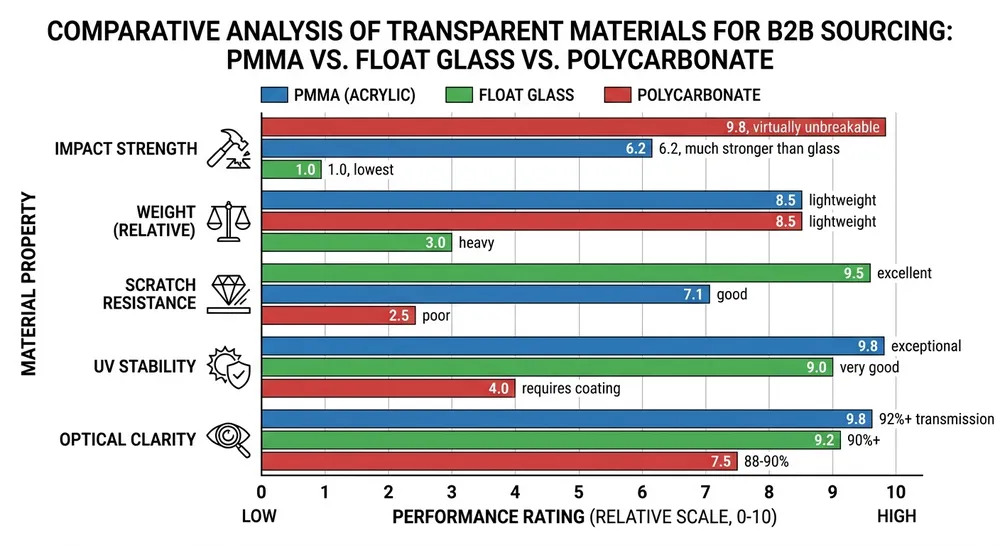
Property PMMA (Acrylic) Float Glass Polycarbonate
Izod Impact Strength (ASTM D256) ~16 kJ/m² ~2 kJ/m² ~60–80 kJ/m²
Weight (per m² at 3mm) ~3.6 kg ~7.5 kg ~3.6 kg
Scratch Resistance Moderate (improvable with hard coat) High Low
UV Stability Good with stabilizer; yellows without Excellent Poor; yellows faster
Optical Clarity (ASTM D1003 haze) <1% haze (cast sheet) <0.5% haze 1–3% haze
Shatter Behavior Breaks into dull chunks, low injury risk Sharp shards Doesn't shatter
Relative Sheet Cost Medium Low High

A few things jump out of this table. PMMA gives you roughly 8x the impact resistance of glass at half the weight. That combination is why shatterproof acrylic mirrors dominate hospitality, children's spaces, and retail display. Polycarbonate is tougher still, but it scratches easily, yellows faster under UV, and costs more per sheet. For decorative wall mirrors where optical clarity and surface finish matter, PMMA hits the practical sweet spot.

(We've tested polycarbonate mirrors for a gym chain project. The impact resistance was overkill for wall-mounted decor, and the surface scratched during installation. We steered them back to hard-coated PMMA and the complaint rate dropped to near zero.)

Comparison chart of PMMA acrylic, float glass, and polycarbonate mirror properties for B2B decor sourcing

How Thickness Drives Impact Performance and Landed Cost

Acrylic mirror sheets for decor applications typically range from 1mm to 5mm. The thickness you spec affects impact resistance, rigidity, weight, and freight cost per unit. Getting this wrong in either direction costs you money.

1mm PMMA: Flexible, lightweight, lowest material cost. Works for adhesive-mounted decorative tiles and flat accent panels where the mirror bonds directly to a rigid substrate. Not self-supporting at sizes above roughly 300mm. If your product relies on the acrylic sheet to hold its own shape, 1mm will bow.

2mm PMMA: The standard for most wall-mounted decorative mirrors in the 300–600mm range. Enough rigidity to stay flat in a frame, light enough to keep shipping costs reasonable. This is where the bulk of our acrylic decor mirror production sits. (About 60% of our acrylic mirror orders spec 2mm, which tells you where the market has settled.)

3mm PMMA: Noticeably more rigid. Appropriate for larger format mirrors (600mm+), frameless designs that need structural integrity, and installations in high-traffic commercial environments where someone might bump the wall. The Izod impact values scale roughly linearly with thickness, so 3mm gives you about 50% more impact absorption than 2mm.

4–5mm PMMA: Specified for safety-critical applications: children's facilities, behavioral health environments, correctional settings. The material cost per unit climbs, but these channels accept the price premium because the alternative is tempered glass at even higher cost and weight.

Thickness Typical Application Self-Supporting Size Relative Material Cost
1mm Adhesive-mount tiles, substrate-backed accents Up to ~300mm Baseline
2mm Standard framed wall mirrors, retail displays Up to ~600mm ~1.6x
3mm Large-format, frameless, hospitality lobbies Up to ~900mm ~2.2x
4–5mm Children's spaces, safety-rated environments 900mm+ ~3–4x

The sourcing decision here is straightforward: spec the thinnest sheet that meets your application's rigidity and impact requirements. Over-specifying thickness inflates your unit cost and container weight without adding value your end customer will notice.

Three Failure Modes That Drive Returns on Acrylic Mirrors

Acrylic decor mirrors durability is strong on impact, but the material has specific vulnerabilities. If you understand these failure modes, you can spec around them and keep your return rate low.

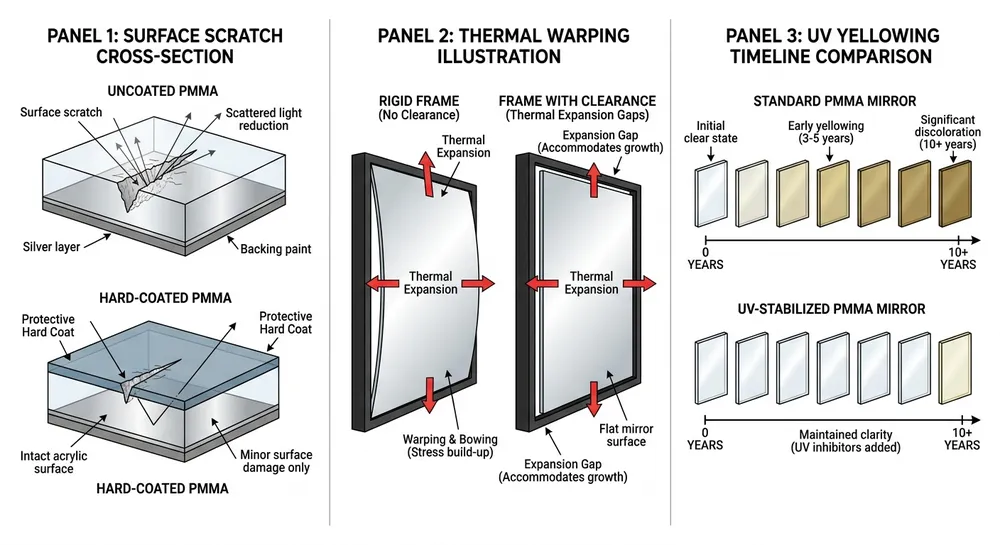
Surface Scratching

PMMA has a Rockwell hardness around M90–M100. That's softer than glass (which sits around Mohs 5.5). In practice, this means acrylic mirrors scratch more easily during handling, installation, and cleaning. For a product that's meant to be looked at, visible scratches are a warranty issue.

The fix is a hard-coat treatment applied during or after sheet production. A good hard coat (typically silicone-based, applied at 3–5 microns) brings the surface pencil hardness up to around 3H–4H and improves Taber abrasion resistance (ASTM D4060) by 5–10x over uncoated PMMA. We specify hard-coated sheet for any acrylic mirror order going into hospitality or retail, where cleaning staff will wipe the surface regularly. The cost adder is modest relative to the return cost of scratched units.

Thermal Warping

PMMA has a coefficient of thermal expansion roughly 7x higher than glass. A 1-meter acrylic panel exposed to a 30°C temperature swing can expand by about 2mm in length. In a rigid frame with no expansion allowance, that expansion has nowhere to go, and the mirror bows.

We account for this in frame design by leaving 1–2mm clearance per linear meter between the acrylic panel edge and the frame rabbet. If you're sourcing acrylic mirrors from a supplier who frames them the same way they frame glass, ask about expansion clearance. It's a small detail that prevents a visible defect.

UV Yellowing

Standard extruded PMMA without UV stabilizers will begin to yellow noticeably after 2–3 years of direct sunlight exposure. Cast PMMA with UV stabilizer additives extends that timeline to 8–10 years under typical indoor conditions, and longer if the mirror isn't in direct sun.

For indoor decor applications, UV-stabilized cast sheet is the right baseline spec. If your product goes into a sunroom, a south-facing lobby, or any space with significant UV exposure, confirm that the sheet supplier includes UV stabilizer in the formulation. This is a raw material spec, not something that can be added after the fact.

Diagram showing three common acrylic mirror failure modes: surface scratching, thermal warping, and UV yellowing with prevention methods

Hard Coats and UV Stabilizers: Protecting Margin on Long-Lifecycle Products

Two treatments separate a commodity acrylic mirror from a product you can confidently warranty for commercial use.

Hard coat is a surface treatment, usually silicone-based, applied at 3–5 microns. It raises scratch resistance from roughly H pencil hardness (bare PMMA) to 3H–4H. For any acrylic mirror that will be cleaned regularly or handled during installation, hard coat is worth the cost adder. We've seen the difference in return rates: uncoated acrylic mirrors in hotel bathrooms generated 3–4x the scratch complaints compared to hard-coated units in the same property.

UV stabilizer is a bulk additive mixed into the PMMA resin during sheet casting. It absorbs UV radiation before it can break polymer chains and cause yellowing. Cast PMMA sheets from reputable suppliers (Mitsubishi, Evonik, Chi Mei) typically include UV stabilizer as standard. Extruded sheet, which is cheaper, often does not. If your supplier quotes you acrylic mirror sheet at a price that seems unusually low, check whether it's extruded without UV stabilizer. The upfront savings disappear when the product yellows in the field.

(We switched our default acrylic sheet sourcing to UV-stabilized cast PMMA in 2019 after a batch of extruded sheet started showing haze in a Middle East hotel project within 18 months. The cost difference was about 8–12% on the sheet, but the warranty claim would have been far more expensive.)

What Happens When Acrylic Mirror Specs Stay Vague on the PO

This is the sourcing trap we see most often with acrylic decor mirrors. The purchase order says "acrylic mirror, 2mm, 400x600mm, qty 3,000" and nothing else. That leaves the supplier free to choose:

  • Extruded vs cast sheet (cost difference, UV stability difference)
  • With or without hard coat (scratch resistance difference)
  • With or without UV stabilizer (yellowing timeline difference)
  • Edge finishing method (laser cut, router cut, polished, raw)
  • Protective film grade (peel-off quality affects installed appearance)

Each of those choices affects your product's field performance and your return rate. When the spec is vague, the supplier optimizes for their margin, not yours.

What to specify on your PO or RFQ:

  • Sheet type: cast PMMA with UV stabilizer (not extruded)
  • Hard coat: yes/no, with pencil hardness target (3H minimum for commercial)
  • Thickness tolerance: ±0.1mm is standard for cast sheet
  • Haze: <1% per ASTM D1003
  • Edge finish: specify polished, beveled, or raw
  • Protective film: specify peel quality (no residue after 30 days)
  • Reflectivity: request sample for visual approval before production

If you're comparing quotes from multiple suppliers and one price is 20–30% below the others, the gap is almost certainly in sheet grade, coating, or both. Ask for the sheet supplier name and grade. A factory that knows its material will answer immediately. One that's brokering won't.

Our QC process runs 100% visual inspection on every acrylic mirror unit before packing, checking for haze, scratches, coating uniformity, and edge quality. That inspection gate catches the problems that vague specs create. But the better approach is to eliminate those problems at the spec stage, before production starts. If you need help writing a tight material spec for decor mirrors by material and frame type, our engineering team can review your requirements and recommend the right sheet grade and treatment combination.

Spec Recommendations by Sales Channel

Different channels have different durability requirements and different price sensitivity. Here's how we typically guide buyers through the thickness and treatment decision.

Hospitality (hotels, restaurants, lobbies): 2–3mm cast PMMA, hard-coated, UV-stabilized. These mirrors get cleaned daily and live in spaces with controlled climate but high foot traffic. Hard coat is non-negotiable. Frame design needs thermal expansion clearance if the mirror is near exterior walls or windows.

Retail display and visual merchandising: 2mm cast PMMA, hard-coated. Weight matters here because displays get reconfigured frequently. Scratch resistance matters because staff handle the mirrors during setup. UV stabilizer is less critical if the display is indoors under artificial light, but we include it as default because the cost difference is small.

Residential wholesale (distributed through home decor retailers): 1–2mm cast PMMA, UV-stabilized. Hard coat is optional depending on your price point. For adhesive-mount decorative tiles, 1mm on a rigid backing works well. For framed wall mirrors, 2mm is the standard. This channel is the most price-sensitive, so spec only what the application genuinely needs.

Children's spaces and safety-rated environments: 3–5mm cast PMMA, hard-coated, UV-stabilized, with rounded or polished edges. These applications often require documentation of impact test results. We can provide Izod impact test data per ASTM D256 on the specific sheet grade used in your order. (Some institutional buyers also ask for a flammability rating per UL 94; cast PMMA is typically HB-rated, which satisfies most building codes for wall-mounted decor.)

For a deeper comparison of acrylic vs glass decor mirrors across these channels, we've covered the full cost and performance trade-off in a separate guide.

Frequently Asked Questions

How durable are acrylic decor mirrors compared to glass in high-traffic commercial spaces?

PMMA acrylic is roughly 8x more impact-resistant than float glass by Izod impact testing (ASTM D256), and it won't shatter into sharp fragments. In high-traffic environments like hotel corridors or retail floors, that impact resistance translates directly to lower replacement costs and zero injury liability from broken glass. The trade-off is scratch susceptibility, which a hard-coat treatment effectively addresses for commercial cleaning cycles.

What ASTM standards should I reference when specifying acrylic mirrors for bulk orders?

Three standards cover the properties that matter most: ASTM D256 for Izod impact resistance, ASTM D1003 for haze and light transmittance (optical clarity), and ASTM D4060 for Taber abrasion resistance (scratch durability). Including these on your RFQ gives your supplier a clear performance target and gives you a measurable basis for acceptance testing.

Will acrylic mirrors yellow over time in indoor installations?

UV-stabilized cast PMMA holds its clarity for 8–10 years under typical indoor lighting conditions. Without UV stabilizer, yellowing can become visible in 2–3 years, especially near windows. Always confirm that your supplier uses UV-stabilized cast sheet, not unstabilized extruded sheet. This is the single most common cause of premature yellowing in acrylic decor mirrors.

What thickness of acrylic mirror do I need for wall-mounted decor products?

For framed mirrors in the 300–600mm range, 2mm is the industry standard. It provides enough rigidity to stay flat in the frame while keeping weight and material cost reasonable. Above 600mm, move to 3mm for structural integrity. Below 300mm or for adhesive-mount applications, 1mm on a rigid substrate works. Over-specifying thickness adds cost without visible benefit to your customer.

How do I prevent scratching on acrylic mirrors during shipping and installation?

Specify hard-coated PMMA sheet (3H pencil hardness minimum) and require protective peel film that leaves no residue after 30 days. For shipping, each mirror should have individual film protection and corner guards. Instruct your installation teams to remove the protective film only after all surrounding construction work is complete. Most field scratches happen during the last mile, not in the container.

Can acrylic mirrors be custom-shaped or beveled for OEM decor products?

Yes. PMMA machines cleanly with standard CNC routing and laser cutting equipment. We produce custom shapes, beveled edges, and radius corners on our acrylic decor mirrors line. Laser-cut edges come out polished and don't need secondary finishing for most decorative applications. If you need a non-standard profile or a backlit design, send your dimensions and we'll confirm feasibility and quote the project with your specific sheet grade and treatment specs.

Frame Decor Mirror Construction Specs — What B2B Buyers Must Verify Before Placing Bulk Orders

Most framed mirror disputes we see come down to the same root cause: the buyer assumed the factory understood what "standard quality" meant, and the factory built to the cheapest interpretation of the spec sheet. By the time the container arrives, the damage is done — coating peeling at the joints, glass cracked from inadequate edge finishing, backing boards warped from moisture. None of it is hard to prevent. All of it requires knowing which specs to lock down before production starts.

This guide covers the construction specs that actually determine whether your Frame Decor Mirrors survive transit, pass retail inspection, and stay off your returns desk.

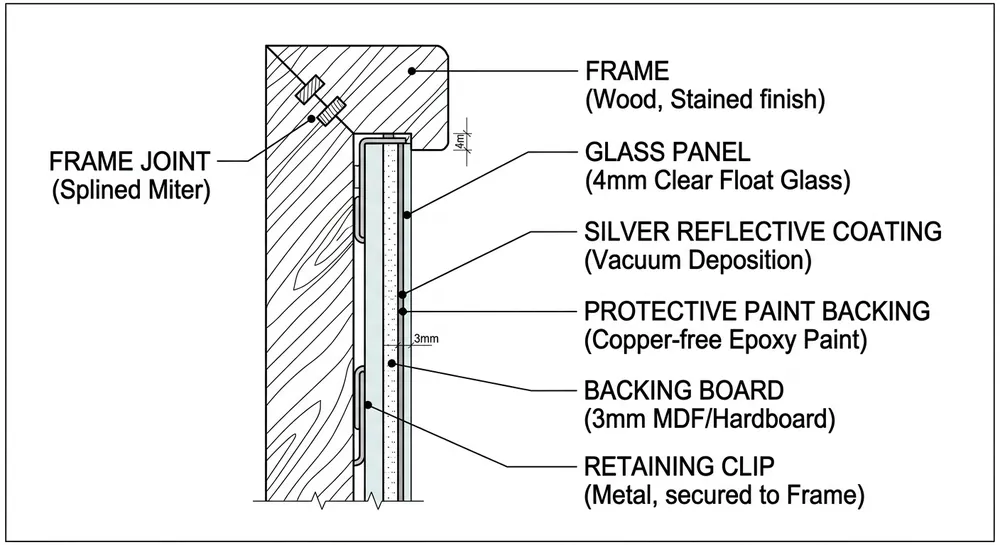
Diagram showing the key construction layers of a framed decorative mirror including glass, silvering, backing, and frame joinery

Glass panel specs: thickness, edge finish, and what each costs you in breakage

The glass is where most buyers under-specify. "Standard mirror glass" tells a factory almost nothing — and a factory optimizing for margin will interpret that as the thinnest sheet that technically qualifies.

For framed decorative mirrors, the practical thickness range runs from 3mm to 6mm. Here's how to think about it:

Glass thickness Typical application Breakage risk in transit Weight impact
3mm Small frames under 40cm Higher — flexes under pressure Lightest
4mm Standard retail sizes 40–80cm Moderate with proper packaging Balanced
5mm Large format 80–120cm Low with corner protection Heavier
6mm Oversized / commercial Very low Heaviest — affects freight cost

We run most of our retail-format mirrors at 4mm. For anything going into hospitality projects or large-format retail display, 5mm is the floor we recommend — the extra cost per unit is negligible against a single breakage claim on a 500-unit order.

Edge finishing matters as much as thickness. Raw-cut edges chip under vibration in a container. Specify one of these:

  • Flat polish: clean, safe, standard for most framed mirrors where the edge is hidden by the frame rabbet
  • Beveled edge: 10mm–20mm bevel at 45°, adds visual value for frameless-look designs or partial-reveal frames
  • Seamed edge: light grind to remove sharpness — minimum acceptable for any glass that handlers will touch during assembly

If your spec sheet just says "mirror glass," you will get raw-cut edges on at least some units. We've seen it happen even with suppliers who should know better. Lock the edge finish in writing.

Silvering and coating specs: where the real quality gap lives

This is the section most buyers skip, and it's the one that generates the most warranty claims.

Mirror silvering is a wet chemical process — silver nitrate reduced onto the glass surface, then sealed with a protective paint layer. The difference between a mirror that lasts 10 years and one that starts showing black edge spots in 18 months comes down to two things: whether the process uses copper backing, and how well the protective paint adheres.

Copper-free vs. copper-backed silvering

Traditional silvering uses a copper layer between the silver and the protective paint. Copper improves adhesion but corrodes over time, especially in humid environments — that's the source of the black "foxing" spots you see on older mirrors. Copper-free silvering eliminates that failure mode. We switched our lines to copper-free in 2016, and the difference in long-term adhesion test results was significant enough that we haven't looked back.

If you're selling into coastal markets, humid climates, or bathroom-adjacent applications, copper-free is worth specifying explicitly. Most catalog suppliers won't volunteer this distinction.

Adhesion testing — what to ask for

Silver coating adhesion is tested by cross-cut tape pull (similar to ASTM D3359). A properly coated mirror should show zero silver lift on a 6×6 grid cross-cut test. Ask your supplier whether they test adhesion per batch or per unit. We run 100% unit-level adhesion checks before packing — batch sampling misses the outliers that end up as claims.

Protective paint layer count

The silver sits under two paint layers: a copper-substitute barrier coat and a final protective enamel. Single-coat systems are cheaper and fail faster at the edges where moisture infiltrates. Specify minimum two-coat backing paint, and ask for the dry film thickness — 40–60μm total is a reasonable target for standard decorative mirrors.

Cross-section diagram of mirror silvering layers showing glass substrate, silver coating, barrier coat, and protective enamel layers with thickness labels

Frame construction specs: material, joinery, and finish — the three places factories cut corners

The frame is where the most visible quality variation lives, and where the most sourcing disputes originate. A frame that looks identical in a product photo can be built three completely different ways — and only one of those ways survives a 30-day ocean container.

Frame material options and their trade-offs

Material Typical profile cost Moisture resistance Finish options Best for
MDF Lowest Poor without sealing Paint, foil wrap, gesso Price-sensitive retail, indoor only
Solid wood Mid–high Good (species-dependent) Stain, paint, natural Premium retail, hospitality
Metal (iron/aluminum) Mid Excellent Powder coat, electroplate Industrial, modern, outdoor-adjacent
Resin/polyurethane Mid Good Paint, antique finish Ornate profiles, high-detail reproduction

MDF is the most common frame substrate in the decorative mirror category — it machines cleanly, takes paint well, and keeps costs down. The failure mode is moisture: unsealed MDF swells, and swollen MDF at a miter joint is the most common frame failure we see on returned product. If you're specifying MDF frames, require sealed edges and moisture-resistant primer before finish coat. (We use a two-pass sealer on all MDF profiles before any paint goes on — it adds a step, but it's the difference between a frame that survives a humid warehouse and one that doesn't.)

Resin frames are worth understanding if you're selling ornate or antique-style mirrors. The profile detail you can achieve in resin is impossible in MDF or solid wood at the same price point. The trade-off is weight — a heavily detailed resin frame on a large mirror adds meaningful freight cost. We've had buyers switch from resin to high-density polyurethane foam core with resin surface for large formats, which cuts weight by 30–40% without losing the profile detail.

Joint construction — the spec that determines container survival

Miter joints are standard for rectangular frames. The question is how they're reinforced:

  • Glue only: adequate for small frames under 40cm, not for anything larger
  • Glue + V-nail (corrugated fastener): standard for mid-size frames, good shear resistance
  • Glue + corner bracket (metal L-bracket): best for large frames and heavy glass — this is what we use on anything over 60cm
  • Dowel + glue: common in solid wood frames, strong but requires precise machining

Specify the joint method in your PO. "Secure joinery" is not a spec — it's an invitation for the factory to use whatever is cheapest that day.

Finish coat specs

For painted frames, specify:

  • Primer coat: yes/no, and type (water-based vs. solvent)
  • Finish coat count: minimum two for any export product
  • Sheen level: matte / satin / gloss
  • Color matching: RAL code or Pantone reference, not a photo

For powder-coated metal frames, 60–80μm dry film thickness is the standard range. Below 60μm and you'll see coverage gaps at edges and corners — exactly where moisture gets in. We test coating thickness on every batch with a digital gauge; it takes 30 seconds per frame and catches the outliers before they pack.

For electroplated finishes (gold, silver, bronze), ask for the plating thickness in microns and the base metal. Zinc alloy base with 0.3–0.5μm gold flash is the standard for decorative mirrors — anything thinner will show wear within a year of normal handling.

Backing board and hardware specs: the last line of defense against transit damage

The backing board is the component buyers most consistently under-specify, and it's the one that causes the most moisture-related failures in the field.

Backing board material options

Material Moisture resistance Weight Cost Notes
Cardboard / grey board Poor Light Lowest Acceptable only for very small, indoor-only mirrors
MDF backing Moderate Heavy Low–mid Requires sealing; swells if unsealed
HDF (high-density fiberboard) Better than MDF Moderate Mid Better dimensional stability
Kraft paper + foam Poor Very light Low Not suitable for export
Plastic composite (PP/ABS sheet) Excellent Light Mid–high Best for humid markets and bathroom-adjacent use

For any mirror going into retail distribution or hospitality projects, specify HDF or plastic composite backing. Grey board backing on a 60cm framed mirror going into a Florida retail chain is a warranty claim waiting to happen.

Moisture barrier

Regardless of backing material, require a moisture barrier layer between the backing board and the silver coating. This is typically a kraft paper or foil layer sealed at the edges. Without it, any moisture that penetrates the frame joint migrates directly to the silver — and that's how you get edge delamination on product that was stored correctly.

Hanging hardware load rating

This is the spec that generates the most liability exposure for distributors and retailers. Specify:

  • Hardware type: D-ring, sawtooth, wire, or keyhole plate
  • Load rating: minimum 2x the mirror's actual weight (safety factor)
  • Fastener type: screws into frame vs. staples — screws only for anything over 3kg
  • Wire gauge (if applicable): specify minimum gauge, not just "picture wire"

We rate all hardware at 3x the mirror weight as our internal standard. A 4kg mirror gets hardware rated to 12kg minimum. (We've seen competitors use staple-mounted D-rings on 5kg mirrors — that's not a spec, that's a liability.)

Diagram showing framed mirror backing construction with labeled components including backing board, moisture barrier, D-ring hardware, and wire attachment points

The spec verification checklist: what to put in your PO before confirming production

Most sourcing disputes are preventable at the PO stage. Here's what to lock down in writing before you confirm any framed mirror production run:

Glass

  • [ ] Thickness (mm) — specify exact, not "standard"
  • [ ] Edge finish type (flat polish / bevel / seamed)
  • [ ] Bevel width if applicable (mm)

Silvering and coating

  • [ ] Copper-free or copper-backed — specify explicitly
  • [ ] Protective paint layer count (minimum 2)
  • [ ] Dry film thickness of backing paint (target 40–60μm)
  • [ ] Adhesion test method and frequency (per unit vs. per batch)

Frame

  • [ ] Substrate material (MDF / solid wood / metal / resin)
  • [ ] Joint method and reinforcement type
  • [ ] Primer: yes/no, type
  • [ ] Finish coat count
  • [ ] Color reference (RAL / Pantone — not photo)
  • [ ] Coating thickness for powder coat (60–80μm)
  • [ ] Plating thickness for electroplate (microns + base metal)

Backing and hardware

  • [ ] Backing board material
  • [ ] Moisture barrier: yes/no
  • [ ] Hardware type (D-ring / sawtooth / wire / keyhole)
  • [ ] Hardware load rating (minimum 2x mirror weight)
  • [ ] Fastener type (screws vs. staples)
  • [ ] Wire gauge if applicable

Packaging

  • [ ] Corner protection type
  • [ ] Inner carton material
  • [ ] Master carton drop-test standard

If a supplier can't confirm these specs in writing before production, that's the answer to your sourcing question.

Visual checklist of framed mirror construction specs organized by category including glass, silvering, frame, backing, and hardware verification points

How vertical production controls spec reliability across every unit

There's a structural reason why spec disputes are more common with trading companies and multi-vendor assemblers than with vertically integrated factories: when different suppliers handle glass, frame, and assembly separately, no single party owns the complete spec. Each vendor optimizes for their own component, and the integration gaps are where failures happen.

We cut glass, run silvering, mold frames, and do final assembly under one roof on our 12,000 m² facility in Dong Nai. That means when you specify 4mm copper-free glass with flat-polished edges going into an MDF frame with corner-bracket joinery and HDF backing, every step of that spec is executed and inspected by the same team. There's no handoff where a spec gets reinterpreted.

Our 12-person engineering team handles custom frame profile development — if your target retail price requires a specific profile width, finish combination, or joint method, we work that out in sampling before production, not after. For buyers sourcing custom frame mirror orders, this matters: a catalog supplier can't adjust the frame profile to your spec because they don't make the frame. We do.

The 100% visual inspection and silver adhesion testing we run on every unit before packing isn't a marketing claim — it's a process requirement that comes from running our own silvering line. We see every unit. Batch sampling is what you do when you're inspecting someone else's product. (We've had buyers ask why we don't just do AQL sampling to save time. The answer is that our silvering line occasionally produces edge adhesion outliers that only show up under direct light at a specific angle — batch sampling misses them. 100% inspection catches them before they pack.)

For buyers evaluating frame material options across wood, metal, and resin, our engineering team can walk you through the cost-performance trade-offs for your specific target market and price point. The right frame spec for a mid-market US retailer is different from the right spec for a Gulf hospitality project — and those differences show up in the PO, not in a product catalog.

Common failure modes and the specs that prevent them

Understanding why mirrors fail in the field makes the spec checklist above less abstract. These are the failure modes we see most often in returned product and warranty claims:

Edge delamination (silver lifting at mirror perimeter) Cause: moisture infiltration through unsealed frame joints or inadequate backing moisture barrier. Prevention: sealed MDF or HDF backing + moisture barrier layer + two-coat silvering paint at minimum 40μm.

Frame joint separation Cause: glue-only miter joints on frames over 40cm, or MDF swelling from humidity. Prevention: corner bracket reinforcement on frames over 60cm + sealed MDF edges before finishing.

Finish peeling at corners and edges Cause: insufficient primer, single-coat finish, or coating applied over unsealed MDF. Prevention: two-pass sealer on MDF + primer + minimum two finish coats. For powder coat: 60μm minimum dry film thickness.

Glass breakage in transit Cause: undersized glass (3mm on frames over 50cm), raw-cut edges that chip under vibration, inadequate corner protection in packaging. Prevention: 4mm minimum for standard retail sizes + flat-polished or seamed edges + foam corner protection.

Hardware pull-out Cause: staple-mounted D-rings on heavy mirrors, or D-rings positioned too close to the frame edge (less than 25mm from corner). Prevention: screw-mounted hardware on anything over 3kg + D-ring placement at 1/3 height from top.

Each of these is a documented, preventable failure. The spec checklist in the previous section maps directly to these failure modes — every item on that list exists because we've seen what happens when it's missing.

FAQ

What glass thickness should I specify for framed mirrors going into retail distribution?

4mm is the standard for retail-format mirrors in the 40–80cm range. It balances breakage resistance with freight weight. For anything over 80cm, move to 5mm — the incremental cost is small against the breakage risk on a large-format mirror in a retail environment. For small decorative mirrors under 40cm, 3mm is acceptable if the packaging includes adequate corner protection.

What's the difference between copper-free and copper-backed silvering, and does it matter for my market?

Copper-backed silvering uses a copper interlayer that improves initial adhesion but corrodes over time in humid conditions — that's the source of the black edge spots ("foxing") on older mirrors. Copper-free silvering eliminates the copper layer and uses a chemical adhesion promoter instead. For markets with high humidity, coastal distribution, or bathroom-adjacent retail placement, copper-free is worth specifying. For dry-climate indoor retail, the difference is less critical, but copper-free is still the better long-term spec.

How do I verify frame joint quality before committing to a production run?

Request a pre-production sample and do a simple stress test: hold the frame at one corner and apply moderate diagonal pressure. A glue-only miter joint will show flex or audible creak. A properly reinforced joint (corner bracket or V-nail + glue) won't move. Also check the inside corner of the miter under direct light — gaps wider than 0.5mm indicate poor machining or inadequate clamping during assembly. For large-format mirrors, ask the supplier to specify the joint reinforcement method in writing before sampling.

What backing board material should I specify for mirrors going into humid markets?

HDF (high-density fiberboard) is the minimum for humid-market distribution. Plastic composite (PP or ABS sheet) is better if your retail channel includes bathroom-adjacent placement or coastal markets. Grey board and standard cardboard backing are only appropriate for small, dry-climate indoor mirrors. Regardless of backing material, require a moisture barrier layer between the backing and the silver coating — this is the single most effective spec for preventing edge delamination in the field.

What MOQ applies to custom frame profiles and finishes?

For standard catalog profiles with custom color or finish, our MOQ starts at 100 pieces. For fully custom frame profiles (new tooling required), the minimum is typically 300–500 pieces depending on profile complexity. Our engineering team can confirm the exact threshold once we review your profile drawings or reference samples. See our OEM ODM Services page for the full custom development process.

How do I know if a supplier's spec claims are actually enforced in production?

Ask for their QC process documentation, not just their certifications. ISO 9001 tells you they have a quality management system — it doesn't tell you whether they test adhesion per unit or per batch, or whether they use a digital gauge on coating thickness. Ask specifically: "Do you test silver adhesion on every unit or by sampling?" and "What is your coating thickness measurement frequency?" A factory that runs 100% inspection will answer that question immediately. A factory that doesn't will give you a vague answer about "strict quality control."

For a detailed technical proposal on your specific frame profile, glass thickness, finish, and quantity requirements, Request Quote — our engineering team will confirm specs and pricing based on your exact configuration. You can also browse our full Decor Mirrors by Material & Frame range to see which frame constructions are available in standard production.

Wood vs Metal vs Resin Mirror Frames — Cost, Durability & Margin Comparison for Wholesalers

You're building a mirror program and you need to pick a frame material — or decide how to mix them across your SKU range. Wood, metal, and resin each have a different cost structure, a different freight profile, and a different ceiling on what your retail or hospitality buyers will pay. Pick the wrong one for your channel and you're either leaving margin on the table or absorbing damage claims you didn't budget for.

We run all three material lines here at Livewellcraft. Same factory, same QC team, same silvering process behind the glass. That means the comparison below isn't pulled from trade publications — it's pulled from our production floor, our packing records, and the conversations we have with buyers every week about what's working in their market.

Quick verdict before we get into the detail: wood frames lead on perceived value and margin ceiling; metal frames lead on durability and logistics efficiency; resin frames lead on design flexibility and tooling economics at mid-volume. The right answer depends on your channel, your order size, and how much finish variation your buyers actually need.

Side-by-side comparison of wood, metal, and resin mirror frames showing different finishes and profiles

What You're Actually Buying: Material Inputs and Production Method

These three materials aren't just aesthetic choices — they're different manufacturing processes with different cost drivers.

Wood frames at our scale means primarily MDF (medium-density fiberboard) with solid wood used for premium profiles. MDF is stable, machines cleanly, and takes paint and foil wrap consistently. Solid wood adds natural grain character but introduces more variability in moisture content and grain matching across a large batch. We run wood frames through a profile milling line, then through a multi-coat paint or stain system depending on the finish spec. The labor content is higher than metal — sanding between coats, hand-touching joints, color-matching across batches.

Metal frames — we work primarily in iron and aluminum. Iron is heavier but holds complex profiles well and takes powder coat cleanly. Aluminum is lighter, better for coastal or humid-market buyers, and the anodizing options give you a finish range that powder coat can't fully replicate. Metal frames are formed, welded or bent, then run through our automated powder coat line at 60–80μm thickness. The process is more repeatable than wood finishing — less hand labor, tighter color consistency batch to batch.

Resin frames are cast from polyurethane or polyresin molds. The mold is the capital investment — a single profile mold runs $800–$2,500 depending on complexity, and you amortize that across your order volume. Once the mold exists, casting is fast and the detail reproduction is excellent. Ornate profiles that would cost three times as much to carve in wood are routine in resin. The hand-finishing step — sanding cast seams, applying base coat, then decorative finish — adds labor back in, but the design ceiling is higher than either wood or metal for decorative applications.

(We've had buyers try to skip the seam-sanding step to cut cost. It shows up in the finish. We don't offer that option.)

Unit Cost Structure at Wholesale Volumes

This is where most buyers start, and it's also where the comparison gets more nuanced than a simple price-per-unit number.

Cost Factor Wood (MDF) Metal (Iron/Powder) Resin
Material cost per unit Low–Medium Low–Medium Low (after mold)
Tooling / mold investment Low (profile cutters, shared) Low–Medium (bending dies) Medium–High ($800–$2,500/mold)
Finishing labor per unit Medium–High Low–Medium Medium–High
MOQ for standard profiles 100 pcs 100 pcs 300–500 pcs (mold amortization)
MOQ for custom profiles 200–500 pcs 300–500 pcs 500–1,000 pcs
Per-unit cost at 1,000 pcs $8–$18 (frame only) $7–$15 (frame only) $9–$20 (frame only)
Per-unit cost at 5,000 pcs $6–$14 $5–$12 $6–$15

A few things worth unpacking here. The resin mold cost is a one-time investment, but it sits on your first order. At 500 units, a $1,500 mold adds $3/unit to your landed cost. At 2,000 units, it's $0.75/unit. If you're running a resin program at low volume, you're paying for design flexibility you may not be able to price into your retail margin. At 2,000+ units per profile, resin becomes very competitive.

Wood finishing labor is the variable that surprises buyers most. A simple flat-profile MDF frame with a solid paint finish is fast and cheap. A multi-step distressed finish with glaze and hand-wipe? That's 4–5 labor touches per unit, and it shows in the quote. When you're comparing wood frame quotes across suppliers, always confirm the finish spec — two "wood frames" at different prices are often different finish processes, not different material quality.

Metal is the most predictable cost structure of the three. The powder coat line runs at consistent throughput, color changeovers are managed in batches, and there's less hand labor variability. For buyers who need tight cost control across large programs, metal frames are the easiest to budget.

Line chart comparing per-unit mirror frame cost across order volumes for wood, metal, and resin materials

Freight Weight, Fragility, and What It Costs You at the Container Level

This section is where buyers who've been burned before pay close attention.

Frame material affects your freight cost in two ways: weight per unit and damage rate in transit. Both hit your landed cost, but damage rate hits your margin twice — once in the claim, once in the customer relationship.

Logistics Factor Wood (MDF) Metal (Iron) Metal (Aluminum) Resin
Typical frame weight (medium mirror) 1.2–2.0 kg 1.8–3.0 kg 0.8–1.4 kg 0.9–1.6 kg
Container loading efficiency Medium Lower (weight limit) High High
Fragility in transit Medium (corner joints) Low Low Medium–High (thin profiles)
Packaging requirement Standard foam corner + carton Standard Standard Reinforced — foam insert required
Typical damage claim rate* 1–3% <1% <1% 2–5% (thin ornate profiles)

*Based on our export shipment records to North America and Europe over the past three years.

Iron metal frames are the most forgiving in a container. They don't crack, the powder coat is impact-resistant, and a corner bump that would chip a resin frame or split an MDF joint leaves a metal frame with a small scuff at worst. For buyers shipping to markets with rough port handling — parts of Southeast Asia, some Middle East routes — metal frames consistently deliver the lowest claim rates.

Resin is the one that requires the most packaging attention. Thin ornate profiles are brittle at the tips. We use custom foam inserts for resin frames, which adds $0.40–$0.80/unit to packaging cost and reduces how many units fit in a carton. On a 40-foot container, that packaging difference can mean 8–12% fewer units loaded versus a comparable metal frame program. (We've had buyers push back on the foam insert cost. We show them the claim rate data from orders that skipped it. The conversation ends there.)

MDF wood frames sit in the middle. The main failure point is corner joints — if the frame takes a hard impact at the corner, the miter joint can open. We address this with internal corner brackets on all our wood frame profiles, which adds a small cost but drops the joint-failure claim rate significantly.

Finish Range, Perceived Value, and Retail Margin Ceiling

Cost and logistics tell you what you'll spend. This section tells you what you can charge.

Wood frames carry the highest perceived value in most retail channels — particularly in North America and Europe where natural materials command a premium. A solid wood or high-quality MDF frame with a hand-applied finish can retail at 2.5–4x the frame's production cost in the right channel. Boutique home decor, hospitality procurement, and premium e-commerce (Wayfair upper tier, independent retailers) are all segments where wood frame mirrors hold strong price points. The finish range is wide: natural stain, painted, whitewashed, distressed, foil-wrapped, lacquered.

Metal frames have a different value story. The finish range — powder coat in any RAL color, brushed finish, electroplate (chrome, gold, black nickel) — is broad and consistent. Metal frames read as modern and industrial, which is exactly what a large segment of the current market wants. The margin ceiling is slightly lower than premium wood in lifestyle retail, but metal frames move faster, have lower return rates, and are easier to reorder at consistent quality. For buyers building a volume program rather than a premium program, metal often delivers better total margin per container than wood.

Resin frames are the design wildcard. The ornate profiles — carved-look, baroque, heavily detailed — are impossible to replicate in wood at the same price point. A resin frame that looks like hand-carved wood costs 30–50% less to produce than actual carved wood. In the right channel (traditional home decor, hospitality with a classic aesthetic, gift and decor wholesale), resin frames can carry strong retail prices. The risk is that resin finishes — particularly antique gold and silver leaf effects — are more variable than powder coat or paint, and finish consistency across a large batch requires tight QC at the hand-finishing stage.

We run a 100% visual inspection on all resin frames before packing. Color shift and finish inconsistency are the two defects we catch most often at that stage — both are fixable before the unit ships, but they add rework labor that a buyer sourcing from a less rigorous supplier will find in their customer returns instead.

Visual matrix showing available finish types for wood, metal, and resin mirror frames side by side

Head-to-Head: The Full Comparison Matrix

Dimension Wood (MDF/Solid) Metal (Iron/Aluminum) Resin
Unit cost at 1k pcs $8–$18 $7–$15 $9–$20
Unit cost at 5k pcs $6–$14 $5–$12 $6–$15
Tooling investment Low Low–Medium Medium–High
MOQ (standard) 100 pcs 100 pcs 300–500 pcs
Frame weight Medium Medium–High (iron) / Low (aluminum) Low–Medium
Transit damage rate 1–3% <1% 2–5%
Finish consistency Medium (labor-dependent) High (automated line) Medium (hand-finish)
Design complexity Medium Low–Medium High
Perceived value ceiling High Medium–High Medium–High
Lead time (standard) 30–40 days 25–35 days 35–45 days
Best channel fit Premium retail, hospitality Volume retail, modern decor Traditional decor, gift wholesale

Lead time note: resin adds hand-finishing time that wood and metal don't require. On a 2,000-unit resin order with a complex ornate profile, plan for 40–45 days production. We can run wood and metal frames in parallel on separate lines, so mixed-material programs don't necessarily extend your overall timeline.

Which Material Wins in Each Buyer Scenario

Scenario 1: Volume Retail Program (1,000–5,000 units per SKU, mid-price channel)

Winner: Metal

You need consistent quality, predictable cost, low damage claims, and easy reorders. Metal frames deliver all four. The powder coat line produces tight color consistency across large batches, the damage rate is the lowest of the three materials, and reordering the same SKU six months later gives you the same result. For buyers supplying mid-tier retail chains or large e-commerce platforms, metal frames are the lowest-risk, most margin-stable choice.

Scenario 2: Premium Home Decor or Hospitality Procurement

Winner: Wood

When your buyer is a boutique retailer, a hotel purchasing manager, or a high-end e-commerce brand, the natural material story matters. Wood frames — particularly solid wood or high-quality MDF with a hand-applied finish — carry a price premium that metal and resin can't match in this channel. The higher finishing labor cost is real, but so is the retail price ceiling. A well-specified wood frame mirror that costs $22 to produce can retail at $85–$120 in the right channel. That margin structure justifies the extra production complexity.

Scenario 3: Decorative or Traditional Aesthetic, Mid-Volume (500–2,000 units)

Winner: Resin

If your market wants ornate, carved-look, or baroque profiles — and you're ordering at volumes where mold amortization makes sense — resin is the only material that delivers that aesthetic at a competitive price. Carved solid wood at the same profile complexity costs 2–3x more. MDF can't hold the fine detail. Resin gives you the design range your buyers want at a price point that protects your margin, provided you're working with a supplier who controls the hand-finishing QC tightly.

(This is the scenario where supplier selection matters most. Resin finish quality varies more across factories than wood or metal. Ask for production samples from the actual mold you'll be ordering from, not showroom samples.)

Scenario 4: Mixed-SKU Program Across Multiple Channels

Winner: Single-source supplier running all three lines

If you're building a mirror program that spans multiple retail tiers or channels — some volume SKUs, some premium, some decorative — the logistics of managing three separate frame suppliers adds cost and risk that buyers often underestimate. Lead time misalignment, inconsistent glass quality across sources, and separate QC standards all create problems at the container level. We run wood, metal, and resin frame lines under one roof, which means your mixed program ships in one container, passes one QC standard, and has one point of contact for any issue. For buyers managing a 10–30 SKU mirror program across channels, that consolidation is worth more than the last dollar of unit cost optimization.

What to Verify When Sourcing Each Material

These are the questions worth asking before you commit to an order — and the answers that separate a reliable supplier from one that will cost you more downstream.

For wood frames:

  • Is the MDF E0 or E1 formaldehyde rated? (Required for EU and increasingly for US retail compliance)
  • What's the finish process — how many coats, what's the drying method, is there a UV topcoat?
  • How are corner joints reinforced? Ask to see a cross-section of the corner construction.
  • What's the moisture content spec on solid wood components? (Relevant for markets with seasonal humidity swings)

For metal frames:

  • What's the powder coat thickness spec? 60–80μm is standard; below 50μm and you'll see chipping on edges within 12 months.
  • Is the pre-treatment phosphate or zinc phosphate? (Zinc phosphate gives better adhesion and salt spray performance)
  • For coastal or humid markets: is aluminum available, and what's the anodizing spec?
  • What salt spray test hours does the finish pass? Ask for the test report.

For resin frames:

  • Who owns the mold — you or the factory? (Critical for reorder security and exclusivity)
  • What's the resin formulation — polyurethane or polyresin? (PU is lighter and less brittle; polyresin is denser and heavier)
  • How are cast seams finished? Ask to see the pre-finish and post-finish surface under good lighting.
  • What's the QC rejection rate at the visual inspection stage? A supplier who can't answer this question hasn't been tracking it.

For a deeper look at wood frame material selection specifically, Solid Wood vs MDF Mirrors covers the MDF vs solid wood trade-off in detail. If you're still working through the broader sourcing decision, Choosing Frame Materials and the Frame Material Sourcing Guide are useful next reads.

Frequently Asked Questions

Which mirror frame material has the lowest damage rate in shipping?

Metal (iron or aluminum) consistently delivers the lowest transit damage rate — typically under 1% on well-packed shipments. The powder coat finish is impact-resistant, and the frame structure doesn't have the brittle failure points that thin resin profiles or MDF corner joints can develop under rough handling. If you're shipping to markets with known port handling issues, metal frames reduce your claim exposure significantly.

What MOQ do I need to make resin frames cost-competitive?

The mold investment is the key variable. At 500 units, a $1,500 mold adds $3/unit to your cost. At 2,000 units, it's $0.75/unit — at that point, resin is cost-competitive with wood and metal for comparable profiles. If you're ordering below 500 units per profile, resin's cost structure works against you unless the design premium justifies it in your retail pricing.

Does frame material affect the mirror's silvering durability?

Yes, indirectly. Frame material affects how well the mirror assembly seals against humidity ingress at the frame-glass junction. Metal frames with tight tolerances and powder-coated edges seal better than poorly finished wood or resin frames. We use copper-free silvering across all our mirror production — it's more humidity-resistant than conventional silver coating — but the frame seal is still the first line of defense. For humid-climate markets (Southeast Asia, coastal US, Middle East), specify aluminum frames or confirm the wood/resin frame has a sealed back panel.

Can I mix wood, metal, and resin frames in one order?

Yes, if your supplier runs all three lines. We do this regularly for buyers building multi-SKU programs. The practical minimum is 100 units per frame style for wood and metal, 300–500 units for resin profiles. Mixed orders ship in one container and go through the same QC process. The main planning consideration is lead time alignment — resin hand-finishing can add 5–10 days versus wood or metal, so we sequence production to hit the same ship date.

What's the realistic retail margin difference between frame materials?

In premium retail channels, wood frames typically support the highest retail-to-cost ratio — 3–4x landed cost in the right channel. Metal frames in modern/industrial aesthetics run 2.5–3.5x in volume retail. Resin ornate frames in traditional decor channels can reach 3–4x when the design is distinctive and the finish quality is tight. The ceiling isn't just the material — it's the channel fit. A wood frame in the wrong channel and a resin frame in the right one will flip those numbers.

Browse the full Decor Mirrors by Material & Frame category to see how each material translates into finished mirror programs, or go directly to Wood Decor Mirrors if wood is your primary focus.

How to Protect Wood Decor Mirror Frames From Moisture Damage During Export

We've opened containers that looked fine on the outside and found warped frames, blistered lacquer, and silver edges gone grey with oxidation. The mirrors weren't broken. They were just unsellable. That's the expensive version of a moisture problem — no obvious transit damage to claim against, just product your buyer won't accept.

Wood frame mirrors are more moisture-sensitive than most buyers realize when they're placing the order. By the time the container arrives at the destination port, the damage is already done. The decisions that prevent it happen weeks earlier, on the production floor and at the packing station.

This guide covers what we actually do at our Wood Decor Mirrors production line — from moisture content testing before frame assembly through container desiccant loading — so you know what to specify and what to verify before your order ships.

Four types of moisture damage on wood mirror frames — warping, finish blistering, mold growth, and silver edge oxidation

What Moisture Actually Does to a Wood Frame Mirror

Warping gets the most attention, but it's not always the first failure. Here's what we see in practice, roughly in order of how quickly each shows up after a humid transit:

Silver edge oxidation — copper-free silver coatings are more stable than traditional copper-backed silver, but the edge seal between the mirror glass and the frame rabbet is still a moisture entry point. Once humidity gets under the backing, you get grey or black oxidation creeping inward from the perimeter. On a 24-inch mirror, even 3–4mm of edge oxidation is visible and unacceptable at retail.

Finish blistering — lacquer and paint finishes on wood frames trap moisture vapor if the substrate wasn't properly sealed before coating. The blister forms between the primer and the topcoat, or between the wood and the primer. It doesn't always appear during production inspection — it can develop in transit when the frame cycles through temperature and humidity changes inside a container.

Frame warping — solid wood frames with moisture content above 14% at packing are a reliable source of warping claims. The wood continues to equilibrate during transit, and if the grain orientation or the joint construction doesn't accommodate movement, the frame pulls out of square. A 2mm warp across a 600mm frame is enough to create a visible gap at the corner mitre.

Surface mold — this one shows up on frames that were packed while the finish wasn't fully cured, or when condensation forms inside the poly bag during a cold-to-warm temperature transition at the destination port. Mold on a lacquered frame is usually superficial, but it's a quality rejection regardless.

Each of these has a different prevention point. Oxidation is controlled at the silvering stage and the edge sealing step. Blistering is controlled at the priming and finishing stage. Warping is controlled at the kiln drying and MC testing stage. Mold is controlled at the curing and packaging stage. None of them are fixed by better outer carton packaging alone.

Moisture Content Thresholds Before Frame Assembly

The single most controllable variable in wood frame moisture protection is the moisture content (MC) of the wood at the time of frame assembly and finishing. We target 8–12% MC for solid wood frame components before they go to the assembly line.

That range isn't arbitrary. Wood at 8–12% MC is in equilibrium with typical indoor environments in North America and Europe (45–55% relative humidity). Frames assembled within this range have minimal residual movement drive — they're not going to continue drying or absorbing moisture significantly once they reach the destination.

Above 14% MC, the risk of warping and joint separation during transit increases substantially. We've seen it. Below 7% MC, the wood is over-dried and becomes brittle at the mitre joints — corner cracking under handling stress becomes more likely.

How we verify it: Every batch of solid wood frame stock gets tested with a pin-type moisture meter before release to the assembly line. We test at least 10% of pieces per batch, sampling from different positions in the stack (surface readings are unreliable — you need to test at mid-depth). Batches that read above 13% go back to the drying room. We don't assemble on a schedule; we assemble when the wood is ready.

(Note: MDF and engineered wood frames behave differently — MDF is dimensionally more stable but absorbs surface moisture faster if the edge sealing is incomplete. We cover that in the frame material selection section below.)

Moisture content testing workflow for wood mirror frames before assembly — pin meter testing at mid-depth on frame stock

Factory-Side Finishing as the First Moisture Barrier

Packaging is the last line of defense. The first line is the finish on the frame itself.

At our facility, solid wood frames go through a multi-coat finishing sequence: sanding to 180-grit, a penetrating wood sealer coat, a primer coat, and then the decorative topcoat (lacquer, paint, or stain-wax depending on the profile). The sealer coat is the moisture barrier — it closes the wood grain before the primer goes on. Skipping it or applying it too thin is where blistering failures start.

We apply the sealer at a wet film thickness that gives us a dry film of at least 25–30μm before priming. On frames with open-grain species (oak, ash), we sometimes do two sealer passes. The extra material cost is minor; the rework cost on a blistered finish is not.

For the topcoat, we run lacquer at 40–60μm dry film thickness. Thinner than 40μm and the moisture vapor permeability goes up. Thicker than 70μm and you start getting adhesion issues at the mitre joints where the film bridges the gap. (We found that range through trial and error on a batch of oak frames going to a Florida distributor — the humidity cycling in that market is unforgiving.)

Edge sealing on the mirror glass is a separate step that often gets missed in supplier audits. The rabbet channel where the mirror glass sits inside the frame is a moisture entry point. We apply a bead of neutral-cure silicone along the back edge of the glass-to-frame interface before the backing board goes on. This seals the silver edge from humidity ingress. It adds about 90 seconds per unit on the assembly line. Buyers who've had oxidation claims on previous orders understand immediately why this step matters.

Our copper-free silvering process also contributes here. Traditional copper-backed silver uses a copper interlayer that can corrode and accelerate edge oxidation when moisture is present. Copper-free silver eliminates that corrosion pathway — the silver layer bonds directly to the glass with a protective topcoat. It's more stable in humid transit conditions and in coastal retail environments where your buyers are selling.

ISPM-15 Compliance for Solid Wood Frame Components

If your order includes solid wood frame components — not MDF, not engineered wood, but actual solid timber — ISPM-15 applies to the wood packaging materials and, depending on the importing country's regulations, may apply to the solid wood product components themselves.

ISPM-15 (International Standards for Phytosanitary Measures No. 15) requires that solid wood be heat-treated to a core temperature of 56°C for a minimum of 30 continuous minutes to eliminate wood-boring pests. The treatment must be performed by an approved facility and the wood must be marked with the IPPC stamp.

For mirror frames, the practical implication is this: if your frame uses solid wood moulding (not MDF or finger-jointed composite), confirm with your supplier that the wood stock was sourced from ISPM-15 compliant treated material, or that the finished frames will be treated before export. Most importing countries in North America, Europe, and Australia enforce this. A container held at customs for phytosanitary inspection is a 2–4 week delay and a demurrage bill.

We source our solid wood frame stock from suppliers with documented heat treatment certification. For orders where the buyer's destination country requires product-level ISPM-15 documentation (not just packaging), we can provide the treatment certificates with the shipping documents.

MDF and HDF frame components are exempt from ISPM-15 — the manufacturing process (high heat and pressure bonding) already eliminates pest risk. This is one practical reason some buyers specify MDF frames for markets with strict phytosanitary enforcement: simpler compliance, no treatment certificates to manage.

Export Packaging Protocol: Shrink Wrap, Desiccant, and Container Loading

Getting the frame finish right is necessary but not sufficient. A well-finished frame packed into a humid container without desiccant will still arrive with problems. Here's the packaging sequence we use for wood frame mirror export orders:

Unit-level protection:

  • Individual poly bag (minimum 0.05mm PE film) heat-sealed around each mirror unit
  • Corner foam protectors on all four frame corners
  • For high-value or large-format frames: additional stretch wrap over the poly bag before boxing

Carton-level:

  • Double-wall corrugated carton (minimum 5-ply for frames over 600mm)
  • Foam sheet lining on all six interior faces
  • Silica gel desiccant inside each carton — we use 1 unit (30g) per 0.03 m³ of carton volume as a baseline, adjusted upward for orders shipping to high-humidity destinations (Southeast Asia, Middle East, Gulf ports)

Container-level:

  • Container desiccant hanging bags (calcium chloride type, not silica gel — calcium chloride has higher absorption capacity for long ocean transits)
  • We load 6–8 hanging bags per 20-foot container, positioned at the container door end and mid-container
  • Cartons are stacked on pallets with at least 50mm clearance from the container walls to allow air circulation
  • Containers are inspected for pre-existing moisture damage (rust streaks, wet floor) before loading — we reject containers with visible moisture history

(One thing we've learned from shipping to the Middle East: containers transiting through the Suez corridor in summer go through significant temperature swings — cold nights at sea, hot days at port. That thermal cycling drives condensation inside the container even when the cargo was packed dry. The calcium chloride bags handle this better than silica gel for transits over 20 days.)

Container loading diagram showing desiccant bag placement and carton stacking clearance for wood mirror frame export

What to Specify in Your Purchase Order to Prevent Moisture Claims

Most moisture damage claims we've seen from buyers sourcing elsewhere come down to the same gap: the PO specified the product but not the process controls. By the time the container arrives, there's no way to know whether the wood was tested, whether the sealer coat was applied, or whether desiccant was loaded.

Here's what to include in your PO or supplier quality agreement for wood frame mirror orders:

Specification Point What to Require
Wood MC at assembly ≤12% MC, verified by pin meter, batch records available
Sealer coat Penetrating wood sealer, minimum 25μm DFT before primer
Topcoat DFT 40–60μm lacquer or equivalent
Edge sealing Neutral-cure silicone bead at glass-to-frame rabbet
ISPM-15 Treatment certificate for solid wood components (if applicable)
Unit packaging Heat-sealed PE poly bag + corner foam protectors
Carton desiccant Silica gel, minimum 30g per 0.03 m³ carton volume
Container desiccant Calcium chloride hanging bags, 6–8 per 20ft container
Pre-shipment inspection MC spot-check on packed units, desiccant loading verification

Asking for batch MC records and desiccant loading photos as part of your pre-shipment documentation is not unusual — any factory that's been doing export work seriously will have this. If a supplier can't provide it, that's useful information before the container ships.

For buyers working with us, these controls are part of our standard export QC process for Wood Decor Mirrors. We include MC test records and packaging photos in the pre-shipment inspection report as standard practice.

When MDF or Resin Frames Are the Better Call

Solid wood frames have real commercial appeal — the grain texture, the weight, the premium positioning. But for certain destination markets and order profiles, MDF or resin frames are the lower-risk choice from a moisture standpoint, and worth considering when you're building your SKU mix.

MDF frames are dimensionally stable — they don't warp the way solid wood does because there's no grain direction. The moisture risk with MDF is surface absorption if the edge sealing is incomplete, but that's a finishing quality issue, not a material instability issue. For buyers selling into markets with high ambient humidity (Southeast Asia, coastal Middle East), MDF frames with fully sealed edges and a quality topcoat often arrive in better condition than solid wood frames at the same price point. They're also ISPM-15 exempt, which simplifies documentation.

Resin frames are the most moisture-inert option. Cast resin doesn't absorb water, doesn't warp, and doesn't have grain joints that can open under humidity cycling. The trade-off is weight (resin is heavier than MDF per unit volume) and the fact that resin frames don't take stain finishes — you're limited to paint and metallic finishes. For ornate profile designs going to humid markets, resin is often the right answer.

The decision usually comes down to your target retail price point and the finish aesthetic your market expects. We can walk you through the cost and durability trade-offs across frame types — there's more detail in our wood vs metal vs resin frames comparison if you want to work through the options before specifying your order.

Pre-Shipment Moisture Checklist

Run through this before your wood frame mirror order loads:

  • [ ] Wood MC records confirm ≤12% at assembly (batch documentation available)
  • [ ] Sealer coat applied and DFT verified before primer
  • [ ] Topcoat DFT within 40–60μm range
  • [ ] Glass-to-frame edge sealed with neutral-cure silicone
  • [ ] ISPM-15 treatment certificates obtained (solid wood components)
  • [ ] Units individually poly-bagged and heat-sealed
  • [ ] Corner foam protectors on all units
  • [ ] Silica gel desiccant loaded in each carton
  • [ ] Container inspected for moisture history before loading
  • [ ] Calcium chloride hanging bags loaded in container
  • [ ] 50mm wall clearance maintained in container stacking
  • [ ] Pre-shipment photos of desiccant loading provided

This checklist is also useful as a supplier audit tool — go through it with a new supplier before your first order ships, not after your first claim.

Frequently Asked Questions

What moisture content should wood mirror frames be at before packing?

Target 8–12% MC for solid wood frame components. Above 14% MC, warping and joint separation risk increases significantly during ocean transit. We test at mid-depth with a pin meter — surface readings underestimate actual MC in freshly dried stock.

Does copper-free silvering actually reduce moisture damage risk?

Yes, in a specific way. Traditional copper-backed silver has a copper interlayer that corrodes when moisture reaches the edge, accelerating the grey/black oxidation you see creeping inward from the frame rabbet. Copper-free silver eliminates that corrosion pathway. It doesn't make the mirror waterproof, but it removes one of the faster failure mechanisms at the glass-frame interface.

Do I need ISPM-15 certification for wood mirror frames?

It depends on the frame construction. Solid wood moulding frames require ISPM-15 heat treatment documentation for most North American, European, and Australian import destinations. MDF, HDF, and resin frames are exempt. If you're unsure about your destination country's requirements, ask your supplier for the frame material specification and check with your freight forwarder before the order ships.

What's the difference between silica gel and calcium chloride desiccant for container shipping?

Silica gel works well at unit and carton level — it absorbs moisture vapor at moderate humidity levels and is safe around finished goods. Calcium chloride has much higher absorption capacity and continues working at high relative humidity levels, making it better suited for container-level protection on long ocean transits (20+ days). We use both: silica gel inside cartons, calcium chloride hanging bags in the container.

Can I specify moisture protection requirements in my purchase order?

Yes, and you should. The key points to specify: MC ≤12% at assembly with batch records, sealer coat DFT minimum, edge sealing at the glass-frame rabbet, desiccant loading quantities, and pre-shipment documentation including MC spot-check results and packaging photos. Suppliers who've been doing serious export work will have no problem meeting these requirements — and will have the records to prove it.

If you're sourcing wood frame mirrors for markets where moisture in transit is a real concern, send us your destination market, frame profile preferences, and order volume. Our engineering team will specify the right frame treatment, coating system, and packaging configuration — and provide the pre-shipment documentation your QA process requires. Request a quote with your project details, or browse our full range of Decor Mirrors by Material & Frame to compare frame options before you specify. “`

Top 10 Framed Decor Mirror Manufacturers in Vietnam for Direct Import (2026)

Vietnam's decorative mirror export sector has matured considerably since the mid-2010s. What used to be a handful of small workshops supplying regional traders has grown into a concentrated cluster of factories — mostly in Dong Nai, Binh Duong, and Ho Chi Minh City — capable of handling retail-ready OEM orders for North American and European buyers. Labor costs remain 30–40% below comparable Chinese facilities, raw material access (MDF, aluminum extrusion, resin casting) is well-established, and the port infrastructure at Cat Lai and Cai Mep handles container exports to the US West Coast in 18–22 days.

The challenge for import buyers isn't finding a Vietnam mirror supplier — directories list dozens. The challenge is separating factories with genuine vertical integration and export-grade QC from trading companies and assembly operations that outsource the hard parts. Frame finishing failures, silver coating delamination, and inconsistent joint tolerances are the three defect categories we see most often on re-import claims, and they almost always trace back to a supplier who outsourced either the silvering or the frame molding step.

This list covers 10 real manufacturers operating in Vietnam's framed decorative mirror space. Where we have direct production knowledge, we've included it. Where we don't, we've kept descriptions conservative and sourcing-relevant rather than inflating capability claims.

Overview map of Vietnam's main decorative mirror manufacturing clusters in Dong Nai, Binh Duong, and Ho Chi Minh City

What Separates a Real Mirror Factory from a Trading Operation

Before the list, a quick framework — because the supplier type determines your risk profile more than any single spec.

Vertical integration is the clearest signal. A factory that cuts its own glass, runs its own silvering line, molds or extrudes its own frames, and assembles in-house controls every defect point. A trading company or light-assembly operation buys silvered glass from one supplier, frames from another, and puts them together — which means finish color matching, dimensional tolerances, and coating adhesion are all outside their direct control.

Ask any candidate supplier these four questions before you shortlist them:

  • Do you cut and silver your own glass on-site, or do you buy pre-silvered glass?
  • Do you produce your own frames (mold, extrude, or machine), or do you source finished frames?
  • What is your silvering process — conventional copper-backed or copper-free?
  • Can you provide SGS or third-party audit reports, not just self-declared certifications?

The answers sort the field quickly. Most trading companies will hedge on questions one and two. On question three: copper-free silvering matters if you're selling into the EU or targeting buyers with RoHS-adjacent environmental requirements — it's a process spec most suppliers don't publish, but it's worth asking for directly.

For a deeper look at how frame material choice affects your landed cost and downstream margin, see our guide on choosing frame materials.

How We Evaluated These Manufacturers

The 10 companies below were selected based on verifiable presence — official company websites, export records, and where applicable, direct production knowledge. We evaluated each on:

  • Vertical integration depth — glass processing, silvering, frame production, and assembly under one roof vs. outsourced stages
  • Frame material range — wood, MDF, metal (aluminum/iron), resin, or multi-material capability
  • Silvering process — copper-free vs. conventional, and whether EU-compliant coating specs are published
  • MOQ flexibility — standard model minimums and OEM/custom thresholds
  • Export certifications — ISO 9001, BSCI, CE, SGS, and retail compliance (EDI, Walmart/Wayfair standards)
  • OEM/ODM readiness — in-house engineering, custom profile capability, and packaging support

No paid placement. Livewellcraft is included in this list and identified as such — we're one of the manufacturers, not a neutral ranking agency.

Supplier evaluation checklist for framed decorative mirror manufacturers covering vertical integration, MOQ, certifications, and OEM capability

The 10 Manufacturers

1. Livewellcraft (CÔNG TY TNHH LIVEWELL CRAFT VN)

Location: Dong Nai, Vietnam Website: livewellcraft.com Frame materials: Wood, MDF, metal, resin Certifications: ISO 9001:2015, SGS, CE, BSCI

We run a 12,000 m² facility in Dong Nai with 6 production lines and 150 staff — glass cutting, silvering, frame molding, and final assembly all under one roof. Annual output is around 400,000 pieces. Our default silvering process is copper-free, which meets EU environmental standards and is documented in our SGS audit reports.

The frame side is where we've invested most heavily. Our 12-person engineering team has developed 200+ custom frame profiles across MDF, solid wood, aluminum, and resin — so if you're sourcing a custom profile rather than a catalog item, we can develop it without sending you to a third-party mold shop. MOQ on standard models starts at 100 pieces, which is lower than most factories in this segment will quote. (We set that threshold deliberately — a 100-piece trial order is enough to test sell-through with your retail accounts before committing to a full container.)

We supply distributors, retailers, and hospitality project buyers in North America, Europe, Australia, Southeast Asia, and the Middle East. Walmart, Wayfair, and Amazon supplier compliance — including EDI — is part of our standard export process.

For buyers comparing frame material options across our product range, the Decor Mirrors by Material & Frame category covers our full lineup.

2. Gương Việt (Vietnam Mirror JSC)

Location: Ho Chi Minh City, Vietnam Website: guongviet.com.vn Frame materials: MDF, aluminum Certifications: ISO 9001

Gương Việt is one of the longer-established mirror manufacturers in southern Vietnam, operating since the early 2000s. Their core volume is in MDF-framed bathroom and decorative mirrors for the domestic market and regional Southeast Asian export. They run their own silvering line and do in-house MDF frame production, which gives them reasonable process control on their standard catalog. OEM capability exists but is limited to profile modifications within their existing tooling — fully custom profiles require external mold sourcing.

3. Minh Long Mirror (Công ty Gương Minh Long)

Location: Binh Duong, Vietnam Website: guongminhlong.com Frame materials: Wood, MDF Certifications: ISO 9001

Minh Long focuses on wood and MDF framed mirrors for the mid-market domestic and ASEAN export segments. Their wood frame production is handled in-house with a dedicated carpentry line, which is less common among Vietnam mirror factories — most source pre-cut wood components externally. Lead times on standard wood-framed models run 35–45 days. Export volume to North America and Europe is limited compared to their domestic and regional business.

4. Saigon Mirror & Glass (Công ty Kính Gương Sài Gòn)

Location: Ho Chi Minh City, Vietnam Website: kinh-guong.com Frame materials: Aluminum, metal Certifications: ISO 9001

Saigon Mirror & Glass specializes in aluminum and metal-framed mirrors, with a stronger presence in commercial and architectural applications than in decorative retail. Their glass processing capability is solid — they run float glass cutting and beveling in-house. Frame production is aluminum extrusion-based, which suits commercial specifications but limits decorative profile variety. For buyers sourcing metal-framed decorative mirrors at volume, they're a credible option; for ornate or multi-finish decorative frames, their catalog is narrow.

5. Viet Mirror Factory (Xưởng Gương Việt)

Location: Dong Nai, Vietnam Website: vietnammirror.vn Frame materials: MDF, resin Certifications: SGS

Viet Mirror Factory operates in the Dong Nai cluster with a focus on MDF and resin-framed decorative mirrors for export. Their resin frame capability is worth noting — resin casting allows more ornate profile shapes than MDF routing or aluminum extrusion, and it's a material that suits the mid-to-upper decorative segment well. Silvering is done in-house. MOQ on standard resin-framed models is reported at 200–300 pieces. OEM support is available for color and finish variations; fully custom profile development requires longer lead times.

6. An Phat Mirror (Công ty Gương An Phát)

Location: Binh Duong, Vietnam Website: guonganphat.com Frame materials: MDF, wood Certifications: ISO 9001, BSCI

An Phat operates a mid-size facility in Binh Duong with a production focus on MDF and wood-framed decorative mirrors. BSCI certification makes them a viable option for European buyers with social compliance requirements. Their export markets are primarily Europe and Australia. Glass silvering is in-house; frame production is a mix of in-house MDF routing and externally sourced wood components. Standard MOQ is around 300 pieces.

7. Hung Thinh Mirror (Công ty Gương Hưng Thịnh)

Location: Ho Chi Minh City, Vietnam Website: guonghungthinhvn.com Frame materials: Aluminum, MDF Certifications: ISO 9001

Hung Thinh has been operating in the HCMC mirror market for over 15 years, primarily serving domestic retail and light export. Their aluminum-framed mirror line is their strongest export product — consistent profiles, reasonable finish quality, and competitive pricing on standard sizes. MDF-framed decorative models are available but represent a smaller share of their output. OEM capability is limited to standard size and finish customization.

8. Phu Quy Mirror (Công ty Gương Phú Quý)

Location: Ho Chi Minh City, Vietnam Website: guongphuquy.com Frame materials: Wood, MDF, metal Certifications: ISO 9001

Phu Quy covers a broader frame material range than most HCMC-based factories, with wood, MDF, and metal-framed mirrors in their catalog. They supply both domestic retail and export channels. Their multi-material capability is useful for buyers who want to consolidate SKUs across frame types with a single supplier. Production scale is mid-size; lead times on mixed-material orders can extend to 50–60 days depending on frame component sourcing.

9. Thanh Trung Mirror (Công ty Gương Thanh Trung)

Location: Binh Duong, Vietnam Website: guongthanhtrung.com Frame materials: MDF, resin Certifications: ISO 9001, SGS

Thanh Trung is a Binh Duong-based factory with a focus on MDF and resin decorative mirrors for the mid-market export segment. SGS certification supports their export credibility. Their resin frame line handles ornate decorative profiles that are difficult to achieve in MDF alone — a useful capability for buyers targeting the home décor retail segment where profile complexity drives perceived value. Standard MOQ is 200–500 pieces depending on frame complexity.

10. Dong Nai Mirror & Decor (Công ty Gương Trang Trí Đồng Nai)

Location: Dong Nai, Vietnam Website: guongdongnai.com Frame materials: Wood, MDF, aluminum Certifications: ISO 9001

Dong Nai Mirror & Decor operates in the same provincial cluster as Livewellcraft, with a product focus on wood, MDF, and aluminum-framed decorative mirrors. Their wood frame production is in-house, which is a differentiator in the Dong Nai cluster. Export markets include Southeast Asia and limited North American volume. OEM support covers standard customization; full custom profile development is available on larger runs.

Side-by-side comparison matrix of 10 Vietnam framed mirror manufacturers showing facility size, MOQ, certifications, and OEM capability

Side-by-Side Sourcing Matrix

Manufacturer Frame Materials In-House Silvering MOQ (Standard) Key Certifications OEM/ODM Primary Export Markets
Livewellcraft Wood, MDF, Metal, Resin Yes (copper-free) 100 pcs ISO 9001, SGS, CE, BSCI Full custom NA, EU, AU, SEA, ME
Gương Việt MDF, Aluminum Yes ~200 pcs ISO 9001 Limited SEA, domestic
Minh Long Mirror Wood, MDF Yes ~300 pcs ISO 9001 Limited SEA, domestic
Saigon Mirror & Glass Aluminum, Metal Yes ~500 pcs ISO 9001 Standard sizes Commercial/architectural
Viet Mirror Factory MDF, Resin Yes 200–300 pcs SGS Finish/color NA, EU
An Phat Mirror MDF, Wood Yes ~300 pcs ISO 9001, BSCI Standard EU, AU
Hung Thinh Mirror Aluminum, MDF Yes ~300 pcs ISO 9001 Limited Domestic, light export
Phu Quy Mirror Wood, MDF, Metal Partial ~300 pcs ISO 9001 Standard sizes Domestic, SEA
Thanh Trung Mirror MDF, Resin Yes 200–500 pcs ISO 9001, SGS Finish/color EU, SEA
Dong Nai Mirror & Decor Wood, MDF, Aluminum Yes ~300 pcs ISO 9001 Standard SEA, limited NA

The Cost of Convenience: Local Distributor vs. Factory-Direct

If you're currently buying framed mirrors through a local importer or distributor, the convenience is real — shorter reorder cycles, no container minimums, someone local to call when there's a problem. For urgent small fills or emergency replacements, that model makes sense and we'd tell you to use it.

Where it compresses your margin is on repeat volume. A local distributor buying from a Vietnam factory at FOB pricing and reselling to you is typically adding 25–40% to the landed cost. On a $15 FOB mirror, that's $3.75–$6.00 per unit sitting in someone else's margin. At 1,000 units per order, that's $3,750–$6,000 per container that stays in your P&L if you source direct.

The break-even point for most buyers is somewhere around 300–500 units per SKU per order cycle. Below that threshold, the logistics overhead of direct import (freight forwarding, customs brokerage, container coordination) often offsets the unit cost savings. Above it, factory-direct economics are almost always better — and the quality control is tighter because you're specifying directly to the factory rather than accepting whatever the distributor has in stock.

(We've had buyers come to us after three years of distributor sourcing, run the numbers on their last 12 months of orders, and find they left $40,000–$80,000 on the table. The math isn't complicated once you do it.)

Common Sourcing Mistakes When Importing Framed Mirrors from Vietnam

Accepting self-declared certifications without audit reports. ISO 9001 certificates are easy to display; SGS or Bureau Veritas audit reports with scope details are harder to fake. Ask for the full audit report, not just the certificate image.

Not specifying silvering process in your PO. If your PO says "mirror" without specifying copper-free silvering, you may receive conventional copper-backed glass — which is fine for most markets but creates problems if your buyers have EU environmental requirements or if you're targeting retail chains with RoHS-adjacent sourcing policies.

Evaluating frame quality from catalog photos. Frame finish failures — peeling lacquer, color shift between batches, joint separation at corners — don't show up in product photos. Request a physical sample and check the corner joints under light, the finish consistency across the frame face, and the backing board seal. (Corner joint separation is the most common frame defect we see on competitor samples that come through our QC lab for comparison.)

Treating MOQ as a fixed number. Most factories will negotiate MOQ on first orders if you're a credible buyer with a clear product brief and realistic volume projections. The published MOQ is a starting position, not a hard floor.

Skipping factory verification. A video call showing the production floor, a third-party factory audit, or a visit during your first order cycle are all standard practice for serious import buyers. Any supplier who resists a factory audit has something to hide.

For buyers comparing wood, metal, and resin frame options across their product line, our wood vs metal vs resin frames guide covers the cost, durability, and margin trade-offs in detail.

When Local Supply Is the Right Answer

Direct import isn't always the right call. Local supply makes more sense when:

  • Order size is below 200–300 units per SKU — container economics don't work at low volumes
  • Lead time is under 4 weeks — Vietnam factory lead times run 30–60 days; local distributors can often ship in days
  • You need emergency replacement stock — a damaged shipment or unexpected sell-through spike is faster to fill locally
  • You're testing a new SKU — before committing to a container, buying 20–50 units from a local importer to test sell-through is a reasonable risk management step

The honest answer is that most buyers use both channels. Local supply for urgent fills and new SKU testing; factory-direct for repeat volume on proven SKUs. The mistake is using local supply for everything because it's easier, and never running the landed cost comparison.

Choosing Your Sourcing Route: A Decision Framework

Scenario Recommended Route
First-time import, testing a new SKU Local distributor or 100-piece factory sample order
Repeat order, 300+ units per SKU Factory-direct import
Custom frame profile or OEM packaging Factory-direct only
Urgent fill, under 4-week lead time Local distributor
EU market with environmental compliance requirements Factory-direct, specify copper-free silvering
Retail chain compliance (EDI, Walmart/Wayfair standards) Factory-direct with compliance-capable supplier

If you're at the stage of comparing frame material options for your product line, the frame decor mirrors category and our OEM/ODM capabilities page cover the customization process in detail — from profile development through sample approval and production.

Frequently Asked Questions

What is the typical MOQ for framed decorative mirrors from Vietnam factories? Standard catalog models typically start at 200–500 pieces at most factories. Livewellcraft's standard MOQ is 100 pieces — we set it there to make trial orders viable without requiring a full container commitment. Custom OEM profiles generally require 300–500 pieces minimum to cover tooling and setup costs.

What certifications should I require from a Vietnam mirror supplier? At minimum: ISO 9001:2015 for quality management, and either SGS or Bureau Veritas audit reports (not just certificate images). For EU markets, ask specifically about copper-free silvering documentation and CE marking where applicable. For US retail chains, BSCI or equivalent social compliance audit is typically required by the retailer.

How do I verify that a Vietnam mirror factory actually produces in-house vs. outsourcing? Ask for a factory video tour showing the silvering line, frame production area, and assembly floor in a single continuous walk-through. Request the factory's business license and production scope documentation. A third-party factory audit (SGS, Bureau Veritas, or similar) is the most reliable verification — budget $300–$500 for an audit and treat it as insurance on your first container.

What is the difference between copper-free and conventional mirror silvering? Conventional silvering uses a copper backing layer over the silver coating to protect against oxidation. Copper-free silvering replaces the copper layer with an alternative protective coating — the result is a mirror that meets EU environmental directives (copper is a regulated substance in some EU waste streams) and typically shows better long-term resistance to edge blackening in humid environments. For buyers selling into EU retail, specifying copper-free is worth the minor cost premium.

What lead times should I expect from Vietnam framed mirror factories? Standard catalog models: 30–45 days from order confirmation. Custom OEM profiles with new tooling: 45–60 days, with the first 2–3 weeks covering sample development and approval. Buyers who build a 60-day buffer into their reorder cycle rarely have stock-out problems; buyers who plan on 30-day lead times consistently run into delays.

Gold Mirror Finish Types Explained — Electroplating vs Spray Coating vs Gold Leaf for B2B Buyers

Pick the wrong gold finish for your order and you'll find out at the worst possible time — when a buyer sends photos of peeling frames three months after delivery, or when your landed cost blows past your retail price target. The finish decision looks cosmetic. It isn't. It determines your unit economics, your container survival rate, and which retail tier you can actually compete in.

This article breaks down the three gold finish methods used on decorative mirror frames — electroplating, spray coating, and gold leaf — from a production standpoint. We run all three at our Dong Nai facility, so the trade-offs here come from the floor, not from a spec sheet.

Three gold mirror frame finish types side by side — electroplated, spray coated, and gold leaf — showing surface texture differences

What each process actually involves on the production floor

Before comparing costs and durability, it helps to understand what you're actually buying when you specify each finish. The process determines the failure mode — and knowing the failure mode tells you where the risk sits in your supply chain.

Electroplating deposits a thin layer of metal — typically brass or zinc alloy with a gold-tone topcoat — onto the frame substrate through an electrochemical bath. The frame is cleaned, pre-treated, submerged in the plating solution, and current is applied. What comes out is a hard, uniform metallic surface bonded at the molecular level to the substrate. At our facility, we run this on metal frames (iron, zinc alloy) where the substrate conducts. The gold tone comes from the alloy composition and any post-plate lacquer — not from actual gold content, which matters when buyers ask about tarnish behavior.

Spray coating (also called spray paint finishing or PU spray) applies pigmented lacquer or polyurethane in gold color onto the frame surface. It's the most flexible process — it works on MDF, resin, wood, and metal — and it's the fastest to set up for new colors or custom shades. The finish quality depends heavily on the number of coats, the primer adhesion, and the topcoat hardness. We typically run 3-4 coat systems on export frames: primer, base color, gold tone, protective clear. Single-coat spray finishes are what you find on the cheapest mass-market product, and they show it within six months.

Gold leaf applies actual metal leaf — genuine gold, imitation gold (brass alloy), or Dutch metal — onto a sized (adhesive-primed) surface by hand or semi-automated press. The result has a warmth and surface variation that neither plating nor spray can replicate. It's also the most labor-intensive and the most sensitive to handling. A gold leaf frame that gets stacked without proper interleaving in the container arrives with pressure marks. We've seen it happen enough times that we now require specific packing specs for every gold leaf order regardless of what the buyer's freight forwarder says.

Side-by-side: what the numbers look like at volume

The table below reflects typical production cost ranges and performance characteristics. Exact figures vary by frame profile complexity, substrate, and order volume — but the relative relationships hold across most standard decorative mirror frames.

Factor Electroplating Spray Coating Gold Leaf (Imitation)
Relative unit cost Medium–High Low–Medium Medium–High
Cost driver Setup + bath chemistry Labor + coat count Labor (hand application)
Durability (scratch) High Medium Low–Medium
Tarnish resistance Medium (lacquer-dependent) Medium–High Low (imitation) / High (genuine)
MOQ sensitivity Higher (bath setup cost) Low (flexible) Medium (labor scales)
Lead time impact +1–2 days (plating cycle) Minimal +2–3 days (leaf application + cure)
Substrate compatibility Metal only MDF, resin, wood, metal Most substrates
Best-fit retail tier Mid to premium Mass to mid Boutique to premium

(Note: "imitation gold leaf" — brass alloy leaf — is what 90% of wholesale decor orders use. Genuine gold leaf is rare outside hospitality custom projects and adds significant cost. When a supplier quotes "gold leaf" without specifying, ask which one.)

Bar chart comparing unit cost and durability ratings of electroplating, spray coating, and gold leaf finishes for mirror frames

How finish choice maps to retail price tier and margin

This is where most sourcing decisions go wrong. Buyers pick a finish based on how it looks in a sample photo, not on whether it can support the margin structure of their target channel.

Mass retail and high-volume e-commerce (think sub-$50 retail price point, 5,000+ unit orders): spray coating is the right answer. The unit cost is lowest, MOQ flexibility is highest, and the finish holds well enough for the product's expected shelf life and use environment. Electroplating at this tier adds cost without adding enough perceived value to justify the price increase. Gold leaf at mass retail volumes is a production bottleneck — the hand labor doesn't scale without significant lead time impact.

Mid-range retail and specialty e-commerce ($50–$150 retail, 1,000–5,000 units): electroplating earns its cost premium here. The harder surface survives retail handling better, the metallic depth reads as quality on product photography, and the finish consistency across a 2,000-unit run is tighter than spray. Buyers in this tier often have return rate targets — electroplated frames generate fewer finish-related returns than spray-coated equivalents at the same price point.

Boutique retail, hospitality, and project specification ($150+ retail or contract specification): gold leaf — imitation or genuine — is the finish that justifies the price. The surface variation and warmth read as handcrafted, which is exactly what boutique buyers and hospitality procurement teams are paying for. The trade-off is lead time and packing cost. We add 2–3 days for leaf application and cure, and packing requires individual wrapping — that adds to your landed cost and needs to be in your margin calculation from the start.

For buyers building a multi-SKU line across price tiers, we often supply all three finish types from the same facility. That means consistent frame profiles with different finish specs — useful when you're ranging a collection from entry to premium without sourcing from three different factories.

Container survival: how each finish behaves from factory to shelf

Finish durability in a lab test and finish durability after 30 days in a container are two different things. Temperature swings, humidity, vibration, and stacking pressure all stress the finish in ways that a scratch test doesn't capture.

Electroplated frames are the most robust in transit. The bonded metallic layer doesn't delaminate from vibration, and the lacquer topcoat protects against humidity-driven tarnish during ocean freight. The main risk is edge chipping on frames with sharp profiles — if the plating is thin at corners (a common shortcut on low-cost electroplated product), those edges chip in transit. We plate to a minimum thickness spec on all export frames and do a cross-section check on first-article samples. Buyers sourcing electroplated frames elsewhere should ask for plating thickness data — it's a quick test that separates serious suppliers from those cutting corners on bath time.

Spray-coated frames are sensitive to two things: adhesion quality and topcoat hardness. A well-applied multi-coat system with a hard clear topcoat survives transit fine. A single-coat or under-cured finish will show pressure marks, scuffs, and micro-scratches after stacking. The test we use internally is a cross-hatch adhesion test (ASTM D3359) on cured samples before the batch ships. If you're sourcing spray-finished mirrors and the supplier can't tell you their adhesion test protocol, that's a gap worth closing before you commit to volume.

Gold leaf frames need the most attention in packing. The leaf surface is physically soft — it marks under direct contact pressure. Standard poly bag packing is not enough. We use foam interleaving between units and corner protectors on all gold leaf export orders. The packing cost is real (typically adds $0.30–$0.80 per unit depending on frame size), but it's cheaper than a container of marked product. See our notes on Preventing Gold Mirror Tarnish in Storage and Transit for the full packing protocol we use on sensitive finishes.

Diagram showing packing requirements for electroplated, spray-coated, and gold leaf mirror frames during container shipping

What to specify when you send an RFQ

Vague finish requests produce vague quotes — and the gap between what you imagined and what arrives gets settled at your expense. When you're requesting pricing on gold-finish mirror frames, include these in your brief:

Finish type and substrate: "Gold electroplated on iron frame" or "Gold spray finish on MDF frame" — not just "gold finish." The substrate determines which process is even possible.

Topcoat requirement: For electroplated frames, specify whether you need a lacquer topcoat and what tarnish resistance you expect (salt spray hours if you have a spec). For spray-finished frames, specify coat count or gloss level. For gold leaf, specify imitation vs. genuine and whether you need a protective sealer coat.

Durability standard: If your buyer or retail channel has a finish durability requirement — scratch resistance, adhesion rating, humidity exposure — state it. We can test to ASTM D3359 (adhesion), ASTM D4145 (scratch), or equivalent. Buyers who don't specify get our standard export spec, which is solid for most channels but may not meet specific retail compliance requirements.

Volume and delivery window: Electroplating bath setup and gold leaf application both have lead time implications at certain volumes. A 500-unit order and a 10,000-unit order of the same electroplated frame have different production scheduling requirements — the quote should reflect that.

Packaging spec: Especially for gold leaf. If you have retail-ready packaging requirements (hang tags, poly bags, specific carton markings), include them. Packing cost is part of your landed cost calculation.

We've developed finish specs for 200+ custom frame profiles across all three methods. If you're not sure which finish fits your target price point and channel, send us the retail price you're working toward and the market you're selling into — our engineering team can work backward from there. Browse our Gold Decor Mirrors range to see how these finishes look across current production profiles, or explore the full Decor Mirrors by Material & Frame category for frame substrate options.

The sourcing trap: what "gold finish" hides on supplier quotes

Most supplier quotes say "gold finish" and leave it there. That two-word description covers a range from a single-coat spray applied over bare MDF to a multi-layer electroplated frame with lacquer topcoat — a cost difference of 3–4x per unit and a durability difference that shows up in your return rate within a season.

The specific shortcuts to watch for:

Thin plating on electroplated frames. Bath time costs money. Suppliers under cost pressure reduce plating thickness, which shows up as edge chipping and faster tarnish. Ask for plating thickness in microns. A credible supplier can tell you. One who can't is telling you something.

Single-coat spray on MDF. MDF absorbs moisture and expands slightly in humid environments. A single-coat spray finish on MDF without proper primer and sealer will crack at joints and peel at edges within months of retail shelf exposure. Ask for the coat system: primer, base, color, clear — minimum four coats for export-grade product.

Imitation gold leaf sold as "gold leaf." Brass alloy leaf tarnishes. Genuine gold leaf doesn't. The price difference is significant. If your product is positioned as premium and the supplier is quoting gold leaf at mass-market pricing, ask what metal the leaf is made from.

No topcoat on gold leaf. Unprotected gold leaf — even genuine — oxidizes in humid storage. A protective sealer coat adds a small cost but meaningfully extends shelf life. Some suppliers skip it to hit a price point. Ask specifically whether a sealer is included.

These aren't edge cases. We see all four of these shortcuts regularly when buyers bring us samples from previous suppliers asking why the finish failed. The fix at the sourcing stage is a few direct questions. The fix after delivery is a claim, a markdown, or a lost account.

For a broader look at how gold and silver finishes compare in terms of market positioning and buyer preference, Gold vs Silver Decor Mirrors covers the commercial angle in detail.

Matching finish to order volume: unit economics at 1K, 5K, and 20K pieces

Finish economics don't scale linearly. The cost relationships shift as volume increases, and the right finish at 1,000 units isn't always the right finish at 20,000.

At 1,000 units, electroplating setup cost is spread across a smaller run, so the per-unit premium over spray coating is at its widest — typically 25–40% higher depending on frame complexity. Gold leaf at this volume is manageable from a lead time standpoint. Spray coating is the most cost-efficient entry point for a new SKU test.

At 5,000 units, electroplating setup cost amortizes more favorably. The per-unit gap versus spray coating narrows to 15–25%. If your retail price point supports it, this is often where electroplating becomes the better margin decision — the finish quality supports a higher retail price that more than covers the cost difference. Gold leaf at 5,000 units requires careful production scheduling; we typically need 3–4 weeks lead time at this volume.

At 20,000 units, spray coating's flexibility advantage matters most — it's the easiest to scale without lead time risk. Electroplating at this volume is fully viable but requires confirmed production scheduling 6–8 weeks out. Gold leaf at 20,000 units is a significant production commitment; most buyers at this volume are using it for a premium SKU within a larger range, not as their primary finish.

(We've run all three at 20,000+ unit volumes. The production planning conversation is different for each — worth having early in the sourcing process, not after the PO is placed.)

FAQ

What's the minimum order quantity for electroplated gold mirror frames? Our standard MOQ for electroplated frames is 200 pieces per SKU. Below that, the bath setup cost makes the per-unit price uncompetitive. For spray-coated frames, MOQ starts at 100 pieces. Gold leaf frames start at 100 pieces but require a longer lead time confirmation.

Can the same frame profile be offered in multiple gold finish types? Yes — and we do this regularly for buyers building tiered product lines. The same MDF or metal frame profile can be finished in spray coat for an entry SKU and electroplated for a premium SKU. The frame tooling cost is shared; only the finishing process changes. This is one of the more practical ways to build a gold mirror range without multiplying your supplier count.

How do I test a gold finish sample before committing to volume? For electroplated frames: check edge coverage under magnification and ask for plating thickness data. Run a fingernail scratch test on a flat panel — thin plating shows through quickly. For spray-coated frames: flex the frame slightly and look for cracking at joints — a sign of poor adhesion or insufficient primer. For gold leaf: press a piece of tissue paper against the surface and pull — if leaf transfers, there's no protective sealer. These are quick checks you can do on any sample before approving production.

Does gold finish affect the mirror glass or silvering? The finish is applied to the frame, not the glass. Our silvering process — copper-free silver coating with multi-layer protection — is independent of the frame finishing line. That said, frame finishing chemicals can contaminate glass edges if the production sequence isn't controlled. We finish frames before glass insertion on all standard profiles, which eliminates that risk entirely.

Which gold finish holds up best in humid climates — Southeast Asia, Middle East, coastal markets? Electroplated frames with lacquer topcoat perform best in high-humidity environments. The bonded metallic layer doesn't absorb moisture, and the lacquer seals against oxidation. Spray-coated frames with a hard clear topcoat are acceptable for most humid markets. Imitation gold leaf without a sealer coat is the most vulnerable — we don't recommend it for coastal retail without explicit sealer specification. If you're selling into humid markets, mention it when you request a quote — we'll adjust the finish spec accordingly.